
MSME Briefing Bureau
Surat has scale, skill and demand, but still lacks a dedicated export ecosystem.
Surat has built one of India’s most powerful man-made-fibre textile ecosystems, but its global footprint remains far smaller than its domestic scale suggests. The city produces at enormous volume, yet much of that strength ends at yarn, fabric and wholesale markets rather than finished apparel. The lesson from Tiruppur is not simply about exports. It is about how dedicated infrastructure, specialised institutions and collective discipline can convert a manufacturing cluster into a globally competitive ecosystem.
The Scale Is Not the Problem
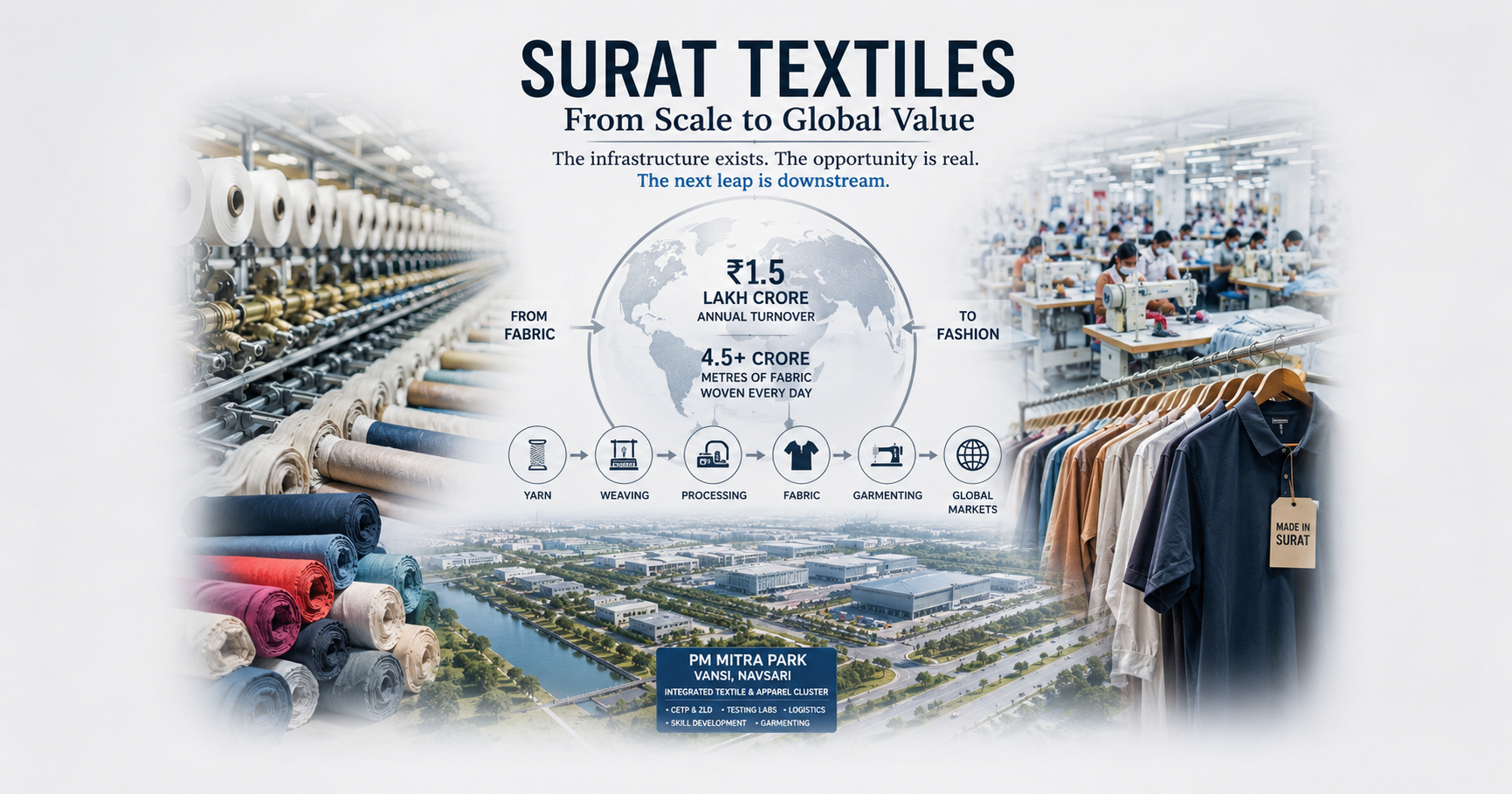
Surat’s textile industry has an annual turnover of around ₹1.5 lakh crore, according to recent industry representations. More than 4.5 crore metres of fabric are woven every day, underlining the extraordinary manufacturing capacity concentrated in and around the city.
Surat is also a national powerhouse in man-made fibre (MMF) textiles. Industry representatives have said the city accounts for about 40% of India’s MMF production, with particularly strong positions in polyester, nylon and viscose.
Yet the paradox is clear.
Surat’s strength is overwhelmingly concentrated in yarn, weaving, processing, fabric trading and domestic distribution. Its direct presence in finished global apparel supply chains remains comparatively modest.
Recent industry estimates indicate that only about 10% of fabrics sold through Surat’s textile markets are exported globally, with around half of that going to the European market. Synthetic yarn exports from Surat to the EU have been estimated at roughly ₹1,000 crore annually.
That is a remarkable gap between manufacturing scale and global value capture.
The issue, therefore, is not whether Surat can manufacture.
It is whether Surat can move further down the value chain.
Tiruppur Offers the More Important Lesson
Tiruppur provides a useful comparison—not because its industrial structure is identical to Surat’s, but because it demonstrates what happens when a textile ecosystem develops deep interdependence.
The Tiruppur Exporters’ Association reports that Tiruppur’s knitwear exports reached ₹44,747 crore in FY2024-25, representing about 68.65% of India’s knitwear exports. The association also puts domestic knitwear business at approximately ₹27,000 crore.
The crucial lesson is not merely the export number.
It is the architecture behind it.
Tiruppur developed a network in which different enterprises perform different stages of the value chain—knitting, dyeing, printing, stitching, finishing, packing and exporting.
One enterprise does not need to own the entire chain.
It needs to be able to depend on the chain around it.
That creates an ecosystem in which specialised MSMEs become mutually dependent. Proximity reduces transaction costs. Specialisation improves capability. Collective institutions address common problems.
The result is a cluster that can respond to global buyers with speed, consistency and scale.
That is the part of the Tiruppur story Surat needs to study.
Surat’s Strength Has Become Its Limitation
Surat is structurally different.
It is a vast, multi-sector economic centre where textiles, diamonds, chemicals, engineering, plastics and other industries coexist.
That diversity has helped Surat grow.
But for textiles, it has also meant that the industry has largely developed as a horizontal manufacturing ecosystem rather than a vertically integrated export cluster.
The dominant chain is highly efficient:
synthetic fibre → yarn → weaving → processing → fabric → wholesale trading → domestic markets.
The model works.
And that is precisely the problem.
When the domestic market is large enough to absorb enormous volumes, there is little economic pressure on individual manufacturers to undertake the much harder transition into finished apparel exports.
Moving downstream requires different capabilities:
design, garment manufacturing, international quality certification, compliance, merchandising, buyer relationships, working-capital structures and logistics.
For an individual MSME, that transition can be expensive and risky.
The rational response is often to remain within the existing business model.
Generic Infrastructure Cannot Create a Cluster Mindset
This is where industrial policy becomes important.
A generic industrial estate can provide land, roads, electricity and basic infrastructure.
But a globally competitive textile cluster needs something more.
It needs shared infrastructure and shared institutional capabilities.
Tiruppur developed these capabilities through decades of industry evolution and institutional coordination.
Gujarat has demonstrated the same principle in other sectors.
The Dahej chemical ecosystem, for example, shows how specialised industrial infrastructure can support industries with common environmental, logistics and utility requirements.
Similarly, Sanand and the wider Ahmedabad-Sanand automotive corridor have developed around a defined automotive and engineering ecosystem, supported by supply-chain connectivity, logistics and major OEM and component manufacturers. Gujarat’s own investment agency describes Ahmedabad-Sanand as a developed automotive cluster with a defined value chain spanning components, transport, logistics and related services.
The principle is straightforward:
Identify the sector → build dedicated infrastructure → create institutional coordination → attract specialised investment → develop collective capability.
Textiles should not be treated differently simply because Surat already has enormous private-sector capacity.
Gujarat Has Already Built Part of the Answer
There is, however, an important development that cannot be ignored.
Gujarat now has the PM MITRA Park at Vansi in Navsari, located close to the Surat textile ecosystem.
The Gujarat Industrial Development Corporation describes it as an exclusive greenfield cluster for integrated textile and apparel manufacturing. The 1,142-acre park includes planned infrastructure such as CETP with ZLD, sewage treatment, waste-management facilities, power and water infrastructure. It also provides for garment and apparel manufacturing, technical textiles, skill development and logistics support.
The original PM MITRA framework was explicitly conceived around the idea of integrating the textile value chain—from spinning and weaving through processing, garment manufacturing and ultimately fashion and exports—within a coordinated industrial ecosystem.
This makes the policy question sharper.
The issue is no longer simply:
“Why hasn’t Gujarat built a dedicated textile cluster?”
It has.
The more important question is:
“How effectively will Surat’s existing textile MSMEs connect with and leverage that ecosystem?”
That is where policy execution now matters.
The Missing Link Is Downstream Value Addition
Surat does not necessarily need another industrial estate.
It needs a mechanism that encourages existing manufacturers to move from fabric to fashion.
That could mean creating dedicated programmes linking Surat’s weaving and processing units with:
- garment manufacturers
- international buyers
- design centres
- testing laboratories
- compliance specialists
- export-finance providers
- fashion and merchandising institutions
- logistics operators
- technology suppliers
The objective should be to create a Surat-to-Navsari textile value chain, rather than treating Surat’s existing textile ecosystem and the PM MITRA Park as separate developments.
That would be a far more powerful proposition.
Bangladesh and Vietnam Show What Is at Stake
Global apparel sourcing is becoming increasingly competitive.
Bangladesh remains a major apparel exporter, while Vietnam has strengthened its position through manufacturing efficiency, trade agreements, diversified products and faster access to global buyers. Recent WTO-based reporting shows Vietnam’s apparel exports continuing to grow, even as competition with Bangladesh intensifies.
The lesson for Surat is not that it should copy either country.
It is that buyers purchase an ecosystem, not merely fabric.
A global apparel buyer wants predictable quality, compliance, delivery schedules, scale, documentation and the ability to repeat orders.
Surat already possesses much of the manufacturing foundation.
What it needs is greater downstream integration.
The MSME Opportunity Is Significant
For Surat’s MSMEs, the transition could create a new growth ladder.
Instead of competing only on metres of fabric, enterprises could compete on:
design → product development → garments → private labels → export orders → global brands.
That is a fundamentally different business model.
It also creates opportunities for smaller enterprises that cannot afford to build complete factories.
A designer does not need a weaving unit.
A garment manufacturer does not need a dyeing plant.
An exporter does not need to own a logistics company.
The cluster can allow each enterprise to specialise while participating in a larger value chain.
That is precisely where the MSME model becomes powerful.
The Five-Year Question
The opportunity is particularly important because India’s external market conditions are changing.
Recent industry assessments following the India-EU trade agreement have highlighted the potential for Indian textile and apparel exporters to expand in Europe. India’s textile and apparel exports to Europe rose in FY2025-26, reinforcing the importance of developing stronger export capability.
Surat therefore faces a strategic choice.
It can continue to be one of the world’s great fabric manufacturing centres.
Or it can attempt to become a much more important global synthetic-apparel sourcing hub.
The second route will require more than subsidies.
It will require institutional coordination, downstream investment, buyer development and a willingness among MSMEs to collaborate beyond traditional business boundaries.
The Question Gujarat Should Ask
Surat has already demonstrated that it can manufacture at extraordinary scale.
Tiruppur demonstrates what happens when textile manufacturing becomes an integrated ecosystem.
Gujarat’s industrial experience demonstrates that sector-specific infrastructure and institutional coordination can accelerate industrial development.
And the PM MITRA Park at Vansi provides Gujarat with an important piece of the infrastructure required to connect fibre, fabric, fashion and foreign markets.
The next challenge is execution.
Can Surat’s existing textile MSMEs be connected to this new infrastructure?
Can manufacturers be encouraged to move from fabric to finished apparel?
Can industry associations create the trust and coordination required for collective export capability?
And can government move beyond facilitation to become a genuine catalyst for ecosystem development?
The answer will determine whether Surat remains primarily a domestic textile powerhouse or becomes a much larger player in the global apparel supply chain.
The infrastructure opportunity exists.
The manufacturing capability exists.
The market opportunity exists.
What remains is the most difficult part:
turning a collection of successful businesses into a globally competitive ecosystem.




Leave a Reply