
MSME Briefing Bureau
China picked high-potential SMEs; India must now back its hidden champions
India does not have an #MSME problem. It has a scaling problem. Millions of enterprises operate below their potential, while a relatively small group already demonstrates the productivity, innovation and export capability needed to become global suppliers. #China recognised this gap and built its “Little Giants” ecosystem around specialised, technology-driven SMEs. India should not copy China’s state-led model. It should copy its most important insight: identify, finance and scale the firms capable of moving up the value chain.
India’s MSME paradox
#India’s #MSME sector is already a formidable economic engine.
According to the Ministry of MSME, it contributes 30.1% of GDP, 35.4% of manufacturing output and 45.73% of exports. The government says 6.5 crore MSME units are now registered across the Udyam and Udyam Assist platforms, generating employment opportunities for 28 crore people.
But beneath those impressive numbers sits a structural problem.
#NITIAayog’s Designing a Policy for Medium Enterprises found that 97% of registered MSMEs are micro enterprises, 2.7% are small and only 0.3% are medium enterprises. Yet this tiny medium-enterprise segment contributes nearly 40% of MSME exports.
That should change the policy conversation.
The question is no longer simply: How do we support more MSMEs?
It should be: How do we help more capable MSMEs graduate into globally competitive companies?
That is where China’s #LittleGiants experiment becomes relevant.
China’s lesson: do not treat every SME alike
China began developing its specialised, refined, distinctive and innovative — SRDI — enterprises as part of a deliberate industrial strategy.
Its national-level “Little Giants” are not simply small companies with government recognition. They are firms selected for specialisation, technological capability, innovation and strength in niche markets.
By the end of 2025, China had 17,600 national-level Little Giant enterprises. Although they represented only 3.5% of China’s major industrial SMEs, they accounted for 9.6% of operating revenue and 13.7% of profits. More than 80% were concentrated in strategic emerging industries such as new materials, high-end equipment, new energy and biopharmaceuticals.
The message is powerful:
China did not try to make every small company a giant. It tried to identify the small companies that could become strategically important.
Research published in 2025 provides further support. A firm-level study of China’s SRDI certification policy found that the programme significantly enhanced corporate innovation, with the results remaining robust across different model specifications.
That is the part India should study closely.
India should borrow the architecture — not copy China
India should not attempt to reproduce China’s state-directed industrial system.
But it can borrow the underlying #IndustrialPolicy logic.
India already possesses many pieces of the puzzle: Udyam formalisation, SIDBI, PLI, technology centres, cluster-development programmes, credit guarantees, public procurement and export-promotion mechanisms.
What is missing is a clear graduation architecture connecting them.
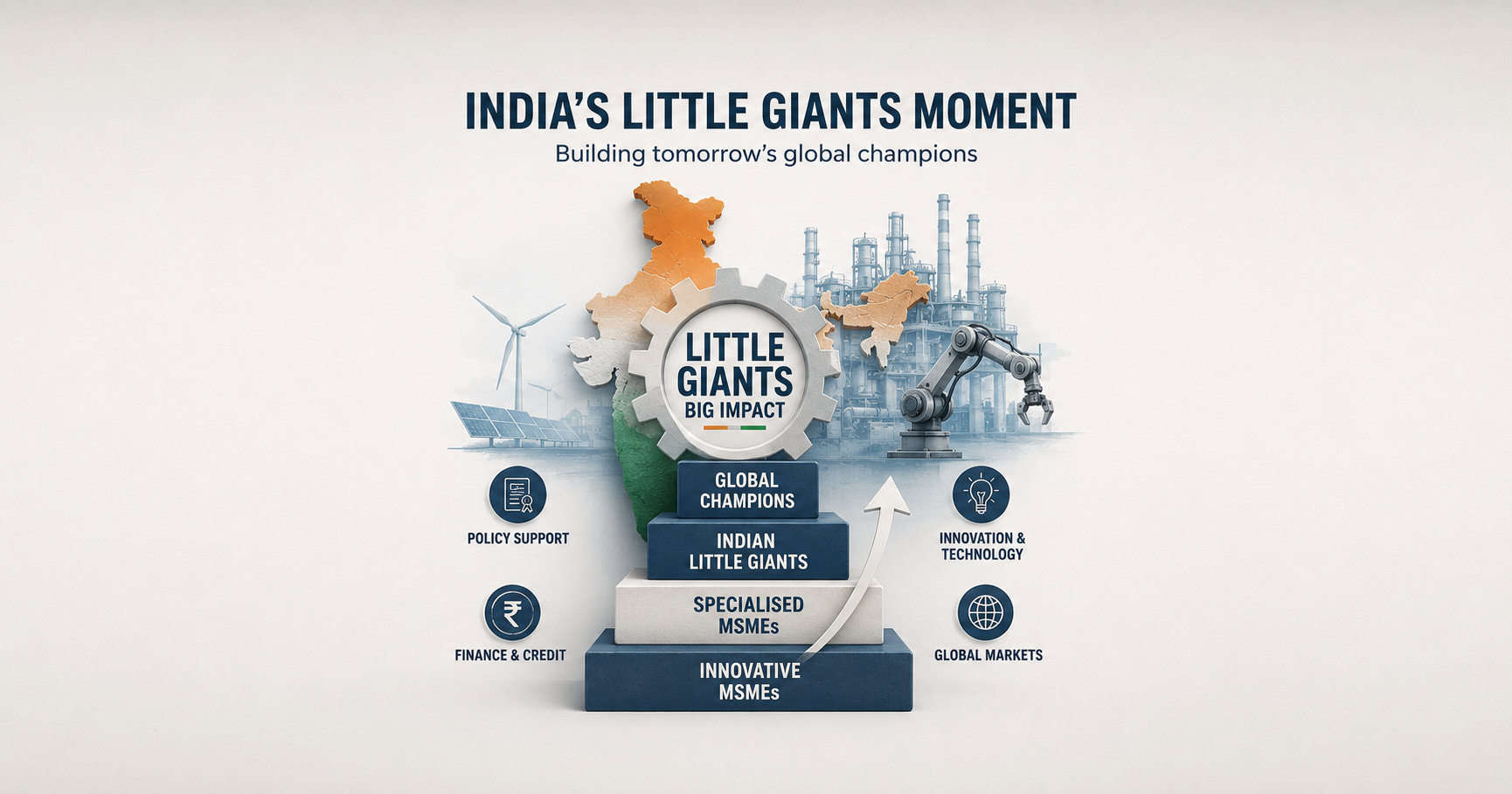
An Indian framework could create four broad levels:
Innovative MSMEs → Specialised MSMEs → Indian Little Giants → Global Champions
The selection criteria should go well beyond turnover.
They should include R&D intensity, proprietary technology, patents, productivity, export traction, quality certifications, skilled employment, digital adoption, energy efficiency and strategic supply-chain relevance.
Most importantly, the status must be earned, reviewed and capable of being withdrawn.
A government certificate should never become a permanent entitlement.
The strategic opportunity is in supply chains
India should initially focus its #Manufacturing strategy on sectors where domestic capability has strategic value.
Consider precision engineering, defence components, semiconductor inputs, EV and battery components, specialty chemicals, pharmaceuticals, medical devices, renewable-energy equipment, green hydrogen and advanced textiles.
The reason is simple.
A company employing 300 people may appear insignificant in conventional MSME statistics. But if it manufactures a critical valve, sensor, coating, component or pharmaceutical intermediate used by global manufacturers, its strategic importance can be enormous.
This is the hidden-champion effect India should deliberately create.
The objective is to move Indian enterprises from being interchangeable vendors to becoming technology partners that global companies cannot easily replace.
That is also how #GlobalValueChains can become a growth strategy rather than merely an export statistic.
Finance must follow capability
Certification alone will not create Indian Little Giants.
The support architecture must address the actual barriers to scale: patient capital, technology acquisition, R&D, testing infrastructure, skilled manpower, intellectual property and international market access.
A recognised Little Giant could receive preferential access to technology-upgradation finance, R&D support, common testing facilities and export-development programmes.
But large corporations must also be brought into the system.
India’s major OEMs should become supplier-development partners, helping promising MSMEs meet global quality, cost, traceability and technology standards.
Government can identify the potential.
Industry must help build the capability.
India must also learn what not to copy
This is where the Chinese experience deserves a more nuanced reading.
Industrial policy can create powerful capabilities, but it can also create misallocation of capital, duplication and protected capacity if selection becomes political or incentives become permanent.
India therefore needs safeguards from day one.
Selection should be transparent. Performance should be measurable. Benefits should have sunset clauses. Independent technical experts should review firms periodically.
The government should not decide which company will become a champion.
It should create the conditions in which capable companies can prove that they deserve to become one.
NITI Aayog has already identified India’s first signal
The most interesting point is that India does not need to start from zero.
NITI Aayog’s research on medium enterprises has already exposed the opportunity: 0.3% of registered MSMEs account for nearly 40% of MSME exports.
That is more than a statistic.
It is a policy clue.
India should build a pipeline around enterprises already demonstrating growth, innovation, productivity and export ambition, rather than distributing scarce resources uniformly.
The goal should be graduation:
More micro enterprises becoming small.
More small enterprises becoming medium.
More medium enterprises becoming large.
And a select group of those companies becoming global niche leaders.
The Gujarat opportunity
For #GujaratMSMEs, the opportunity is particularly compelling.
The state already possesses deep industrial ecosystems in engineering, auto components, pharmaceuticals, specialty chemicals, textiles, ceramics and emerging clean-energy industries.
A state-level “Gujarat Little Giants” initiative could identify firms with the potential to become strategic suppliers and connect them with technology institutions, financial institutions, anchor companies and export markets.
The objective should not be another subsidy scheme.
It should be a scale-up ecosystem.
The bigger idea
India’s MSME #policy has traditionally had to perform two jobs simultaneously: protect #livelihoods and promote enterprise.
Both remain important.
But India’s next economic phase requires a third objective — building globally competitive firms.
That is where the Chinese Little Giants model offers its most valuable lesson.
India does not need a Chinese-style industrial state.
It needs a more intelligent #MSMEPolicy.
The government should identify capability early, reduce the friction of scaling and concentrate support where the economic multiplier is highest.
India has the entrepreneurs.
It has the clusters.
It has the domestic market.
It has an increasingly formal MSME ecosystem.
What it lacks is a graduation mechanism for its hidden champions.
For #ViksitBharat2047, the ambition cannot simply be to have more enterprises. It must be to have more Indian companies capable of competing on technology, quality, productivity and supply-chain resilience.
The next generation of Indian global champions may already exist.
The policy challenge is to find them — and help them grow.
#MakeInIndia must ultimately mean more than making products in India.
It must mean creating companies the world needs to buy from India.
Sources
1. #Government of India — Ministry of MSME / #Press Information Bureau
“MSME sector accounts for 30.1% of India’s GDP, 35.4% of manufacturing and 45.73% of exports”, 4 July 2025.
2. NITI Aayog
Designing a Policy for Medium Enterprises, May 2025. The report records the 97% micro / 2.7% small / 0.3% medium composition and highlights the disproportionate export contribution of medium enterprises.
3. Ministry of Industry and Information Technology, China / #Xinhua
Data released in 2025–26 showing 17,600 national-level Little Giants, representing 3.5% of major industrial SMEs but contributing 9.6% of operating revenue and 13.7% of profits.
4. Li, Qiaoli & Hong, Ruyan (2025)
Does the Specialized, Refined, Differentiated, and Innovative “Little Giants” Certification Policy Promote the Innovation of Firms? The study finds a significant positive effect of SRDI certification on corporate innovation.
5. Government of India — MSME export data
Government data shows MSME-related products accounted for 45.73% of India’s total exports in 2023–24.



Leave a Reply