
MSME Briefing Bureau
When Tony Hsieh tried to remove hierarchy, the people problem became bigger than the structure
What happens when a founder removes managers and gives employees the freedom to decide for themselves? The answer depends on something rarely visible on an organisation chart: whether people are ready to carry responsibility without someone above them telling them what to do. Tony Hsieh’s Zappos experiment with Holacracy offers a powerful warning. The idea was bold, the intention was admirable, and the business survived. But the experiment exposed a deeper truth: you cannot create decision-makers merely by removing decision-makers above them. People must first learn to become one.
The founder who wanted to remove bureaucracy
When Tony Hsieh became CEO of Zappos around 1999–2000, the company was a tiny online shoe retailer. Under his leadership, it grew into a major e-commerce business and was acquired by Amazon for $1.2 billion in 2009.
But growth created a problem Hsieh increasingly disliked: management layers, bureaucracy and slower decision-making.
He believed Zappos risked becoming another conventional corporation — precisely the kind of organisation that loses the entrepreneurial energy that made it successful.
His answer was radical: remove traditional hierarchy and distribute authority.
Holacracy: the idea behind the experiment
From 2013, Zappos began moving towards Holacracy, a system of organisational self-management that replaces conventional managerial authority with defined roles, circles and distributed decision-making.
The theory was attractive.
Instead of asking a manager for permission, the person closest to the problem could act. Instead of waiting for instructions, employees could take ownership. Instead of a hierarchy of people, the organisation would operate through a hierarchy of purpose and accountability.
But there was a hidden assumption:
If you remove the boss, employees will become decision-makers.
That assumption proved much harder to implement than the organisational structure itself.
The human being behind the job title
This is where the Zappos experiment becomes particularly interesting for today’s founders.
Not every human being is naturally a decision-maker.
Some people enjoy ambiguity. They take responsibility, make a judgement and move forward.
Others need validation.
Some want frequent guidance. Some hesitate because they fear making the wrong decision. Some become confused when authority is unclear. And some genuinely prefer hierarchy because it gives them a defined role, a clear escalation point and protection from accountability.
That does not make them bad employees.
A person can be an outstanding engineer, salesperson, operator, designer or customer-service professional without wanting to decide the direction of the organisation.
Hierarchy often compensates for this difference.
Remove it suddenly, and the weakness does not disappear. It becomes visible.
And this is where Ricardo Semler becomes important
Tony Hsieh was not the first entrepreneur to challenge hierarchy.
In Brazil, Ricardo Semler transformed Semco by progressively reducing management layers and giving employees substantially greater authority. Semco eventually moved from 12 layers of management to three, while self-managed teams were given responsibility for budgets, production goals and operating decisions.
But Semler’s journey was not effortless either.
Managers resisted. Workers initially resisted responsibility. Some managers left.
The difference was in the process.
Semco did not simply announce: There are no more bosses. Now decide.
It built participation, information and economic responsibility into the system. Employees were given access to financial information. They were taught to understand it. Teams were progressively given greater responsibility. Managers could be challenged and evaluated by those working with them.
In other words, Semco developed the muscle before demanding the performance.
Zappos chose the radical leap
Zappos took a different route.
After more than a year of transition, Hsieh became frustrated that employees were operating partly within the old hierarchy and partly within Holacracy. In 2015, he offered employees a stark choice: embrace the new system or leave with severance.
Around 18% of employees — roughly 260 people — accepted the buyout. Total turnover that year reached about 30%.
The company did not collapse.
Its balance sheet did not suddenly implode.
But organisational disruption was real. Employees faced uncertainty, established leaders lost their positions, and the company had to absorb the consequences of changing its operating model while continuing to run a demanding business.
Holacracy also introduced something ironic: a highly formal system for creating a less hierarchical organisation. Research into the Zappos experiment found that the number of defined roles per employee increased substantially as the system developed.
The lesson is not that Holacracy was foolish.
The lesson is that removing one form of bureaucracy can create another if the organisation has not developed the judgement to operate with greater freedom.
What today’s founders should learn
There are several lessons here.
1. Do not confuse removing authority with creating empowerment.
Taking away a manager does not automatically give an employee confidence, judgement or accountability.
2. Identify decision-makers before creating a decision-making culture.
Look for employees who already demonstrate initiative, judgement and ownership. Start there.
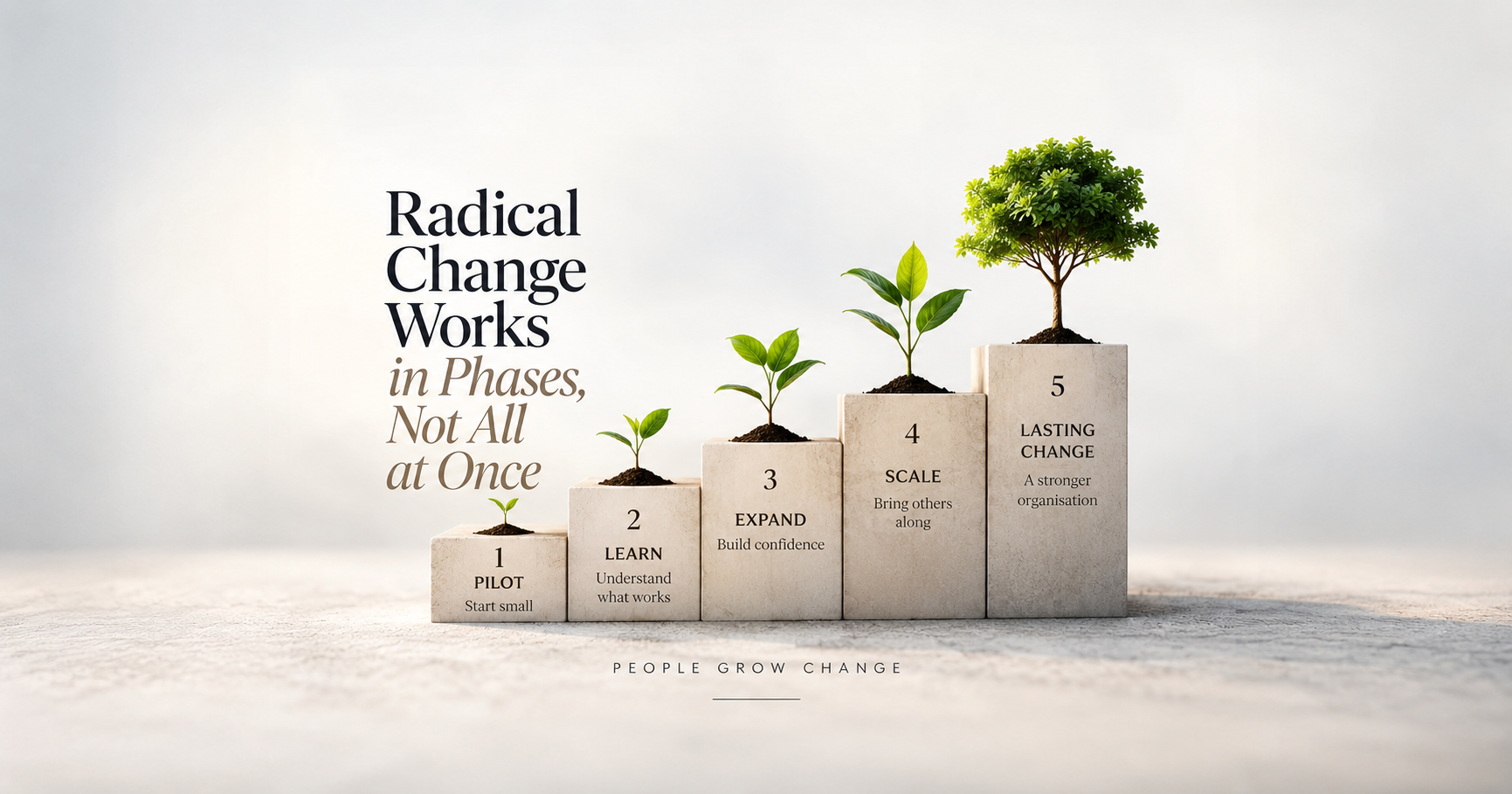
3. Pilot radical change.
Why impose a new operating philosophy on 500 people when 20 capable people can test it first?
Give a selected team greater authority. Measure results. Learn from failure. Then expand.
4. Let success recruit the next wave.
When employees see colleagues making decisions, succeeding and growing, others will often want the same opportunity.
5. Keep coaching even when you remove control.
A manager may disappear from the approval chain without disappearing from the organisation’s need for mentoring, feedback and development.
6. Give people information before giving them responsibility.
Semco’s experience is instructive here: people cannot make responsible business decisions if they do not understand the numbers behind those decisions.
7. Change the organisation at the speed at which people can absorb it.
A founder may see the destination clearly. Employees still have to make the journey.
The founder’s real job
The temptation for a new-generation founder is to believe that the flatter the organisation, the more entrepreneurial it becomes.
That is too simple.
The objective is not to eliminate managers. It is to eliminate unnecessary dependence on managers.
Semler’s experience suggests that this can happen when responsibility, information and participation are built progressively into the organisation. Hsieh’s Zappos experiment shows what can happen when the structural revolution moves faster than the human one.
For today’s founder, the question is therefore not:
“How quickly can I remove hierarchy?”
It is:
“How many people in my organisation are genuinely ready to make decisions — and what am I doing to create more of them?”
That is the difference between flattening an organisation and building an empowered one.
And perhaps that is the most important lesson from both Semco and Zappos: radical leadership is not about removing control. It is about knowing when people are ready to receive it.




Leave a Reply