
By Haresh B. Jhala
Mani Vajipey’s Banyan journey reveals what founders discover before the market catches up
The story began with plastic — but not with a business plan
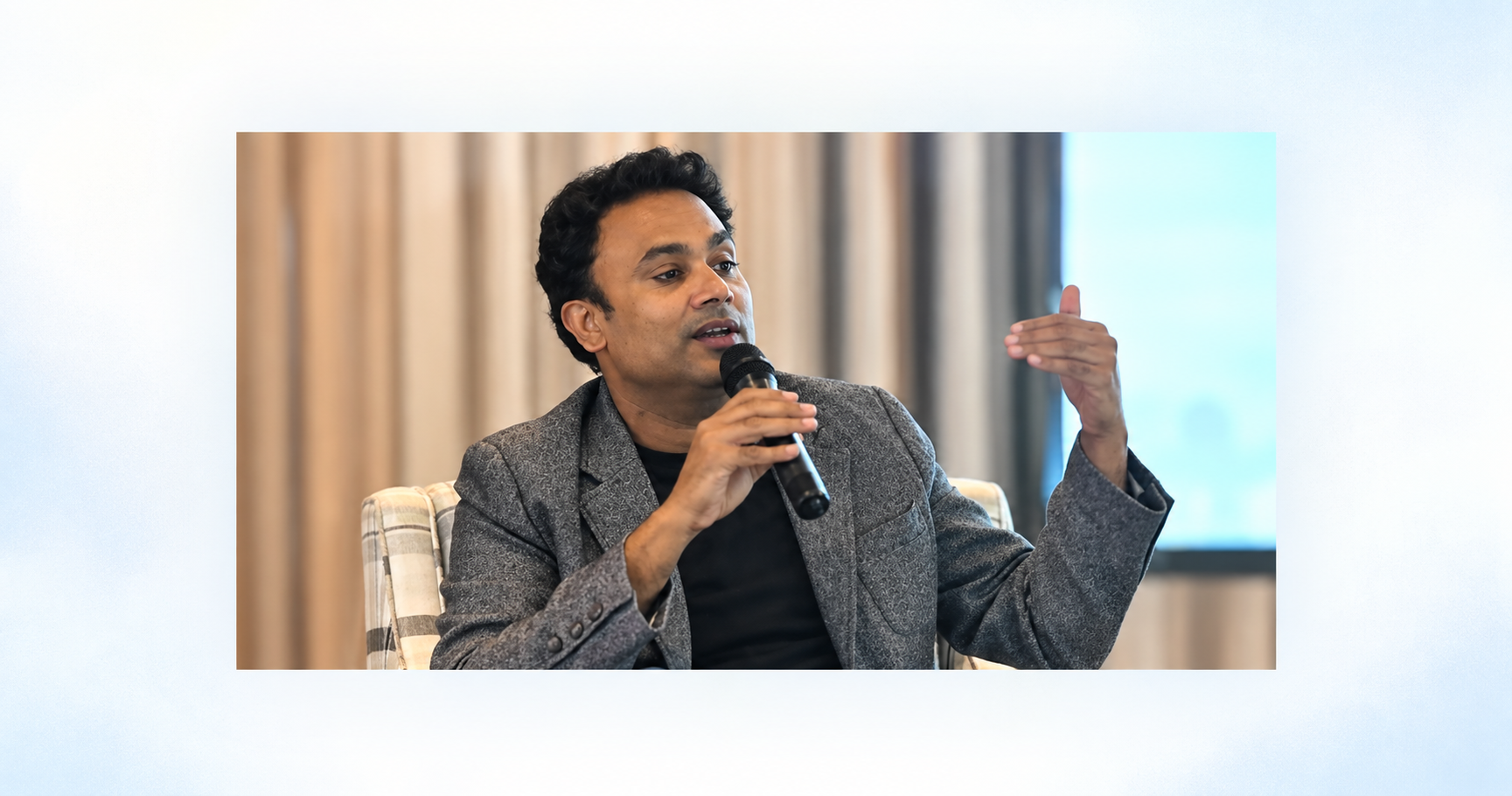
On September 18, 2026, in Gandhinagar, Mani Vajipey took the audience back to a time when Banyan Nation was not a success story. Speaking at the $100M Circular Startup Finland–India event, in an ecosystem conversation that included Rashi Agarwal, Chief Growth Officer at T-Hub, Mani narrated the journey of a company born from an uncomfortable question: why was India generating so much plastic waste when so much of it was already being recycled?
The answer would eventually change his career, but first it changed the way he looked at a problem.
A successful career was not the destination
Mani was living in California, working with Qualcomm on mobile technologies connected with Apple’s iPhone and iPad product lines. His friend Raj Madangopal was also settled in the United States.
Then Mani returned to India.
The plastic waste he saw on roads, around landfills and across the environment stayed with him. But instead of immediately designing a product, he began asking questions.
He spoke to multinationals, waste-management contractors, scrap collectors, ragpickers and kabadiwalas.
What he found was fascinating.
India already had a huge informal recycling network. Plastic was being collected. It was being sorted. It was being sold.
Yet something was missing.
The recycled material was often contaminated by inks, adhesives and labels. That made it difficult for large companies to use the material in applications demanding consistent quality.
The problem, therefore, was not simply plastic collection.
It was quality recycling at scale.
That distinction became the starting point of Banyan Nation.
In 2013, Mani and Raj left their lucrative careers and returned to India to build the company in Hyderabad.
Before building, they spent years understanding
This may be the least glamorous part of the Banyan story — and perhaps one of the most useful for founders.
For the first three years, according to Mani’s account, they invested their energy in understanding the plastic-waste and recycling market.
They were not simply asking:
“What can we make?”
They were trying to understand:
“What does the market actually need?”
That is a different entrepreneurial question.
Founders often begin with an idea and then search for customers. Banyan’s early journey suggests another route: understand the ecosystem deeply enough to discover the gap before committing fully to the solution.
They had found one.
Then the money did not come
Knowing the problem was one challenge.
Building the solution was another.
Banyan needed technology, physical infrastructure and a way to organise a fragmented informal supply chain. It was not a lightweight software business that could scale with relatively little physical investment.
Traditional VCs and angel investors repeatedly turned them down.
For investors looking at the business through a conventional lens, waste management did not immediately resemble an attractive technology opportunity. The founders were asking capital to back a business that needed patience before its economics could become visible.
This is where the Banyan journey becomes more interesting than a simple story of persistence.
The founders did not merely keep knocking on the same doors.
They changed the kind of door they were knocking on.
Finding people who understood the vision
When conventional finance remained difficult, Banyan found support through the impact-investment and philanthropic ecosystem.
Networks and institutions including IIX, Shujog, KKR, Artha Initiative and CIIE became important to the company’s early development. A crucial early funding round amounted to $800,000.
The importance of that money went beyond the number.
It provided something a young company needs almost as much as capital:
validation.
The people backing Banyan were prepared to examine the environmental and social value alongside the commercial model.
That gave Mani and Raj the opportunity to continue building the technology and supply chain.
The years of losses became years of learning
The next chapter was not an overnight transformation.
Banyan operated through a prolonged period of investment and losses while developing its plant, technology and supply network. The journey involved years of expenditure before the business could demonstrate the economics at scale.
Eventually, the pieces began to connect.
Banyan developed high-quality recycled rHDPE and rPP granules, while its vertically integrated model enabled it to move from waste collection towards producing material suitable for demanding applications.
The companies that eventually used Banyan’s recycled material included global names such as Unilever, Reckitt, Shell and Tata Motors. The company has recycled more than 100,000 tonnes of plastic, according to the figures in the material available to us.
Yet Mani’s own perspective keeps the achievement in proportion.
Even after reaching substantial scale, he points out that India’s requirement for plastic packaging remains enormous. Banyan’s contribution is still only a fraction of the potential market.
And perhaps that is the final twist in the story.
The founder who once had to explain why the problem mattered is now looking at a market where the problem is still much bigger than the solution.
What We Took Away From Mani’s Journey
These are our observations from Mani Vajipey’s journey, rather than lessons presented by him as a formal prescription.
1. Don’t start with the product. Start with the gap.
Banyan’s early years were spent understanding the ecosystem before scaling the solution.
2. Discover what the market does not need.
Sometimes eliminating the wrong assumptions is more valuable than finding the right product immediately.
3. Capital must understand the business model.
If an idea needs patient capital, searching endlessly for investors looking for a different type of growth may waste precious founder energy.
4. Technology becomes powerful when it solves a specific commercial problem.
Banyan’s technology mattered because it addressed the quality limitations of recycled plastic.
5. Years without visible success are not necessarily wasted years.
They can build knowledge, relationships, technology and capability that become the foundation for later growth.
The Banyan story, therefore, is not simply about converting plastic waste into recycled material.
For a founder, its deeper question is more uncomfortable:
When people say “no” to your idea, are they rejecting the idea — or are you still searching for the market, technology and people capable of saying “yes”?



Leave a Reply