
MSME Briefing Bureau
2026-27 forecast: FTA access meets inflation; diversify demand risk
Forecast: The India-EU Free Trade Agreement could give Indian exporters a significant tariff advantage in 2026-27. But if Europe’s energy-cost shock persists, the lower tariff barrier could meet a weaker demand environment — as households and businesses face higher energy, transport and other essential costs. The risk is not that European consumers will suddenly stop buying. It is that higher costs could absorb part of the purchasing-power benefit that Indian exporters expect from lower tariffs.
The FTA opens the door — but who has money to walk through it?
India and the European Union concluded negotiations on their FTA on 27 January 2026. The European Commission says the agreement will eliminate tariffs on more than 90% of EU tariff lines, representing 91% of tariff value, while sectors such as Indian textiles, footwear, chemicals, pharmaceuticals and fisheries are expected to gain. But the agreement is not yet legally in force; the European Commission presented proposals to the Council for signature and conclusion on 11 September.
European Commission President Ursula von der Leyen described the agreement as a landmark achievement, saying: “We have created a free trade zone of 2 billion people.” Trade Commissioner Maroš Šefčovič said the priority was ensuring businesses “reap tangible benefits from this FTA as quickly as possible.”
That is the opportunity.
The challenge is the economic environment into which that opportunity is arriving.
Europe has replaced Russian gas — but not the old cost structure
Before the Ukraine war, Russia supplied around 152 billion cubic metres of gas to the EU in 2021 — about 45% of EU gas imports. By 2025, Russian gas imports had fallen to 36 bcm, or about 12%.
Europe has successfully diversified towards Norway, the US, North Africa and LNG. But this has also created a fundamentally different energy-supply structure, with greater exposure to global LNG markets and geopolitical disruptions.
The adjustment is not finished. The EU plans to eliminate Russian LNG imports by the end of 2026 and Russian pipeline gas by no later than November 2027.
Then came the new Middle East shock.
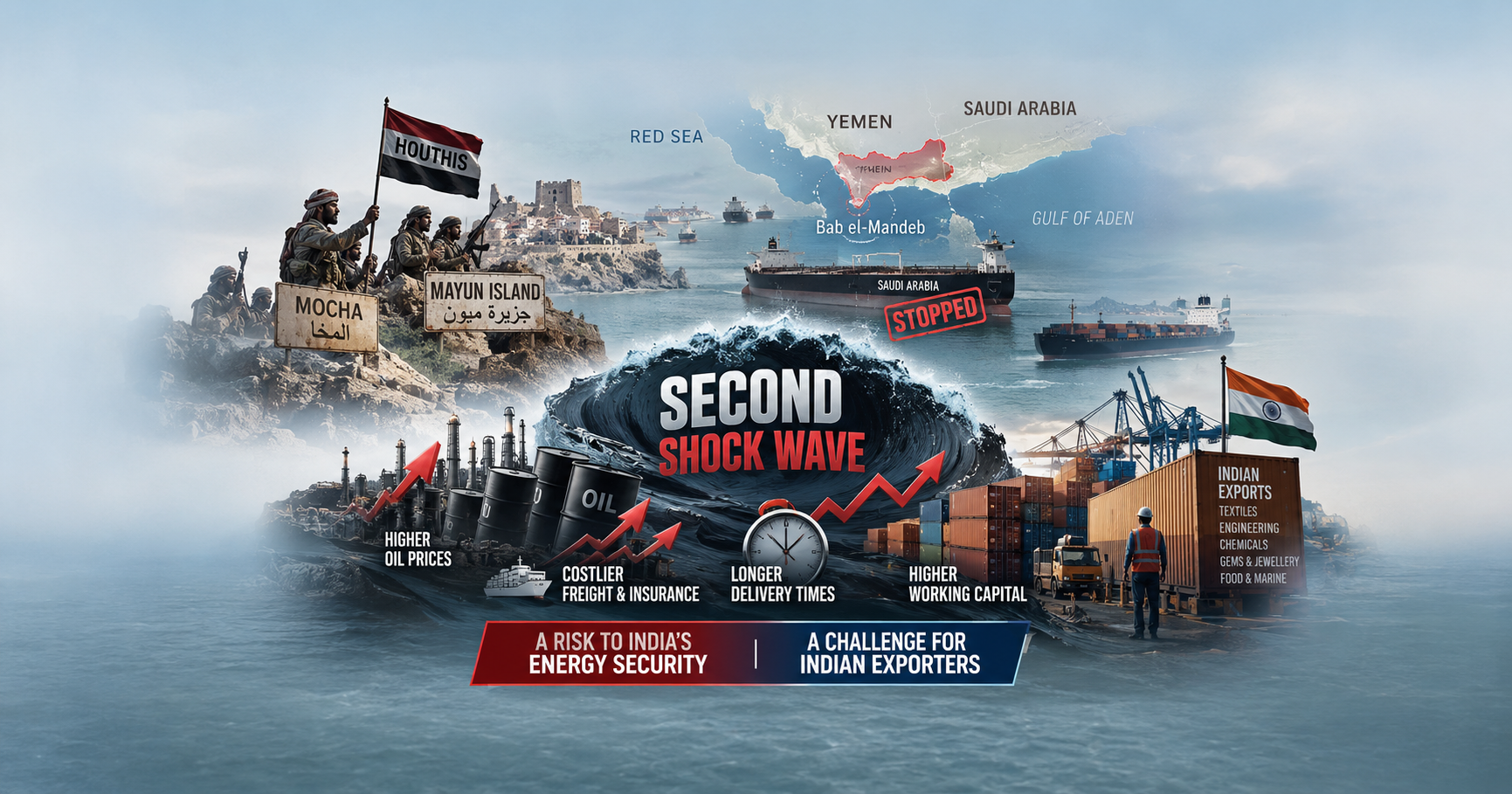
On 15 September, New Agencies reported that Saudi Arabia had cancelled some September-loading crude cargoes for European customers after attacks damaged its East-West pipeline and forced a suspension of loadings at Yanbu. Brent was trading around $108 a barrel, while some European physical cargoes were around $122.
The important point is not one pipeline or one day’s oil price. It is the cumulative effect of repeated energy shocks on an economy that is still adapting to a structurally different gas market.
As European Commission Economy Commissioner Valdis Dombrovskis put it in May: “The conflict in the Middle East has triggered a major energy shock.”
The inflation number is 3.3%. The energy number is the warning
Eurostat’s August 2026 flash estimate puts euro-area inflation at 3.3%, up from 2.9% in July.
But the headline number hides the more important detail.
Energy inflation was 14.3%.
Food, alcohol and tobacco inflation was comparatively modest at 1.2%, while services were at 3.0%.
For an exporter, the 14.3% energy figure matters because energy does not remain inside the energy bill. It enters transport, manufacturing, packaging, chemicals, refrigeration, warehousing and logistics.
That pressure is already visible at factory level. Eurostat reported that industrial producer prices increased 1.6% month-on-month in the euro area in July, while energy producer prices rose 5.6% in the same month. Industrial producer prices were 5.8% higher than a year earlier in the euro area.
The European Commission has warned that higher energy costs would feed through production, agriculture, distribution and transport, while reducing households’ real disposable income.
Now look at the European household — in ₹100, not percentages
This is where the inflation story becomes easier to understand.
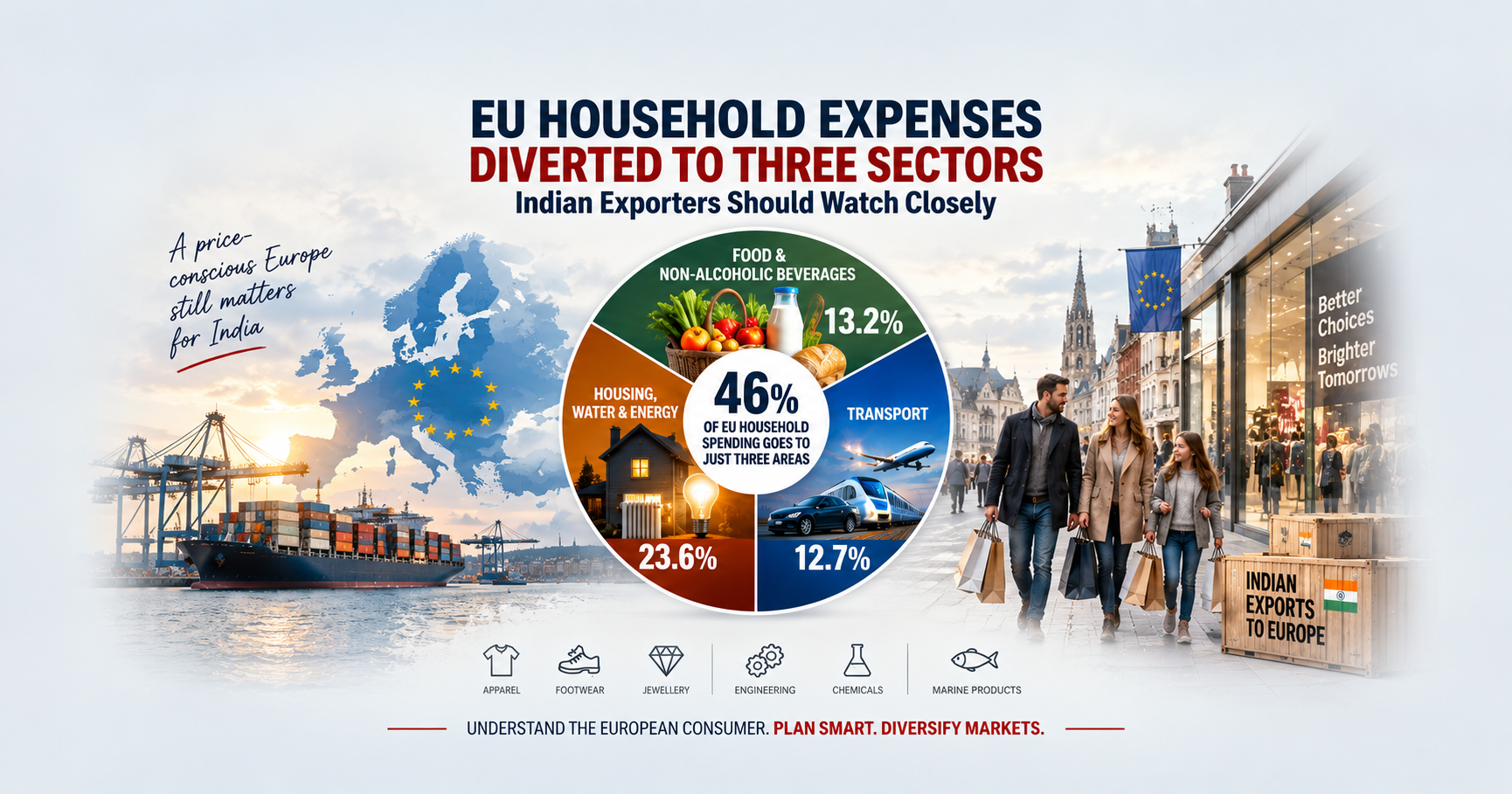
Eurostat’s January 2026 household-expenditure data shows that 46% of EU household consumption expenditure went towards three broad areas: food and non-alcoholic beverages; housing, water and energy; and transport.
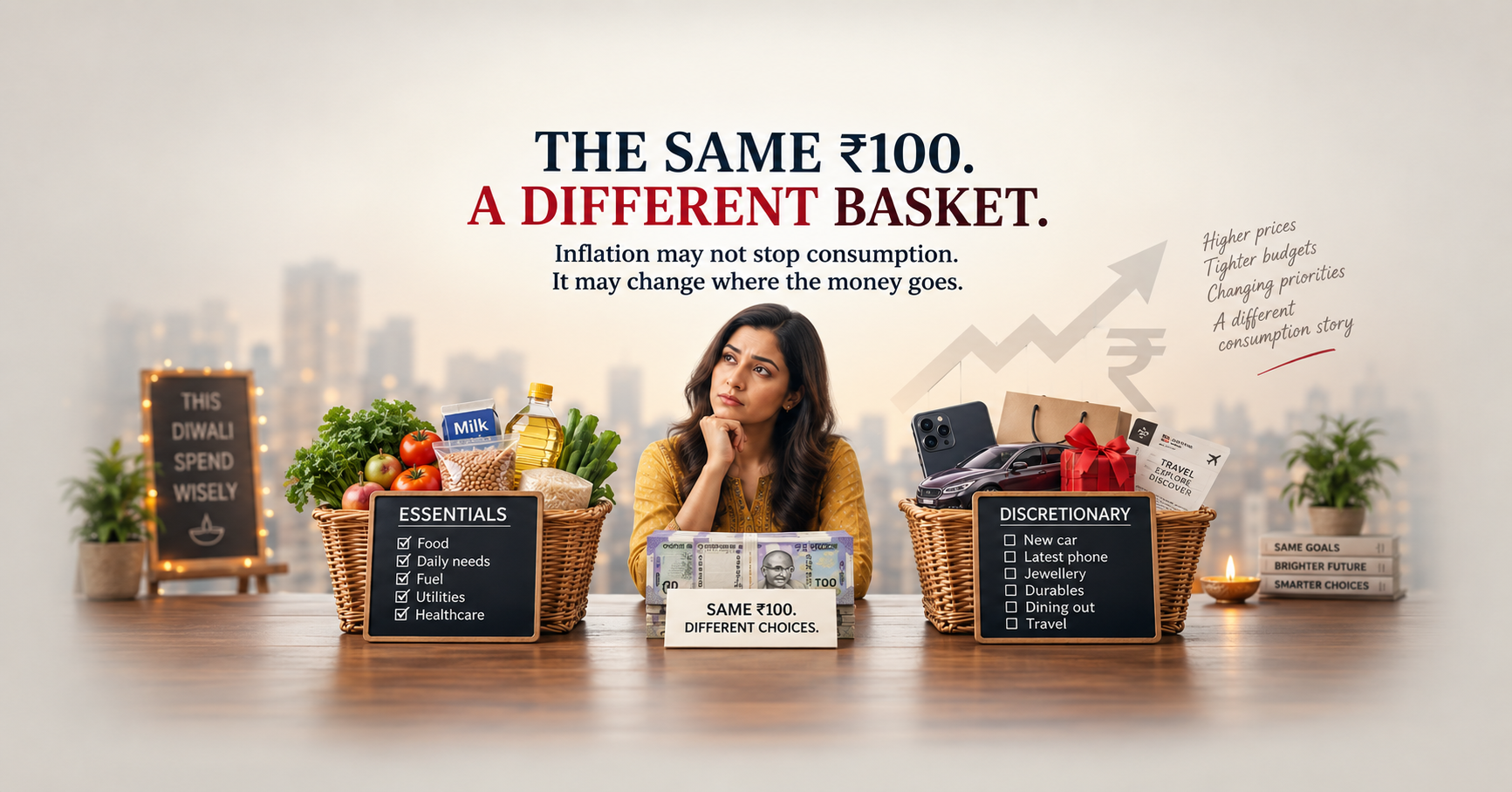
Put simply, imagine an EU household has ₹100 equivalent to spend.
Nearly ₹46 is already committed to food, housing/energy and transport.
That leaves roughly ₹54 for everything else — clothing, footwear, restaurants, recreation, communications, household goods, personal services and other discretionary spending.
This does not mean Europeans have stopped spending. But it tells us where the adjustment can occur when essential costs rise.
Eurostat’s annual household data gives an even clearer picture. In 2024, housing, water, electricity, gas and other fuels accounted for 23.6% of household consumption expenditure; food and non-alcoholic beverages accounted for 13.2%; and transport for 12.7%.
So, for every ₹100 equivalent of household consumption, approximately:
- ₹23.60 goes towards housing, electricity, gas and other fuels;
- ₹13.20 towards food;
- ₹12.70 towards transport.
Together, these three areas absorb ₹49.50 out of every ₹100.
Clothing and footwear account for only ₹4.10 out of every ₹100.
This is important for Indian exporters.
If electricity, fuel, heating and transport become more expensive, a family does not necessarily stop buying clothes. It may simply delay buying a new jacket, choose a cheaper pair of shoes, reduce restaurant visits, postpone a holiday or trade down to a lower-priced product.
The FTA can reduce the tariff on an Indian product.
It cannot reduce a European family’s electricity bill, petrol bill or grocery bill.
The first signs of caution are already visible
Eurostat’s July retail data provides an early signal.
EU retail volumes fell 0.4% month-on-month, while euro-area retail volumes fell 0.6%. More importantly for consumer-facing Indian exporters, EU non-food retail volume fell 1.1% in July and euro-area non-food retail fell 1.4%.
But there is an important counterpoint: retail volumes were still 1.0% higher year-on-year in the EU.
So this is not a story of a European consumer collapse.
It is a story of slower momentum and greater selectivity.
That is a much more useful warning for Indian MSMEs.
Europe is also paying a larger energy import bill
The pressure is visible beyond households and retail.
In the second quarter of 2026, the EU recorded a goods trade deficit of €21.8 billion — approximately ₹2.41 lakh crore. The energy deficit alone widened from €71.3 billion (about ₹7.90 lakh crore) in Q1 to €101.1 billion (about ₹11.19 lakh crore) in Q2.
That represents a substantial increase in the amount being spent on imported energy.
And the pressure is not confined to energy. The FAO Food Price Index reached 133.3 points in August, up 1.9% from July and 2.5% year-on-year. FAO Chief Economist Maximo Torero warned that “climate shocks, geopolitical tensions and disrupted trade logistics are converging” to tighten supply expectations.
For Indian food, marine, textile and consumer-product exporters, that matters because food and energy shocks can change the composition of European demand even when headline economic activity remains positive.
What does this mean for Indian exporters?
The EU remains too important to ignore.
EU goods imports from India were €71.281 billion — approximately ₹7.90 lakh crore — in 2024, while EU exports to India were €48.771 billion. Total goods trade was about €120.05 billion, or ₹13.29 lakh crore. In 2025, EU-India goods trade stood at about €118 billion.
So the answer is not to walk away from Europe.
It is to stop assuming that tariff reduction automatically means proportionate volume growth.
For Indian MSME exporters, the coming period could produce three different effects.
First, price-sensitive consumer categories such as apparel and footwear may face greater pressure to remain competitive even after tariff reductions.
Second, premium discretionary categories such as jewellery may face greater demand volatility because consumers can postpone such purchases.
Third, B2B sectors such as chemicals, engineering components and industrial products may find opportunities where European manufacturers seek reliable suppliers, but buyers themselves may demand sharper pricing because their own input costs are elevated.
The 2026-27 strategy: retain Europe, reduce dependence
The opportunity created by the FTA should therefore be used — but strategically.
1. Protect the European footprint.
Do not surrender established buyers simply because demand is temporarily softer. Lower tariffs can still improve competitiveness when the agreement becomes operational.
2. Sell value, not merely price.
Sustainability credentials, quality consistency, shorter lead times, traceability and specialised products can matter more when European buyers are under margin pressure.
3. Build a second demand engine.
MSMEs heavily dependent on Europe should deliberately develop markets in the Middle East, Africa, Southeast Asia and Latin America rather than waiting for European demand to normalise.
4. Watch the buyer’s economics, not just the tariff schedule.
The key question in 2026-27 will be: after the tariff saving, does the European buyer still have the purchasing power and confidence to increase orders?
The real warning
The India-EU FTA is a tariff opportunity. Europe’s energy situation is a demand-side risk.
These two forces can operate simultaneously.
The European Commission expects private consumption growth to slow to 1.1% in 2026 before recovering to 1.3% in 2027, while its forecast says the higher inflation outlook reduces growth in household real disposable income by 1.4 percentage points over the forecast horizon.
For Indian exporters, therefore, the issue is not whether the FTA is good or bad.
The issue is timing and demand.
India may be getting better access to Europe at a time when European households and businesses are becoming more careful about where they spend.
That is the double challenge Indian MSMEs need to prepare for in 2026-27:
a lower tariff barrier, but potentially a higher demand barrier.
Sources
- European Commission
- Eurostat
- Food and Agriculture Organization (FAO)
- News Agencies




Leave a Reply