
By Haresh B. Jhala
Russia, Iran, India, China: Can Sanctions Work?
What happens when economic pressure meets countries unwilling to bend?
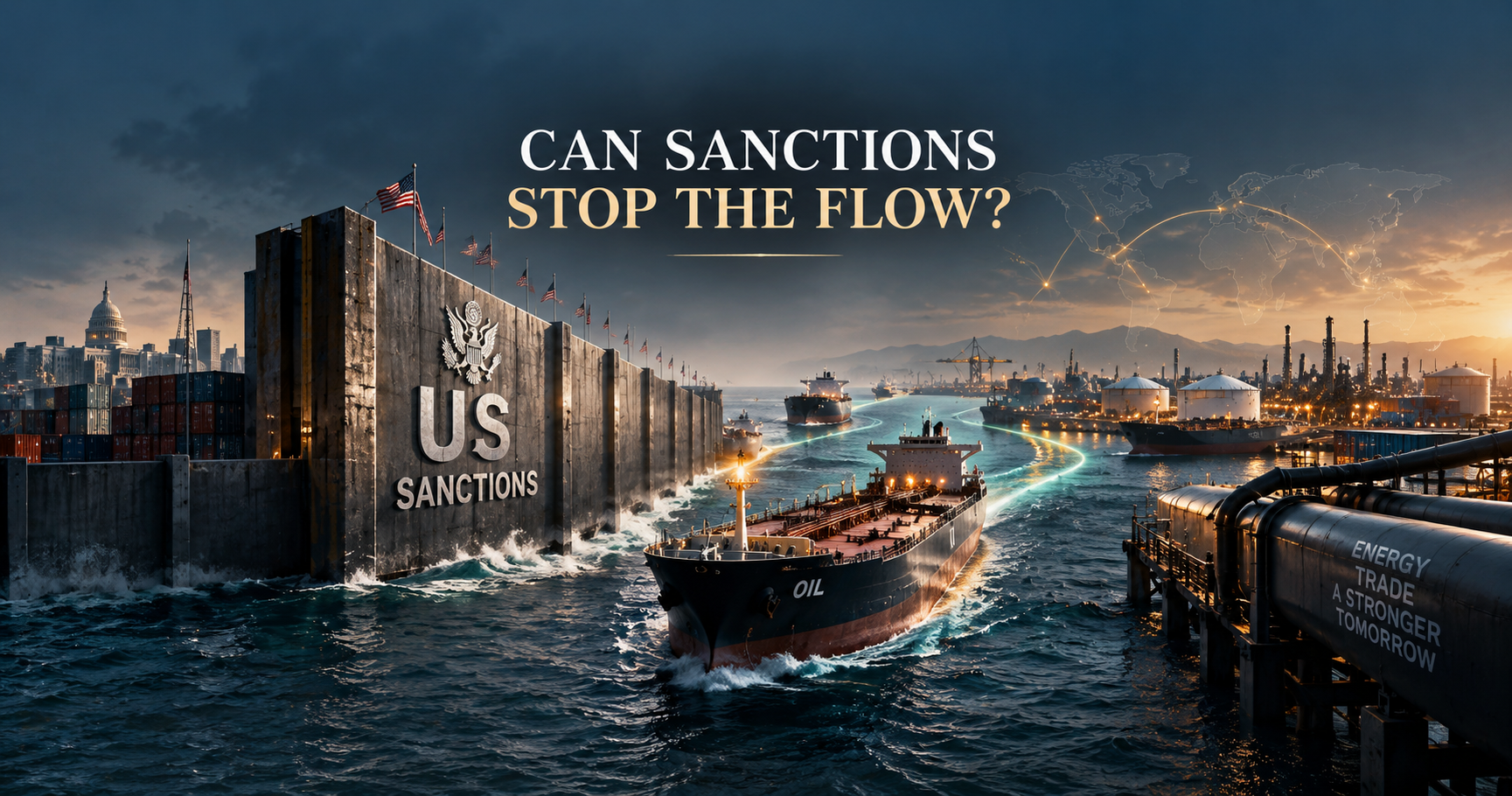
A sanction can punish a country. But what happens when the target has oil, alternative buyers, shadow shipping, local-currency payments and strategic partners willing to absorb the pain? And what happens when the countries being pressured are not small economies, but China and India? Could an American weapon designed to squeeze Russia and Iran instead produce higher oil prices, deeper geopolitical divisions and a world increasingly prepared to trade around the US financial system?
The weapon is ready—but will Washington fire it?
The Lindsey O. Graham Sanctioning Russia and Iran Act of 2026 has cleared Congress. The House passed it 262–159, following Senate approval by 86–11. The legislation gives the US President discretionary authority to impose tariffs of up to 100% on countries that remain among the largest buyers of Russian oil and gas or are identified as major facilitators of sanctions evasion.
There is an important distinction: the legislation authorises the tariff; it does not automatically impose a 100% tariff. The mechanism includes a 30-day window after enactment and presidential discretion.
That discretion may be the most important part of the entire legislation.
Washington’s objective is clear: reduce Russia’s energy revenue, tighten pressure on Iran and make third countries reconsider transactions that sustain sanctioned economies.
But the American economy itself faces pressures.
US federal debt has crossed US$40 trillion (about ₹33.6 lakh crore). Gasoline prices have remained above US$4 a gallon (about ₹336), while the Strategic Petroleum Reserve has fallen to approximately 289–300 million barrels, against authorised capacity of about 714 million barrels.
The political calendar adds another dimension: the November 2026 midterm elections.
Sanctions offer Washington a highly visible instrument of pressure without requiring another large military commitment. But if sanctions disrupt oil supplies and send prices higher, the same policy could feed directly into American inflation.
India: energy security versus American market access
India’s dilemma is unusually complicated.
Russian crude became increasingly important after 2022 because substantial discounts made it commercially attractive to Indian refiners. Research cited in the material places India’s Russian crude purchases at roughly 1.7–1.8 million barrels per day in 2024–25, with substantially higher monthly volumes during 2026.
The economic attraction is obvious.
If discounted Russian crude is replaced by more expensive supplies, India’s import bill rises. A 50% reduction in Russian purchases has been estimated in the research at an additional US$5–10 billion (₹42,000–84,000 crore) annually, depending on replacement prices.
The consequences would not stop at the refinery gate:
higher crude prices → higher transport costs → inflation → pressure on the rupee → higher financing costs.
At the same time, a 100% US tariff on Indian goods would create another problem. Labour-intensive sectors such as textiles, engineering, chemicals, gems and jewellery and pharma intermediates, including smaller exporters, could become severely disadvantaged in the American market.
New Delhi therefore faces two competing economic calculations:
cheap energy from Russia versus access to America’s huge consumer market.
That is why a negotiated waiver, phased reduction or quota system remains a possible route.
China: the bigger test
China’s exposure is larger and strategically different.
Research in the supplied material estimates China’s Russian crude intake at roughly 2.4–2.7 million barrels per day, combining seaborne and pipeline supplies. China has also imported substantial quantities of Iranian crude, with some 2025 estimates placing Iranian supplies at around 1.38 million barrels per day.
On gas, the Russia–China relationship is equally significant. Power of Siberia deliveries were around 31 bcm in 2024 and more than 38 bcm in 2025, while Chinese imports of Russian LNG reached approximately 9.8 million tonnes in 2025.
Could China simply stop?
Technically, it could substitute some volumes through the Middle East, Central Asia, LNG markets and domestic resources.
Economically, however, replacement would be expensive.
Strategically, Beijing faces a bigger question:
Should Washington be allowed to determine where China’s energy comes from?
Russia and China have already demonstrated their willingness to challenge the sanctions architecture. On 17 September 2026, they vetoed a United Nations resolution extending independent monitoring of sanctions on Iran.
China therefore has incentives to adapt rather than capitulate—through alternative shipping, payment mechanisms, suppliers and deeper non-dollar trade.
Russia’s answer may be surprisingly simple: discount
Russia has already spent years building alternatives to Western financial and shipping systems.
Its shadow fleet, alternative insurance, ship-to-ship transfers, non-Western buyers and discounted crude have allowed substantial volumes to continue moving.
There is another complication.
If sanctions genuinely remove Russian barrels from the international market, the price of the remaining barrels could rise.
That creates a possible sanctions paradox:
less Russian volume × higher global oil price = potentially smaller volume loss but greater revenue per barrel.
The research also records Russian Urals discounts narrowing sharply as Middle Eastern supply risks increased.
Therefore, the effectiveness of the legislation cannot be measured simply by asking:
“How many Russian barrels disappeared?”
The more important question is:
“At what price did Russia sell the barrels that remained?”
Iran: when economic pressure becomes geopolitical pressure
Iran may present Washington with the most unpredictable response.
Its economy is already under severe pressure. The research records inflation around 66%, a rapidly depreciating rial and shrinking foreign trade.
But economic hardship does not automatically produce regime collapse.
A government under pressure can restrict currency flows, prioritise strategic imports, deepen informal trade and seek stronger relationships with China and Russia.
It can also increase asymmetric pressure outside its borders.
This is where Iran’s network of armed partners and aligned groups in Yemen, Iraq and Syria becomes important.
If direct confrontation becomes too costly, indirect pressure may become more attractive.
Attacks on shipping, pipelines, oil installations or other energy infrastructure could impose costs many times greater than the cost of the weapons used.
The danger is obvious.
Sanctions → Iranian pressure → Gulf disruption → higher oil prices → higher US inflation.
The pressure intended to weaken Tehran could therefore create a second economic problem for Washington.
The $120 oil question
The oil market is the critical transmission mechanism.
Venezuela cannot quickly replace Russian and Iranian supplies to India and China. Its production is estimated at only around 1.1–1.25 million barrels per day—far below the several million barrels per day that could require replacement.
Alternative supplies would therefore have to come from Saudi Arabia, Iraq, UAE, the United States, Brazil, Guyana, West Africa and others.
But if Gulf infrastructure, pipelines or shipping routes are simultaneously disrupted, the mathematics changes dramatically.
The research cites US$120 per barrel (about ₹10,080) as a credible stress scenario if Gulf supply is materially constrained.
At that level, the consequences extend far beyond energy:
petrol → diesel → freight → food → inflation → interest rates → economic growth.
For the United States, there is an additional problem: the SPR has already been substantially depleted. Further releases could cushion the market temporarily, but they cannot become an unlimited substitute for physical supply.
The dollar may face dilution, not disappearance
This is perhaps the longest-term question.
Russia, China, India and other countries are increasingly exploring local-currency settlement, alternative payment channels and non-Western financial arrangements.
But the idea that BRICS will suddenly replace the dollar with a single common currency is not supported by current developments.
The more realistic possibility is more subtle.
The world may not abandon the dollar. It may simply need it less often.
If oil can increasingly be purchased using yuan, roubles, rupees, dirhams or other arrangements, the US still retains the world’s dominant currency—but the reach of secondary sanctions gradually becomes less absolute.
That is a five- or ten-year question, not a five-month prediction.
Five possible paths from here
1. Compliance: India and China substantially reduce Russian purchases, weakening Moscow’s energy revenue.
2. Adaptation: Russia, China and India reroute oil, shipping, insurance and payments, reducing the effectiveness of sanctions.
3. Escalation: Iran-linked groups increase pressure on Gulf energy infrastructure, pushing oil prices higher.
4. Negotiation: Washington uses the threat of 100% tariffs to secure waivers, quotas or phased reductions rather than actually imposing maximum tariffs.
5. Fragmentation: Global trade increasingly develops parallel payment, shipping and energy networks outside the traditional Western financial system.
None of these outcomes is predetermined.
But they point towards one central question.
Can Washington impose enough economic pain on Russia and Iran without creating economic pain for America, India, China and the wider world?
That may ultimately be the real test of the sanctions weapon.
The issue is no longer simply whether Russia, Iran, India and China can withstand American pressure.
It is whether they can adapt faster than Washington can close the alternatives.
And if they can, the consequences may extend well beyond this legislation—to oil, global trade, BRICS, the rupee, the yuan and, eventually, the reach of the US dollar itself.
Sources & Research Credits
US Congress; Congressional Research Service; International Monetary Fund; International Energy Agency; US government and congressional records; News Agencies; Financial Times; The Guardian; Al Jazeera; The New York Times; The Washington Post; S&P Global; Carnegie Endowment for International Peace; relevant energy-market research; international trade and economic databases.
Note: Energy volumes vary by month and methodology, particularly where sanctioned or indirect Iranian and Russian flows are involved. INR equivalents are indicative and use approximately ₹84 per US$1 solely for comparability.






Leave a Reply