
MSME Briefing Bureau
Fast growth is real in both nations, but who is moving up the ladder?
India and Vietnam are among Asia’s fastest-growing economies. India expanded 7.8 per cent in the first quarter of FY2026-27, while Vietnam recorded 8.18 per cent growth in the first half of 2026. On paper, both are growth stories. But GDP tells only how much an economy has grown — not who has captured that growth, who has received the capital, and whether smaller businesses are moving upwards with it.
The K-shaped question
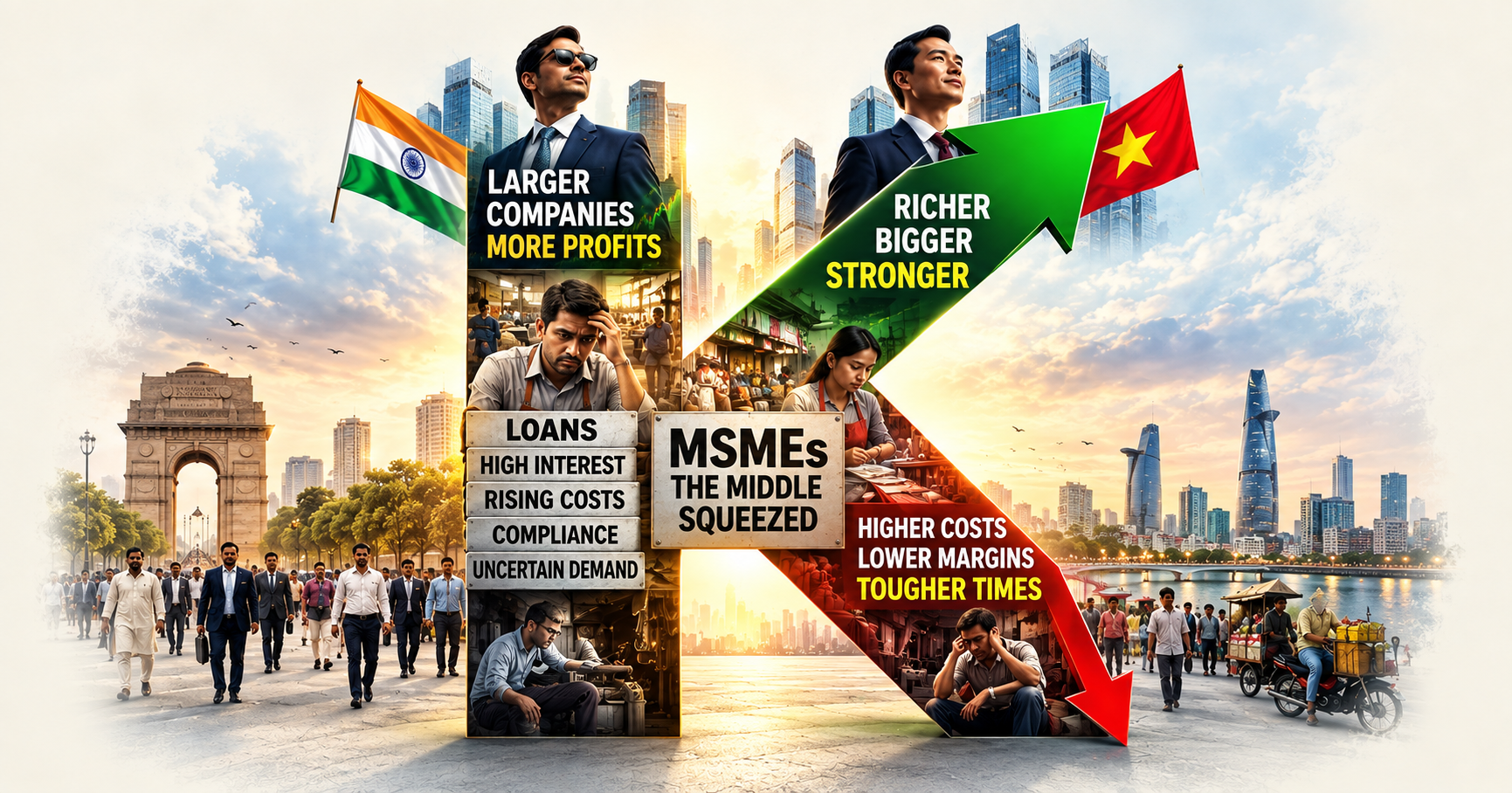
Imagine economic growth as the letter K.
The upper arm moves upwards: large corporations, foreign-invested companies, capital-intensive industries, infrastructure and businesses connected to global supply chains.
The lower arm moves downwards or remains under pressure: micro enterprises, small manufacturers, household businesses and workers dependent on domestic demand.
This does not automatically mean that India or Vietnam is a K-shaped economy. It is a question worth testing.
And when the two countries are placed side by side, an interesting pattern emerges.
Vietnam: Growth is real — but unevenly transmitted
Vietnam’s 8.18 per cent H1 2026 growth was supported by industry, construction and services. Industrial production increased 10.8 per cent, while manufacturing expanded 11.4 per cent. Goods exports rose 21 per cent.
But look beneath the headline.
Vietnam’s foreign-invested sector generated about 80 per cent of merchandise exports, while the domestic economic sector accounted for only about 20 per cent.
More revealing is the pace of growth.
FDI-sector exports grew by around 26 per cent, while domestic-sector exports grew only 4.6 per cent.
That is not an argument against FDI. Foreign investment has helped transform Vietnam into a major manufacturing and export base.
But it raises a more important question:
How deeply is the domestic business ecosystem participating in that success?
India: A different structure, but the same question
India’s economy grew 7.8 per cent in Q1 FY2026-27, with manufacturing and services supporting the expansion. Investment rose 11.9 per cent, household consumption increased 7.1 per cent, and exports grew 12 per cent.
India’s story is structurally different from Vietnam’s.
Indian MSMEs are not a small peripheral part of the economy. According to the Economic Survey 2025-26, MSMEs account for approximately 31.1 per cent of GDP, 35.4 per cent of manufacturing and 48.58 per cent of exports.
That means India’s smaller businesses are already deeply embedded in the national economy and export system.
Yet the question remains:
Are they scaling at the same speed as the economy around them?
That is the real India-Vietnam comparison.
The credit divide
Money is where the K-shape becomes easier to understand.
For a large company, access to capital can mean a bank relationship, bond market, institutional investors, equity markets or foreign capital.
For a small manufacturer, it can mean something much simpler:
“Do I have enough collateral for the bank?”
Vietnam provides a striking example.
SMEs represent roughly 98 per cent of operating businesses, yet their share of outstanding bank credit has been estimated at only around 20–22 per cent.
More than 90 per cent of business loans require collateral, creating a major barrier for enterprises whose biggest assets may actually be orders, customers, machinery, intellectual property and future cash flow rather than land and buildings.
This is important because the absence of finance can prevent a good business from becoming a larger business.
India has a much larger formal credit-support architecture for MSMEs. The government’s CGTMSE system, for example, had provided guarantees covering about ₹15.12 lakh crore (US$157 billion) by July 2026.
So India’s challenge is not simply “small businesses receive no credit”.
The more useful question is:
Is credit reaching the right businesses, at the right cost, for long enough to allow them to scale?
The household-business warning
Vietnam offers another warning signal.
A 2025 survey found 81.5 per cent of household businesses reported declining revenue. Household businesses are important because they sit much closer to ordinary consumers and employment than large export corporations do.
This creates a striking contrast:
Vietnam’s industrial and export numbers are booming while a large section of its smallest businesses reports falling revenue.
That does not cancel out the growth story.
It tells us something more important:
Growth and business health are not always the same thing.
India should ask the same question about its own vast micro-enterprise ecosystem.
The missing middle
There is another similarity between the two countries.
Both need a stronger middle layer of businesses.
At one end are global companies with technology, capital, sophisticated management and access to international markets.
At the other end are millions of very small businesses.
Between them should exist a powerful layer of scaled domestic companies — businesses that employ hundreds or thousands of people, invest in technology, export directly or become strong suppliers to global companies.
This middle layer matters because it converts economic growth into broader employment, productivity and local wealth creation.
Without it, a country can produce impressive GDP and export numbers without creating enough domestic corporate depth.
A new way to measure growth: The Growth Transmission Gap
Perhaps the traditional question — “How fast is GDP growing?” — is no longer enough.
For emerging economies, we need another measure.
Call it the Growth Transmission Gap.
The idea is simple.
Track the journey:
GDP growth
↓
Investment
↓
Large companies & FDI
↓
Supply chains
↓
MSMEs
↓
Employment
↓
Household income
The larger the gap between the top and bottom of this chain, the weaker the transmission of growth.
A country could therefore record 8 per cent GDP growth but have a large Growth Transmission Gap if most of the additional capital, productivity and export opportunities remain concentrated among large companies.
Conversely, a country with slightly slower GDP growth could potentially create broader prosperity if more of its growth reaches smaller businesses.
This is not a conventional economic indicator. It is a proposed way of looking at growth from the perspective of the entrepreneur rather than only the national accounts.
What should governments ultimately measure?
The next generation of economic policy may need to look beyond GDP and ask five additional questions:
1. How many small businesses are scaling into medium-sized companies?
2. How much new credit is reaching businesses without large collateral pools?
3. How many domestic companies are entering global supply chains?
4. How much productivity improvement is occurring outside the largest corporations?
5. How much of export growth is translating into domestic value addition?
These questions matter to both India and Vietnam.
The real lesson
Vietnam’s 8.18 per cent growth and India’s 7.8 per cent growth are genuine achievements. Neither should be dismissed because inequality, credit access or business distress exists alongside them.
But neither should GDP growth be treated as proof that prosperity is automatically spreading.
Vietnam shows what happens when FDI-led manufacturing becomes exceptionally powerful while domestic businesses struggle to participate at the same speed.
India presents a different model, where MSMEs already account for a substantial share of GDP, manufacturing and exports — but where the challenge is to help millions of smaller enterprises move from survival and informality to scale, productivity and global competitiveness.
That leads to a more useful definition of successful growth:
A growing economy is not merely one where the top rises faster. It is one where the capacity of the middle expands fast enough to carry the lower layers upwards.
The real test for both India and Vietnam, therefore, may not be whether they can sustain 8 per cent growth.
It is whether they can make that growth travel further down the economic chain.
Sources
India: Government of India, Press Information Bureau; Economic Survey 2025-26; Ministry of MSME; MSME Dashboard.
Vietnam: National Statistics Office of Vietnam, socio-economic performance reports for Q1 and H1 2026; State Bank of Vietnam and publicly reported SME-financing data; OECD economic analysis of Vietnam.
Currency conversion: approximately ₹96.13 per US$1, 17 September 2026.






Leave a Reply