
By Haresh Jhala:
Food inflation, rising costs and RBI dilemma may reshape Diwali demand
India is not facing a consumption collapse. It may be facing something subtler: a change in what people buy. Retail inflation has risen, food prices are climbing, wholesale inflation is close to double digits and input costs are squeezing businesses. As Diwali approaches, the crucial question is not whether Indians will spend, but where that money will go—and what households, companies and the RBI may have to sacrifice if inflation persists over the coming months.
The next inflation problem may be what people stop buying
The most important question for India is no longer simply “Will inflation rise?”
It is:
What will Indians stop buying if essential expenses keep rising?
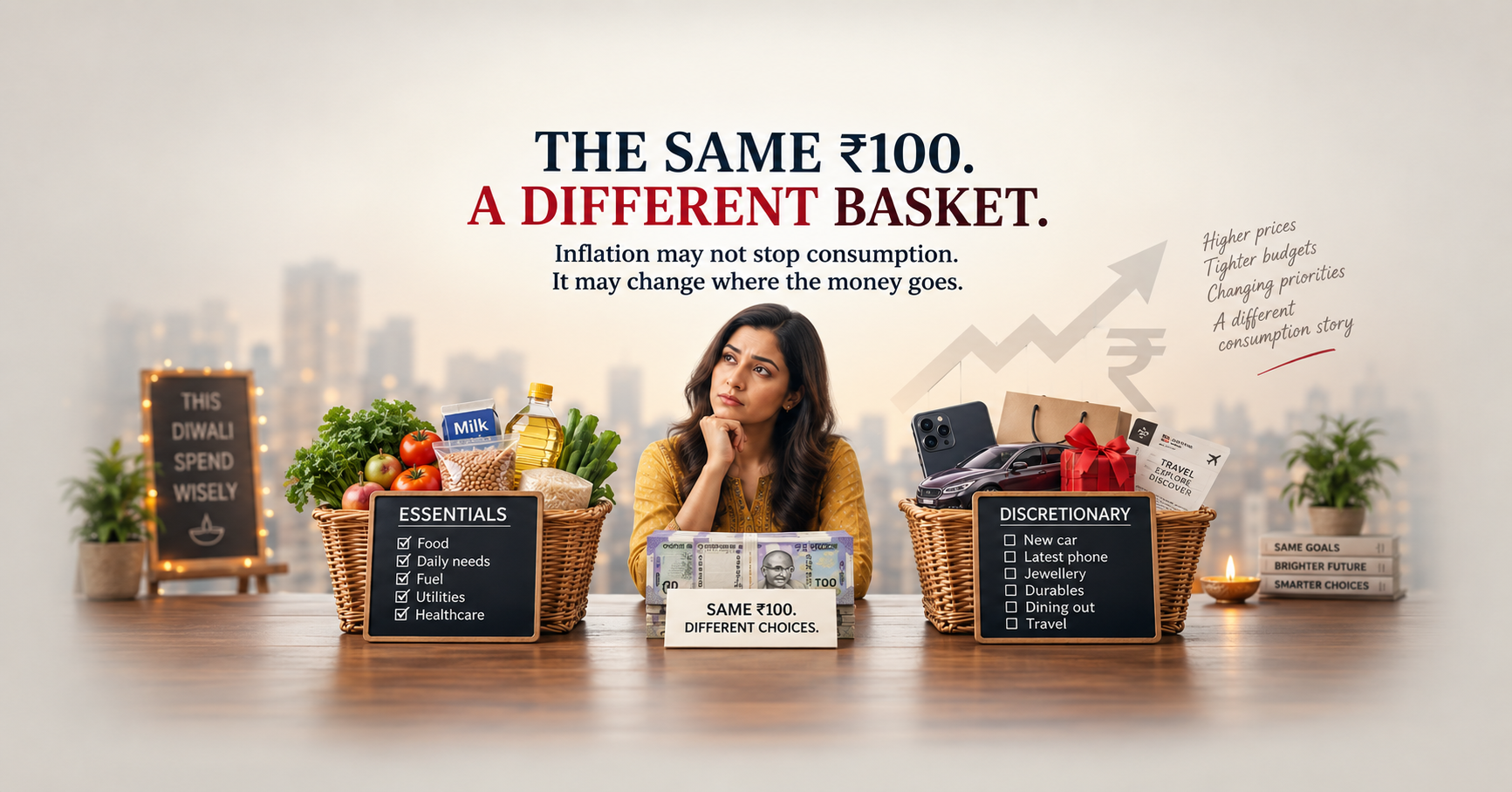
India is not heading into a consumption collapse. Auto sales remain strong and festive demand is currently being described as robust. But inflation can change consumption without destroying it.
A household does not necessarily stop spending when prices rise.
It changes what it spends on.
A larger grocery bill can mean a smaller discretionary purchase. A more expensive phone can mean a cheaper model. A jewellery buyer can buy a lighter piece. A family can still celebrate Diwali—but with a smaller basket.
That shift could become the more important economic story of the next few months.
First comes the household squeeze
India’s August CPI inflation rose to 4.82%, from 4.45% in July. Food inflation rose from 5.52% to 5.95%. Inflation is now above the RBI’s 4% target for the third consecutive month.
The significance is not merely the headline number.
Food already accounts for about 40% of urban household consumption expenditure and nearly 47% in rural India, according to the latest Household Consumption Expenditure Survey.
That means persistent food inflation does something very simple: it leaves less money available for everything else.
This does not mean salaries will suddenly fail to keep pace. The issue is real purchasing power—how much of a salary increase survives after essentials become more expensive.
And that is where inflation begins to affect the wider economy.
Then the pressure moves upstream
The more worrying signal is coming from wholesale prices.
Within that:
- Food: 7.05%
- Manufactured products: 8.37%
- Fuel and power: 22.93%
Petroleum and natural gas prices were up 34.41% year-on-year.
This creates a crucial gap between what consumers see today and what businesses are already experiencing.
Retail inflation is 4.82%. Wholesale inflation is 9.92%.
That does not mean retail inflation will automatically rise to 9.92%.
It means that a significant amount of cost pressure is sitting upstream.
The question is how much businesses absorb, how much they pass through, and how long that transmission takes.
Then comes the business margin squeeze
For manufacturers and suppliers, the first response is rarely an immediate price increase.
They negotiate with suppliers.
They improve productivity.
They reduce waste.
They postpone investment.
They absorb some of the increase.
But margins have limits.
CRISIL expects operating margins in India’s auto-component industry to moderate from around 12% to 10.5–11%, with raw materials accounting for nearly three-fourths of costs. It also expects cost pass-through to OEMs to occur with a one-to-two-quarter lag.
That lag matters.
The consumer may not see today’s cost increase immediately.
The manufacturer’s margin feels it first.
And if costs remain elevated, prices eventually become the next line of defence.
For India’s commercial-credit ecosystem, the exposure is substantial. Outstanding commercial credit reached around ₹65.8 lakh crore by March 2026.
A simple sensitivity calculation shows that a 25–50 basis-point increase applied across that entire credit stock would represent ₹16,450–₹32,900 crore of annualised interest-cost exposure.
That is not a forecast of the actual additional interest bill—loan repricing is gradual and uneven—but it illustrates the scale of the financing channel.
Then comes Diwali
This is where the story becomes more interesting.
The evidence does not support a forecast of a weak Diwali.
Quite the opposite.
Current forecasts point to strong festive demand. Datum Intelligence expects India’s 2026 festive online season to reach ₹1.50–1.55 lakh crore, 25–29% above 2025. But its analysis also points to an important detail: growth is being driven by more shoppers and more orders, not bigger baskets.
That distinction could become critical.
Consumption can grow while consumers become more price-sensitive.
The same pattern is visible elsewhere: consumers may trade down, buy lighter products, choose financing, or postpone higher-ticket purchases.
So the question for manufacturers and retailers is not simply:
“Will Diwali sales grow?”
It is:
“What will consumers buy—and at what price?”
Then the RBI faces the difficult choice
The RBI has kept the repo rate at 5.25%.
August inflation strengthens the case for caution. Global oil prices and currency pressures add another layer of uncertainty. Some economists now see an October hike as possible; others expect the RBI to wait.
But the RBI faces a problem whichever way it moves.
If it raises rates:
Borrowing becomes more expensive, potentially slowing credit, investment and consumption.
If it holds rates:
Growth receives support, but persistent food, energy and wholesale cost pressures could become more embedded in inflation expectations.
There is therefore no painless option.
And a rate hike cannot produce more onions, lower global oil prices or bring rain.
And the weather risk has not disappeared
The monsoon has been uneven and below normal in several periods, with August rainfall 13.8% below normal and September also running below normal so far. Around 43% of India remains rainfall-deficient, according to the latest IMD assessment reported this week.
The El Niño risk adds another layer.
IMD has noted that El Niño generally weakens the Indian summer monsoon, although the historical relationship is not automatic: only seven of 16 El Niño years since 1950 significantly affected India’s monsoon rainfall.
So we should not say “El Niño will cause food inflation.”
The correct concern is narrower:
uneven rainfall + crop uncertainty + global food and energy prices = a higher risk of persistent food-price pressure.
The real forecast
India’s immediate risk is not a sudden collapse in consumption.
It is something quieter.
Households may continue spending—but change what they buy.
Businesses may continue growing—but with thinner margins.
MSMEs may continue borrowing—but at a higher cost.
Festive sales may rise—but average baskets may not.
And the RBI may have to choose between protecting inflation expectations and protecting the momentum of growth.
If food inflation remains elevated while wholesale and input costs stay high, the next stage of the story may therefore be less about whether India grows at 7% and more about the quality of that growth.
Because GDP measures what the economy produces.
It does not tell us how much it costs households and businesses to keep participating in it.
For founders, the question is simple:
Are you preparing for higher costs—or for customers changing what they buy?
Follow MSME Briefing for the next data-led forecast on inflation, consumption and the decisions Indian businesses will face.
Sources
- Ministry of Statistics & Programme Implementation — August 2026 CPI data.
- Ministry of Commerce & Industry — August 2026 WPI data.
- Reuters — August CPI, RBI expectations and inflation outlook.
- CRISIL Ratings — auto-component margins and cost pass-through.
- Datum Intelligence — 2026 festive consumption forecast.
- India Meteorological Department / Government of India — 2026 monsoon and El Niño assessment.
- MoSPI — Household Consumption Expenditure Survey 2023–24.



Leave a Reply