
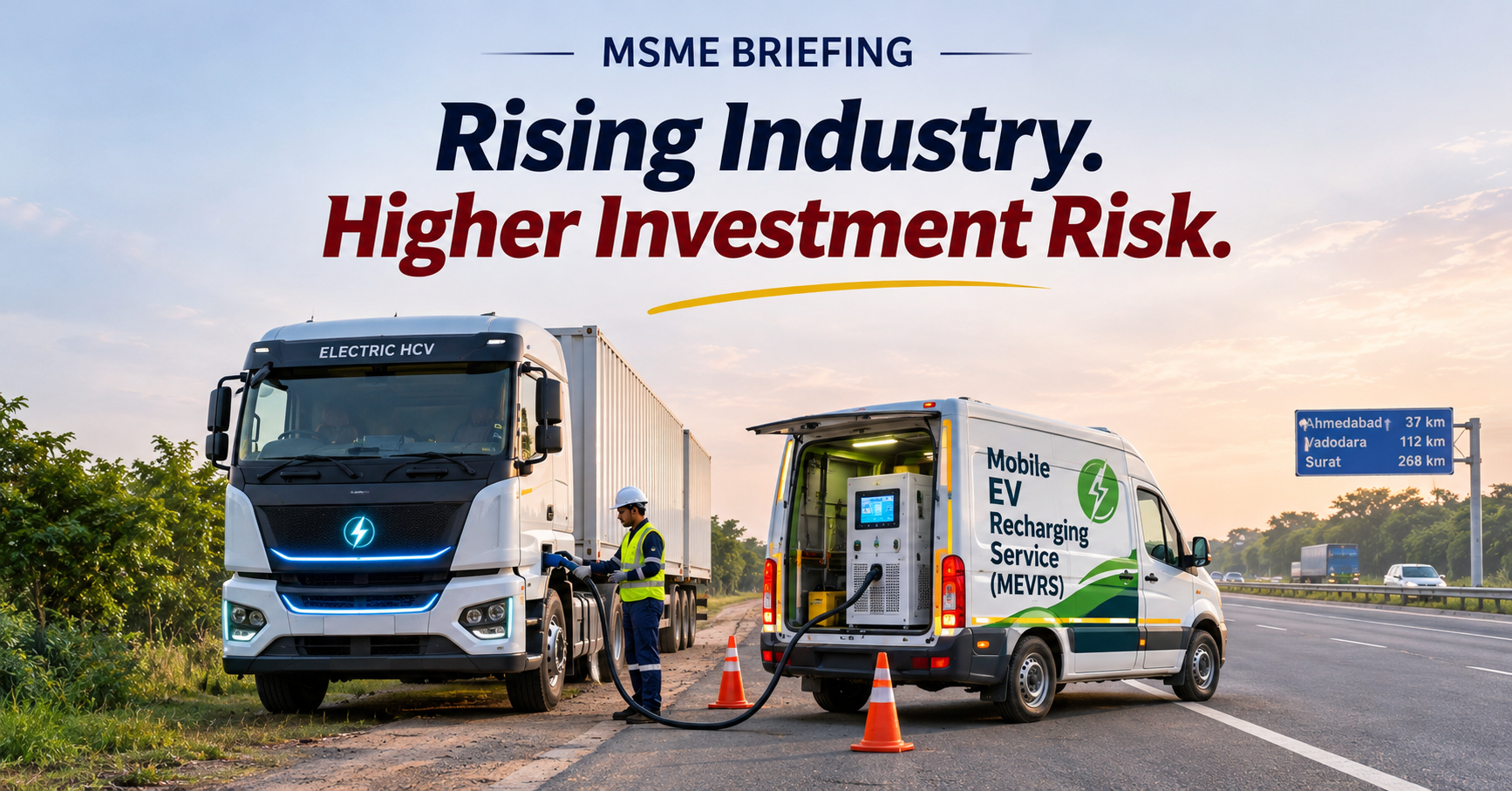
MSME BRIEFING | BUSINESS INVESTMENT ADVISORY
The business models, investment economics and strategies aspiring entrepreneurs must understand.
The opportunity is real. The profitability is not guaranteed. Mobile EV recharging services (MEVRS) are attracting attention as India’s electric vehicle population expands. But aspiring founders and investors must look beyond charging vans and roadside rescues. With a two-unit operation potentially requiring ₹75–90 lakh, the real questions concern customer contracts, energy costs, equipment utilisation and investment recovery. Should entrepreneurs pursue individual EV owners, commercial fleets or insurer-backed roadside assistance? The answer lies in disciplined business economics.
India’s EV Expansion Creates an Opportunity, Not an Assured Market
India’s transition towards electric mobility is creating business opportunities beyond vehicle manufacturing, batteries and conventional charging stations. One emerging segment is Mobile Electric Vehicle Recharging Services (MEVRS), which takes charging equipment to the vehicle rather than requiring the vehicle to travel to a fixed charging station.
The concept addresses three distinct requirements: emergency charging for stranded motorists, scheduled charging for commercial fleets and doorstep charging for private EV owners.
The opportunity is particularly relevant where charging infrastructure is insufficient, grid connections are delayed, or commercial operators cannot afford to keep vehicles idle during working hours.
However, a growing EV population does not automatically translate into profitable demand for mobile charging.
India’s EV registrations are dominated by electric two-wheelers and three-wheelers. Passenger cars and electric light commercial vehicles represent smaller segments, although they may offer more attractive opportunities for higher-value mobile charging services.
Industry projections cited for the Indian mobile EV charging market suggest potential expansion to approximately ₹1,138–1,575 crore (US$130–180 million) by 2034–35, using an illustrative exchange rate of ₹87.50 per US dollar. These estimates require independent verification of their market definitions, base years and forecasting assumptions.
More importantly, the addressable market for a founder operating two charging vans in Ahmedabad or Surat is vastly smaller than the national market.
The relevant question is not how large India’s EV market will become, but how many customers within a commercially viable service radius will pay enough to sustain a mobile charging operation.
What Exactly Is a Mobile EV Recharging Business?
MEVRS is a commercial service, while Mobile Electric Vehicle Supply Equipment (M-EVSE) refers to the charging hardware.
A typical mobile charging unit combines a commercial vehicle with an onboard Lithium Iron Phosphate (LFP) battery, power conversion equipment, charging connectors, battery management systems and electrical safety equipment.
Depending on its configuration, the unit can deliver electricity to a stationary EV without requiring a grid connection at the customer’s location.
The distinction is important: mobile charging is not grid-independent electricity generation.
The mobile unit must obtain electricity from somewhere, usually a depot or compatible charging facility. Its battery must be replenished after delivering energy to customers.
Consequently, an MEVRS operator is managing three businesses simultaneously: energy procurement, vehicle logistics and commercial charging services.
Profitability depends on controlling all three.
The First Business Question: Who Will Pay, and Why?
An entrepreneur should begin by identifying a customer whose financial problem is sufficiently expensive to justify paying a premium for mobile charging.
Three customer categories deserve examination.
1. Commercial fleets: Selling operational uptime
Consider an electric light commercial vehicle operating for an e-commerce delivery company.
If insufficient charging prevents the vehicle from completing scheduled deliveries, the fleet operator may face lost contribution margin, wasted driver hours, rescheduling expenses and service-level penalties.
An illustrative operational loss of ₹1,800–3,500 per vehicle per day would make an appropriately priced mobile charging service attractive. However, this range must be validated against actual fleet economics; not every idle vehicle generates losses of this magnitude.
The opportunity becomes more compelling when fleet operators occupy rented industrial premises without adequate electrical capacity.
A permanent transformer or grid upgrade could involve substantial capital expenditure, installation delays and landlord approvals. A hypothetical ₹20 lakh electrical upgrade may encourage an operator to consider outsourced charging.
But the comparison must be fair. The ₹20 lakh figure is not a standard DISCOM charge, and fixed AC chargers, load management or nearby public charging may offer cheaper alternatives.
The strongest selling proposition is not electricity. It is the cost of vehicle downtime avoided.
2. Highway roadside assistance: Selling rescue and availability
An EV stranded along NH-48 or another major highway may require towing to the nearest compatible charging station.
For illustration, a towing bill of ₹3,000–6,000, depending on distance and vehicle category, could make a ₹2,500 mobile charging rescue commercially appealing.
However, a mobile charging operator must reach the stranded vehicle, deliver sufficient energy and recover the cost of keeping equipment available.
The economics become more interesting when the customer is an automotive OEM, insurer or roadside assistance (RSA) aggregator, rather than an individual stranded motorist.
Such institutional customers could potentially contract mobile operators to provide defined geographical coverage.
3. Private EV owners: Selling convenience
Doorstep charging may appeal to EV owners without reliable home charging facilities, particularly those living in older residential complexes.
But consumer willingness to pay is uncertain.
A private owner may compare mobile charging with a nearby public charger, workplace charging or a permanent residential installation.
For an entrepreneur, scattered bookings introduce travel time, customer acquisition costs and unpredictable utilisation.
Therefore, standalone B2C charging should be considered a selective premium service rather than the default foundation of a new MEVRS venture.
B2B or B2C: Which Model Makes Better Business Sense?
The commercial distinction becomes clearer when the three models are compared.
| Parameter | B2C doorstep | B2B fleet | Institutional RSA |
|---|---|---|---|
| Demand | Fragmented | Scheduled | Unpredictable incidents |
| Customer acquisition | Individual users | Fleet contracts | OEM/insurer agreements |
| Revenue model | Per session | Per kWh or contract | Retainer and dispatch |
| Main advantage | Premium convenience | Demand concentration | Contracted availability |
| Principal risk | Travel and idle time | Pricing and concentration | Standby cost and SLA |
| Strategic role | Supplementary | Potential anchor | Conditional second revenue stream |
For a new entrant, contracted fleet charging appears the strongest starting hypothesis, provided the fleet genuinely needs mobile charging and is willing to pay a commercially sustainable tariff.
RSA can complement this model, but only where contract terms justify keeping a unit available for emergencies.
A founder should not assume that one vehicle can simultaneously serve scheduled fleet customers and guarantee rapid roadside response.
That operational conflict must be resolved before promising service-level commitments.
The ₹90 Lakh Question: Can Two Mobile Units Earn Enough?
An entrepreneur considering a mobile EV charging venture must confront the capital requirement before deciding on the business model.
A proposed two-unit operation could require ₹75–90 lakh, depending on the vehicle configuration, battery storage capacity, charging output, depot arrangements and working capital.
For illustration, consider two mobile charging vehicles costing ₹38 lakh each, supported by ₹12 lakh for depot infrastructure, software and initial working capital.
That produces an initial commitment of ₹88 lakh.
These are planning assumptions, not verified equipment quotations. Battery specifications, charger certification, integration costs and financing terms must be established through supplier proposals.
Why one van may be insufficient
A single vehicle presents several operational risks.
When its battery is depleted, the unit must return to a depot or suitable charging facility. During maintenance or breakdown, the entire business may become unavailable.
For a founder offering guaranteed roadside assistance, such interruptions could result in service-level failures.
However, starting with two vehicles is not automatically the financially superior decision.
A founder could initially operate one unit and negotiate backup coverage with an existing service provider. That would reduce capital exposure, although it would introduce dependence on another operator.
The correct decision depends on contracted demand, expected dispatch frequency, charging capacity and response-time commitments.
The economics of a two-unit pilot
Consider an illustrative monthly operating model.
| Particulars | Assumption |
|---|---|
| Initial investment | ₹88 lakh |
| Monthly fleet revenue | ₹1.50 lakh |
| RSA availability retainers | ₹1.00 lakh |
| RSA dispatch and service revenue | ₹0.60 lakh |
| Other scheduled charging | ₹0.40 lakh |
| Total monthly revenue | ₹3.50 lakh |
| Illustrative cash operating costs | ₹2.20 lakh |
| Operating cash surplus | ₹1.30 lakh |
The ₹2.20 lakh cost allowance is an illustrative aggregate covering energy procurement, staff, depot operations, travel, maintenance, insurance and administration. It is not a supplier-validated budget.
At this level, annual operating cash surplus would be approximately ₹15.60 lakh, implying a simple capital recovery period of 5.6 years.
However, this is not a projected investment return. The calculation excludes financing costs, taxation, major battery replacement and changes in working capital. Accounting depreciation would also affect reported profit.
A lower revenue outcome changes the picture substantially.
Illustrative two-unit financial sensitivity
| Monthly revenue | Cash costs | Monthly surplus | Simple payback |
|---|---|---|---|
| ₹2.50 lakh | ₹2.20 lakh | ₹0.30 lakh | 24.4 years |
| ₹3.50 lakh | ₹2.20 lakh | ₹1.30 lakh | 5.6 years |
| ₹4.50 lakh | ₹2.20 lakh | ₹2.30 lakh | 3.2 years |
Illustrative calculations based on ₹88 lakh initial investment. Operating costs are held constant solely to isolate revenue sensitivity; actual costs will vary with utilisation. Financing, tax and replacement expenditure are excluded.
The comparison demonstrates the sensitivity of capital recovery to monthly revenue.
A business that appears attractive at ₹4.50 lakh monthly revenue can become economically unattractive at ₹2.50 lakh.
The entrepreneur must therefore establish minimum contracted revenue before acquiring equipment.
The Hidden Problem: Selling Electricity at ₹18/kWh
The proposed B2B tariff of ₹18 per kWh deserves particular scrutiny.
Suppose a mobile unit delivers 100 kWh daily over 25 operating days.
At ₹18/kWh, monthly revenue would be ₹45,000.
Even if both units achieved that volume, combined energy-sales revenue would be only ₹90,000 monthly.
This is insufficient to support the proposed investment without additional contracted service revenue or substantially higher throughput.
The operator must recover electricity procurement costs, charging losses, labour, vehicle movement, equipment depreciation, financing and maintenance.
Consequently, MEVRS cannot be evaluated solely as a business buying electricity cheaply and selling it at a higher tariff.
Commercial contracts may require a combination of energy charges, availability fees, minimum monthly commitments and service charges.
For example, a fleet operator might agree to a minimum monthly payment in exchange for guaranteed charging availability during defined operating windows.
Such arrangements could improve revenue predictability, but their commercial acceptance must be tested.
The most important financial metric is contribution earned per mobile unit per productive operating hour, supported by delivered kWh, travel costs and contracted revenue.
RSA: Recurring Revenue or Expensive Standby?
Roadside assistance offers a potentially valuable second revenue stream.
An OEM or insurer may prefer contracting an external specialist rather than maintaining mobile charging vehicles across multiple cities and highway corridors.
A possible commercial arrangement could combine a ₹40,000–60,000 monthly availability retainer per contracted coverage area with ₹2,200–3,500 per emergency dispatch.
These are illustrative negotiating assumptions, not established industry tariffs.
Consider a hypothetical RSA contract producing ₹50,000 in monthly availability revenue and 15 dispatches at ₹2,500 each.
Monthly revenue would be ₹87,500, before any separately billed energy charges.
Two such arrangements could generate ₹1.75 lakh monthly.
But the operator must establish whether contracts of this nature are available, whether minimum response times are achievable and whether the contracting company will pay when emergency demand is low.
An RSA contract may also impose penalties for missed calls or delayed response.
The most dangerous assumption would be treating a potential RSA retainer as assured income before obtaining a signed agreement.
Furthermore, scheduled fleet charging and emergency response compete for the same equipment.
If one unit is committed to overnight fleet charging and another is reserved for highway emergencies, the business must earn sufficient revenue from both activities to justify keeping two assets operational.
A founder should therefore seek minimum guaranteed payments, clearly defined geographical coverage and realistic service-level obligations.
Engineering Can Make or Break the Business
An 80 kWh onboard LFP battery does not mean the operator can sell 80 kWh during every deployment.
Energy conversion losses, battery operating limits and reserve requirements reduce usable delivery.
Assuming 85% net deliverable energy for illustration, an 80 kWh pack could provide approximately 68 kWh before any additional reserve.
If one customer requires a 30 kWh top-up, the mobile unit may have enough energy for only two comparable sessions before replenishment.
Actual performance depends on battery specifications, charger efficiency, vehicle compatibility and operating conditions.
Gujarat’s summer temperatures introduce further considerations.
Battery thermal management, connector temperatures, ventilation, electrical protection and charging-power derating must be assessed under local operating conditions.
The weight of battery storage and power electronics also affects vehicle payload, handling and fuel or energy consumption.
A founder should obtain independent technical assessment of battery capacity, safe charging output, usable energy, vehicle weight compliance and expected battery life before committing capital.
The depot itself requires adequate electrical capacity. Charging two depleted 80 kWh battery packs requires at least 160 kWh of replenishment energy before losses. At a combined 40 kW input, this would take more than four hours under idealised conditions.
The mobile unit’s own recharging time is therefore a direct constraint on revenue-generating availability.
Fixed Charging: The Competitor That Could Undermine MEVRS
Mobile charging is not competing only with other mobile operators.
Its strongest long-term competitor may be conventional charging infrastructure.
A fleet with predictable overnight parking and adequate grid capacity could find fixed AC charging substantially cheaper.
Where electricity connections are available, fixed DC charging may also provide better economics at higher utilisation.
India’s Ministry of Power guidelines permit low-tension electricity connections for EV charging loads up to 150 kW, subject to applicable requirements. Power Ministry of India+1
The Government has also allocated ₹2,000 crore under PM E-DRIVE for public EV charging infrastructure, including urban and highway locations. Press Information Bureau
This expansion could progressively reduce demand for routine mobile charging in well-served areas.
Mobile charging may retain advantages in emergency rescue, temporary fleet deployments, locations awaiting grid upgrades and specialised commercial applications.
The strategic implication is significant.
An entrepreneur should not build a business whose profitability depends permanently on the absence of fixed charging stations.
Instead, mobile services should solve problems that fixed infrastructure cannot address economically or quickly.
Gujarat: Where Should the First Unit Operate?
Gujarat offers several locations worth investigating because of its industrial activity, logistics networks and intercity highways.
However, industrial density alone is insufficient to establish mobile charging demand.
The founder must identify electric vehicle concentrations, fleet operating patterns, existing charging facilities and customers facing genuine charging constraints.
Three geographical clusters deserve preliminary consideration.
| Location | Potential opportunity |
|---|---|
| Ahmedabad–Sanand–Changodar–Naroda | Delivery fleets, industrial logistics, corporate mobility |
| Surat–Vapi–Ankleshwar–Vadodara | Commercial transport, industrial fleets, highway RSA |
| Rajkot–Morbi–Jamnagar | Industrial transport, intercity operations and possible RSA coverage |
These are proposed market-testing locations, not verified demand hotspots.
For a Gujarat-based entrepreneur, Ahmedabad’s industrial and logistics belt may offer a practical starting point, provided customer interviews establish sufficient EV fleet density.
A highway rescue operation should begin with a narrowly defined service radius rather than promising coverage across hundreds of kilometres.
Competition: The Market Is Not Empty
India already has companies exploring different approaches to mobile charging and EV assistance.
Hopcharge has been associated with doorstep EV charging, while names such as Cargar, SpotCharge, Battwheels Garages and ReadyAssist appear in the wider mobile charging or roadside assistance landscape.
However, the current operating scale, equipment specifications, commercial partnerships and geographic coverage of these businesses require direct verification. Their inclusion should not be interpreted as confirmation that all presently operate the described MEVRS models.
For a new entrant, the important competitive questions are whether existing providers have contracted fleet customers, whether OEMs already have adequate emergency coverage and whether a new operator can offer superior response times or economics.
The absence of visible competitors does not necessarily indicate an untapped opportunity. It may indicate insufficient demand.
Regulation and Safety: Not Merely an RTO Formality
The Ministry of Power recognises EV charging station operations as an unlicensed activity under the applicable framework. Press Information Bureau
But this does not exempt a mobile operator from other applicable requirements.
Depending on vehicle and equipment configuration, these may include Central Motor Vehicles Rules, vehicle modification approvals, electrical safety requirements, relevant BIS charging standards, battery safety provisions and commercial vehicle insurance.
Founders should obtain written clarification from relevant transport and electrical authorities and qualified testing agencies regarding the specific mobile configuration.
They should not assume that every mobile battery installation automatically requires the same approval, or that a standard commercial vehicle registration covers all modifications.
Likewise, Gujarat-specific electricity duty concessions or incentives should be verified for eligibility before being included in the financial model.
Regulatory uncertainty must be resolved before purchasing or modifying vehicles, not after deployment.
A 90-Day Market Validation Plan Before Investing
The most sensible market-entry strategy begins without purchasing a charging van.
An aspiring founder should first establish whether the business can secure customers at commercially sustainable prices.
Days 1–30: Identify paying fleet customers
Approach at least 10 commercial fleet operators with electric LCVs or other compatible vehicles in a concentrated industrial geography.
Investigate their charging patterns, daily energy requirements, downtime costs, existing electricity connections and willingness to outsource charging.
Seek at least two conditional commercial commitments, preferably with minimum monthly revenue provisions. Twelve vehicles across two fleet customers could provide an initial testing base, but their energy demand—not merely their number—must justify the proposed equipment.
Days 31–45: Test RSA partnerships
Approach OEM service networks, insurers and established roadside assistance aggregators.
Establish whether they will consider availability retainers, per-dispatch contracts or subcontracted coverage.
Obtain clarity on response times, payment cycles, penalties, service radius and minimum guaranteed revenue.
Days 46–75: Validate equipment and economics
Obtain detailed quotations from multiple equipment suppliers, including chassis, battery, charger, integration, warranty, maintenance and compliance costs.
Compare one owned unit with outsourced backup against a two-unit operation.
Prepare monthly cash-flow projections under conservative, base and optimistic scenarios, including financing costs and battery replacement reserves.
Days 76–90: Make the investment decision
Negotiate a paid pilot, establish a reliable depot energy source and finalise operating arrangements.
Only then should the founder consider committing substantial capital.
A non-binding letter of intent is useful evidence of interest, but it is not a substitute for contracted revenue.
Who Should Enter This Business?
MEVRS is more naturally suited to entrepreneurs with existing commercial or technical capabilities.
Logistics and fleet operators may have an advantage because they already understand vehicle utilisation, maintenance, dispatch and customer contracts.
Charge Point Operators (CPOs) may benefit from established energy procurement, charging infrastructure and technical expertise.
Roadside assistance networks may possess the dispatch systems and institutional relationships needed to add emergency charging services.
Battery and energy-storage companies may understand the hardware, but still require customer acquisition and field-service capabilities.
For entrepreneurs without such advantages, entering through an asset-light service integration model may be worth exploring.
Under this arrangement, the entrepreneur secures fleet or RSA contracts while partnering with an equipment owner for service delivery.
It reduces initial capital requirements but introduces risks involving partner reliability, thinner margins and reduced operational control.
The least attractive approach is to purchase expensive charging equipment and subsequently search for customers.
The Adviser’s Verdict: Secure Demand Before Buying Assets
Mobile EV recharging is an emerging business opportunity, but it is neither a guaranteed growth story nor an easy route to recurring income.
The sector combines high capital intensity, uncertain utilisation, technical complexity and dependence on commercial contracts.
For aspiring founders and investors, the following recommendations are critical.
First, prioritise B2B fleet customers with demonstrable charging constraints. Avoid building a business around general assumptions about range anxiety or EV adoption.
Second, treat RSA retainers as potential contracted revenue, not assured income. Do not build financial projections around unconfirmed OEM or insurer agreements.
Third, resist the temptation to begin with two expensive mobile units simply for operational redundancy. Establish whether one owned unit, backed by an outsourced service arrangement, can validate the market at lower risk.
Fourth, calculate profitability from delivered energy, productive hours and contractual service revenue—not from the number of vehicles served or the theoretical capacity of the battery.
Fifth, compare mobile charging against fixed charging before promising customers long-term savings. The business must remain relevant as conventional infrastructure expands.
Sixth, insist on paid pilots, realistic financial projections and technical compliance before committing capital.
Finally, founders should recognise that the long-term opportunity may lie in building a specialised EV energy-services company rather than merely operating a fleet of mobile charging vans.
Such a company could eventually combine emergency rescue, fleet energy management, temporary charging and fixed infrastructure services.
But that ambition must begin with a commercially viable first operation.
The investment decision should be driven by contracted demand and proven economics—not by enthusiasm for electric mobility.
For an entrepreneur contemplating a ₹75–90 lakh commitment, the most valuable first investment may be in customer discovery, technical due diligence and financial validation, rather than the charging equipment itself.
Do not buy the charging van and hope customers arrive. Find customers willing to pay, establish the economics, and only then buy the van.
Editorial Note
This article is intended solely as a general business advisory and market-opportunity assessment. It should not be construed as financial or investment advice, a detailed project report, a bankable feasibility study or an assurance of profitability. All financial models, investment estimates, tariffs, revenue assumptions and payback calculations are illustrative unless explicitly supported by verified sources.
Prospective founders and investors should conduct their own independent market research, technical and regulatory due diligence, customer validation and detailed economic feasibility assessment. They should obtain current supplier quotations, examine applicable legal requirements and consult qualified financial and technical professionals before making any investment decision.
Sources and Research References
The following sources informed the market context, strategic framework and technical considerations. Commercial assumptions drawn from the supplied research have been identified as illustrative where independently verified evidence was unavailable.
Government and institutional sources
- Ministry of Road Transport and Highways (MoRTH): VAHAN Public Dashboard — EV registration trends, vehicle categories and state-level analysis.
- Ministry of Power: Guidelines for Installation and Operation of EV Charging Infrastructure, 2024 — charging infrastructure, electricity connections and regulatory framework.
- Ministry of Heavy Industries: PM E-DRIVE public charging infrastructure allocation — ₹2,000 crore infrastructure provision and implementation framework.
- Bureau of Energy Efficiency and BIS: EV charging regulations and technical guidance — applicable charging infrastructure standards and regulatory references.
- International Energy Agency: Global EV Outlook — international EV adoption and charging infrastructure trends.
Industry and commercial research references
- Precedence Research and MarketsandMarkets: EV charging infrastructure market forecasts. The specific India-only mobile charging projections supplied for this article were not independently substantiated.
- Society of Manufacturers of Electric Vehicles (SMEV) and FADA: Indian EV sales and segment-level industry trends.
- Cargar, Hopcharge, SpotCharge, Battwheels Garages and ReadyAssist: Identified for competitive and business-model assessment; current operations and commercial terms require direct confirmation.
- IndustryBuying, Havells, ZEVpoint and B2B equipment marketplaces: Indicative charging hardware and battery component pricing references, not verified turnkey mobile-unit quotations.
Research methodology: Financial sensitivity calculations and proposed customer acquisition strategies are editorial scenario analyses based on the supplied working assumptions. They are not audited company results, confirmed customer contracts or independently established industry averages.






Leave a Reply