
MSME Briefing | Sunday Musing
How Sharp’s LCD success became a lesson in reinvention and adaptation!
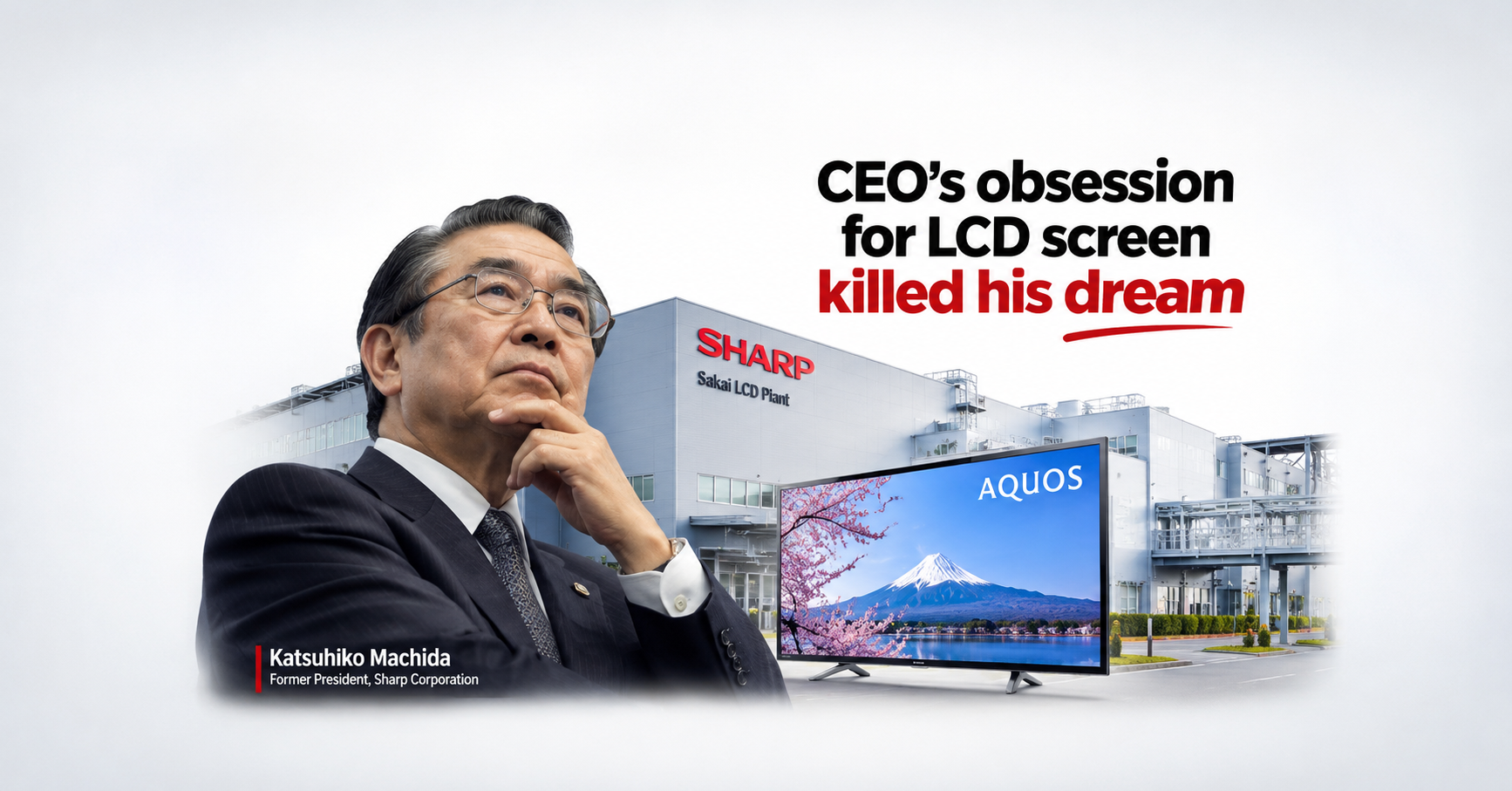
When Katsuhiko Machida took charge of Sharp in 1998, he challenged a television business and bet the company’s future on LCD technology. The gamble transformed Sharp into a pioneer: AQUOS became a brand, while Kameyama showcased manufacturing excellence. Yet success hardened into conviction. Sharp kept committing capital to LCD factories as competition intensified and display prices fell. Its story is not an argument against innovation; it is a warning against loyalty to yesterday’s breakthrough.
Don’t Fall in Love with Your Product: The Sharp Story
There is a fundamental distinction between being passionate about innovation and becoming emotionally attached to an innovation that once made your business successful. The former drives an enterprise forward; the latter can prevent it from recognising when the market has moved on.
For business founders, particularly those who have built companies around proprietary products, manufacturing capabilities or specialised technologies, this distinction can determine the difference between sustained growth and strategic decline.
Japan’s Sharp Corporation offers a compelling case study. Its journey from an LCD technology pioneer to a financially distressed manufacturer, eventually coming under the control of Taiwan’s Foxconn, illustrates how a successful innovation strategy can gradually turn into an organisational constraint.
The lesson is not that Sharp should never have invested in LCD technology. Quite the opposite. Its original decision was visionary. The problem was the inability to reassess the economics of that success as competition, technology and consumer demand evolved.
The central question is: When should a successful company stop protecting its winning formula and start reinventing it?
1. The audacity to challenge an established business
1998–2005: Katsuhiko Machida’s LCD revolution
When Katsuhiko Machida became President of Sharp in June 1998, the global television industry was still dominated by bulky Cathode Ray Tube (CRT) technology. Sharp was an established electronics manufacturer, but the television business faced increasing competition and the prospect of price erosion.
Machida recognised that competing indefinitely in a mature technology market would not secure Sharp’s future.
He made a bold commitment: replace CRT televisions sold in the Japanese domestic market with flat-screen LCD televisions by 2005.
This was not an incremental product improvement. It was a fundamental change in the company’s business priorities.
Sharp had been developing LCD technology for decades. Its first commercial LCD calculator appeared in 1973. Machida decided to transform this accumulated technological knowledge into a much larger consumer electronics opportunity.
The company introduced AQUOS LCD televisions in 2001 and subsequently invested in dedicated manufacturing infrastructure.
In 2004, Sharp commissioned its Kameyama Plant in Mie Prefecture, integrating the production of LCD panels and large-screen televisions.
The strategic advantages were considerable:
- Technology differentiation: Sharp could offer a product that was visibly different from conventional CRT televisions.
- Manufacturing control: Integrating panel and television production strengthened quality control and production coordination.
- Brand premium: AQUOS helped position Sharp as a technology leader rather than merely another television manufacturer.
- Intellectual property: Proprietary production knowledge and process expertise created barriers to imitation.
By 2005, Sharp had established itself as one of the leading players in LCD televisions.
Machida had correctly identified that the future of the industry lay in a different technology.
This was strategic innovation at its best: recognising an approaching transition before it became an industry-wide necessity.
2. When manufacturing excellence becomes a competitive moat
The Kameyama model: Integrating technology, production and brand value
Sharp’s Kameyama strategy deserves closer examination because it demonstrates why vertical integration can be a powerful competitive advantage.
Instead of relying entirely on external suppliers, Sharp sought greater control over the production chain. Its approach protected manufacturing expertise, improved coordination between components and finished products, and helped establish the reputation of the ‘Made in Kameyama’ television.
The business logic was straightforward.
If a company controls critical technology, production processes and product quality, it can differentiate itself from competitors and potentially command better margins.
For Sharp, this approach delivered several benefits:
First, manufacturing differentiation. The company could coordinate LCD panel production with television design and assembly.
Second, quality assurance. Greater control over production processes reduced dependence on external manufacturing partners.
Third, brand positioning. The Kameyama name became associated with technological sophistication and product quality.
Fourth, knowledge protection. Sharp could protect critical manufacturing processes and accumulated expertise.
However, there was an important strategic disadvantage hidden within this success.
The greater the dependence on proprietary infrastructure, the greater the capital commitment required to sustain it.
Factories require continuous investment, maintenance, technological upgrades and adequate utilisation. A manufacturing model that is highly profitable at one stage of an industry’s development can become expensive when product prices fall or competitors achieve lower production costs.
Sharp’s manufacturing advantage was real. But it also encouraged management to believe that the same model could deliver another generation of success through further expansion.
That assumption would be tested at Sakai.
3. The billion-dollar bet: Repeating yesterday’s success
2007–2010: The Sakai mega-plant decision
Success often creates a dangerous management assumption: if an investment worked once, a larger investment in the same direction will work even better.
In Sharp’s case, the Kameyama experience encouraged management to pursue an even more ambitious manufacturing strategy.
Machida became Chairman in 2007, while Mikio Katayama took over as President. The company began building the Sakai manufacturing complex in Osaka in November 2007. Production commenced in October 2009.
The LCD panel facility was designed around the world’s first 10th-generation glass substrates, measuring 2,880 × 3,130 mm. These larger substrates allowed manufacturers to cut multiple large television panels from a single sheet.
The initial investment announced by Sharp for the LCD panel plant was approximately ¥380 billion (excluding any attempt to equate this with the entire wider complex). The subsequent Sharp–Sony joint venture documentation placed the estimated total investment of the joint venture company at approximately ¥430 billion, including leased assets.
This was a substantial commitment to large-screen LCD manufacturing. Press Releases:SHARP+2
Why did Sharp make such a massive investment?
The business reasoning was understandable:
- Larger glass substrates could improve production efficiency.
- Higher production volumes could reduce manufacturing costs per panel.
- Integrated manufacturing could strengthen control over quality and supply.
- Growing demand for large-screen televisions appeared to justify additional capacity.
In other words, Sharp was trying to replicate the Kameyama model on a much larger scale.
But there was a critical difference between the two investments.
The competitive and economic environment had changed.
The global financial crisis had weakened consumer demand. Korean manufacturers such as Samsung and LG were expanding their display businesses. Taiwanese manufacturers were also becoming formidable competitors.
LCD technology was gradually becoming more widely available. As production capacity expanded across the industry, price competition intensified.
Sharp had invested heavily in a manufacturing model that required high utilisation to generate attractive returns.
The company’s strategic risk was no longer just technological. It had become a question of capital allocation, market timing and the ability to absorb excess capacity.
4. Four strategic miscalculations that changed the equation
Sharp’s difficulties cannot be attributed to a single bad decision. They emerged from the interaction of several business risks.
1. Mistaking technological leadership for permanent market leadership
Sharp had pioneered LCD television technology, but innovation does not guarantee permanent commercial dominance.
As competitors acquired manufacturing expertise and expanded capacity, LCD panels became increasingly competitive products.
The differentiation that once supported premium pricing became harder to defend.
A company can own a technology today without owning the economics of that technology tomorrow.
2. Excessive capital concentration
Large manufacturing plants have substantial fixed costs. Depreciation, maintenance, energy, labour and financing commitments continue irrespective of whether the production line is operating at full capacity.
When demand falls, a manufacturer with high fixed costs faces a disproportionate impact on profitability.
Sharp’s Sakai investment made the company particularly exposed to fluctuations in large-panel demand and prices.
3. Geographic and currency exposure
Sharp’s substantial manufacturing concentration in Japan exposed its export competitiveness to domestic cost structures and currency movements.
The appreciation of the Japanese yen made Japanese exports more expensive for overseas buyers and reduced the competitiveness of manufacturers whose costs were largely denominated in yen.
In addition, the company faced strong competition from manufacturers operating across different Asian manufacturing locations.
The problem was not simply that Japan was expensive. It was that Sharp’s manufacturing footprint offered insufficient flexibility when the economics of global production changed.
4. Management’s attachment to the winning formula
Perhaps the most important lesson concerns management judgement.
The Kameyama investment had validated Sharp’s technological and manufacturing strategy. But success can create a form of organisational confirmation bias.
Management begins to interpret new market developments through the assumptions that made its previous decisions successful.
Sakai was not simply another factory. It represented a belief that greater scale, proprietary technology and vertical integration would continue to deliver competitive superiority.
However, the market was rewarding cost efficiency, flexibility and scale across a wider manufacturing ecosystem, not just technological sophistication.
The lesson is not that Sharp should have abandoned LCD technology. LCD remained commercially relevant for years. The company needed to reassess the scale, economics and strategic concentration of its exposure to large LCD panels.
5. The financial reckoning: When the balance sheet loses patience
2011–2016: From technological pioneer to foreign acquisition
The consequences became increasingly visible in Sharp’s financial statements.
The company reported the following consolidated net results:
Revised financial figures
| Original figure | US$ |
|---|---|
| LCD TV sales, FY2005: ¥410.7 billion | US$3.7 billion |
| Sakai plant investment: ¥380 billion | US$4.1 billion |
| FY2010–11 net profit: ¥19.4 billion | US$221 million |
| FY2011–12 net loss: ¥376 billion | US$4.7 billion loss |
| FY2012–13 net loss: ¥545.3 billion | US$6.3 billion loss |
| FY2013–14 net profit: ¥11.5 billion | US$110 million |
| FY2014–15 net loss: ¥222.3 billion | US$2.0 billion loss |
| Foxconn’s 2016 total share investment: ¥388.8 billion | US$3.6 billion |
The FY2012–13 loss was particularly severe. Sharp’s annual report and financial disclosures recorded impairment charges, restructuring expenses and the impact of changing market conditions. Sharp Global+3
The deterioration exposed the limitations of a business model with heavy fixed-asset commitments and significant exposure to a highly competitive display market.
In 2012, Machida left his position as Chairman and Katayama was replaced as President. Sharp had to seek financial support from creditor banks and undertake restructuring.
By then, the company was no longer simply defending its market share. It was fighting to restore financial stability.
In March 2016, Sharp and Foxconn announced a strategic investment agreement.
Foxconn acquisition: Describe US$3.6 billion as the approximate total share investment, not simply the price paid for the 66% common stake.
This was a significant change in the ownership of a Japanese electronics institution that had been founded in 1912. Sharp Global+1
Sharp’s acquisition was not proof that its original LCD strategy had been misguided. Rather, it demonstrated how a company can lose financial resilience when an otherwise intelligent technology strategy becomes too concentrated, capital-intensive and difficult to adapt.
6. The founder’s dilemma: When should you reinvent your product?
Sharp’s story raises a question that every business founder should periodically ask:
Are we improving our product because the market needs it, or because we have become too comfortable with what we already manufacture?
There is a difference between product loyalty and customer loyalty.
A founder may have spent 20 years developing a product, building a manufacturing facility, establishing distribution and earning customer trust. Naturally, there is emotional and financial attachment.
But markets do not reward emotional attachment. They reward relevance, performance, cost competitiveness and the ability to meet changing customer expectations.
A successful business must continuously evaluate five areas.
1. Product updation must be continuous
Customer expectations change. Features, design, efficiency, durability and pricing must evolve accordingly.
A product that satisfied customers five years ago may no longer meet their expectations.
2. Technology adoption cannot be postponed indefinitely
New technologies can initially appear expensive, unfamiliar or commercially unproven. However, refusing to evaluate them can leave a business technologically disadvantaged.
Founders must continuously assess emerging technologies and determine when adoption makes commercial sense.
3. Manufacturing infrastructure must remain adaptable
A factory should not become a monument to the founder’s original vision.
Automation, process improvements, energy efficiency, alternative production methods and equipment upgrades must be evaluated against changing market economics.
4. Capital expenditure must follow market realities
Expansion should be based on credible demand, capacity utilisation, competitive positioning and expected returns.
A larger factory does not automatically create a more profitable business.
5. Founders must be prepared to challenge their own successful decisions
This is perhaps the most difficult responsibility.
A founder who built a successful enterprise around a particular product or technology may find it difficult to accept that the next phase of growth requires a different approach.
But leadership requires the ability to question one’s own assumptions.
The willingness to disrupt your existing business model is sometimes the strongest competitive advantage you can create.
7. What Indian MSME founders can learn from Sharp
Sharp’s experience has particular relevance for India’s manufacturing MSME sector.
Consider a few examples.
- A brass components manufacturer investing in CNC machinery must continuously evaluate automation, precision requirements and changing customer specifications.
- A kitchen appliance manufacturer cannot rely indefinitely on a successful product design while competitors introduce smarter, energy-efficient and more affordable alternatives.
- A water purifier manufacturer must keep pace with changing filtration technologies, water-quality requirements and consumer preferences.
- An engineering company cannot postpone digitalisation, process automation and energy-efficiency investments simply because its existing manufacturing system remains profitable.
- A chemical manufacturer must periodically upgrade production processes, safety systems and environmental compliance rather than treating existing infrastructure as a permanent asset.
These are not arguments for indiscriminate technology adoption or expensive modernisation.
Technology investment must be commercially justified. A new machine, software platform or production process should demonstrate measurable benefits in productivity, quality, cost, customer satisfaction or market access.
The important point is to keep evaluating alternatives rather than allowing the existing product or production system to dictate the future of the business.
Founder’s lesson: Love innovation, not your invention
Sharp’s story is not a warning against ambitious investment. Without Machida’s willingness to challenge an established business, Sharp might never have achieved its position as an LCD pioneer.
His original strategic decision was bold, commercially intelligent and transformative.
The failure came later, when the business needed to reassess its investment commitments, competitive positioning and manufacturing economics.
For founders, there are three important takeaways:
- Never confuse a successful product with a permanent competitive advantage.
- Never allow yesterday’s technology to become tomorrow’s organisational constraint.
- Never let emotional attachment to an existing business model prevent necessary reinvention.
A product can have a successful history, a loyal customer base and a profitable present. None of these guarantees its future.
Your product may have built your company. But your willingness to upgrade, adapt and reinvent it will determine whether your company remains relevant.
That is the real lesson from Sharp.
Don’t fall in love with what you have created. Remain committed to creating what the market will need next.
Sources & references
- Sharp Corporation – Sharp’s 100-Year History: Historical account of the LCD TV declaration, Machida’s leadership and the Kameyama manufacturing model. Read historical documentation.
- Sharp Corporation – Historical Timeline: Corporate milestones from 1998 onwards, including AQUOS, Kameyama and Sakai. Read timeline.
- Sharp Corporation – Sakai LCD Plant Announcement, 8 April 2009: Investment, capacity and 10th-generation glass substrate specifications. Read announcement.
- Sharp–Sony Joint Venture Announcement, 30 July 2009: Sakai investment and joint venture structure. Read joint announcement.
- Sharp Corporation – FY2012 and FY2013 Financial Results: Consolidated losses and restructuring disclosures. FY2012 results; FY2013 results.
- Sharp Corporation – FY2014 Financial Results: Subsequent financial performance. Read financial results.
- Sharp–Foxconn Joint Press Release, 30 March 2016: Shareholding and investment details. Read acquisition announcement.
- IMD Business School – Be Sharp! Sharp’s Innovation in the LCD Industry: Independent management case study by Kazuo Ichijo. Read case study description.




Leave a Reply