

MSME Briefing Bureau
INVESTIGATIVE FEATURE | ORGANIC FOOD | INDIA
From Sikkim’s organic transformation to Gujarat’s certification system, consumers need evidence beyond the label.
Consumers increasingly pay a premium for organic food, trusting that its production follows stricter environmental and agricultural standards. But what does an organic label actually guarantee? Sikkim’s journey to becoming India’s first fully organic state demonstrates the scale of commitment such a transition requires. Gujarat presents a different question: with conventional farming widespread and substantial land registered under organic certification, how can buyers distinguish verified products from unsupported claims? The answer lies in evidence, inspection and accountability, not labels alone.
Organic is a standard, not simply a marketing claim
The distinction between organic, natural, farm-fresh and chemical-free is central to the debate. These expressions are not interchangeable. A product described as natural or farm-fresh does not automatically qualify as certified organic.
India recognises two principal certification systems under the Food Safety and Standards (Organic Foods) Regulations, 2017: the National Programme for Organic Production (NPOP), implemented by APEDA, and Participatory Guarantee System (PGS-India), implemented through the Ministry of Agriculture and Farmers Welfare. The regulations came into force in 2018.
Certification provides evidence that an operator follows applicable organic production and handling standards. It is not an unconditional guarantee that every sample will be free from every possible chemical residue, or that every product sold by a company is organic.
That distinction matters to consumers, but it is equally important for food processors, retailers, exporters and manufacturers sourcing agricultural commodities.
Sikkim: a transition built over years
Sikkim offers an important example of what a state-wide organic transition entails.
The state began its policy journey in 2003, progressively reduced dependence on chemical fertilisers and pesticides, and developed programmes to help farmers adopt organic practices. The Sikkim Organic Mission, launched in 2010, supported the transition. By 2015, the state’s agricultural area had been converted to certified organic farming; in 2016, Sikkim was formally declared India’s first fully organic state.
The achievement was not simply a change in branding. It required policy continuity, changes in farming practices and support for farmers adapting to a different production system.
Yet Sikkim’s experience should not be reduced to a declaration that a state is organic. A complete assessment must also consider farmers’ incomes, productivity, market access, pest management and the long-term economic viability of organic agriculture.
For Gujarat, Sikkim provides a useful benchmark: what institutional support is needed, how is compliance verified, and how can farmers secure markets that reward the additional effort?
Gujarat’s numbers need careful interpretation
APEDA’s NPOP data for 2024–25 record 192,940.85 hectares of certified organic farm area in Gujarat, alongside 244,092.15 hectares under conversion. The combined area covered by NPOP was 437,033 hectares. Reported organic farm production for sale was 292,845.12 tonnes, while production from land under conversion was 133,673.11 tonnes.
These figures place Gujarat among India’s leading states for certified organic farm area and production. But they do not mean that all agriculture in Gujarat is organic.
Nor do they mean that every kilogram of castor, cotton, cumin, coriander, groundnut or mango grown in the state is certified organic.
Certification applies to the specific farm, farmer or operator, product and scope covered by the applicable certificate. If a particular grower, company or defined group has certified organic groundnut, that does not automatically certify other groundnut producers in the same district—or every product sold by that company.
The distinction is crucial for consumers buying branded food and for businesses procuring agricultural commodities. Buyers must establish that the specific product and supply chain are covered by the relevant certification, rather than relying on a broad claim about a crop or region.
The figures also require another qualification: APEDA describes production as commercial output for sale, not total actual farm production. In-conversion output must be kept separate from fully organic output.
Chemical inputs and organic certification: the Gujarat question
Gujarat’s wider agricultural practices raise a legitimate question about how organic certification is protected in a state where conventional farming remains substantial.
Official figures previously identified for 2023–24 put Gujarat’s consumption of technical-grade pesticides at 1,835 metric tonnes. Fertiliser consumption was reported at 3.054 million tonnes of nutrients in the same year. These are different measures and should not be directly compared.
However, state-wide consumption figures do not prove that certified organic farms use prohibited chemicals. Conventional and organic farms can operate alongside each other. The relevant issue is whether certification systems can identify non-compliance and protect the integrity of certified production.
That requires asking how farm boundaries and buffer zones are managed, whether prohibited inputs or spray drift can contaminate neighbouring plots, how inspectors assess risks, and what happens when a violation is detected.
The public needs more than aggregate agricultural statistics. Gujarat-specific records on inspection volumes, residue-test results, complaints, suspensions and enforcement actions would help establish how effectively the safeguards work.
How is organic food certified?
Under NPOP, farmers, processors, traders and other eligible operators apply through a recognised certification body. The process involves checking the operator’s production system, relevant records, permitted inputs, handling practices and compliance with applicable standards. Certification is limited to the approved scope.
PGS-India follows a participatory approach in which farmers and groups assess compliance under the programme’s prescribed procedures. It is not simply an informal promise exchanged between neighbours.
Land transitioning from conventional agriculture must meet the applicable conversion requirements before it can qualify for full organic status. Certification also requires continuing compliance and periodic inspection or appraisal. It is not a permanent licence that remains valid regardless of subsequent farming practices.
The important question is not merely whether a certificate exists, but whether it is current, covers the product being sold and is supported by credible inspection and records.
What must the packaging display?
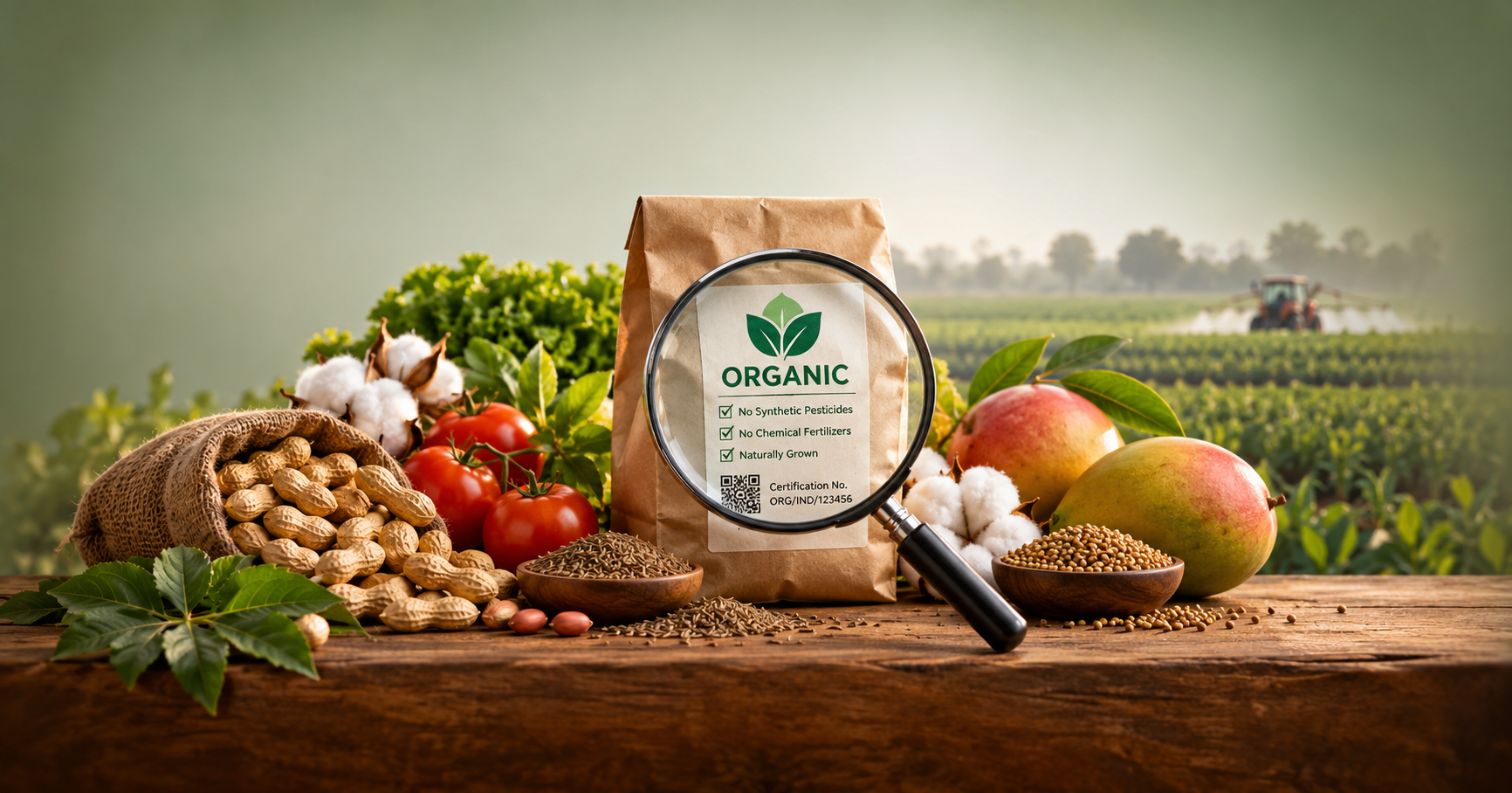
For consumers, the label is the first practical point of verification. FSSAI’s Jaivik Bharat logo is the unified identity mark for organic food in India. Depending on the certification system, additional marks and details apply.
According to official consumer guidance, buyers should look for:
- The FSSAI logo and licence number.
- The applicable organic identification, such as India Organic under NPOP or the relevant PGS-India identification.
- Certification-body and accreditation details where required under NPOP.
- The prescribed product description and certification details.
Under the official guidance, NPOP-certified single-ingredient products may be labelled “Organic”; multi-ingredient products labelled “Certified Organic” must contain at least 95% ingredients of certified organic origin. PGS-India has corresponding requirements for products labelled under its system.
There are also regulatory provisions for qualifying direct sales by small original producers or producer organisations to end consumers. Therefore, it would be inaccurate to assume that every farm-gate sale follows precisely the same certification route as a packaged supermarket product.
How can consumers verify an organic claim?
The official Jaivik Bharat portal provides consumer guidance and access to information about organic standards and certified operators.
Consumers should take five practical steps:
- Check the label: Look for the relevant organic mark and FSSAI licence details.
- Search the operator: Use the Jaivik Bharat portal to check available certification information.
- Match the product: A company’s certificate for one product does not automatically cover its entire range.
- Check validity and scope: Where possible, verify that the certificate is current and covers the product being purchased.
- Question unsupported claims: “Natural”, “farm-fresh” and “chemical-free” do not, by themselves, prove organic certification.
Visual appearance is not a reliable test. Colour, size, shine and uniformity cannot establish whether produce was grown organically. Nor does a single clean laboratory result prove that the crop followed organic farming standards.
For B2B buyers, the checks must go further. Food manufacturers, retailers, processors and exporters should examine supplier certificates, relevant transaction and traceability documents, product scope and batch records. Where warranted, independent testing and supplier audits can provide additional assurance.
India’s organic market: how large is the opportunity?
India’s organic market is economically significant, but its different components need to be understood correctly.
An APEDA study prepared with CRISIL estimated the Indian organic market at ₹16,800 crore in FY2023. Its breakdown was:
| Market component | Estimated value |
|---|---|
| Exports | ₹5,520 crore |
| Organised domestic organic market | ₹3,340 crore |
| Unorganised domestic market | ₹1,600 crore |
| Organic produce sold through conventional channels | ₹6,340 crore |
| Total | ₹16,800 crore |
Source: APEDA/CRISIL, Indian Organic Market and Export Promotion Strategy.
The study projected that the domestic organic market could reach ₹12,500 crore by FY2033, with estimated annual growth of 13–15%. This is a forecast, not a current market valuation.
These figures also reveal an important limitation: the unorganised organic market is not synonymous with fraudulent or uncertified organic food. Some organically grown produce enters conventional supply chains because farmers lack suitable market linkages or cannot secure an organic premium. Such produce cannot automatically be classified as fraudulent.
The available estimates do not establish the precise size of India’s market for falsely labelled or genuinely uncertified organic food. Assigning it a percentage without reliable evidence would be misleading.
For legitimate producers, however, the distinction matters. Weak verification can undermine consumer confidence, disadvantage compliant businesses and make it harder for farmers to obtain a premium for meeting organic standards.
Who checks the inspectors?
NPOP uses accredited certification bodies, with rules covering inspector competence and safeguards against conflicts of interest. These are necessary protections, but their existence does not prove that the system never fails.
The real test is performance: how many inspections are conducted, how many samples are tested, what violations are found, and how many certificates are suspended or withdrawn? How are complaints investigated, and are corrective actions independently verified?
Laboratory testing must also be interpreted carefully. A result showing that a particular pesticide residue was not detected establishes only what the test found in that sample, within its detection limits. It does not independently establish organic production. Conversely, an adverse result must be assessed against the substance, concentration, sampling quality and applicable standards.
Gujarat-specific information on inspection volumes, failed residue tests, complaints and enforcement would allow consumers and businesses to judge the system on evidence rather than assumption.
Trust requires transparency
Sikkim demonstrates that a state-wide organic transition takes years of policy commitment and changes in agricultural practice. Gujarat’s certification figures show a substantial registered organic sector, but they do not establish that every farm or every product within a crop category is organic.
The way forward is neither to discredit organic food nor to accept every claim uncritically. Regulators and certification bodies should make meaningful enforcement information accessible. Businesses should verify suppliers and product scope. Consumers should check labels and certification records wherever possible.
An organic label should be the beginning of verification, not the end of scrutiny.
Sources and references
- APEDA — Organic Certification Data under NPOP 2024–25. Gujarat’s certified and in-conversion land, production and national organic statistics.
- APEDA — About Organic Products. NPOP standards, certification framework and national production and export data.
- FSSAI — Organic Food Regulations and Guidance. India’s organic-food regulatory framework.
- Jaivik Bharat — Consumer Guidance on Organic Food Labels. Labelling requirements and consumer checks for NPOP and PGS-India products.
- Jaivik Bharat — Official Organic Food Portal. Consumer information and certification resources.
- APEDA/CRISIL — Indian Organic Market and Export Promotion Strategy. FY2023 market estimates and domestic-market projections.
- Government of India — Sikkim organic transition background. Background on Sikkim’s organic farming initiative.
- Ministry of Chemicals and Fertilisers — Statistics at a Glance 2024. Source for Gujarat’s technical-grade pesticide-consumption figure for 2023–24.
- Fertiliser Association of India — Annual Review of Fertiliser Production and Consumption 2023–24. Source for Gujarat’s fertiliser-nutrient consumption figure.



Leave a Reply