
MSME Briefing Bureau
How can paper, packaging and textile mills prepare for alternatives?
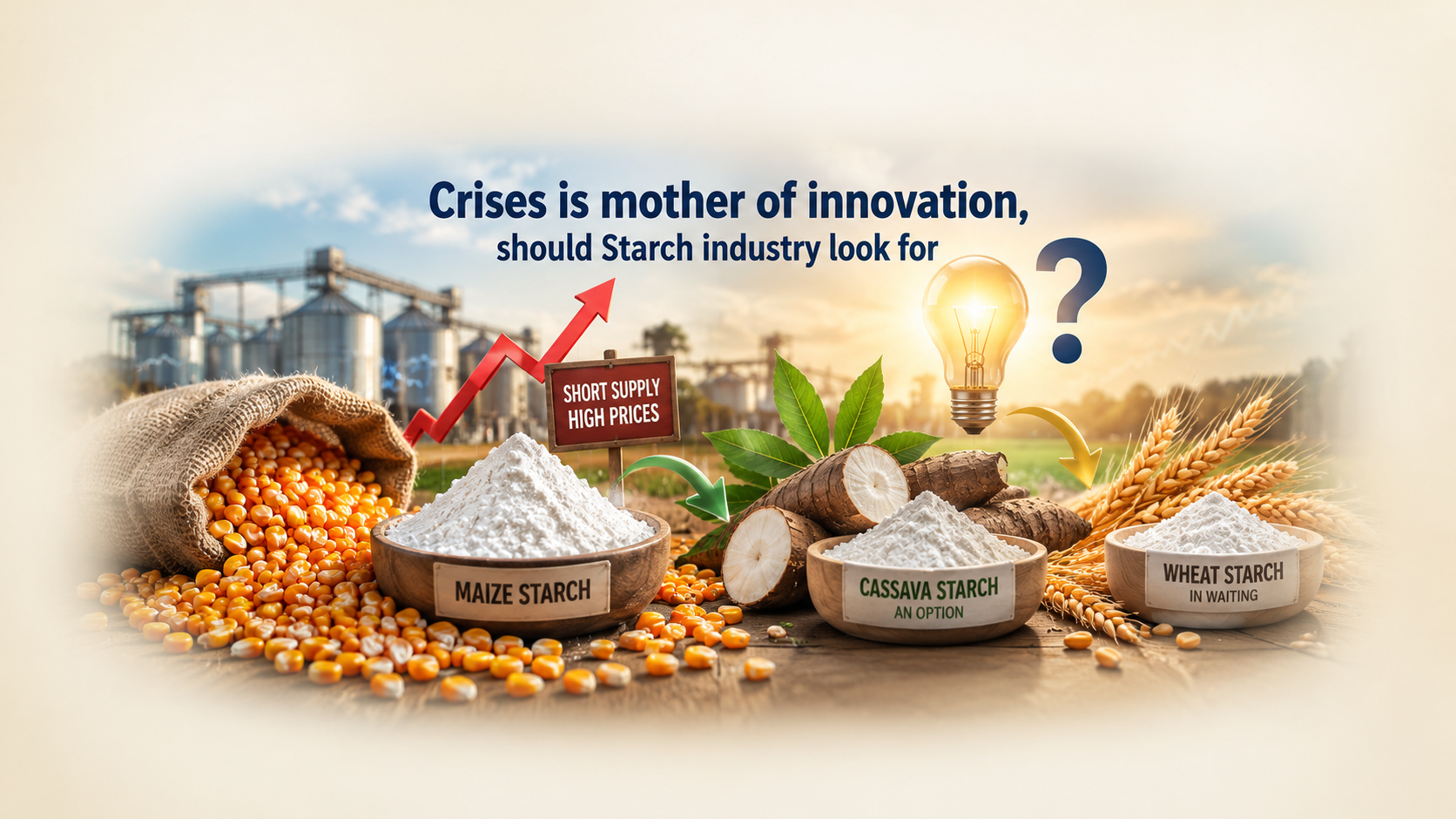
India’s maize supply is coming under pressure as weaker crop prospects coincide with demand from animal feed, ethanol and starch manufacturers. For paper mills, corrugated-box producers and textile units, the concern is no longer limited to higher prices: reliable supplies of industrial-grade maize starch may also become harder to secure. With prices in western India projected at ₹34,000–₹36,000 per metric tonne, businesses need to assess alternative starches, test production performance and prepare procurement plans before shortages disrupt operations.
Maize starch prices could reach ₹36,000 per tonne
India’s maize market faces a difficult balancing act. The 2026–27 production outlook points to approximately 50 million metric tonnes (MMT), against around 55 MMT in the previous year. Meanwhile, demand from animal feed, ethanol production, starch processing and human consumption is competing for the same raw material.
Estimates of total demand vary by source and forecast period, but the central concern remains: supplies may not comfortably meet the requirements of every major consuming industry.
The impact is already visible in raw-material prices. In Gujarat’s maize markets, prices reportedly moved from approximately ₹1,850–₹2,000 per quintal in October 2025 to ₹2,450–₹2,750 per quintal in October 2026. That represents an increase of roughly 28–37%, depending on the market and grade. The minimum support price for maize for the 2026–27 season is ₹2,410 per quintal.
For starch manufacturers, the pressure is particularly significant because maize accounts for an estimated 65–70% of production costs.
Native maize starch, which was priced at approximately ₹28,500–₹30,500 per metric tonne in late 2025, is projected to reach ₹34,000–₹36,500 per tonne in October 2026. This implies an increase of approximately 18–20% at the relevant ends of the price ranges.
These are market estimates and projections, not a uniform price applicable to every grade, supplier or delivery location. Actual quotations will depend on quality, volumes, contractual terms and freight.
A potential 1 lakh-tonne gap in western India
The supply challenge could extend beyond price increases to the availability of industrial-grade starch.
Industry estimates put annual non-food industrial starch demand across Gujarat and Maharashtra at approximately 320,000 tonnes. Of this, maize starch is estimated to account for about 275,200 tonnes, or 86%, under the baseline allocation.
Under a projected tighter-supply scenario, maize starch allocation to these users could fall to around 170,000 tonnes. That would create a potential shortfall of approximately 105,200 tonnes, or about 1.05 lakh tonnes.
These regional figures should be treated as indicative industry estimates rather than a verified official supply-demand balance. Actual shortages will vary by manufacturer, application and contractual access to supplies.
The same estimates suggest that cassava or tapioca starch allocation could increase from 44,800 tonnes to 118,000 tonnes. That would represent an increase of 73,200 tonnes, or about 163%.
However, substituting another starch is not simply a matter of purchasing an equivalent quantity. Different starches behave differently during cooking, bonding, drying, film formation and processing. Their suitability depends on the product being manufactured and the process conditions.
What the shortage means for paper and packaging
Paper mills use starch for several purposes, including surface treatment, coating and improving paper strength. Corrugated-box manufacturers use starch-based adhesives to bond paper layers.
A higher starch bill can therefore affect both operating costs and production performance.
For corrugated packaging units, industry estimates indicate that starch-binder costs could rise by approximately 20–25%, potentially increasing overall packaging overheads by 3–5%. The actual impact will depend on adhesive consumption, the type of board produced, selling prices and the proportion of total costs represented by starch.
For paper mills, a squeeze on operating profitability could be material. Some industry estimates indicate potential EBITDA margin erosion of 150–200 basis points, although this will not apply uniformly across mills.
Smaller manufacturers may find it particularly difficult to pass higher costs on to large FMCG companies, e-commerce businesses and other customers working under fixed-price contracts.
The operational risk also matters. A substitute that changes adhesive viscosity, bonding speed or moisture behaviour may affect corrugator speed, board strength, rejects and wastage. A cheaper purchase price is of little benefit if it increases production losses.
Textile manufacturers face a different challenge
Textile mills use starch and modified starches in sizing formulations to strengthen yarns and reduce breakage during weaving. The formulation must suit the yarn, loom speed, fabric construction and subsequent processing requirements.
Industry estimates suggest textile sizing formulation budgets could face an increase of 18–22% under current cost pressures. The impact will differ according to the starch grade and the mill’s formulation.
Switching to an alternative requires more than checking its price per tonne. Mills must assess viscosity, film strength, yarn abrasion, size pick-up, desizing performance and fabric quality. A formulation that works on one yarn count or fibre blend may not perform equally well on another.
For manufacturers operating on tight delivery schedules, production trials are essential before changing a proven formulation.
Which alternatives should industry examine?
1. Cassava or tapioca starch
Cassava starch is already used in selected industrial applications, including paper and adhesive formulations. It deserves early consideration where its bonding and processing characteristics meet the end user’s specifications.
However, sourcing it from southern India can add an estimated ₹3,000–₹4,500 per tonne in freight and related logistics, depending on origin and destination. Indicative landed-price estimates of ₹39,000–₹42,500 per tonne would place it above the projected ₹34,000–₹36,500 range for maize starch.
Some applications may require 8–12% less tapioca starch to achieve a comparable result. If trials confirm such a reduction, the relevant comparison is the cost per usable tonne of finished output—not merely the purchase price per tonne. The saving must be demonstrated for each application.
2. Wheat starch
Wheat starch has established uses in paper processing, corrugated-board adhesives and textile applications. Its viscosity development and gelatinisation behaviour can differ from maize starch, potentially offering advantages in particular formulations.
But domestic availability, grade consistency, food-industry demand and delivered cost need to be checked before a mill commits to large volumes. Evidence of technical suitability does not establish that sufficient industrial quantities are available in India.
3. Potato starch
Potato starch has properties that may be useful in selected paper and textile processes. Research has examined its use in cotton yarn sizing, with results varying according to yarn count and processing conditions.
It is therefore a candidate for controlled trials, rather than a universal replacement. Buyers must establish local availability, specifications, delivered price and performance on their own equipment.
4. Modified starches and formulation changes
Modified starches and dextrins may provide useful alternatives for specific adhesive, coating or sizing applications. Paper and packaging manufacturers can also examine enzyme-based treatment, retention aids, adhesive solids, viscosity control and glue application rates.
Textile mills may evaluate carefully designed blends involving starch, carboxymethyl cellulose (CMC) or polyvinyl alcohol (PVA), depending on fibre type and process requirements. PVA or acrylic-based systems may also suit selected synthetic or blended yarn applications, although their cost and downstream processing implications must be assessed.
None of these options should be adopted solely on a supplier’s assurance. Each requires application-specific technical and commercial validation.
What manufacturers should do now
The immediate priority is to reduce uncertainty before it becomes a production problem.
Paper and packaging manufacturers should calculate starch consumption per tonne of saleable output, assess current inventory cover, obtain quotations from alternative suppliers and run controlled adhesive trials. Any reduction in glue consumption must be checked against bond strength, board quality, line speed and rejection rates.
Textile mills should identify which yarns and sizing recipes are most exposed to price or supply disruptions. Trial formulations should be assessed for weaving efficiency, yarn breakage, abrasion, desizing and final fabric quality.
Starch suppliers should communicate grade-wise availability, lead times and price revisions more transparently. They can also work with customers to develop application-specific alternatives, rather than offering a generic substitute for every use.
Purchasing teams should compare landed cost, technical performance, consistency of supply and the risk of production downtime. Where possible, they should avoid dependence on a single source and negotiate clear terms for price revisions, delivery schedules and specifications.
The decision is about continuity, not just price
A potential 1 lakh-tonne industrial starch gap in western India would be significant if the projected shortfall materialises. But the effect will not be identical across paper mills, corrugated-box producers and textile manufacturers. Each sector uses starch differently, and each must assess alternatives against its own production requirements.
Cassava, wheat and potato starch offer options worth investigating. Modified starches and process improvements may widen the choices further. Yet availability, freight, price, consistency and technical performance will determine which alternatives are commercially viable.
The practical response is to start testing before procurement becomes urgent. Manufacturers that quantify their exposure, qualify more than one suitable source and validate formulations on their own production lines will be better placed to manage a disruption.
For industry, the question is no longer simply whether another starch can replace maize starch. It is whether the alternative can be secured reliably and deliver the required quality, at a commercially sustainable cost.






Leave a Reply