
MSME Briefing | Sunday Musing
How Gojek organised an informal market and scaled beyond bike taxis
In Jakarta, traffic jams were more than an inconvenience. They exposed a gap between people who needed to move and motorcycle-taxi drivers waiting for customers. In 2010, entrepreneur Nadiem Makarim began tackling that mismatch with a simple call centre and 20 drivers. No sophisticated app. No elaborate technology platform. Just an attempt to organise an existing informal service. The experiment evolved into Gojek, offering founders lessons in testing, scaling, financial discipline and managing growth.
1. The opportunity hiding in plain sight
Let me begin with a question for every founder.
Have you ever looked at an existing business, an informal market or a familiar everyday problem and wondered whether there was a better way to organise it?
Sometimes, the opportunity is not in inventing something new. It lies in making something that already exists work more efficiently.
That is the starting point of the Gojek story.
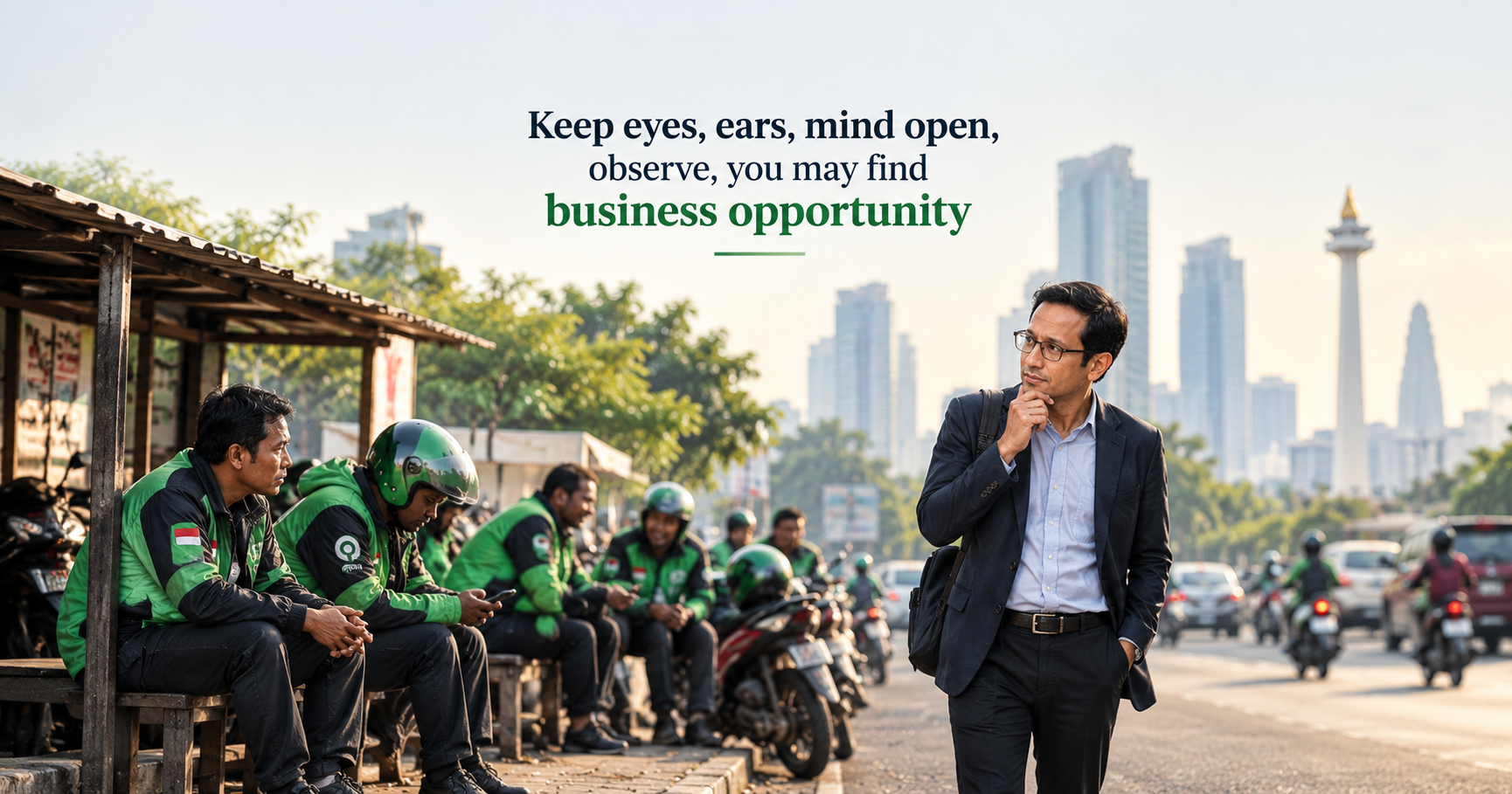
In Jakarta, Indonesia, motorcycle taxis, locally known as ojeks, were already an established part of urban life. Commuters used them to navigate congested roads, while drivers waited at roadside stands, known as pangkalan, for customers.
The service existed. The drivers existed. The demand existed.
What was missing was an efficient system connecting the two.
Nadiem Makarim, an Indonesian entrepreneur who had studied at Brown University and Harvard Business School and worked at McKinsey & Company, recognised an opportunity in this everyday problem.
Rather than attempting to invent a new mode of transport, he sought to organise an existing service.
In 2010, Gojek began with 20 motorcycle-taxi drivers and a call centre. The company’s own history describes its founding mission as removing friction from everyday life. The technology came later; the initial challenge was connecting customers with drivers more efficiently.
For an MSME founder, this is the first lesson: an existing market can still contain an unsolved business problem.
2. Twenty drivers, one call centre, no app
Today, entrepreneurs are often encouraged to build an app, develop a digital platform, invest in branding and launch with a sophisticated technology stack.
But what if the first step is much simpler?
Gojek initially operated through a telephone-based dispatch system. Customers contacted the call centre, and operators connected them with available motorcycle-taxi drivers.
The process was straightforward:
Customer calls → Call centre coordinates → Driver receives the booking → Service is delivered.
There was no need to begin with a complex mobile application. The immediate objective was to test whether coordinating drivers and customers could make the service more useful.
This is an important distinction. Technology can improve a business model, but technology alone does not establish that customers will pay for the service.
The early call-centre operation allowed Gojek to test its proposition before the mobile application arrived in 2015. Gojek’s technology history subsequently documented the growth that followed as manual matching was increasingly automated.
The lesson is not that every startup should begin with a call centre. It is that founders should identify the minimum practical system required to test their core business assumption.
A manufacturer considering a new product, for example, could begin with a pilot batch and a handful of committed buyers. A distributor could test a new route with a small customer group. A service company could manually coordinate bookings before investing in automation.
The principle is the same: establish demand, understand the operating process and identify the economics before committing substantial capital.
3. From a transport service to a multi-service platform
A working business model is a beginning, not the destination.
As Gojek expanded, it moved beyond its original call-centre operation. The mobile application launched in January 2015, opening the way for a more scalable system.
Its services included GoRide for passenger transport, GoSend for deliveries and GoFood for food delivery. GoPay subsequently added a digital payments dimension.
The strategic significance was not simply that Gojek offered more services. It was that an existing customer relationship and operating network could support additional transactions.
Consider the possibilities.
A customer might first use a platform for a ride, later order food and eventually use it to send a parcel. Drivers and merchants could participate in different parts of the ecosystem, subject to the requirements of each service.
For the business, each additional service created another potential reason for customers to return.
The underlying strategy was to build on an existing network rather than start every new service from scratch.
However, founders should not mistake diversification for a guaranteed route to growth. Each additional service brings its own operational demands, customer expectations, costs and competitive pressures.
GoFood, for instance, addressed a different customer need from passenger transport. Its expansion illustrates how a company can extend its proposition, but it does not by itself prove that food delivery was the sole or primary driver of customer acquisition.
The broader lesson is more useful: look for adjacent customer needs that your existing capabilities can serve economically.
For an Indian MSME, this might mean a component manufacturer adding testing or maintenance services, a packaging business offering design and logistics, or a food processor developing additional products for its existing distribution network.
The objective is not to offer everything. It is to create more value from capabilities and relationships the business already possesses.
4. Growth came with a financial cost
Now comes the part of the story that entrepreneurs should examine particularly carefully.
Building a large customer base and expanding a platform can require substantial investment. Competition can make the process more expensive, especially when companies use discounts, incentives and promotional offers to attract customers and drivers.
Gojek operated in an increasingly competitive ride-hailing market, alongside rivals including Grab and Uber. The challenge was not simply to acquire customers; it was to build a business capable of sustaining its operations as competition intensified.
This is where a founder must distinguish between growth, valuation, revenue and profitability.
In 2019, Gojek was widely reported to be approaching a valuation of US$10 billion (approximately ₹69,000 crore). TechCrunch reported an estimated valuation of around US$9.5 billion (approximately ₹68,875 crore), based on an illustrative exchange rate of ₹72.50 per US dollar.
That was an estimated investor valuation, not money sitting in the company’s bank account. Nor did it mean the business was generating profits of a comparable scale.
That was a reported investor valuation, not money sitting in the company’s bank account. Nor did it mean the business was generating profits of a comparable scale.
For a founder running a small or medium-sized enterprise, this distinction is critical.
A company can increase sales while its margins deteriorate. It can attract customers while spending too much to acquire them. It can expand capacity while tying up working capital in receivables, inventory and operating expenses.
Growth is valuable only when the business can finance it and eventually earn an adequate return from it.
The question is not merely how quickly a company can grow, but whether its economics can support that growth.
5. From a single service to a wider ecosystem
Gojek’s evolution continued through digital payments and, in 2021, its combination with Tokopedia to form GoTo Group.
The combination brought together on-demand services, e-commerce and financial technology within a broader digital ecosystem. It was an attempt to create value across connected activities, rather than relying on a single service.
But building an ecosystem also introduces complexity. Different businesses have different cost structures, competitive conditions and capital requirements. Their combined scale does not automatically guarantee that each business will be profitable.
There was, nevertheless, a measurable improvement in the group’s financial performance. In March 2024, GoTo reported that its group adjusted EBITDA turned positive at approximately ₹45 crore (IDR 77 billion) in the fourth quarter of 2023, compared with a negative ₹1,814 crore (IDR 3.1 trillion) in the corresponding quarter of 2022.
The group still reported a full-year adjusted EBITDA loss for 2023. This distinction matters: positive adjusted EBITDA for one quarter was an operational milestone, not proof of full-year net profitability.
This distinction matters: positive adjusted EBITDA for one quarter was an operational milestone, not proof of full-year net profitability.
For founders, the point is not to replicate Gojek’s scale or business structure. It is to recognise that a business model must evolve as its market changes.
The early call centre tested the idea. The app increased the potential for scale. Additional services broadened the proposition. The later focus on financial performance addressed the cost of expansion.
Each stage demanded a different management priority.
6. What founders should take home
Let us return to the original question: what can an Indian MSME founder learn from a business that began by coordinating 20 motorcycle-taxi drivers?
First, look for inefficiencies in existing markets.
You do not necessarily need to invent a new product. There may be an opportunity to improve how customers find suppliers, how orders are processed, how machines are utilised or how deliveries are coordinated.
Second, test the proposition before making a major investment.
A manual process, pilot order or limited customer trial can reveal whether a proposed solution addresses a real need. Technology should strengthen a validated proposition, not disguise an untested one.
Third, improve the utilisation of existing assets.
Examine whether machinery, staff, vehicles, distribution networks or production capacity remain underused at particular times. Additional business can create value, but only if the extra revenue exceeds the associated costs.
Fourth, expand through adjacent opportunities, not ambition alone.
A new product or service should fit the company’s capabilities, customer relationships and financial resources. More offerings do not necessarily mean a stronger business.
Fifth, measure cash flow and unit economics alongside growth.
Know what it costs to acquire a customer, fulfil an order, finance inventory and collect payment. Revenue growth without financial discipline can increase risk rather than reduce it.
Finally, remember that organising a market is a leadership task.
It requires understanding how people work, what customers need, where coordination fails and which incentives encourage participants to cooperate.
Nadiem Makarim’s story is not simply about a motorcycle-taxi service becoming a digital platform. It is about recognising a problem in an existing market, testing a practical solution and building on it over time.
For MSME founders, the opportunity may be much closer to home: in an underused factory, a fragmented distribution network, an inefficient procurement process or a service customers still struggle to access.
The next big business idea may not require inventing a new market. It may require organising an existing one better.
Sources and references
The following sources support the principal historical and financial claims in the article.
1. Gojek — Official company history: founding in 2010 with 20 motorcycle taxis, followed by the app and subsequent expansion. Gojek: The story of our ride.
2. Gojek Technology — Company history: manual driver matching through a call centre, the 2015 app launch and subsequent order growth. Gojek Tech: About.
3. Google Maps Platform — Gojek background: the original call-centre model, informal motorcycle-taxi market and development of the wider platform. Gojek: Helping drivers reach their pickup points more quickly.
4. Harvard Business School, Digital Innovation and Transformation: background on Gojek’s business model, local-market innovation and expansion. Gojek — A Motortaxi for Every Need.
5. TechCrunch, 8 April 2019: contemporary reporting that challenged the claim that Gojek had definitively reached a US$10 billion valuation. No, Go-Jek isn’t valued at $10 billion… yet.
6. GoTo Group, 19 March 2024: official fourth-quarter and full-year 2023 results, including adjusted EBITDA and the group’s financial performance. GoTo Group’s 2023 financial results.





Leave a Reply