
MSME Briefing Bureau
How CMOs and Turnkey ODMs Are Opening a New Growth Route for Indian Manufacturers
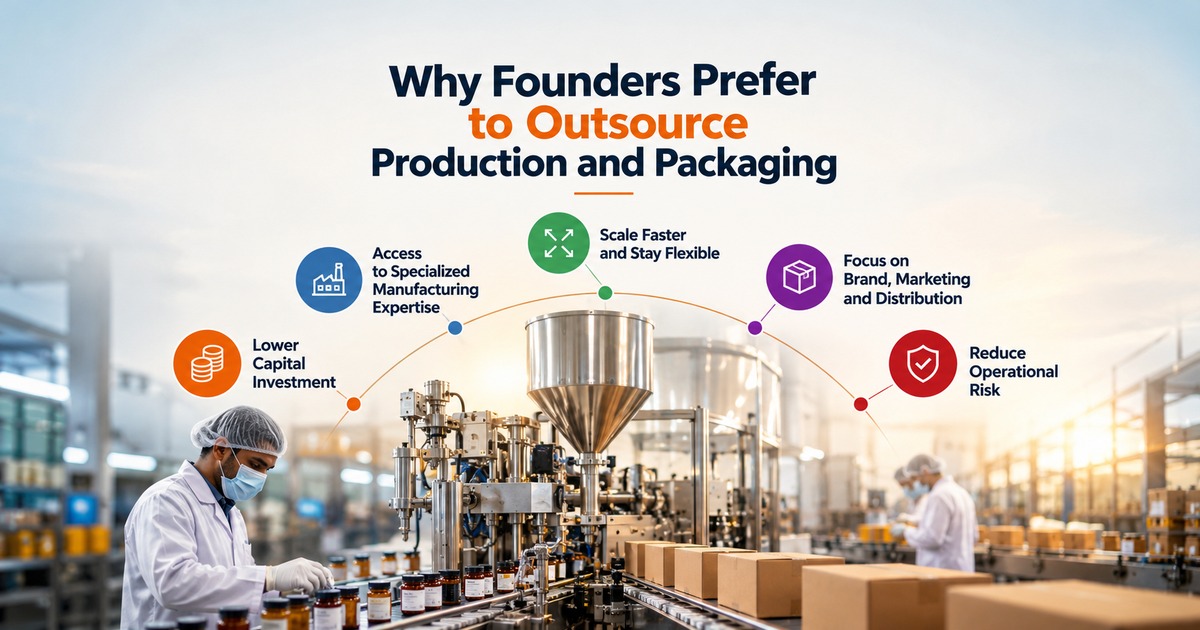
A consumer brand can grow into a national business without building a factory. A large FMCG company can combine its own manufacturing facilities with dozens of external production partners. And a specialist manufacturer may be able to expand beyond processing orders to supplying a finished product, with sourcing, formulation, testing and packaging built into the service.
This is changing the commercial possibilities for Indian manufacturers. The opportunity is not simply to obtain more job-work orders. It is to assess whether customers will pay a manufacturer to take responsibility for a larger part of the production process.
Contract manufacturing organisations (CMOs), co-packers and Original Design Manufacturers (ODMs) occupy different positions in this ecosystem. Their services overlap, but their business models are not identical. What connects them is that the brand does not have to perform every manufacturing activity itself.
For MSMEs, the opportunity is substantial—but so are the questions about investment, margins, working capital and customer dependence.
A large market, with India positioned for growth
BCC Research estimated the global contract-manufacturing market at ₹58.34 lakh crore (US$686.4 billion) in 2025 and projected it to reach ₹82.34 lakh crore (US$968.7 billion) by 2030, a compound annual growth rate of 7.1%.
A Frost & Sullivan estimate reproduced in Aequs’ offer document valued India’s contract-manufacturing market at ₹2.25 lakh crore (US$26.78 billion) in FY2025 and projected it to reach ₹4.15 lakh crore (US$49.43 billion) by FY2030.
These are reported market estimates, not audited totals of factory orders. Their definitions may differ, and the Indian estimate covers a broader industrial opportunity than any single sector.
For a manufacturer, the significance lies in the breadth of demand. Contract manufacturing spans consumer products, electronics, pharmaceuticals, precision engineering and other industries. The opportunity available to an individual factory, however, depends on its product category, capabilities, customers and competitive position.
The more useful question is where demand is expanding and whether a manufacturer can enter that market without taking on risks it cannot finance.
FMCG: even established brands rely on manufacturing networks
Hindustan Unilever’s FY2024–25 disclosures show how established brands use a combination of owned and external manufacturing. HUL reported 27 owned factories and more than 50 collaborative manufacturing sites. Its wider network produced over 80 billion units, serving approximately nine million outlets.
The 80-billion-unit figure relates to the combined network, not solely to external manufacturers. HUL’s model is not a story of factories becoming irrelevant. It demonstrates that a large brand can combine its own manufacturing capacity with outside partners to serve a broad portfolio and distribution network.
boAt provides a different example. Imagine Marketing’s disclosures reported that the proportion of boAt units manufactured in India rose from 39.65% in FY2023 to 71% in FY2025. Its production arrangements, including its joint venture with Dixon Technologies, illustrate how manufacturing partnerships can support localisation and scale.
These examples establish the demand side of the business. Brands use external manufacturing for different reasons, including production capacity, specialist capabilities, flexibility and localisation. They do not necessarily outsource everything, and they remain dependent on suppliers for quality, cost and delivery.
For an MSME, the commercial opportunity is to become a supplier that a brand can rely on—not merely to win a purchase order, but to retain the customer as volumes grow.
Three sectors where manufacturers should look more closely
1. Ready-to-eat and ready-to-cook foods
India’s convenience-food market is attracting attention as urban consumers seek faster meal preparation and retailers expand their product ranges. The manufacturing requirements vary by product, but can include recipe development, retort processing, freezing, high-barrier packaging, shelf-life testing and food-safety controls.
Technavio forecasts that India’s ready-to-eat food market will grow by ₹25,245 crore (US$2.97 billion) between 2025 and 2030, at a reported CAGR of 28.8%. For ready-to-cook products, it projects additional market growth of ₹6,106 crore (US$718.4 million), at an 8.3% CAGR.
These are forecasts for the product markets, not the revenue available to contract manufacturers. Nevertheless, expanding product demand can create opportunities for food-processing units that possess the necessary equipment, certifications and technical expertise.
The investment decision must be product-specific. A plant already equipped for shelf-stable meals may be better positioned to take orders for retort-pouch products than a factory that must install an entirely new processing line. Frozen and chilled products bring additional cold-chain and storage requirements.
The commercial test is whether expected repeat orders can justify the equipment, quality systems and working capital needed.
2. Cosmetics and personal care
Cosmetics offer another route into higher-value manufacturing services. Depending on the product, brands may require formulation, ingredient sourcing, stability testing, filling, packaging and regulatory documentation.
Grand View Research estimated India’s personal-care contract-manufacturing market at ₹6,499 crore (US$764.6 million) in 2024 and projected it to reach ₹11,563 crore (US$1.36 billion) by 2030, with a reported CAGR of 10.2%.
For a capable manufacturer, the opportunity may lie in offering more than filling and packaging. Formulation and product-development capabilities can deepen a client relationship and make the supplier useful at an earlier stage of product creation.
But the label “turnkey” does not itself command a premium. The factory needs credible technical capabilities, quality control, testing and compliance systems. These require investment, and demand must be sufficient to recover the cost.
3. Broader FMCG and private-label production
Consumer brands need manufacturing partners that can maintain quality, meet deadlines and respond to changes in product demand. A supplier may be asked to source ingredients, coordinate packaging, manufacture the product and deliver finished goods.
The more stages the supplier manages, the greater the potential value of the service—but also the greater the responsibility. Procurement errors, rejected batches, raw-material inflation and delayed customer payments can turn a seemingly larger order into a cash-flow problem.
The opportunity is therefore not simply to make more products. It is to provide services for which customers are willing to pay, while retaining control over cost and risk.
Rappid Valves: the financial evidence behind the opportunity
Rappid Valves (India) Limited offers a useful manufacturer-side case study. Its reported revenue from operations rose from ₹12.14 crore (US$1.43 million) in FY2022 to ₹16.40 crore (US$1.93 million) in FY2023, ₹36.51 crore (US$4.30 million) in FY2024 and ₹52.12 crore (US$6.13 million) in FY2025.
Profit after tax increased from ₹0.29 crore (US$34,000) in FY2022 to ₹0.45 crore (US$53,000) in FY2023, ₹4.13 crore (US$486,000) in FY2024 and ₹6.04 crore (US$711,000) in FY2025.
Its reported PAT margin consequently increased from approximately 2.4% in FY2022 to 2.7% in FY2023, 11.3% in FY2024 and 11.6% in FY2025.
The financial trajectory is striking. But the figures alone do not prove that a move towards turnkey solutions caused the improvement. That would require evidence from the company’s disclosures about product mix, customer orders, pricing, capacity utilisation, costs and business strategy.
For MSMEs, this is precisely the point worth investigating. Did profitability improve because the company sold more value-added products, gained larger customers, improved utilisation, changed its product mix or controlled costs more effectively? The answer matters more than the label attached to the business model.
Rappid’s performance is evidence of a company whose scale and profitability changed significantly over the period. It should not be treated as a ready-made template for every job worker.
From job work to turnkey: where value can be added
In a conventional job-work arrangement, a manufacturer may perform a defined operation on customer-supplied materials and charge a conversion fee. In a more integrated arrangement, the manufacturer may source materials, develop or adapt a formulation, coordinate packaging, manage quality checks and supply the finished product.
An ODM may also contribute design or product-development capabilities. The actual scope varies by sector and contract.
This broader role can increase the value of an order, but turnover is not profit. A manufacturer buying and reselling raw materials will record more revenue than one charging only a conversion fee, even if the underlying economics are not better.
The relevant comparison is the contribution after material costs, labour, energy, quality control, development, logistics, finance costs and the risk of rejected or unsold products. Gross margin, EBITDA margin and net profit margin are different measures and should not be compared as if they were interchangeable.
There is no reliable universal rule that conventional job work earns one fixed margin and turnkey ODM another. Any claimed margin advantage must be supported by comparable company or sector data.
Why some factories should enter—and others should not
The strongest candidates for expansion are likely to be manufacturers with reliable production processes, a record of meeting specifications, sufficient working capital and customers willing to commit to repeat business.
A manufacturer should assess four questions before investing:
- Demand: Is there a credible customer pipeline, or is the investment based only on an attractive market forecast?
- Capability: What equipment, testing, technical staff and certifications are needed to deliver the proposed service?
- Economics: What additional contribution will the service generate after material costs, financing, quality control, logistics and operating expenses?
- Risk: Who bears the cost of rejected batches, unused packaging, raw-material price changes, delayed payments and cancelled orders?
Customer concentration is especially important. A dedicated line may make sense when a customer commits to sufficient volume over a defined period. It becomes more dangerous when the manufacturer invests first and depends on uncertain future orders.
Working capital also deserves close scrutiny. When a supplier buys ingredients or components, cash may be tied up well before the customer pays. Growth can increase the need for finance even when sales and reported profits are rising.
Moving up the value chain is therefore not automatically the right choice for every factory. It is a strategic decision that should be based on customer demand, capability and the return on incremental investment.
The business opportunity is real—but conditional
The global and Indian market estimates, forecasts for convenience foods and personal care, and manufacturing networks used by HUL and boAt point to an important opportunity for specialist suppliers. Rappid Valves’ financial trajectory adds a manufacturer-side example of how revenue and profitability can change over time.
But none of these facts guarantees success for another factory. A market forecast is not a purchase order; a larger order is not necessarily a more profitable order; and a turnkey label is not proof of a differentiated capability.
The manufacturers best placed to benefit will be those that identify a specific customer need, build the capabilities to meet it, price the additional responsibility correctly and finance the business through the full order cycle.
For an MSME considering this route, the objective is not to abandon job work simply because turnkey manufacturing sounds more sophisticated. It is to establish whether a broader service can generate repeat demand and a sustainable return after accounting for the additional investment and risk.
Source and verification notes
- Global contract manufacturing: BCC Research estimates the market at US$686.4 billion in 2025 and US$968.7 billion by 2030.
bccresearch.com+1
- India contract manufacturing: Frost & Sullivan figures reproduced in Aequs’ offer document: ₹2.25 lakh crore (US$26.78 billion) in FY2025, projected to ₹4.15 lakh crore (US$49.43 billion) by FY2030.
aequs.com
- Ready-to-eat and ready-to-cook: Technavio’s forecasts for India’s RTE market and RTC market. The forecasts measure growth in the respective product markets, not contract manufacturers’ revenue alone.
Technavio+1
- Personal-care contract manufacturing: Grand View Research’s India market estimate and forecast.
grandviewresearch.com
- HUL manufacturing network: HUL’s FY2024–25 performance highlights and annual report.
Hindustan Unilever Limited+1
- Rappid Valves: The company’s annual-report and financial-results pages, with FY2025 revenue and PAT figures corroborated by the director’s report summary.




Leave a Reply