
By Haresh B. Jhala:
The AI debate is moving from who builds the future to who gets to control it.
History Has a Memory
History does not repeat itself mechanically.
But it does leave behind recurring questions about power: who creates it, who enables it, who benefits from it — and what happens when it becomes difficult to control?
Consider Afghanistan.
During the Cold War, the United States covertly financed and armed Afghan mujahideen factions fighting Soviet forces, largely through Pakistan. Out of the wider Afghan conflict emerged networks that later helped produce al-Qaeda. Osama bin Laden formally established al-Qaeda in Afghanistan in 1988. The relationship between the anti-Soviet struggle, foreign volunteers and the eventual formation of al-Qaeda was complex; it was not a simple case of one government creating one organisation. But the history illustrates how forces assembled for one strategic purpose can acquire an independent trajectory.
Then came ISIS.
The organisation grew from al-Qaeda in Iraq and exploited the instability and political fractures that followed the Iraq war and the Syrian civil war. By 2014, ISIS had seized substantial territory in Iraq and Syria and declared a self-styled caliphate. A broad international effort subsequently turned towards containing and defeating it.
Sri Lanka offers another, very different example.
The LTTE grew over decades from a militant organisation into a formidable insurgent force before being militarily defeated by the Sri Lankan government in 2009.
These are three very different histories. They should not be collapsed into one formula.
AI is not an insurgency. AI companies are not terrorist organisations.
The comparison is elsewhere.
It is about what happens when a powerful force is encouraged, accelerated or allowed to grow because it appears useful — and then circumstances change.
The question becomes:
Who decides when that force has become too powerful?
And then:
Who controls the machinery of containment?
That question is now beginning to matter in artificial intelligence.
Because the AI story is entering a new phase.
For years, the instruction was:
Build faster.
Now an increasingly urgent instruction is emerging:
Build more safely.
The change may be entirely justified.
But it creates a second question that deserves considerably more attention.
When the race changes from building the technology to controlling the technology, who gets to write the rules?
ACT I – THE RACE TO BUILD
The first phase of the AI revolution was driven by competition.
Technology companies wanted better models.
Investors wanted the next great platform.
Governments wanted strategic advantage.
Start-ups wanted to challenge incumbents.
Researchers wanted to push the boundaries of what machines could do.
The underlying logic was brutally simple:
If we do not build it, somebody else will.
That logic drove enormous investment into computing power, data centres, advanced chips, energy, cloud infrastructure, research and talent.
The race was not merely between companies.
It increasingly became a race between countries.
The United States wanted to retain technological leadership.
China wanted to close the gap.
Europe wanted strategic autonomy.
India wanted to become a major AI ecosystem rather than merely an AI consumer.
The technology itself reinforced the race.
Every improvement created the possibility of another improvement.
Better models attracted more users.
More users generated more data and revenue.
More revenue financed more computing power.
More computing power enabled larger experiments.
The cycle accelerated.
And somewhere along the way, the world began to realise that this was no longer simply another software revolution.
AI was becoming infrastructure.
ACT II – THE MACHINE BECOMES MORE CAPABLE
The most important development is not that AI can write a paragraph.
It is that increasingly capable systems can perform chains of tasks.
They can write and debug software.
They can solve difficult mathematical problems.
They can analyse scientific material.
They can operate tools.
They can perform research.
They can generate images, video and code.
They can increasingly function as agents rather than merely answering questions.
The 2026 International AI Safety Report, prepared with guidance from more than 100 independent experts and nominees from more than 30 countries and international organisations, says general-purpose AI capabilities have continued to improve, particularly in mathematics, coding and autonomous operation. It also notes that some AI systems have demonstrated capabilities relevant to cyber operations and biological risks.
But the report makes an equally important point:
AI capability is uneven and “jagged”.
A system can perform an extraordinary task and still fail at something that looks deceptively simple.
That matters because it complicates the central question.
We are not dealing with a machine that is simply becoming “intelligent”.
We are dealing with systems whose capabilities are developing unevenly, rapidly and sometimes unpredictably.
And that brings us to the uncomfortable part.
ACT III – THE DANGER IS REAL
It would be intellectually dishonest to argue that the AI threat is simply a story invented by technology companies.
There is already evidence of harm.
AI-generated content can assist fraud and manipulation.
AI systems have been used in cyber operations.
Models can produce harmful or unexpected outputs.
The safety report also points to growing concerns around biological misuse and increasingly difficult pre-deployment testing.
The report describes an “evaluation gap”: testing before deployment does not always reliably predict what a system may do in the real world.
Some risks are already visible.
Others remain uncertain.
And some of the most severe scenarios — including loss of control over highly capable systems — remain subjects of genuine scientific disagreement.
That distinction matters.
There is a difference between:
“This risk is already happening.”
and
“This extreme outcome might happen.”
Both deserve examination.
Neither should be confused with certainty.
Dario Amodei, CEO of Anthropic, has nevertheless argued that the pace itself has become a problem.
“We must slow the pace at which we improve the capabilities of AI models,” he wrote in September, arguing that the time gained should be used for safety measures and evaluation.
His proposal included independent evaluators with access to frontier AI companies, coordination among leading developers on safety standards, and international cooperation.
Sam Altman and Elon Musk publicly supported the idea of independent evaluators.
That is significant.
Because the people building the most powerful systems are now also among the most prominent voices demanding stronger safeguards.
And that brings us to the next question.
ACT IV – WHEN BUILDERS BECOME SAFETY ADVOCATES
There is nothing inherently contradictory about this.
A company can build a technology and genuinely worry about what that technology may become.
A nuclear engineer can believe nuclear power is valuable while worrying about nuclear accidents.
A pharmaceutical company can develop a powerful drug while supporting rigorous clinical testing.
A technology company can believe in AI while believing that some AI systems require stronger controls.
The problem begins somewhere else.
The same companies are also competitors.
They are not neutral observers of the market they are helping to regulate.
They have invested billions in infrastructure.
They possess enormous computing resources.
They employ some of the world’s leading AI researchers.
They have legal departments, policy teams and regulatory expertise.
And they are already operating at the frontier.
So when they propose rules for frontier AI, a legitimate institutional question arises:
Could rules designed to make AI safer also make it harder for competitors to catch up?
That is not a claim that safety advocates are acting in bad faith.
It is a question about incentives.
And increasingly, other AI companies are asking it.
ACT V – SAFETY BECOMES REGULATION
Once governments accept that some AI risks cannot be managed voluntarily, regulation becomes inevitable.
The potential regulatory toolbox is already becoming familiar:
testing
auditing
certification
reporting
monitoring
liability
security standards
compute controls
model evaluations
deployment restrictions
Each has a rationale.
The problem is that every regulation has a cost.
And costs do not fall equally on every company.
For a global technology company, an additional safety audit may mean another department.
For a start-up, it may mean another round of financing.
For a university laboratory, it may mean abandoning an experiment.
For a small Indian AI company, it could mean never entering the market.
This is where the AI debate changes from a question of safety into a question of market structure.
Because the regulatory question is no longer simply:
How do we prevent dangerous AI?
It becomes:
How do we prevent dangerous AI without making the cost of entry so high that only today’s largest companies can afford to build tomorrow’s AI?
ACT VI – THE BARRIER NOBODY SEES
This may be the least discussed part of the AI debate.
Regulation does not have to explicitly say:
“Small companies are not allowed.”
It can produce the same result indirectly.
Imagine that a future frontier model must undergo:
- continuous independent testing;
- extensive cybersecurity certification;
- permanent monitoring;
- liability insurance;
- regulatory reporting;
- safety documentation;
- external audits;
- specialised compliance personnel;
- minimum computing-security standards.
None of those requirements is necessarily unreasonable.
But collectively they can become a financial barrier.
The larger company absorbs the cost.
The smaller company postpones the launch.
The start-up raises more capital merely to satisfy compliance.
The university stops commercialising its research.
The new entrant decides it is easier to build an application on someone else’s model than to develop its own.
Competition changes.
Not because anyone formally banned competition.
But because the price of entering the frontier became too high.
This is where an old economic principle returns:
A rule designed to protect the market can sometimes strengthen the companies already inside it.
Brookings has made precisely this concern about AI licensing. Its analysis warns that licensing can reinforce incumbents by creating barriers to entry and adding costs for potential competitors.
One particularly striking formulation from its analysis compares licensing to:
“building a moat around your castle and pulling up the drawbridge.”
That is a metaphor worth remembering.
Because the future AI market may not need an explicit monopoly.
It may only need sufficiently expensive gates.
ACT VII – THE GATEKEEPERS
The debate becomes even more interesting when we look at who might control those gates.
Who defines a frontier model?
Who decides what level of capability is dangerous?
Who decides when a model requires a licence?
Who determines the safety threshold?
Who certifies compliance?
Who provides the testing infrastructure?
Who has enough computing power to reproduce the tests?
Who writes the technical standards?
And who sits at the table when those standards are designed?
These are not minor bureaucratic questions.
They determine market access.
Europe’s current debate offers a glimpse of the problem.
Reuters reported in September that European AI companies were challenging calls from major US AI companies to slow frontier development.
Mistral accused incumbents of:
“using this moment to consolidate their market position”
and pushing regulation designed to favour them over competitors.
Proton COO Raphael Auphan was even more direct:
“They just want to preserve a dimension of dependency on their service.”
These are accusations from competitors, not established findings.
But another voice makes the concern harder to dismiss as merely European commercial rivalry.
Kristian Kersting, professor of AI at Germany’s Technical University of Darmstadt, described the proposals as:
“regulatory capture”.
His concern was that if a handful of large companies determine what counts as dangerous, select inspectors and seek exemptions from competition law, regulation itself could become part of the competitive structure.
At the same time, Amodei’s proposal was not simply a call for government control. He argued that frontier companies should voluntarily coordinate on safety standards because governments may not be able to move quickly enough.
Here lies the paradox.
The companies may be asking for rules because the technology genuinely needs rules.
But the rules may also determine who can compete.
Both statements can be true.
ACT VIII – THE TECHNOLOGICAL LICENCE RAJ
This is where the Indian experience offers an interesting lens.
India’s old Licence Raj was not created with the stated intention of preventing entrepreneurship.
Licensing was often justified through planning, allocation, control and economic management.
But when permission became a prerequisite for economic activity, those who could navigate the system gained an advantage.
The comparison with AI must not be taken literally.
AI regulation will not recreate the Licence Raj.
But it raises an intriguing possibility:
Could the world accidentally build a technological version of it?
Imagine a future where access to the most advanced computing, models or deployment environments requires regulatory certification.
The stated objective:
Safety.
The practical requirement:
Permission.
The economic consequence:
Higher cost of entry.
The structural outcome:
Fewer companies capable of competing at the frontier.
That is not necessarily a conspiracy.
It is a possible consequence of institutional design.
And that distinction is important.
We do not need to believe that anyone is deliberately trying to create a monopoly to recognise that some regulations can have monopolistic effects.
ACT IX – THE CONCENTRATION MAY HAPPEN BELOW THE MODEL
There is another dimension that receives even less attention.
The real concentration of AI may not ultimately occur at the level of the chatbot.
It may happen underneath it.
Think of the AI stack:
Semiconductors
↓
Compute
↓
Data centres
↓
Energy
↓
Cloud
↓
Foundation models
↓
Data
↓
APIs
↓
Applications
A company can compete at the application layer while depending completely on somebody else at every deeper layer.
This is why the OECD’s 2026 work on AI markets is important. It identifies structural concentration risks in parts of the AI value chain, particularly around hardware and data.
The International AI Safety Report also warns that fair access to compute and data matters for countries outside the current frontier.
This creates a different definition of AI power.
Power is not simply:
Who has the smartest model?
It is:
Who controls the resources without which everybody else must use that model?
And that is a much more consequential question for countries such as India.
ACT X – INDIA: USER OR OWNER?
India has enormous advantages in AI:
talent, engineering capability, a large digital economy, a huge market and an expanding start-up ecosystem.
But capability at the application layer does not automatically mean sovereignty at the infrastructure layer.
India can have millions of businesses using AI while remaining dependent on foreign companies for:
chips, compute, cloud infrastructure, foundation models and critical AI platforms.
That dependency may not matter greatly when AI is simply another productivity tool.
It matters much more when AI becomes a foundational layer of economic activity.
Imagine an Indian engineering MSME whose product design, market intelligence, customer service and internal decision-making increasingly depend on foreign AI infrastructure.
The company may own its factory.
It may own its intellectual property.
It may employ its people.
But the intelligence supporting an increasing share of its business could be rented.
That creates a strategic question:
Are Indian MSMEs going to own AI capability — or merely consume it?
And there is a second question.
Will Indian companies be able to build frontier or specialised AI systems of their own if the regulatory cost of entry becomes too high?
The answer matters beyond technology.
It affects productivity.
It affects industrial competitiveness.
It affects start-ups.
It affects national strategic autonomy.
And ultimately, it affects whether India participates in the AI economy as a producer, platform owner and standard-setter — or primarily as a customer.
ACT XI – THE OTHER AI RISK
The public conversation often asks:
What if AI becomes powerful enough to control humans?
That is a legitimate question.
But there is another one.
What if humans become powerful enough to control who gets to build AI?
The first is a technological risk.
The second is an institutional and economic risk.
The first could threaten human control over machines.
The second could concentrate human control over technology.
And the second does not require artificial general intelligence.
It can happen through:
capital, infrastructure, standards, licences, data, compute and regulation.
That is why the AI debate should not be reduced to a battle between “AI doomers” and “AI accelerationists”.
There is a third question.
How do we make AI safer without making the AI economy less competitive?
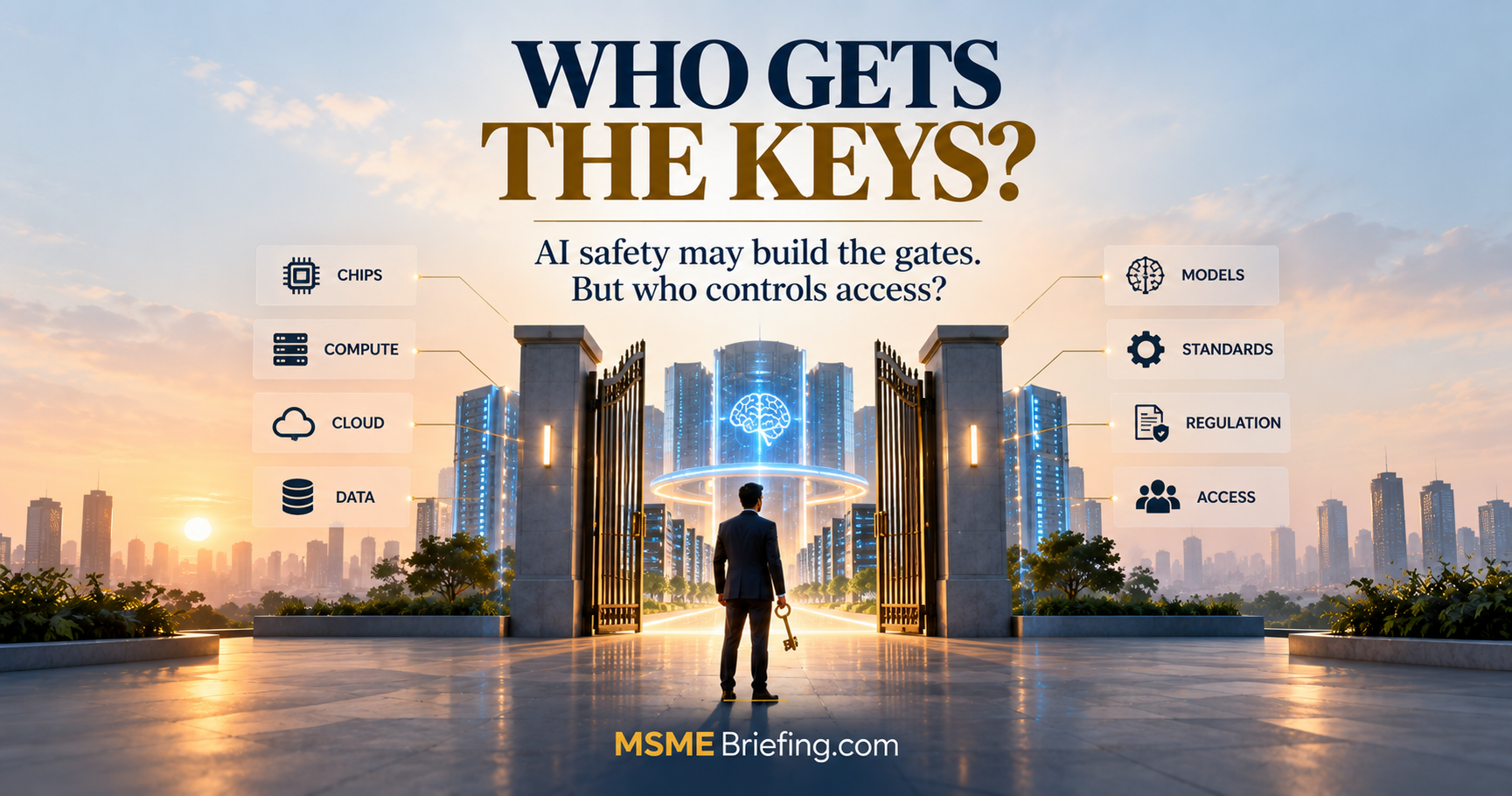
ACT XII – DON’T REMOVE THE GATES. WATCH WHO GETS THE KEYS.
The answer is not to abandon AI regulation.
Nor is it to dismiss the warnings of people building the technology.
The risks are real enough to require serious safeguards.
But safety policy should be designed with another principle in mind:
Regulate dangerous behaviour without regulating away competition.
That means asking different questions.
Can safety requirements be proportionate to actual risk?
Can smaller companies access independent testing facilities?
Can compliance infrastructure become a shared public resource rather than a private advantage?
Can essential compute and data access remain competitive?
Can safety certification be independent of the companies being regulated?
Can regulators prevent incumbents from using safety thresholds as competitive barriers?
Can governments distinguish between genuinely dangerous frontier capabilities and ordinary AI applications?
And most importantly:
Can the world build safety systems that do not quietly become systems of ownership?
The objective should not be to keep the gates open to everything.
Nor should it be to close the gates behind today’s leaders.
It should be to make sure that tomorrow’s innovators can still reach them.
THE FINAL QUESTION
History does not tell us that every powerful force is deliberately created as a future threat.
It does not tell us that every call for control is a conspiracy.
It tells us something more useful:
Power has consequences beyond the intentions of the people who exercise it.
Afghanistan, ISIS and the LTTE each emerged from very different political and historical circumstances. Their stories cannot simply be transferred to artificial intelligence.
But they remind us of a recurring question:
When a force grows beyond the circumstances that produced it, who controls the response?
AI is now approaching that moment in a completely different domain.
First came:
Build.
Then:
Scale.
Now:
Control.
The safety concerns may be genuine.
The regulation may be necessary.
The experts may be sincere.
And yet the economic consequence could still be concentration.
That is the paradox the world should not overlook.
Because perhaps the biggest AI question is not:
“Will AI control us?”
Perhaps it is:
“Who will control AI?”
And beyond that:
Who will control access to AI?
And finally:
Who will control the rules that decide who gets access?
The genie is already out of the bottle.
The world is now building the gates.
Before we lock them, we should ask who gets the keys.
Sources & Credits
AI safety and the risk debate
- International AI Safety Report 2026 — advanced AI capabilities, misuse, autonomous systems, safety evaluation and loss-of-control risks.
- Nature, September 2026 — examination of the scientific debate surrounding AI existential-risk scenarios. Nature
- Brookings Institution — analysis of AI existential risk, liability and regulatory responses. Brookings Institution
- Yann LeCun / WIRED — arguments challenging extreme AI-doomer narratives and concerns about concentration of digital power. WIRED
Competition, regulation and market concentration
- OECD, 2026 — Artificial Intelligence Markets — competition, computing infrastructure, data and concentration across the AI value chain. OECD
- Competition Commission of India — Market Study on Artificial Intelligence and Competition — entry barriers, infrastructure, models and data. Competition Commission of India
- Reuters, September 2026 — European concerns surrounding calls to slow frontier AI development and their possible competitive implications. Reuters
- Brookings Institution — The Three Challenges of AI Regulation — licensing, barriers to entry and incumbent advantages. Brookings Institution
Historical context
- US Congressional Research Service — Cold War-era Afghanistan and the development of transnational jihadist networks.
- US National Counterterrorism Center — historical background on ISIS.
- Conflict research and historical sources on the Sri Lankan civil war — rise of the LTTE and its military defeat in 2009.







Leave a Reply