
By Haresh B. Jhala:
₹1.64 lakh crore is building fabs; the real opportunity is beyond fabs
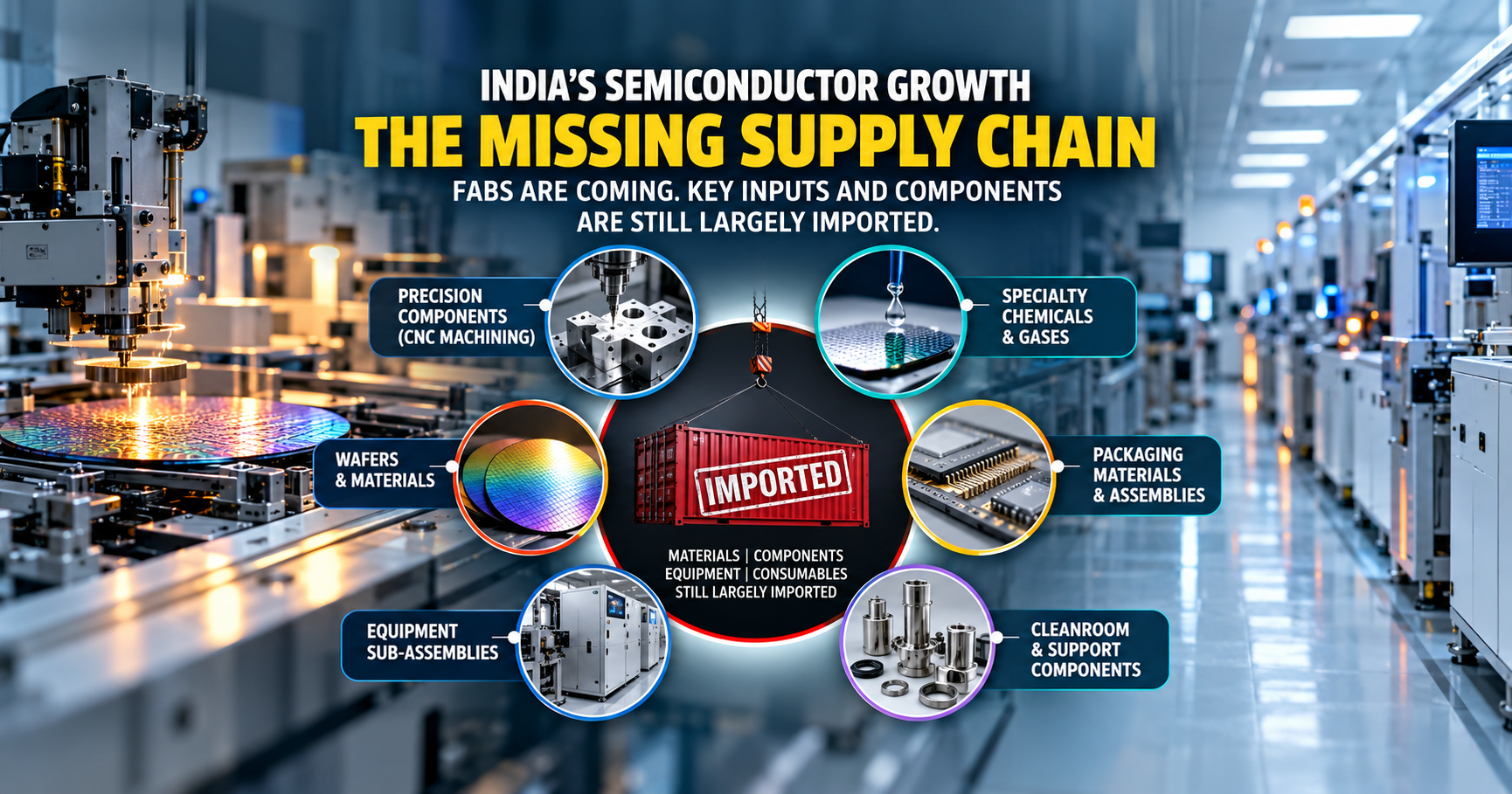
India’s semiconductor story has moved from policy ambition to physical factories. Twelve projects, more than ₹1.64 lakh crore committed and commercial production already underway mark a significant shift. But factories are only the visible part of the opportunity. Behind every fab and packaging plant lies a recurring demand for materials, gases, chemicals, precision components, equipment, sub-assemblies and specialised services. For Indian founders, the bigger question is no longer whether India will make chips, but who will supply the factories making them.
The factories are coming. The ecosystem is next
India has approved 12 semiconductor manufacturing projects across six states, with cumulative investment commitments exceeding ₹1.64 lakh crore (US$18.9 billion). The projects span silicon and compound-semiconductor fabrication, display fabrication and advanced packaging.
Three facilities have already commenced commercial production, signalling that India’s semiconductor story has moved beyond announcements and into manufacturing. The Government now describes Semicon 2.0, approved in July 2026 with an outlay of ₹1,27,500 crore (US$14.8 billion), as the next phase of building the wider semiconductor ecosystem.
That second phase matters.
The first phase was substantially about getting semiconductor manufacturing established in India.
The next phase is about building what surrounds it.
The Government has explicitly identified semiconductor equipment and materials as one of the six pillars of Semicon 2.0. It has also highlighted the need for domestic capabilities in materials, gases, chemicals, precision manufacturing and supply chains.
For entrepreneurs, that changes the question.
It is no longer simply:
“Will India manufacture semiconductors?”
It is:
“How much of the business surrounding those semiconductor factories can Indian companies capture?”
The market behind the semiconductor market
A semiconductor fab does not operate on wafers alone.
It requires a continuous stream of highly specialised inputs.
These include:
- Silicon and compound-semiconductor wafers
- Specialty and ultra-high-purity gases
- Electronic-grade chemicals
- Photoresists and related materials
- CMP materials
- Targets
- Packaging substrates
- Leadframes
- Bonding wire
- Die-attach and moulding materials
- Cleanroom consumables
- Precision mechanical components
- Equipment sub-assemblies
- UHP fluid and gas-handling systems
- Testing and measurement equipment
- Maintenance and replacement components
SEMI’s global classification itself demonstrates how extensive this materials ecosystem is, covering everything from silicon, gases, chemicals, photoresists and CMP materials to leadframes, substrates, bonding wire, die attach and packaging materials.
And this is not a small global market.
The global semiconductor materials market reached ₹6.14 lakh crore (US$73.2 billion) in 2025, according to SEMI. Of this, wafer-fabrication materials accounted for ₹3.84 lakh crore (US$45.8 billion) and packaging materials for ₹2.30 lakh crore (US$27.4 billion).
That is the global opportunity.
But the more interesting question for Indian founders is much narrower:
What portion of this demand will India’s new semiconductor capacity generate — and how much of it will continue to be imported?
The import opportunity is the real signal
India is building semiconductor factories, but it does not yet manufacture the complete upstream ecosystem required to operate them.
Industry assessments continue to point to high import dependence across several critical semiconductor inputs.
That dependence is particularly significant in specialised chemicals, gases, wafers, equipment and several packaging materials.
The Government itself now identifies materials, gases, chemicals, precision manufacturing and supply chains as capabilities that need to be developed domestically.
This creates an unusual situation.
India is creating domestic demand before domestic supply has fully developed.
For a conventional entrepreneur, that should sound familiar.
When a large industrial cluster comes up, somebody has to supply it.
The difference is that semiconductor manufacturing demands far tighter quality, contamination control, documentation, consistency and traceability than most conventional industrial sectors.
That raises the entry barrier.
But it also raises the value of getting in.
₹40,000–50,000 crore: our working estimate
This is where the numbers become important.
There is no official Government forecast saying that India will import ₹40,000–50,000 crore (US$4.6–5.8 billion) of semiconductor inputs every year.
So we will not present it as one.
MSME Briefing’s working estimate is that India’s semiconductor manufacturing ecosystem could eventually generate an annual import requirement in the region of ₹40,000–50,000 crore (US$4.6–5.8 billion) for materials, consumables, components and related inputs as the approved manufacturing capacity reaches meaningful scale.
This is an analytical estimate, not an official projection.
It is based on the combination of:
planned manufacturing capacity + semiconductor operating requirements + materials and consumables intensity + India’s present import dependence.
The estimate should therefore be treated as a starting point for business analysis, not as a guaranteed market size.
A founder may calculate a lower number.
Another may calculate a higher one.
That is precisely why we are publishing the number.
The purpose is to identify the size of the pool before asking who can enter it.
A ₹40,000 crore market does not mean ₹40,000 crore for you
This distinction is critical.
A large semiconductor-input opportunity does not mean an individual Indian company can address the entire market.
Nor does it mean every imported product can or should be manufactured domestically.
Some products require enormous capital.
Some require proprietary technology.
Some depend on global intellectual property.
Some require chemical processes and purity levels that may be beyond the practical reach of a conventional MSME.
Others may be considerably more accessible.
That is where the opportunity becomes interesting.
The objective is not to replace the entire semiconductor supply chain.
It is to identify small pieces of a very large value chain where an Indian company can become competitive.
Where could an Indian founder enter?
Consider the difference between making a semiconductor and supplying the industry that makes it.
An entrepreneur does not necessarily need to build a fab costing thousands of crores.
There may be opportunities much further down the chain.
1. Precision engineering
Semiconductor equipment requires precision mechanical parts, fixtures, brackets, chambers, tooling and specialised assemblies.
An existing CNC/VMC company may already possess part of the required capability.
The challenge is upgrading:
tolerance + surface finish + cleanliness + documentation + traceability + process discipline.
That is a very different proposition from building a semiconductor fab.
2. Equipment sub-assemblies
The opportunity can move beyond individual components.
Indian companies could potentially participate in the manufacture of sub-assemblies and selected equipment systems, particularly where global equipment companies or Indian system integrators are looking for local suppliers.
This is precisely why the inclusion of equipment and materials in Semicon 2.0 matters.
The Government has specifically identified domestic capability in capital equipment, materials, precision manufacturing and supply chains as part of the next phase.
3. Packaging materials
Advanced packaging creates another set of requirements.
SEMI’s materials classification includes:
leadframes, substrates, bonding wire, die attach, mould compounds, encapsulants and ceramic packages.
Not every category is an MSME opportunity.
But the sheer number of specialised products means the market deserves to be examined product by product rather than dismissed as a domain reserved for multinational corporations.
4. Specialty chemicals
This is a more demanding opportunity.
Purity requirements can be extremely high, and qualification can be lengthy.
Yet India already has chemical companies attempting to move into semiconductor-grade materials.
At SEMICON India 2026, Indian exhibitors included companies working on high-purity electronic materials, photolithography intermediates, photoresist-related materials and semiconductor processing chemicals.
That is significant.
It demonstrates that the transition from conventional chemicals to semiconductor applications is not merely theoretical.
But it also illustrates the difference between having the chemistry and meeting semiconductor-grade qualification requirements.
The global market tells us where the money is
The semiconductor industry is not simply a chip business.
It is an enormous industrial ecosystem.
The global semiconductor materials market alone was worth ₹6.14 lakh crore (US$73.2 billion) in 2025.
And the equipment market is another major pool of value.
The commercial power of the sector therefore sits at multiple levels:
chips → fabs → equipment → materials → components → sub-assemblies → maintenance → testing → logistics → specialised services.
India has begun establishing the first two layers of its manufacturing story.
The opportunity for Indian companies lies in asking:
Which of the remaining layers can we realistically capture?
The profit question cannot be ignored
This is where India’s semiconductor ambition deserves a more practical examination.
Building a plant in India does not automatically mean that all the value generated by that plant remains in India.
The global semiconductor industry has highly concentrated capabilities in:
- capital equipment
- advanced process technology
- specialty materials
- electronic-grade chemicals
- intellectual property
- design software
- high-end manufacturing know-how
Many of these capabilities are controlled by companies headquartered in the United States, Japan, the Netherlands, Germany, South Korea, Taiwan and other advanced semiconductor economies.
India is therefore entering a global industry in which some of the most valuable upstream capabilities are already established elsewhere.
That does not diminish the opportunity.
It defines it.
If India only manufactures the final product while continuing to import a large proportion of the equipment, materials and specialised components, much of the higher-value economics will remain outside the country.
If Indian companies begin supplying those requirements, the economics change.
Jobs are only one part of the story
Employment will undoubtedly be created.
The Government said in September 2026 that around ₹1 lakh crore (approximately US$11–12 billion) of investment commitments had already been received under the broader Semicon 2.0 ecosystem and expected close to one lakh new employment opportunities across the semiconductor ecosystem.
But employment is not the only measure of economic value.
For an entrepreneur, the more important questions are:
Who owns the technology?
Who supplies the equipment?
Who supplies the materials?
Who manufactures the components?
Who captures the recurring margin?
Who becomes indispensable to the customer?
Those questions take the semiconductor discussion from employment policy to industrial economics.
This is where the MSME opportunity becomes real
A small engineering company does not need to compete with ASML.
A chemical company does not need to become Shin-Etsu.
A packaging company does not need to become a global semiconductor giant.
The opportunity can be much smaller.
Become a reliable supplier of one product that the industry currently imports.
That is a completely different business proposition.
Imagine an engineering company that specialises in a particular precision component.
It may start with:
₹3–5 crore (US$0.35–0.58 million) of investment.
It may already have CNC/VMC infrastructure.
It may already serve automotive, aerospace, medical or industrial customers.
The semiconductor opportunity may then require an upgrade in:
- precision
- metrology
- surface finishing
- cleaning
- ESD control
- documentation
- quality systems
- traceability
- customer qualification
The entrepreneur is not starting from zero.
He is moving an existing industrial capability into a higher-value application.
That distinction matters.
But qualification will be the real barrier
This is not an easy-money story.
A machine shop cannot simply put “semiconductor supplier” on its website and expect orders.
The semiconductor industry is built around reliability.
A component that works 999 times but contaminates a process on the thousandth occasion may be unacceptable.
That means the real entry barriers can include:
process capability
statistical process control
metrology
material traceability
surface-finish control
cleanliness
documentation
repeatability
quality certification
customer audits
long qualification cycles
This is why the opportunity should not be sold as a shortcut.
It is better described as:
A potentially high-value industrial upgrade for companies willing to build the discipline required by semiconductor customers.
The ₹3–7.5 crore question
For an existing precision-engineering business, an illustrative investment pathway could look very different from the capital required to establish a semiconductor fab.
Stage 1 — Build the foundation
An existing engineering company could invest approximately ₹1.5–2.5 crore (US$0.17–0.29 million) in additional CNC/VMC capability, tooling, CAD/CAM and basic metrology, depending on its existing assets.
The objective would not be semiconductor production immediately.
It would be to establish a strong precision-engineering business that can serve several industries.
Stage 2 — Upgrade towards semiconductor-grade work
A further ₹1–2 crore (US$0.12–0.23 million) could, as an illustrative model, be directed towards advanced machining, CMM capability, surface-finish measurement, controlled cleaning and ESD-safe handling.
That would bring cumulative investment to roughly:
₹2.5–4.5 crore (US$0.29–0.52 million).
Stage 3 — Create a specialised cell
A company that succeeds in obtaining semiconductor customers could subsequently consider another ₹1–3 crore (US$0.12–0.35 million) for controlled environments, specialised finishing, assembly and reliability-related capabilities.
The illustrative cumulative investment becomes:
₹3.5–7.5 crore (US$0.40–0.87 million).
These are business-model illustrations, not industry-prescribed investment requirements.
The actual requirement would depend entirely on the product, customer, technology, existing machinery and qualification standard.
The market must be broken down before the money is invested
This is perhaps the most important lesson for a founder.
Do not start with:
“I want to enter semiconductors.”
Start with:
“Which semiconductor product is currently imported, what is its annual Indian demand, who buys it, what specification is required, how many competitors exist, what investment is required and what margin can I realistically earn?”
That is a business plan.
Everything else is industry jargon.
A founder should be able to take a single product and build a calculation like this:
Indian annual demand: ₹XXX crore
Current imports: ₹XXX crore
Potential addressable market: ₹XX crore
Existing Indian suppliers: X
Required investment: ₹X crore
Qualification period: X months/years
Potential annual capacity: ₹X crore
Target gross margin: X%
Likely customer: Fab / OSAT / equipment manufacturer / system integrator
Only after answering those questions does the word “opportunity” have meaning.
The first-mover question
India’s semiconductor manufacturing capacity is being established now.
That creates an important timing issue.
The supplier ecosystem will not appear overnight.
Equipment vendors and semiconductor manufacturers will qualify suppliers, test components, establish quality systems and build relationships.
Once a supplier is qualified and consistently performs, replacing it is not necessarily attractive to the customer.
That creates the possibility of long-term supplier relationships.
But it also means the entry window is not infinite.
A company that waits until every fab is fully operational may find that many supplier relationships have already been established.
The opportunity therefore may lie in getting qualified before the ecosystem reaches full scale, rather than waiting for a headline saying the semiconductor industry has arrived.
The Government has now recognised the missing layer
This is where the policy story becomes more interesting.
Semicon 1.0 created the manufacturing foundation.
Semicon 2.0 explicitly expands the mission towards machines, materials, design, research and talent, alongside fabrication and advanced packaging.
The Government has also explicitly stated that domestic capabilities in capital equipment, materials, gases, chemicals, precision manufacturing and supply chains are required to build a deeper semiconductor ecosystem.
That is important for entrepreneurs.
It means the supply-chain question is no longer something being raised only by industry observers.
It is now part of the official architecture of India’s semiconductor policy.
But founders should not wait for another subsidy
This is where the opportunity should be approached differently.
Government incentives can help.
They cannot create a business model.
A founder should first determine:
What product can I make?
Who is buying it?
What is imported today?
What specification must I meet?
What does qualification cost?
How much capital is required?
What is the achievable margin?
Can I sell to other industries while building the semiconductor business?
That last question may be particularly important.
A ₹3–7 crore investment becomes considerably less risky if the company’s equipment can continue serving automotive, aerospace, medical, defence, industrial automation or electronics customers while the semiconductor qualification process develops.
The semiconductor opportunity should ideally become an extension of an existing industrial capability, not a blind bet on a fashionable sector.
The bigger opportunity may be hiding in plain sight
India has spent years discussing the semiconductor shortage.
The next decade could be about something else:
the shortage of companies capable of supplying the semiconductor industry.
That shortage may exist in:
precision engineering
specialty chemicals
high-purity materials
packaging
equipment components
sub-assemblies
cleanroom systems
testing
maintenance
process-control equipment
specialised industrial services
Not every category will be suitable for an MSME.
Some will demand hundreds of crores.
Some will require technology partnerships.
Some may never make economic sense to localise.
But some could become ₹50 crore, ₹100 crore or ₹500 crore businesses in their own right.
The job of the entrepreneur is to find those pockets.
The opportunity is not the ₹1.64 lakh crore
The ₹1.64 lakh crore (US$18.9 billion) investment is what gets attention.
But it is not necessarily where the most interesting MSME opportunity lies.
The more interesting number may eventually be the recurring annual expenditure created by those factories.
Factories are built once.
They buy inputs repeatedly.
They replace components.
They maintain equipment.
They qualify new suppliers.
They consume chemicals and gases.
They require packaging materials.
They need precision parts.
They need testing.
They need specialised services.
That recurring demand is where a supply-chain business can be built.
Our ₹40,000–50,000 crore (US$4.6–5.8 billion) working estimate is therefore not a claim that Indian companies can capture the whole amount.
It is a signal that the pool may be large enough to justify looking beneath the headline semiconductor investments.
And that is where serious founders should begin their own calculations.
The founder’s opportunity
The semiconductor story is no longer about whether India will enter the industry.
India has entered.
The question now is how deeply Indian companies will participate.
Will India have fabs on Indian soil but continue importing most of the specialised equipment, materials and components?
Or will a generation of Indian industrial companies use the next few years to move up the value chain?
The answer will not come from policy alone.
It will come from thousands of business decisions made by founders.
A precision-engineering entrepreneur in Rajkot.
A speciality-chemicals manufacturer in Ahmedabad or Vadodara.
An electronics company in Pune.
A machining company in Coimbatore.
A packaging-material manufacturer in Chennai.
An equipment company in Bengaluru.
Each may be looking at a different piece of the same emerging market.
The opportunity is not to become a semiconductor company.
The opportunity may be to become a company that the semiconductor industry cannot easily replace.
A question for founders
If you already operate a business in precision engineering, CNC/VMC machining, speciality chemicals, electronics, packaging, automation, metrology, industrial gases, cleanroom systems, testing or equipment manufacturing, the semiconductor supply chain deserves more than a casual look.
Start with one product.
Find out its current import value.
Identify the Indian buyers.
Understand the specification.
Calculate the investment.
Calculate the cost.
Calculate the margin.
Then ask the only question that ultimately matters:
Can I make it competitively enough for a semiconductor customer to buy it from me?
The market may be emerging now. Your calculation should start before the market is fully formed.
Sources & data backbone
This special report draws on Government of India / Press Information Bureau, India Semiconductor Mission, Ministry of Electronics and Information Technology, SEMI, and the secondary research compiled in the accompanying research notes.
Key government sources include official information on the 12 approved semiconductor projects and ₹1.64 lakh crore (US$18.9 billion) investment commitments, and the ₹1,27,500 crore (US$14.8 billion) Semicon 2.0 outlay. The Government’s latest material also identifies equipment, materials, gases, chemicals, precision manufacturing and supply chains as key areas for ecosystem development.
SEMI’s 2026 materials-market data places the global semiconductor materials market at ₹6.14 lakh crore (US$73.2 billion) in 2025, comprising ₹3.84 lakh crore (US$45.8 billion) of wafer-fabrication materials and ₹2.30 lakh crore (US$27.4 billion) of packaging materials.
Important note on estimates: The ₹40,000–50,000 crore (US$4.6–5.8 billion) annual Indian semiconductor-input opportunity is MSME Briefing’s working estimate, not an official Government forecast. The illustrative ₹3–7.5 crore (US$0.40–0.87 million) investment pathway, potential product economics and other business calculations in this report are likewise analytical illustrations rather than guaranteed market outcomes. Founders should undertake product-level due diligence before investing.
Sources: Government of India / PIB; India Semiconductor Mission; MeitY; SEMI; SEMICON India 2026 industry material; secondary industry research and the research notes accompanying this report.






Leave a Reply