
MSME Briefing Bureau
Can Reliance repeat its Jio and Campa Cola disruption strategy
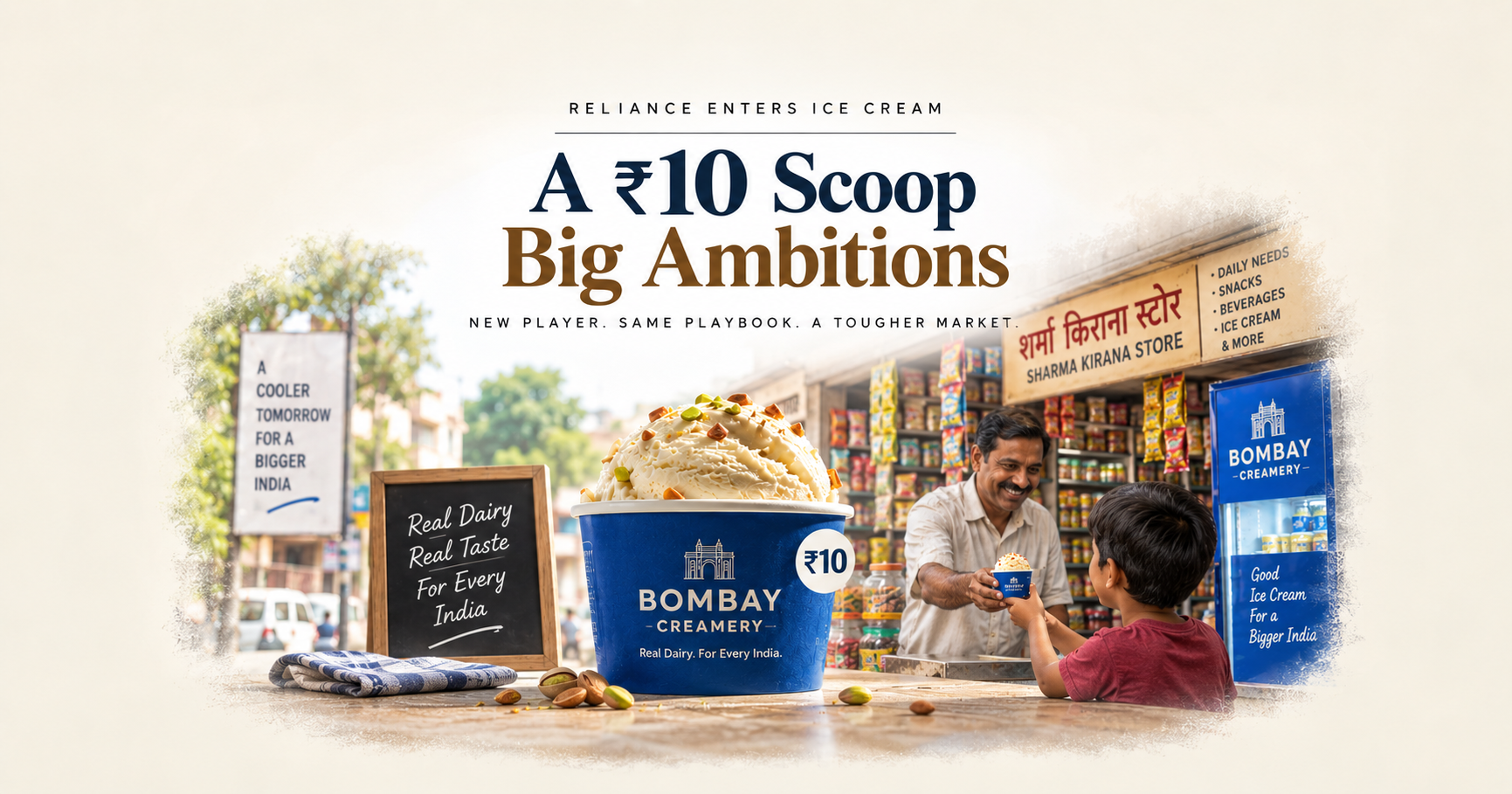
Reliance Industries’ consumer products arm has just entered India’s ice cream sector with Bombay Creamery, launching in September 2026 with an aggressive ₹10 price point and real-dairy positioning. The market is watching carefully—because Reliance’s entry into telecommunications (Jio) and soft drinks (Campa Cola) fundamentally rewired those sectors. But ice cream is structurally different, and legacy players must not mistake initial disruption for inevitable dominance. What separates strategic brilliance from expensive mimicry lies in market fundamentals, distribution lock-in, and consumer behaviour—none of which favour a carbon-copy playbook.
The Reliance Playbook: Infrastructure + Price Aggression = Market Dent
Reliance’s strategy is predictable by now. Deploy massive capital to build exclusive distribution infrastructure, undercut rivals on price using supply-chain economies of scale, and force competitors into a margin squeeze. This worked spectacularly for Jio (launched 2016), which commanded 39.3% telecom subscriber market share and now handles 60% of India’s mobile data traffic. It worked quickly for Campa Cola, which carved out 7–8% of the soft drinks market within a compressed timeframe, squeezing PepsiCo’s margins whilst Coca-Cola held its 40–42% leadership via brand loyalty and premiumisation.
For Bombay Creamery, Reliance is deploying branded deep freezers directly into mom-and-pop kirana stores—mirroring Jio’s cell-tower saturation strategy. The ₹10 entry price targets the impulse segment, which represents 60.60% of the national market volume. In raw disruption terms, this is textbook Reliance: infrastructure lock-in + price competition + supply-chain dominance.
T. Krishnakumar, Executive Director and Chief Executive Officer of Reliance Consumer Products Limited, articulated the company’s vision with confidence: “Our objective at RCPL is to democratise access to everyday high-quality consumer goods across India. With Bombay Creamery, we are bringing 100% real-dairy indulgence to every household, ensuring uncompromised quality coupled with unmatched affordability through our robust distribution network.” This framing—quality + affordability + penetrative distribution—echoes the precise logic that made Jio unstoppable and Campa Cola disruptive. The market is paying attention.
The Market Reality: Bombay Creamery Will Gain Share, Not Dominate
Reliance will almost certainly capture 8–12% of the organised market within 18–24 months through deep-freezer deployment and aggressive pricing. This will dent Amul’s impulse margins and force Vadilal and Kwality Wall’s to defend their low-end pricing. These are not trivial pressures. A. Manikandan, Senior FMCG Industry Analyst and Market Strategist, acknowledged the severity: “Reliance entering the ice cream sector changes the rules of engagement. By hitting the ₹10 price point with real dairy rather than vegetable fat, they are putting immense margin pressure on established regional and national players who rely on low-end impulse sales for volume.”
This bull case is credible. Deven Choksey, Managing Director of KRChoksey Shares and Securities, captured the execution narrative precisely: “Reliance’s strength lies in execution speed and retail distribution synergies. When they scale deep-freezers into millions of kirana stores using the same playbook as Campa Cola, legacy brands will be forced to defend their turf through aggressive marketing or risk losing rural and tier-2 volume share.”
But credible market entry is not the same as market dominance. The real question is: does the ₹10 assumption still hold?
A Market Paradox: Price and Quality Co-Exist
But there is also a parallel market narrative, articulated by those operating on the ground. Japesh Jayadhevan, Chief Executive Officer of Hocco Foods, recently observed a market reality that coexists with Reliance’s ₹10 play: “There was a long-standing assumption that rural and smaller-town consumers were primarily looking for affordable products—often priced at ₹5 or ₹10. Consumers outside the metros have changed significantly. Social media has exposed them to global trends. Travel has broadened their experiences. Their expectations around taste and quality have evolved. And they are increasingly willing to pay when they see genuine value. The belief that consumers in smaller markets will automatically choose the cheapest product can become a convenient shortcut. But consumers do not necessarily think in such simple categories. They may be price-conscious and still aspire to better taste, better quality and new experiences.”
This is not a challenge to Reliance’s strategy; it is a parallel market truth. Reliance’s ₹10 pricing will undoubtedly capture volume in the impulse segment—that is real disruption. But Japesh’s observation (validated by Hocco’s ₹532 crore revenue trajectory) identifies a coexisting segment where rural and semi-urban consumers are price-conscious and quality-seeking simultaneously. The market is bifurcating not because Reliance is entering, but because consumers themselves have become more discerning. Cheapest is no longer the only criteria. Test, flavours, and quality have a say. This nuance reshapes how established brands should respond—not by competing on price, but by owning the space where Reliance cannot naturally extend.
Why Ice Cream Is Not Jio. Or Campa Cola. (But Reliance Will Still Disrupt)
Here lies the nuance: Ice cream is structurally different from telecom and soft drinks, which means Reliance will capture volume and margin—but not dominance. The market will bifurcate, accommodating both strategies.
Firstly, price is a decisive lever, but not the only one. Jio succeeded because zero-tariff voice and cheap data addressed a suppressed structural demand that legacy players had monopolised. Campa Cola won because consumers perceived functional equivalence: a ₹10 soft drink delivers identical thirst-quenching as a ₹20 Coke. Reliance will replicate this for impulse ice cream sticks and cones. The ₹10 Bombay Creamery stick will convert price-conscious consumers who see no functional difference between ₹10 and ₹20 ice cream. But ice cream is also discretionary indulgence, which creates room for segmentation. Consumer purchasing behaviour splits into two distinct market tiers:
- The Volume Impulse Tier: ₹10–₹20 sticks and cones. Reliance will dominate here through deep-freezer saturation and supply-chain cost advantage. This is real volume loss for Amul and Vadilal’s low end.
- The Test, Flavour & Quality Tier: ₹25–₹80 parlours, premium formats, craft flavours, regional customisation. Dominated by Rangoli and Sheetal today. This tier is growing specifically because consumers with improved expectations want more than cheap cold milk fat. Reliance’s ₹10 infrastructure does not naturally compete here.
Secondly, brand trust intersects with quality expectations. Amul, with 35–40% market share, has built cooperative trust over decades—but that moat is strongest where quality and regional authenticity matter. Rural and semi-urban Amul consumers (the same consumers Japesh describes as social-media-exposed and quality-conscious) will not automatically trade down to Bombay Creamery. Why? Because Amul carries implicit quality assurance through cooperative sourcing. If Amul introduces strategic premiumisation—₹30–₹40 craft flavours and regional variants that emphasise dairy quality—it can defend share against ₹10 disruption. This is the opposite of the Jio/Campa pattern, where no amount of Vodafone nostalgia or Coca-Cola brand saved margins.
Thirdly, impulse is volume, but not profit. The impulse segment represents 60.60% of volume but a declining proportion of value margin. If consumers are simultaneously price-conscious and quality-seeking, then the real profit pool is moving to the ₹25–₹50 space. Reliance is capturing margin-compressed volume; established brands can defend by capturing margin-rich experience.
What Established Brands Must Do Now: A Strategic Roadmap
For Amul (GCMMF):
Defend impulse margins through volume, not pricing. Amul cannot undercut Reliance on ₹10 sticks profitably; instead, strengthen rural and semi-urban penetration where Reliance’s retail footprint is thinner. Leverage cooperative advantage for supply-chain flexibility. Premiumise selectively—introduce a ₹30–₹50 range of craft flavours and regional variants that Bombay Creamery cannot easily match due to manufacturing rigidity. Amul’s dairy sourcing strength is an asset Reliance cannot easily replicate.
For Kwality Wall’s (Unilever):
Pivot decisively toward quick-commerce and experiential formats. Compete where Reliance’s scale is irrelevant. Expand Cornetto and Magnum as premiumised sticks that justify ₹50–₹80 price points through perceived quality and brand heritage. Partner with urban cafés and quick-commerce platforms (Blinkit, Zepto) where convenience trumps freezer saturation. Cede some low-end impulse share to Reliance; this is a strategic retreat, not a defeat.
For Vadilal and Regional Players (Sheetal, Rangoli, Hocco):
Specialise ruthlessly. Vadilal should consolidate its Western India stronghold and double down on flavour innovation and regional taste authenticity—areas where Reliance’s scale offers no advantage. Rangoli and Sheetal should aggressively expand parlour networks in urban and semi-urban centres, treating the parlour as a brand asset, not a channel. Position parlours as lifestyle destinations, not ice cream vending points.
The Verdict: Disruption Will Happen. But So Will Bifurcation.
Reliance will successfully disrupt the organised ice cream sector’s low-end impulse economics. Margins will compress on ₹10–₹15 sticks and cones. Amul and Vadilal will lose share in this segment. This is real disruption, and it will hurt.
But the market itself is splitting into two distinct value pools. Reliance will own 10–15% of total market value by dominating volume-impulse; Amul will retain 30–35% by defending both impulse-quality and premiumisation; regional players (Rangoli, Sheetal, Hocco) will hold their experiential moats at ₹25–₹80 price points.
The opportunity for established brands is clear: Do not compete with Reliance on ₹10. Instead, own the bifurcating market where price is no longer the only criteria. Defend rural through supply-chain resilience and quality assurance. Grow upmarket via craft premiumisation. Build experience through parlours. Specialise regionally through authentic flavour innovation and taste differentiation.
The ice cream market is not winner-take-all. It is winner-take-segment. Reliance will win the impulse-volume segment. Amul, Walls, and regional players will win quality, experience, and premiumisation segments. Established brands that recognise this bifurcation will survive Bombay Creamery’s entry with margin intact. Those that try to fight on price will face erosion they cannot sustain.
Sources & Research Credits
Primary Research Sources:
- IMARC Group (Ice Cream Market in India Report): Market valuation at INR 243.50 Billion (2025), projected to INR 271.70 Billion (2026), with 11.29% CAGR.
- MarkNtel Advisors: Concurrent valuation tracking at USD 2.98 billion (2025), scaling to USD 3.38 billion (2026).
- Reliance Consumer Products Limited (RCPL): Official corporate press release and announcement on Bombay Creamery launch (September 2, 2026).
- Press Trust of India (PTI): Dispatch on Bombay Creamery’s Western India rollout and initial distribution strategy.
- Telecom Regulatory Authority of India (TRAI): Periodic performance indicator reports on Reliance Jio subscriber market share and data traffic metrics.
- Reliance Industries Limited (RIL): Annual reports and investor presentation archives on Jio and RCPL strategic initiatives.
- Business Dailies: The Economic Times, Mint, Financial Express, Business Today reporting on ice cream sector structure and competitive landscape.
- Industry Analyst Commentary: Deven Choksey (KRChoksey Shares and Securities), A. Manikandan (Senior FMCG Industry Analyst), and Japesh Jayadhevan (Chief Executive Officer, Hocco Foods) on competitive positioning, margin impacts, and evolving rural consumer behaviour regarding taste, quality, and value perception.
- Corporate Filings & Financial Disclosures: Hindustan Unilever (Kwality Wall’s), GCMMF (Amul cooperative structure), Vadilal Industries cold-chain and flavour portfolio data.
- Scribd and IBEF (India Brand Equity Foundation): Industry aggregates on brand market share, organised vs. unorganised player segmentation, and competitive structure verification.




Leave a Reply