
By Haresh B. Jhala:
The crisis exposed a world rich in economies, poor in leverage
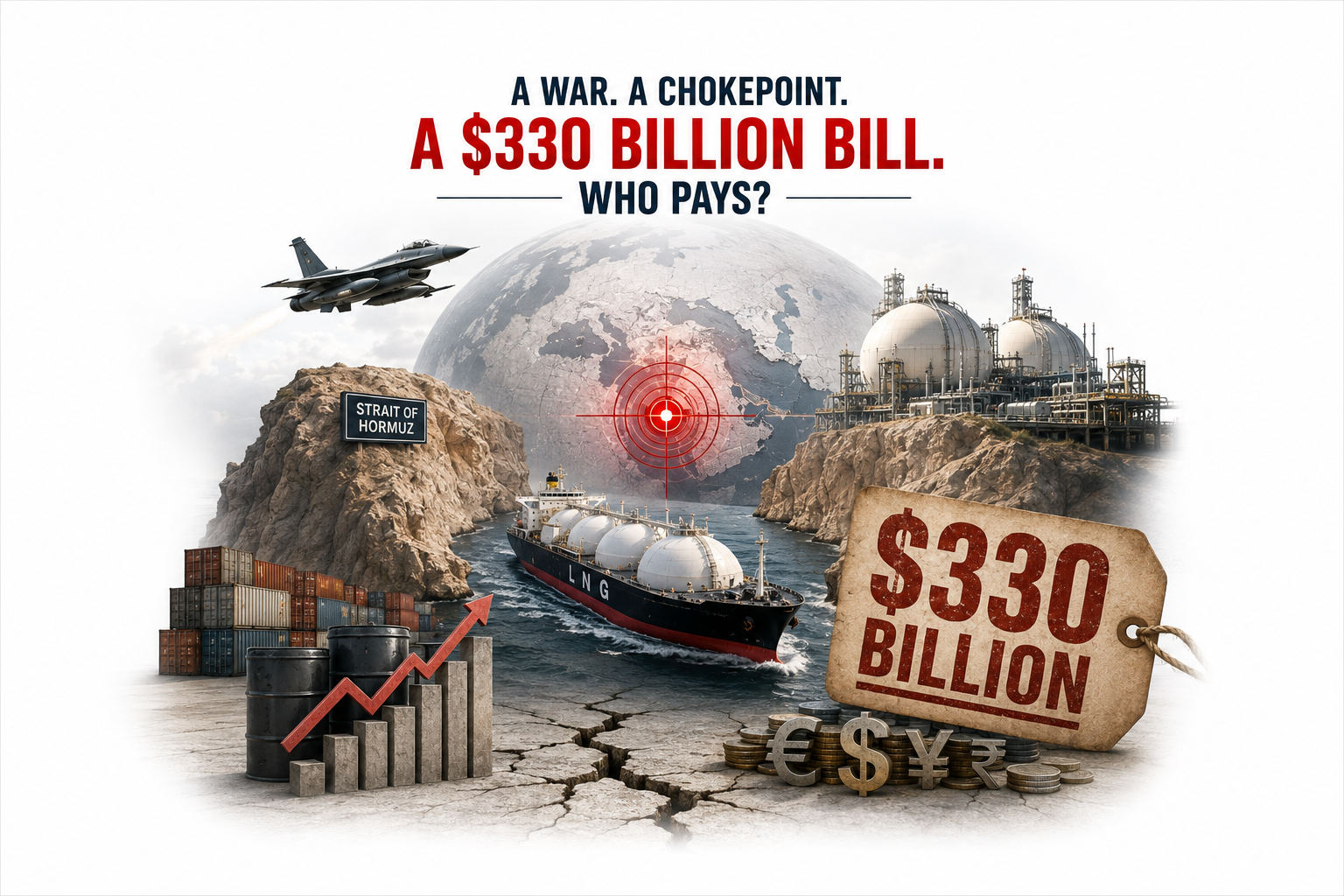
$330 billion. That is the additional fossil-fuel import bill incurred by importing nations between March and August 2026. But behind that number lies a more uncomfortable question: who decides, who pays, and who has the power to resist? The Hormuz crisis showed how a military conflict involving powerful states can travel through energy markets, currencies and factories—and leave countries thousands of kilometres away absorbing the damage, largely without a collective voice.
THE BILL ARRIVES
On February 28, 2026, the US and Israel launched air strikes on Iranian targets. The Strait of Hormuz—the world’s most critical energy chokepoint—was effectively closed to commercial shipping.
Through the 21-mile-wide strait flows 20% of global liquefied natural gas. When Qatar’s LNG infrastructure suffered damage from strikes in the wider region, QatarEnergy declared force majeure on 17% of its production capacity.
The market reacted immediately.
Spot LNG prices rose from a baseline ₹48/SCM to ₹88/SCM within days. Propane, a critical fallback fuel for India’s ceramic industry, surged from ₹55/kg to ₹108–120/kg, a 120% increase in two weeks.
But price was not the most dangerous part.
It was availability.
In Week 2 of March, before formal rationing was announced, propane vendors in India simply stopped accepting orders. Manufacturers were no longer deciding whether to buy expensive fuel or cheap fuel. They were deciding whether to risk paying ₹120/kg without delivery certainty—or stop production.
That is how a geopolitical crisis becomes a manufacturing crisis.
WHO PAID?
According to Centre for Research on Energy and Clean Air (CREA) analysis published on August 26, 2026, fossil-fuel importing nations incurred $330 billion in additional costs between March and August 2026.
But the burden was anything but equal.
European Union — $78 billion.
The shock was substantial, but strategic reserves, policy buffers and financial depth provided room to absorb it.
China — $35 billion.
China is a net energy importer, but its enormous domestic coal capacity gave it an important escape route. As LNG prices rose, China increased reliance on domestic coal, reduced LNG purchases and negotiated better long-term contracts. Strategic reserves and fuel flexibility created options.
India — $22 billion, including $20.5 billion in crude-oil costs.
For India, every day of spot-market premium meant additional pressure on foreign exchange. The number is not simply an inflation statistic. It represents a significant external vulnerability.
The same war therefore produced different degrees of pain because countries entered the crisis with different degrees of leverage.
That is the real lesson behind the $330 billion.
THE WORLD GOES SILENT
Here is the question that deserves greater attention:
Why did India, Japan, South Korea and Europe not coordinate a stronger collective response?
A coordinated purchasing mechanism could have strengthened bargaining power. Simultaneous strategic-reserve releases could have reduced spot-market premiums. Unified diplomatic pressure over the closure of Hormuz could have created political costs.
Instead, countries largely acted individually.
India bought at spot rates. Japan drew strategic reserves. South Korea tightened industrial allocations. Europe competed with Asia for Atlantic cargoes.
The fragmentation was complete.
Why?
Because this is not simply an economic problem.
It is a problem of power asymmetry.
Japan, South Korea and EU nations are security allies of the United States. Their security architecture is deeply connected to Washington. Coordinating a unified economic response—or publicly criticising US military action in the Middle East—carries geopolitical costs.
India faces a different calculation. It competes with China for geopolitical influence. Public coordination with Japan and South Korea can carry its own strategic implications.
And the economic pain is uneven.
The EU can absorb $78 billion through financial and policy buffers. India cannot treat $22 billion with the same indifference.
When the cost of resistance is politically higher than the cost of suffering, countries choose survival over solidarity.
The world goes silent because speaking up can cost more than suffering in silence.
IS AN ALTERNATIVE BEING BORN?
This is where the crisis raises a bigger question about BRICS.
BRICS brings together major emerging economies, including some of the world’s largest energy producers, consumers and importers. But being a geopolitical grouping is not the same as possessing a functioning alternative economic-security architecture.
The Hormuz crisis exposes the gap.
An alternative would require more than declarations and summits. It would require common energy purchasing, strategic reserves, alternative payment mechanisms, shipping arrangements and the political willingness to act collectively when one member—or its trading partners—is exposed.
So the question is not whether BRICS already provides an alternative to the US-centred system.
It does not—not yet.
The more important question is whether crises such as Hormuz will accelerate its evolution.
Can BRICS move from diplomatic grouping to economic risk-management architecture?
Can an emerging coalition do for vulnerable economies what existing alliances currently do for their members?
The alternative, if there is one, may be in the womb.
But the crisis has shown that it is not yet strong enough to protect those exposed to the shock.
And that distinction matters.
The world does not merely need alternative suppliers. It needs alternative leverage.
MORBI: WHERE THE BILL BECAME REAL
For a country, $22 billion appears in a balance sheet.
For a factory, it arrives differently.
In Morbi, India’s ceramic-export capital, approximately 500 units—40–60% of the cluster—shut down by March 20, 2026.
Ceramic kilns operate continuously at 1,100–1,200°C. Once shut, restarting takes 3–7 days and consumes enormous energy.
The supply disruption therefore created a brutal chain:
Fuel uncertainty → kiln shutdown → production loss → missed export commitments → lost customers.
By April 1, when Gujarat Gas formally implemented propane rationing at ₹88/SCM for non-regular users, most Morbi units were already shut.
Within three weeks, MCMA negotiated the rate down to ₹77/SCM. By late May, it stabilised at ₹75–78/SCM.
But by then, the damage had moved beyond the fuel price.
April–June is peak ceramic export season.
When reliable propane became available again in late April, customers had already shifted to competitors, moved commitments forward or cancelled.
Morbi’s ceramic exports collapsed 70% in Q1 FY2026–27: from ₹5,200 crore in Apr–Jun 2025 to ₹1,700 crore in Apr–Jun 2026.
This is the critical business lesson:
A supply shock is not measured only by how high prices rise. It is measured by when the disruption occurs.
A six-week shutdown during an off-season may be recoverable.
A six-week shutdown during peak season can permanently destroy orders, customers and market position.
THE REAL AFTERSHOCK
The 2026 Hormuz crisis will not necessarily be the last.
Climate change, geopolitical fragmentation and the concentration of critical resources in contested regions make future chokepoints and supply disruptions increasingly plausible.
The conventional response is familiar:
Diversify suppliers. Hold more inventory. Increase working capital. Find alternative fuels. Build resilient supply chains.
All are necessary.
But they are not sufficient.
Because the deeper vulnerability is structural.
When critical energy routes are concentrated in contested geography, businesses remain exposed to decisions made far beyond their control.
When countries are divided by security relationships and strategic competition, collective economic action becomes difficult.
When collective action fails, richer economies absorb the shock through reserves and financial depth.
Smaller economies and manufacturers absorb it through lost production, lost exports, lost customers and depleted foreign exchange.
That is why the $330 billion matters.
It is not merely an energy-market statistic.
It is a measure of how geopolitical power gets converted into economic pain.
THE LESSON FOR COUNTRIES AND BUSINESS
Governments need to think beyond securing supplies.
They need strategic reserves, diversified energy sources, emergency purchasing mechanisms and credible multilateral coordination before the next chokepoint closes.
And countries seeking a more multipolar world must answer a harder question:
Can they build collective leverage—or merely collective rhetoric?
For founders and executives, the lesson is closer to home.
Your factory may be local.
Your customers may be local.
Your suppliers may appear reliable.
But your vulnerability may sit in a 21-mile-wide strait thousands of kilometres away.
Map the geopolitical chokepoints behind every critical input. Identify substitutes before they are needed. Know which suppliers can actually guarantee delivery during a crisis. Stress-test your business against price shocks, supply denial and calendar disruption.
Because resilience is not simply surviving an expensive month.
It is ensuring that a seven-week disruption does not erase your next seven years.
The question after Hormuz is therefore not simply who paid $330 billion?
The bigger question is:
Who will have the leverage when the next crisis comes?
Countries must build it.
Businesses must prepare for it.
Because when a superpower can influence the world’s economic bloodstream, being a spectator is not the same as being safe.
Source credit: CREA; Gujarat Gas utility notices and industry reports; Indian trade statistics and Morbi Ceramic Manufacturers Association (MCMA) briefings; Economic Times and Indian Express reporting; QatarEnergy announcements; and field observations/interviews with manufacturing-sector contacts in Gujarat.



Leave a Reply