

By Haresh Jhala:
West Asia shock demands relief—but ₹5 cannot repair a 40% price shock
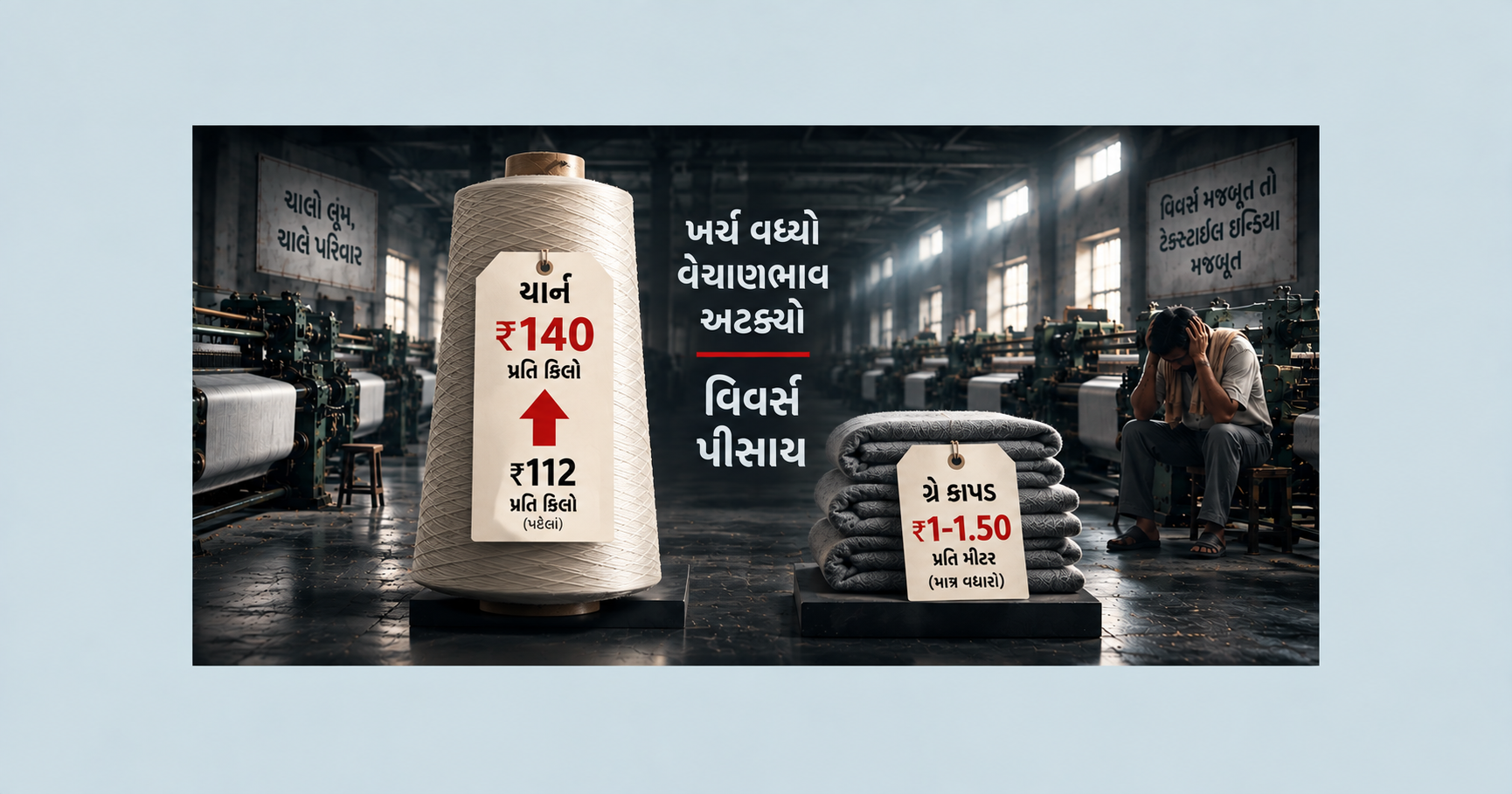
India’s textile industry is facing a raw-material shock that is rapidly becoming a competitiveness problem. Polyester yarn prices have risen 35–40% in six months, according to industry reports, while downstream manufacturers in #Gujarat, #Punjab, #Maharashtra and #Tamil Nadu are already struggling with weak demand and squeezed margins. Industry leaders are now appealing to fellow industrialists to write to the Finance Minister, Commerce and Industry Minister and Petroleum Minister, seeking zero customs duty on key yarn raw materials. The demand is justified. But one question must be asked: can a ₹3–5 per kg saving really change a market where yarn prices have jumped by tens of rupees?
The pressure begins upstream. PTA and MEG account for roughly 65% of polyester yarn production costs, making them critical to the economics of man-made fibre production. India imports around 35% of its MEG requirement and a significant share of PTA. The earlier 7.5% basic customs duty therefore added directly to landed input costs.
The government has already demonstrated that it can intervene. It reduced the basic customs duty on more than 40 petrochemical raw materials, including PTA and MEG, to zero for a temporary period in 2026, with the measure subsequently extended to 15 July. The objective was to provide relief to industries facing global input-cost pressures.
But the present crisis has moved beyond the arithmetic of customs duty.
As of 25 July, PTA was around ₹93.90 per kg and MEG around ₹58.70 per kg, following another increase in PTA prices. At the yarn level, market reports from Surat and Ludhiana have recorded repeated price increases as fibre and feedstock costs moved higher. On 19 August, Fibre2Fashion reported further increases in polyester yarn prices and noted that excessive price increases were already dampening downstream demand.
This is the critical point.
If restoring zero duty saves only ₹3–5 per kg at the #yarn level, it is unlikely by itself to reverse a 35–40% price escalation. For a textile manufacturer buying tonnes of yarn, every rupee matters—but ₹3–5 cannot be presented as a cure for a much larger cost shock.
Therefore, the industry’s demand should be seen as emergency relief, not the final solution.
The immediate objective should be to prevent another round of cost escalation. A temporary zero-duty regime for #PTA and #MEG can provide some cushion, particularly when global crude, freight and petrochemical markets remain volatile. But the government should simultaneously examine how much of that benefit actually reaches yarn buyers, weavers and processors.
This matters because raw-material relief does not automatically translate into equivalent yarn-price relief. High-cost inventories, contracts, market power and weak demand can all affect the pass-through. The experience of the earlier duty reduction itself showed that downstream prices could take time to respond.
The China factor makes the situation still more complicated. China dominates global man-made fibre production, and changes in its capacity utilisation, exports and domestic demand have a cascading impact on Asian markets. India also depends overwhelmingly on China for several man-made fibre inputs. But some #China-related production and export numbers currently circulating in the market are second- or third-hand data and should be treated as directional rather than precise.
The answer, therefore, cannot be simply “zero duty”.
India needs a three-part response: temporary raw-material duty relief, transparent pass-through of the benefit, and a longer-term strategy to reduce vulnerability to imported petrochemical feedstocks.
The government should also keep the #GST structure under review so that taxation does not create distortions between raw materials, yarn, fabric and garments. But GST is not the immediate issue. The immediate issue is the cost of yarn and the survival of downstream demand.
For #Gujarat’s textile clusters, #Surat’s synthetic textile ecosystem, Punjab’s #Ludhiana industry and India’s wider man-made fibre chain, this is ultimately about competitiveness.
The industry’s appeal deserves a positive response. But the government should be clear about what zero duty can—and cannot—do.
₹3–5 per kg may provide breathing space. It will not, by itself, undo a 35–40% price shock.
The real policy objective must therefore be bigger: bring down the cost of yarn, restore downstream demand and protect India’s textile competitiveness.
Sources
- New Indian Express, “West Asia conflict to raise costs, dent polyester yarn volumes by 2–3%: Crisil report”, 24 July 2026.
- Retail ET, “Fast fashion is about to get caught up in Hormuz”, 21 July 2026.
- Fibre2Fashion, “US–Iran re-escalation jolts naphtha and PX, pressuring textile cost”, 31 July 2026.
- iExcellents, “Oil Price Surge Drives Polyester Costs Higher for China’s Textile & Apparel Industry in H2 2026”, 21 July 2026.
- Amar Ujala, “Yarn gets costlier: Ludhiana knitwear industry under cost pressure, prices up 40% in six months”, 30 July 2026.
- CRISIL, “Domestic polyester yarn volumes expected to fall 2–3% this fiscal”, August 2026.
- Bhaskar English, “Yarn Supply Crisis: India & Surat Face Price Surge”, 20 August 2026.
- Moneycontrol, “Petroleum sector contribution to central exchequer surges 12% to Rs 4.76 lakh crore in FY26”, 6 August 2026.
- Fibre2Fashion, “Polyester prices rise sharply in India amid Hormuz oil risks”, 27 July 2026.
- Fibre2Fashion, “India’s polyester yarn prices rise; viscose, cotton remain stable”, 19 August 2026.
- Fibre2Fashion, “India extends zero customs duty on PTA, MEG till July 15”, 2 July 2026.




Leave a Reply