
MSME Briefing Bureau
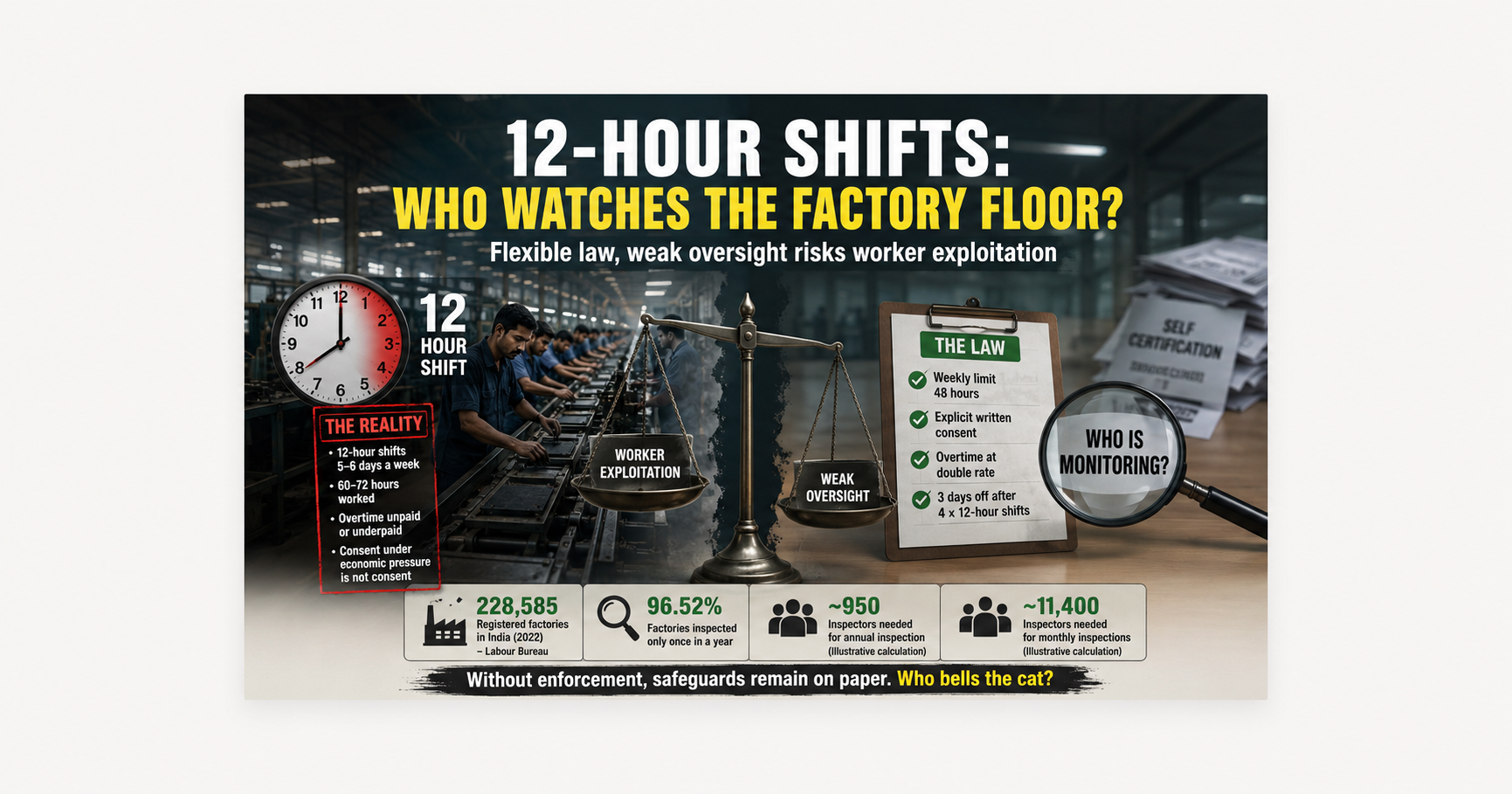
Flexible law, weak oversight risks worker exploitation
Flexible working hours appear progressive on paper. Under India’s newly notified Labour Codes, now adopted across industrial states including Gujarat, factories may extend daily shifts to 12 hours, provided the 48-hour weekly ceiling is maintained and workers receive compensatory days off. The arithmetic is clean. The enforcement, however, is not.
The Rule Versus the Reality
The law allows a 12-hour workday only under three explicit conditions:
- Weekly hours must not exceed 48, typically structured as four 12-hour shifts.
- Worker consent must be explicit and written, not implied or enforced.
- Overtime must be paid at double the ordinary wage rate.
Yet, ground-level accounts from textile and engineering clusters suggest a different picture. Workers report 12-hour shifts extending across five to six days, pushing total weekly hours to 60–72 hours, often without proportionate compensation.
The most critical safeguard — consent — becomes fragile in informal labour markets. For a contract or daily-wage worker, refusal is rarely an option.
Consent under economic compulsion ceases to be genuine consent.
The Verified Baseline
According to the Labour Bureau’s Statistics of Factories, India had 228,585 registered factories as of 2022. This remains the most reliable, citable figure.
Inspection data reveals a deeper concern:
- 96.52% of inspected factories were visited only once in a year
- A negligible fraction received multiple inspections
This is not just a statistic — it defines the limits of enforcement capacity.
The Enforcement Gap: A Transparent Estimate
There is no officially published national headcount of factory inspectors. Any definitive claim would be speculative. However, the scale of the gap can be illustrated through a transparent, assumption-based calculation.
Let us assume:
- One inspector conducts 1 meaningful inspection per working day
- Approximately 240 working days per year
This yields:
- 240 inspections per inspector annually
Using the verified factory count:
- To inspect all 228,585 factories once a year, India would require approximately 950 inspectors working at full efficiency, with no leave, training, or administrative burden — an unrealistic scenario.
Now consider meaningful oversight:
- For monthly inspections, essential to detect violations such as forced overtime or falsified consent,
- The requirement rises to approximately 11,400 inspectors nationwide
This is not an official figure. It is an illustrative scale calculation, open to scrutiny and recalibration. But it frames the central question:
Does India’s current inspection capacity match the legal ambition of its labour reforms?
Signals from the States
Recent recruitment drives across states such as Rajasthan and Bihar have added only small batches of inspectors. These incremental additions suggest:
- Persistent vacancies
- Structural understaffing
- A widening gap between policy expansion and enforcement capacity
Yet, the actual sanctioned versus filled inspector posts remain undisclosed in most states — the missing number in this debate.
When Inspectors Become Facilitators
The Labour Codes introduce a structural shift:
- From “Inspectors” to “Facilitators”
- From physical inspections to self-certification and digital filings
For large, compliant enterprises, this improves efficiency and reduces friction.
For smaller units and contract labour environments, it removes a crucial safeguard:
- Unannounced physical verification
In effect, compliance moves from being independently verified to being self-declared.
Where Accountability Breaks
Three operational fault lines emerge:
1. The Disappearing Rest Day
Workers are often called back on designated off-days under informal arrangements, effectively nullifying the promised three-day break.
2. The Overtime Loophole
Double-rate overtime depends on transparent records. In smaller units, extended hours are reportedly compensated in cash at standard rates, bypassing legal requirements.
3. The Self-Certification Gap
With fewer inspections, enforcement relies heavily on employer-submitted data, reducing independent verification.
The Core Question
Flexible scheduling is not inherently exploitative. In fact, when implemented correctly, it can benefit both employers and workers.
But the 12-hour framework rests on three pillars:
- Consent
- Weekly hour limits
- Fair overtime compensation
Without consistent and credible enforcement, these safeguards risk becoming procedural formalities.
So, Who Bells the Cat?
The data tells us:
- Most factories are inspected once a year or less
- The estimated requirement for effective oversight runs into thousands of inspectors
- The actual enforcement capacity remains undisclosed
Which leads to an uncomfortable but necessary conclusion:
The system is not equipped to verify what the law promises.
Until governments publish transparent inspectorate data, strengthen independent verification mechanisms, and restore on-ground inspection credibility, the question will persist:
Who is monitoring the factory floor?
And more importantly,
Who is accountable when no one is?





Leave a Reply