
MSME Briefing Bureau
Murugappa case exposes why equity alone cannot guarantee governance rights
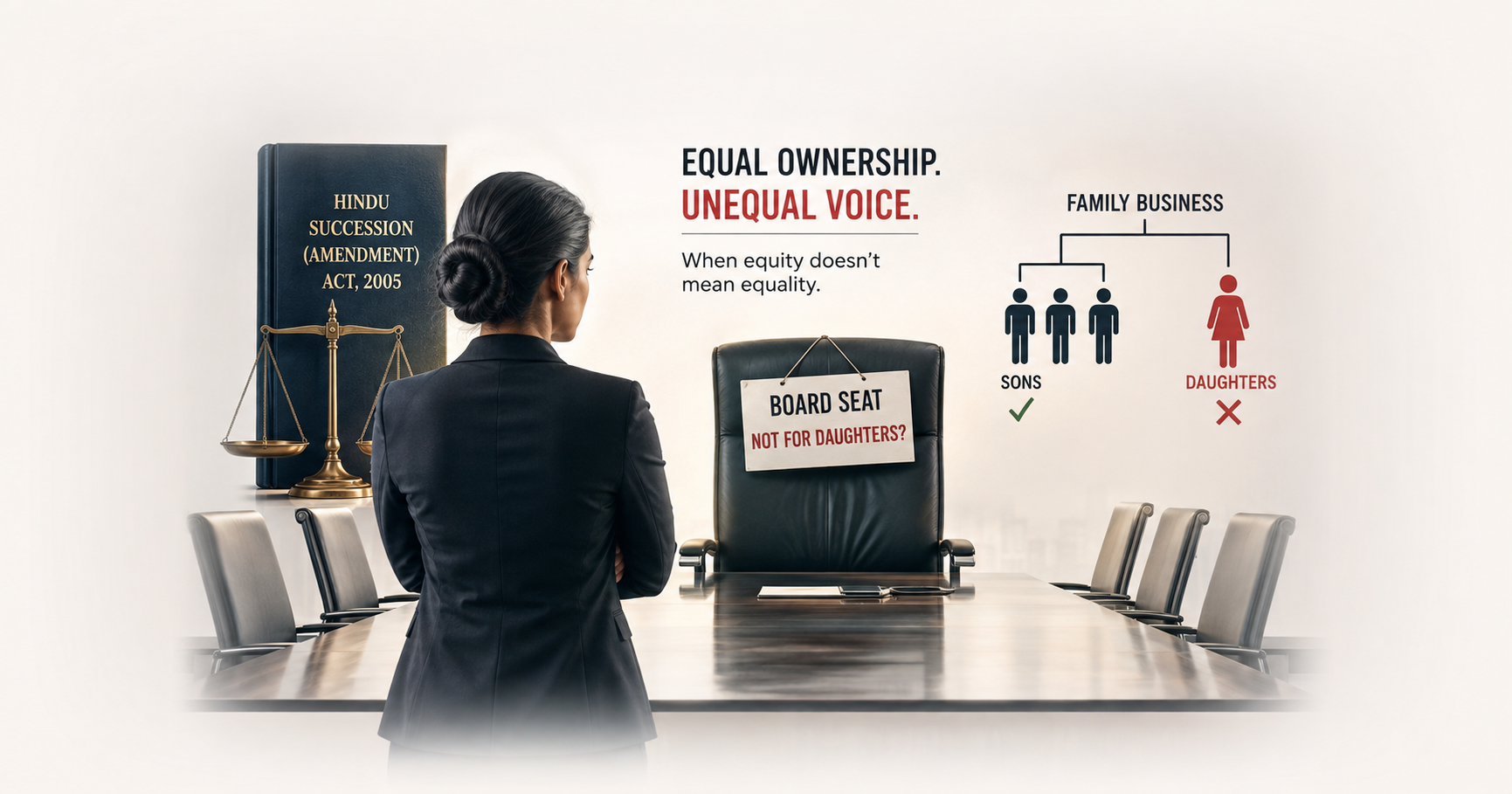
For generations, Indian family businesses have proudly spoken about legacy, values and continuity. Yet, when it comes to succession, many still draw an invisible line between sons and daughters. The Murugappa family dispute demonstrates that legal ownership does not always translate into boardroom influence. It raises an uncomfortable question for every promoter-led enterprise: If daughters can inherit equity, why are they still denied an equal voice in governance?
Locked Out: When Daughters Own Equity but Not a Board Seat
India’s family-owned businesses are entering a decisive phase. The Hindu Succession (Amendment) Act, 2005 gave daughters equal inheritance rights as coparceners in Hindu Undivided Families. The law changed. In many boardrooms, however, tradition did not.
The dispute within the Murugappa Group, one of India’s oldest industrial conglomerates, has become one of the country’s most significant governance case studies—not because it involved fraud, debt or a hostile takeover, but because it highlighted the growing gap between ownership rights and governance rights.
A Qualified Heir, Yet No Seat at the Table
Following the death of former Executive Chairman M.V. Murugappan in 2017, his elder daughter, Dr Valli Arunachalam, together with her sister Vellachi Murugappan and their family branch, sought representation on the board of Ambadi Investments Ltd, the Murugappa family’s principal holding company.
Dr Arunachalam was not seeking preferential treatment. She possessed strong academic credentials, international corporate experience and represented a family branch that held approximately 8.2–8.23% of Ambadi Investments.
However, shareholders voted against her appointment. According to public records and court proceedings, Ambadi Investments had an all-male board, reflecting a long-standing family convention under which board and executive positions traditionally went to male heirs. Dr Arunachalam publicly alleged that the refusal reflected gender discrimination.
The Law Recognised Her. Tradition Did Not.
This is where the case becomes particularly significant.
The dispute was not about inheritance. The family’s ownership rights were acknowledged.
It was about participation in governance.
That distinction matters.
A shareholder may legally own part of a company while having virtually no influence over strategic decisions if board representation remains inaccessible. In family enterprises, such situations often create long-term resentment, fractured relationships and costly legal battles.
The Murugappa dispute ultimately reached the National Company Law Tribunal (NCLT) before the family opted for a negotiated settlement.
The Settlement Ended the Dispute—Not the Debate
In August 2023, the Murugappa family announced a confidential family settlement. The agreed transactions were completed later that year, and legal proceedings were withdrawn. As part of the arrangement, the branch represented by Dr Valli Arunachalam exited its promoter status after the agreed share transactions. Importantly, the settlement specifically stated that none of the listed Murugappa companies were parties to the family arrangement, making it a private family resolution rather than a governance reform.
The family found peace.
The governance question remains.
Why Every MSME Promoter Should Pay Attention
Many Indian MSMEs are now entering the second and third generations of ownership.
Today’s daughters are engineers, chartered accountants, lawyers, MBAs and entrepreneurs. Many have greater professional exposure than their male siblings. Yet in numerous family businesses, succession practices remain governed by unwritten customs rather than written governance frameworks.
When capable family members are excluded despite owning equity, businesses risk:
- Losing experienced promoters and future leaders
- Lengthy legal disputes that drain management attention
- Forced buyouts that strain family wealth
- Damage to reputation among investors, employees and lenders
- Permanent fractures within promoter families
In an era where ESG, governance standards and professional management increasingly influence investment decisions, such disputes are no longer viewed as purely private family matters.
The Real Lesson
The Murugappa case should not be reduced to a simple story of winners and losers.
Nor should it be interpreted as evidence that every shareholder is automatically entitled to a board seat. Boards have fiduciary duties, and director appointments are ultimately governed by company law, shareholder decisions and corporate governance principles.
The broader lesson is different: family governance frameworks must evolve alongside inheritance laws and changing social realities.
Where ownership, succession and board eligibility remain undefined—or are based solely on unwritten patriarchal traditions—the probability of conflict rises sharply.
A carefully drafted family constitution, transparent succession policy and objective criteria for board appointments can prevent tomorrow’s disputes far more effectively than tomorrow’s litigation.
Call to Action
If your family business is preparing for its next generation, do not wait for a crisis to define the rules.
Ask the difficult questions now:
- Who can own equity?
- Who is eligible to join the board?
- Will eligibility be determined by gender, lineage or merit?
- How will future disputes be resolved?
The Murugappa dispute reminds Indian promoters that succession is not merely about transferring wealth—it is about transferring trust, opportunity and legitimacy. Families that modernise their governance today are far more likely to preserve both their businesses and their relationships tomorrow.
In our next instalment, we examine the governance dynamics and succession framework of the Bajaj Group. Promoters and family business leaders with governance or succession case studies to share may write to us at connect@msmebriefing.com




Leave a Reply