
MSME Briefing Bureau
₹27,000-crore maritime push could open new orders for Gujarat’s industrial MSMEs
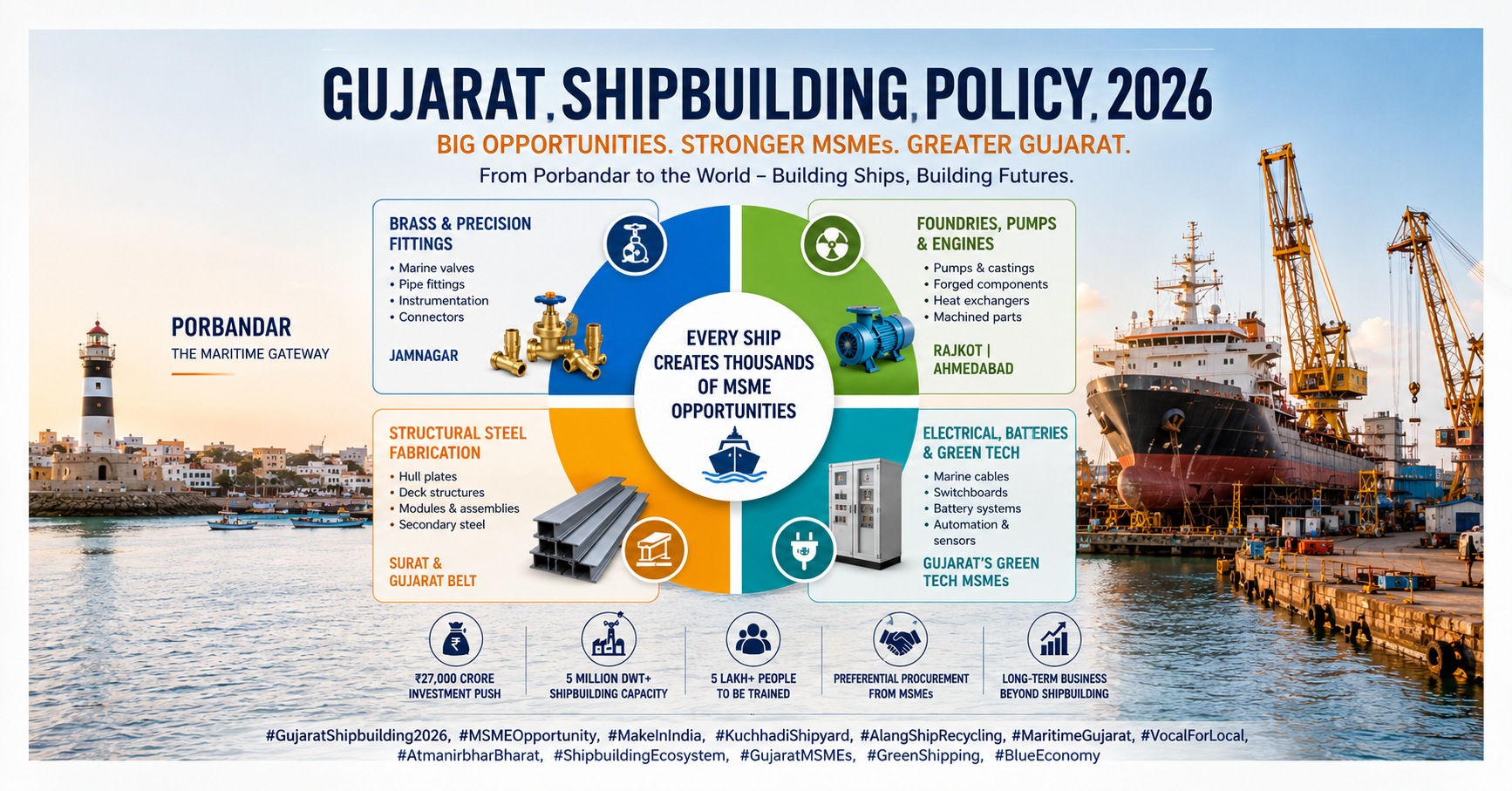
Gujarat’s new Shipbuilding and Ship Repair Policy 2026 puts a ₹27,000-crore maritime ecosystem on the drawing board: about ₹23,700 crore in private investment at Kuchhadi, Porbandar, plus ₹3,300 crore in common infrastructure. For MSMEs, the bigger number may be hidden inside every vessel. Valves, pumps, castings, fabricated steel, cables, electronics and repair services could turn each ship order into business spread across Jamnagar, Rajkot, Ahmedabad, Surat and Gujarat’s wider engineering belt for years to come.
The policy, announced on 27 July 2026, should therefore not be read merely as another large infrastructure announcement. For an MSME founder, the more useful question is simple:
What will a shipyard actually have to buy — and can my factory supply it?
That is where Gujarat’s opportunity begins.
What One Ship Buys — The MSME Opportunity Matrix
A commercial vessel is effectively a floating industrial plant. Building one requires thousands of components sourced from metallurgy, engineering, electrical, electronics, fabrication, coatings, automation and safety-equipment manufacturers.
For Gujarat, that creates an unusual advantage: many of these capabilities already exist within its established MSME clusters.
The following MSMEBriefing estimates are modelled on broad naval-architecture and industry benchmarks for a mid-sized commercial vessel. They are indicative opportunity estimates, not Gujarat government projections or guaranteed procurement values.
| MSME Cluster/Sector | Potential Supplies | Indicative Opportunity |
|---|---|---|
| Jamnagar — Brass & Precision Engineering | Marine valves, pipe fittings, bushings, fasteners, instrumentation fittings and connectors | ₹8–14 crore |
| Rajkot & Ahmedabad — Foundries, Pumps & Engineering | Pumps, cast housings, forged parts, heat-exchanger components and machined engineering parts | ₹18–30 crore |
| Surat & Gujarat Fabrication Belt | Structural fabrication, secondary steel structures, deck assemblies, gratings, modules and related fabrication | ₹35–55 crore |
| Electrical, Electronics & Green-Tech MSMEs | Marine cables, switchboards, lighting, controls, sensors, battery systems and automation | ₹12–22 crore |
On this illustrative model, the potential MSME-addressable component value can run into tens of crores of rupees for a single vessel, depending heavily on vessel type, localisation levels and what the prime shipyard chooses to manufacture in-house.
That distinction matters.
MSMEs do not need to build ships to benefit from shipbuilding. They need to become part of the shipbuilder’s approved supply chain.
Does This Help Alang — Or Is Ship Recycling a Separate Story?
The answer is: both sectors are separate businesses, but national policy is increasingly linking them economically.
Alang-Sosiya already handles around 98 per cent of India’s ship-recycling activity. It has 128 operational plots with annual recycling capacity of about 4.5 million LDT, and more than 8,900 ships have been recycled there since its establishment.
More importantly, India’s ship-recycling industry has recently recovered ground.
India’s share of global ship recycling increased from 30.1 per cent in 2024 to 35.4 per cent in 2025, while recycling volume rose nearly 60 per cent, from 1.86 million GT to 2.99 million GT. The Centre says 115 operational Alang yards are now compliant with the Hong Kong International Convention for the Safe and Environmentally Sound Recycling of Ships.
But the most interesting connection for Gujarat lies in the Centre’s Shipbreaking Credit Note mechanism.
Under the Shipbuilding Financial Assistance Scheme 2.0, an eligible shipowner recycling a vessel at a compliant Indian yard can receive a credit note worth 40 per cent of the vessel’s fair scrap value. That credit can be used towards up to 5 per cent of the value of a new ship built at an Indian shipyard.
This potentially creates a powerful Gujarat loop:
Recycle at Alang → earn the credit → order a new vessel in India → Gujarat shipyards compete for that order → Gujarat MSMEs compete for the components.
It does not mean the Gujarat policy itself will revive Alang. Alang’s competitiveness depends on global scrap prices, vessel availability, environmental compliance and competing yards in South Asia.
Nor should the circular-economy argument be misunderstood. Recovered ship steel does not automatically become certified steel plate for a new vessel. Much of Alang’s recovered material moves into re-rolling, construction and secondary markets.
The bigger opportunity is economic circulation rather than physical reuse of the same steel.
For MSMEs, that can mean two markets: supplying services, refurbishment and downstream businesses around recycling, while simultaneously entering the emerging new-build and ship-repair supply chain.
Step One: The Order Lands — And Factory Floors Light Up
This is where policy begins touching an MSME’s balance sheet.
When a large Gujarat shipyard receives an order, it becomes the prime integrator. It cannot economically manufacture every valve, pump, cable, switchboard, fitting, fabricated assembly and electronic system itself.
That creates the vendor chain.
A Jamnagar precision-engineering unit could supply marine-grade valves, fittings and connectors.
A Rajkot foundry could produce pump bodies, cast components and machined parts.
An Ahmedabad engineering company could supply pumps, motors, controls, automation or electrical equipment.
Fabricators across Surat, Bharuch, Vadodara, Rajkot and other industrial belts could compete for structural assemblies, piping systems, modules and specialised fabrication.
Electrical MSMEs could move into marine cables, switchgear, lighting, instrumentation, sensors and control panels.
The new Integrated Mega Shipbuilding Parks are designed to include shipyards, marine-equipment clusters, testing facilities, logistics infrastructure, R&D and skill-development facilities.
For MSMEs, therefore, the first opportunity is not land inside the shipbuilding park.
It is vendor qualification.
Step Two: One Ship Can Become Years of Business
Shipbuilding is only the first revenue layer.
Once delivered, commercial vessels enter decades-long operating lives involving inspection, repair, dry-docking, repainting, replacement and upgrading.
Pumps wear out. Valves require replacement. Corrosion protection must be renewed. Electrical systems are upgraded. Automation changes. Engines and auxiliary equipment require maintenance.
That makes ship repair potentially as important to Gujarat MSMEs as new shipbuilding.
A vendor entering the ecosystem through one construction contract can potentially migrate towards spares, repairs, maintenance and retrofit work.
And Gujarat’s yards will not have to depend only on ships originally built in the state. Competitive repair facilities can pursue India’s existing merchant fleet and international vessels operating along nearby trade routes.
That is what transforms shipbuilding from a project opportunity into a marine engineering ecosystem.
Step Three: Green Shipping Could Decide Who Earns Higher Margins
The next battle will not be over ordinary components alone.
Global shipping is gradually moving towards lower-carbon propulsion and alternative fuels, including LNG, methanol, ammonia, battery-hybrid systems and potentially hydrogen-based technologies.
That changes the specification sheet.
Marine equipment intended for alternative-fuel vessels may require specialised valves, seals, piping, sensors, electrical systems, automation, safety equipment and materials.
This is particularly relevant to Gujarat’s precision-engineering MSMEs.
A company making an industrial valve today cannot assume that the same product automatically qualifies for marine or alternative-fuel applications. Class approvals, material traceability, testing, welding qualifications and marine certification become entry barriers.
But entry barriers also protect margins.
The Gujarat MSME that begins certification and product development before the purchase orders arrive could be better positioned than a competitor waiting for the first tender.
Step Four: The Scale Behind the Demand
The government’s ambition gives this supply chain its significance.
The policy targets shipbuilding capacity of more than 5 million DWT, the creation of two Integrated Mega Shipbuilding Parks, and training and capacity-building for more than five lakh people.
The 5-million-DWT figure should, however, be read carefully.
It cannot reliably be translated into a fixed number of ships because vessel size, vessel type, order books, construction periods and yard utilisation will determine actual throughput.
For MSMEs, the better indicator is the breadth of the ecosystem being created.
If Gujarat succeeds in attracting multiple large shipyards, marine-equipment manufacturers and repair facilities, demand will extend far beyond hull construction into machining, foundry products, pumps, piping, electricals, electronics, coatings, automation, logistics, testing, maintenance and professional services.
That is where the multiplier lies.
Step Five: ₹27,000 Crore Is Building the Marketplace
The centrepiece is the proposed Mega Greenfield Shipbuilding Cluster at Kuchhadi in Porbandar district.
The project has received approval from the Government of India, while the Gujarat Maritime Board is preparing Detailed Project Reports. The cluster is expected to accommodate two to three world-class shipyards and supporting industries, attracting about ₹23,700 crore in private investment.
Another approximately ₹3,300 crore is envisaged for common marine and land infrastructure including breakwaters, dredging, harbour basins, navigation channels, floating cranes, roads, power and water infrastructure.
Gujarat also enters the race with a structural advantage: its 2,340-kilometre coastline, existing ports and one of India’s deepest engineering and manufacturing supply bases.
The shipyard, therefore, is only the anchor investment.
The bigger economic story could be what grows around it.
Step Six: The Policy Gives MSMEs a Door — They Must Walk Through It
The policy provides financial and non-financial support including capital assistance, stamp-duty concessions, interest subsidies, dredging assistance, electricity-tariff and water-charge support, benefits for marine-equipment manufacturing clusters and, crucially, incentives for procurement from MSMEs.
That last provision deserves attention from Gujarat’s industrial entrepreneurs.
Government incentives can encourage localisation, but they cannot make an uncertified vendor technically acceptable to a shipyard.
The MSME still has to demonstrate quality systems, traceability, marine standards, testing capability, delivery reliability and competitive pricing.
That means founders should begin asking three questions now:
Which ship component can we manufacture?
Which certification will the shipyard require?
Which Tier-1 or shipyard procurement team must we qualify with?
The Bottom Line for Gujarat’s MSME Founders
The Gujarat Shipbuilding and Ship Repair Policy 2026 is only days old. DPRs, investment decisions, vendor-development programmes and actual procurement pipelines will take time to mature.
But MSMEs should not wait for the first ship to reach the slipway.
By then, procurement teams may already have begun identifying suppliers.
For Jamnagar’s brass industry, Rajkot’s foundries and engineering companies, Ahmedabad’s machinery and electrical manufacturers, Surat’s fabricators, Gujarat’s cable and electronics companies, coating manufacturers, automation firms, testing laboratories and green-technology businesses, shipbuilding can become an entirely new customer vertical.
Alang adds another dimension by linking Gujarat’s enormous ship-recycling capability with India’s new shipbuilding ambitions through the Centre’s credit-note mechanism.
The opportunity, therefore, is larger than “Gujarat will build ships.”
The real proposition is:
Gujarat can build an industrial supply chain around the entire life of a ship — from components and construction to repair, retrofit and, ultimately, recycling.
For an MSME founder, the action point is clear: map your existing product against marine applications, identify the required certifications, follow Gujarat Maritime Board’s implementation and procurement guidelines, and start preparing for shipyard vendor qualification.
The first keel may still be some distance away.
The supply-chain race has already begun.





Leave a Reply