
Beyond Products, Toward Possibilities
MSME Briefing Business Strategy Desk
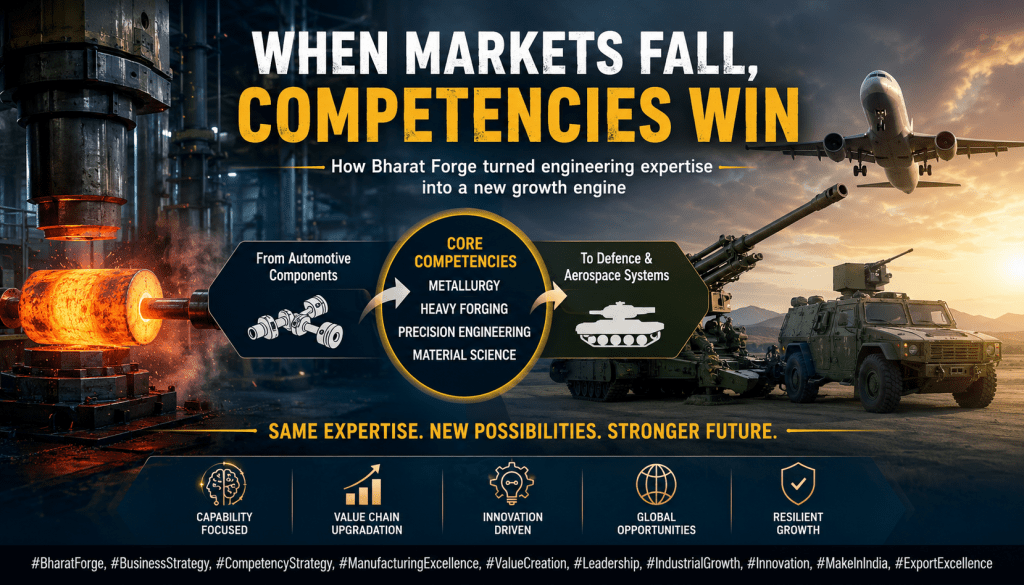
How Bharat Forge turned engineering expertise into a new growth engine
Every industrial leader eventually faces a painful reality. The market that built the business will not grow forever. Demand slows, margins shrink and competition intensifies. Most companies respond by cutting costs and waiting for conditions to improve. A few choose a different path. They stop looking at what they manufacture and start examining what they truly know. Bharat Forge’s transformation from an automotive forging giant into a global defence and aerospace player offers one of the most powerful business strategy lessons for modern manufacturers: growth often lies hidden inside capabilities you already possess.
The Day the Product Became a Limitation
Most companies define themselves by the products they sell.
A textile mill sees itself as a fabric producer.
A plastics company sees itself as a moulded-components manufacturer.
An engineering company sees itself as a pump maker.
The danger begins when management starts believing that the product is the business.
For years, Bharat Forge was recognised as one of the world’s largest forging companies serving the automotive sector. Its growth was closely linked to global commercial vehicle demand.
When truck markets weakened, many expected the company to face the same challenges confronting countless automotive suppliers worldwide.
Instead, the leadership asked a different question.
Are we an automotive company, or are we a metallurgy and precision engineering company that happens to serve automotive customers?
That single shift in perspective changed the company’s future.
The answer revealed something profound.
The company’s real strengths were not crankshafts, axle components or automotive parts.
Its real strengths were:
- Advanced metallurgy
- Heavy metal forming
- Large-scale forging
- Precision engineering
- Materials science
- Complex manufacturing capability
Once viewed through that lens, entirely new markets appeared.
The same expertise used to manufacture heavy automotive components could also be applied to artillery systems, armoured vehicles, aerospace structures and mission-critical engineering products.
The company did not change its capabilities.
It changed the market in which those capabilities were deployed.
The Competency Advantage
One of the biggest strategic mistakes organisations make is confusing products with competencies.
Products have life cycles.
Competencies have longevity.
Products become obsolete.
Competencies evolve.
Markets rise and fall.
Capabilities travel across industries.
This distinction is critical.
A factory manufacturing industrial valves may actually possess deep expertise in fluid control systems.
A machining company may possess world-class precision engineering capabilities.
A casting unit may be sitting on decades of metallurgical knowledge that could be valuable in entirely different sectors.
Leaders who understand their competencies can enter new industries with far greater confidence than those who define themselves by products alone.
Bharat Forge recognised that its true competitive advantage was not what left the factory gate.
It was the knowledge embedded within the factory walls.
Moving Up the Value Chain
A second lesson from Bharat Forge’s transformation is equally important.
Many manufacturers entering a new industry choose the safest route.
They become suppliers.
They manufacture components.
They execute designs created by others.
While this approach generates revenue, it rarely creates strategic control.
Bharat Forge pursued a more ambitious path.
The company invested in research, design, systems integration and product development.
Rather than remaining a component supplier, it progressively moved towards becoming a provider of complete defence platforms and engineering solutions.
This shift created three powerful advantages.
Higher Margins
Complete systems command significantly higher value than individual components.
The company captured a larger share of the value chain rather than competing solely on manufacturing cost.
Greater Customer Dependence
Customers can replace a component supplier.
Replacing a complete systems provider is far more difficult.
The relationship becomes strategic rather than transactional.
Intellectual Property Ownership
By developing proprietary products and technologies, the company created assets that competitors could not easily replicate.
For manufacturers seeking long-term growth, moving upward in the value chain often matters more than expanding production capacity.
The Hidden Opportunity Inside Every Factory
The Bharat Forge story raises an important question for every entrepreneur.
What is your organisation genuinely exceptional at?
Not what do you sell.
Not who are your customers.
Not which industry you serve.
What capability have you mastered over years or decades?
The answer may reveal opportunities that are currently invisible.
Consider a few examples.
A company serving the textile sector may possess expertise in industrial automation.
A plastics manufacturer may have advanced material engineering capabilities.
A machine shop may have developed exceptional precision manufacturing skills.
A fabrication company may have specialised welding and structural engineering expertise.
The future growth engine of the business may not come from the existing customer base.
It may come from applying those capabilities to entirely different industries.
Timing Matters as Much as Strategy
A brilliant strategy executed too early often struggles.
A brilliant strategy executed at the right moment can transform an organisation.
Bharat Forge’s diversification coincided with significant shifts in global supply chains, defence procurement priorities and manufacturing partnerships.
The company recognised that traditional supply networks were being restructured and acted decisively.
This highlights another lesson for business leaders.
Opportunities rarely arrive neatly packaged.
They usually appear disguised as disruption.
Economic downturns.
Technology transitions.
Regulatory changes.
Supply shortages.
Geopolitical shifts.
Leaders who learn to read these signals often discover opportunities while others remain focused on threats.
Five Strategic Recommendations
1. Audit Competencies, Not Products
List the skills, technologies and capabilities your organisation has mastered. These are often more valuable than the products themselves.
2. Define Your Business Differently
Describe your company based on what it knows rather than what it sells.
3. Explore Adjacent Industries
Look for sectors where your existing capabilities can solve different problems at higher margins.
4. Move Up the Value Chain
Progress from manufacturing parts to designing solutions, systems and proprietary products.
5. Invest in Intellectual Property
Knowledge, patents, proprietary processes and specialised expertise create long-term competitive advantage.
Final Thoughts
The transformation of Bharat Forge demonstrates a truth that every business leader should remember.
Markets do not create enduring companies. Capabilities do.
Products change.
Industries evolve.
Technologies advance.
Customer preferences shift.
But deep expertise remains valuable across generations.
When faced with a slowing market, many companies focus on defending yesterday’s business.
The most successful leaders focus on discovering tomorrow’s opportunity.
Bharat Forge did not escape an automotive slowdown by abandoning its strengths.
It escaped by understanding those strengths more deeply than its competitors.
The next breakthrough for your business may not require a new factory, a new machine or a new acquisition.
It may simply require seeing your existing capabilities through a different lens.
Because sometimes the greatest opportunity is already sitting on the shop floor—waiting to be recognised.

 MSME Briefing
Leave a comment