
Trust Built One Bottle at a Time
MSME Briefing Business Strategy Desk
How Surat’s Sosyo built a durable business despite global beverage giants
Every MSME founder eventually faces the same question: How do you compete when your competitor has deeper pockets, greater visibility and a larger distribution network?
The instinctive answer is to spend more, expand faster and imitate the market leader.
History suggests otherwise.
The century-old journey of Surat-based Sosyo Hajoori Beverages demonstrates that sustainable growth is often built not through intensity, but through strategic consistency. In an industry dominated by multinational corporations, Sosyo’s rise offers valuable lessons in market positioning, customer loyalty and disciplined expansion.
The Business Strategy Behind Sosyo’s Success
India’s soft drink market is among the most fiercely contested consumer sectors in the country.
From the liberalisation era of the 1990s to today’s multi-billion-dollar beverage industry, competition has largely been shaped by global players such as Coca-Cola and PepsiCo, backed by massive marketing budgets, celebrity endorsements and extensive distribution networks.
Many domestic brands disappeared under this pressure.
Some sold out.
Others simply faded away.
Yet one regional brand from Surat chose a different path.
Instead of competing head-on with multinational corporations across every market, Sosyo concentrated on strengthening its core territories, preserving product identity and cultivating customer loyalty.
That strategic decision would eventually become its greatest competitive advantage.
A Different Growth Philosophy
Business history often celebrates companies that scale rapidly.
However, rapid expansion frequently comes at the cost of profitability, operational control and customer relationships.
The Hajoori family adopted a markedly different philosophy.
Rather than pursuing nationwide visibility, the company focused on building a dominant presence in selected markets, particularly South Gujarat and parts of Maharashtra.
This regional strength created a dependable revenue base and enabled the company to withstand multiple competitive cycles.
For MSMEs, this illustrates an important strategic principle:
Market leadership in one region is often more valuable than weak presence across ten regions.
When Product Integrity Becomes a Competitive Moat
One of Sosyo’s most significant strengths has been its commitment to product consistency.
Its distinctive mixed-fruit formulation, combining grape and apple cider flavours, remained largely unchanged over decades.
While competitors frequently adjusted strategies to suit changing market conditions, Sosyo focused on preserving what customers already trusted.
The result was more than product recognition.
It created emotional loyalty.
Consumers who grew up with the brand continued purchasing it across generations.
For MSMEs operating in crowded markets, this offers a crucial lesson:
Brand trust cannot be bought through advertising alone. It is earned through consistent product delivery over time.
Distribution Relationships Matter
The beverage business is not only about manufacturing.
It is equally about distribution.
Industry observers have long noted how multinational players leveraged extensive trade incentives, cold-chain infrastructure and exclusive retail arrangements to strengthen market presence.
Despite these challenges, Sosyo maintained strong relationships with distributors, wholesalers and retailers.
Many trade partners continued supporting the brand because those relationships had been built over years rather than quarters.
The lesson for MSMEs is straightforward.
Distribution channels should be treated as strategic partners, not merely sales outlets.
Strong relationships often become a critical defence mechanism when competitive pressure intensifies.
The Power of Patient Growth
Perhaps the most remarkable aspect of the Sosyo story is its patience.
When Parle sold iconic beverage brands such as Thums Up, Limca and Gold Spot to Coca-Cola for approximately US$60 million in 1993, many believed the future belonged exclusively to multinational corporations.
The Hajoori family chose not to exit.
Instead, it continued investing in manufacturing, distribution and brand development.
That patience produced tangible results.
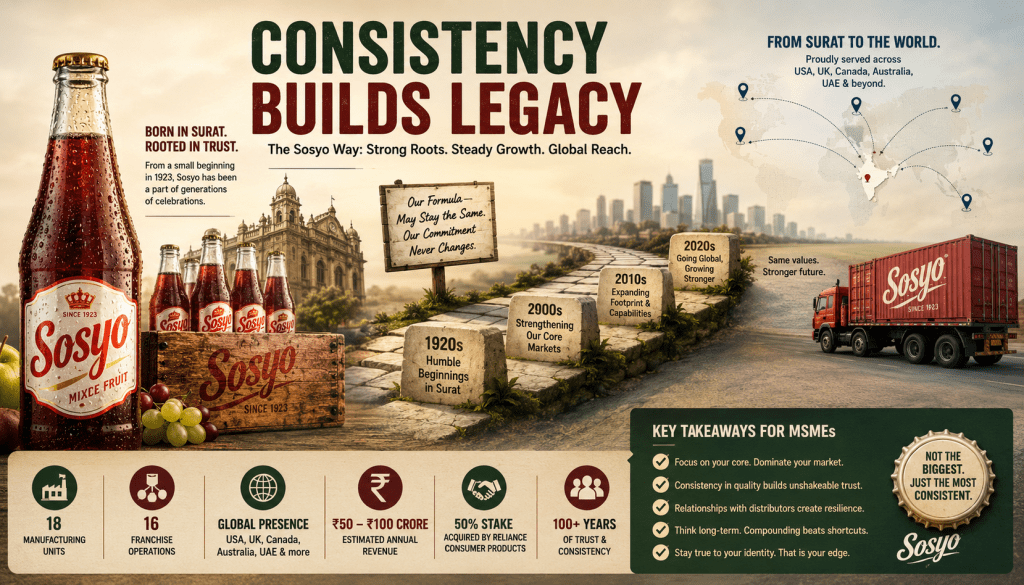
Today, the company operates through approximately 18 manufacturing facilities and 16 franchise operations, while serving customers across international markets including the United States, United Kingdom, Canada, Australia and the UAE.
Industry estimates place annual revenues in the ₹50-100 crore range, while the business received a major strategic endorsement when Reliance Consumer Products acquired a 50 per cent stake in Sosyo Hajoori Beverages.
Importantly, the family did not lose its identity.
It gained scale while retaining its legacy.
Five Strategic Lessons For MSMEs
1. Dominate Before You Diversify
Build leadership in a defined market before pursuing wider expansion.
2. Protect Product Quality Relentlessly
Consistency in quality creates customer loyalty that competitors struggle to replicate.
3. Build Relationships Across The Value Chain
Strong distributor and retailer partnerships create long-term resilience.
4. Think In Decades, Not Quarters
Sustainable businesses are built through compounding, not shortcuts.
5. Stay True To Your Differentiation
Avoid competing on the strengths of larger rivals. Compete on your own strengths.
What MSME Founders Should Remember
Many entrepreneurs assume that competing against larger companies requires matching their spending power.
In reality, successful MSMEs rarely win through scale alone.
They win through focus.
They win through consistency.
They win through understanding customers better than anyone else.
The Sosyo story demonstrates that a business does not need the largest marketing budget to create a lasting brand.
It needs a clear identity, disciplined execution and the patience to compound small advantages over time.
Final Thoughts
The business world often celebrates disruption, rapid growth and aggressive expansion.
Yet some of the most enduring enterprises are built through quieter virtues.
Consistency. Discipline. Commitment.
For more than three decades, Sosyo navigated one of India’s most competitive consumer markets without surrendering its identity or abandoning its strategy.
For MSMEs seeking sustainable growth, the lesson is both simple and powerful:
Scale may create visibility. Consistency creates longevity.
And in business, longevity is often the ultimate competitive advantage.

 MSME Briefing
Leave a comment