How a Kanpur MSME defeated FMCG giants through strategy, patience and retail trust
The MSME That Rewrote Market Rules
MSME Briefing Business Strategy Desk
In business, victory does not always belong to the company with the largest advertising budget, the deepest pockets, or the most celebrated brand. Sometimes, it belongs to the enterprise that understands its customers, distributors and geography better than anyone else. The rise of Ghadi Detergent is one such story. From the industrial heartland of Uttar Pradesh, a homegrown MSME built a formidable market position and challenged both Indian giants and multinational corporations without engaging in an expensive advertising war.
FIVE LESSONS FROM GHADI’S MARKET PLAYBOOK
● Win Your Home Ground Before Expanding
Ghadi spent years strengthening its position in Uttar Pradesh and neighbouring markets before pursuing wider expansion.
● Make Retailers Your Brand Ambassadors
Higher dealer margins and stronger relationships turned shopkeepers into active promoters of the brand.
● Distribution Is a Competitive Weapon
A dense logistics network reduced costs and ensured faster replenishment.
● Speak the Language of Your Consumer
Authentic messaging created trust where expensive advertising often failed.
● Grow Through Discipline, Not Hype
Organic growth and prudent financial management strengthened resilience during market battles.
GHADI’S MARKET MANTRA:
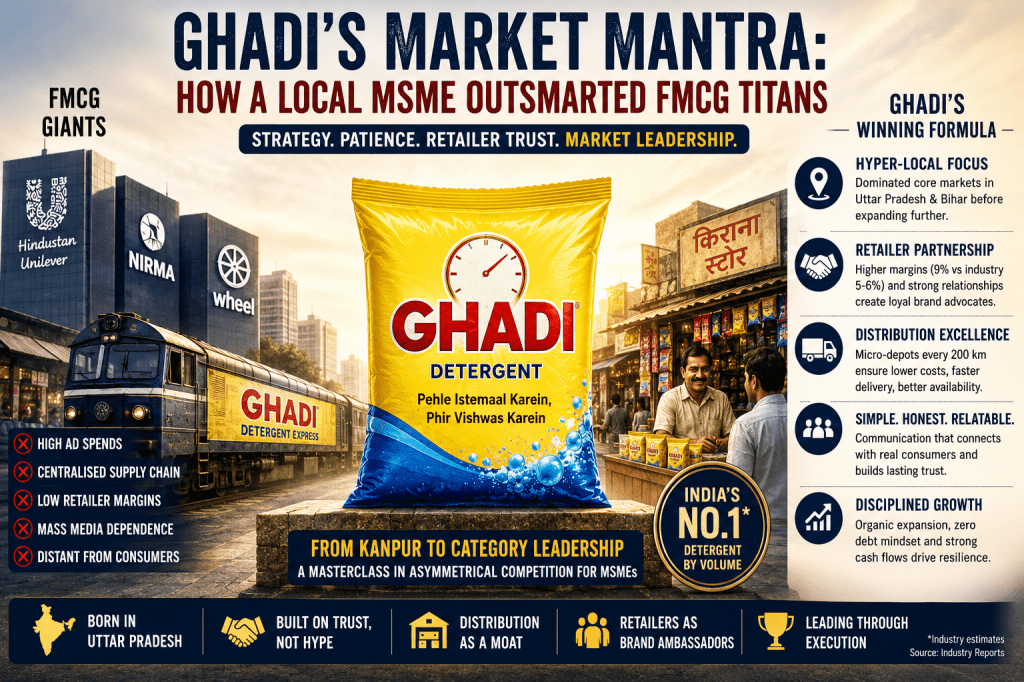
How a Local MSME Outsmarted FMCG Titans
When business schools discuss market disruption, the conversation often revolves around technology, venture capital, or digital innovation. Yet one of India’s most remarkable competitive victories emerged from a far less glamorous sector—detergent manufacturing.
The story of Ghadi is a reminder that strategy frequently defeats scale.
When multinational corporations and established domestic brands were spending heavily on television advertising, Ghadi focused on something many competitors underestimated: distribution efficiency and retailer relationships.
The company recognised an important truth. In India’s consumption economy, particularly in smaller towns and semi-urban markets, the retailer often exerts greater influence than a television commercial.
Rather than allocating disproportionate resources to advertising, Ghari invested in creating a robust distribution ecosystem. Better margins encouraged retailers to prioritise the brand, while efficient logistics ensured product availability. Together, these became a powerful growth engine.
Equally significant was the company’s commitment to regional dominance before national ambition.
Many MSMEs pursue rapid expansion long before achieving operational excellence in their core markets. Ghadi followed the opposite route. It consolidated its presence across Uttar Pradesh and the Hindi-speaking belt before moving further afield. This patient approach generated stronger cash flows, deeper market understanding and enduring customer loyalty.
Its communication strategy also deserves attention. Ghadi’s messaging was simple, relatable and trustworthy. Instead of attempting to impress consumers with sophisticated advertising campaigns, it focused on demonstrating value and performance.
Perhaps the most overlooked lesson is financial discipline.
At a time when many businesses chase growth through aggressive borrowing or external funding, Ghadi largely relied on internal accruals and measured expansion. This reduced vulnerability during competitive pricing battles and economic slowdowns.
The result was extraordinary. A company that began as a regional player gradually emerged as one of India’s most influential detergent brands, competing effectively against some of the world’s largest consumer goods corporations.
MSME Leadership Recommendations
1. Build Depth Before Breadth
Market leadership in one region often creates a stronger foundation than a weak presence across many territories.
2. Treat Channel Partners as Strategic Assets
Distributors and retailers are not merely intermediaries; they are growth multipliers.
3. Create Operational Advantages That Competitors Cannot Easily Copy
A unique distribution model can become a stronger moat than advertising.
4. Stay Close to Consumer Reality
Local insight frequently delivers greater value than expensive market research.
5. Prioritise Sustainable Growth
Cash flow, profitability and resilience should remain more important than headline expansion.
Final Thoughts
The rise of Ghadi is not simply a detergent success story. It is a leadership case study in strategic patience.
In an era obsessed with valuations, virality and rapid scaling, Ghadi demonstrates that enduring success is built through execution, trust and operational excellence. Its journey proves that MSMEs do not need multinational budgets to challenge multinational competitors.
They need clarity of purpose, disciplined execution and the courage to play a different game.
For today’s MSME founders, business leaders and entrepreneurs, the message is clear: competitive advantage is rarely purchased—it is carefully built, one decision at a time.


 MSME Briefing
Leave a comment