
Why founders stay trapped in firefighting despite hiring managers
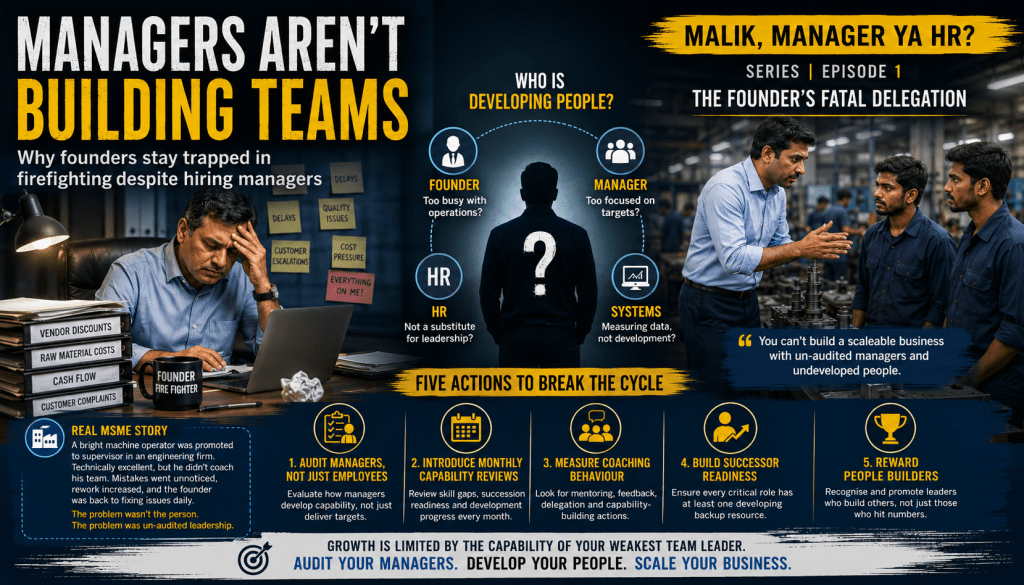
Who Is Building Your Future Leaders?
MSME Briefing Leadership Mantra Desk
Leadership Mantra Series: Malik, Manager ya HR?
Episode 1: The Founder’s Fatal Delegation
Every growing enterprise eventually reaches a point where the founder can no longer personally supervise every customer, supplier, machine, employee or operational decision.
At that moment, a critical leadership question emerges:
Who is responsible for developing people?
This five-part MSMEBriefing series examines a challenge rarely discussed openly in Indian industry. Organisations invest heavily in recruitment, payroll, technology and performance systems, yet many continue to struggle with weak managers, disengaged employees and an alarming dependence on founders for routine decisions.
In this opening episode, we explore a dangerous assumption that quietly weakens businesses: the belief that employee development can be delegated without accountability.
The Most Expensive Item on the Balance Sheet
Walk into any growing manufacturing unit, engineering company, logistics business or service enterprise.
The founder knows:
- Raw material costs
- Vendor payment terms
- Customer receivables
- Working capital requirements
- Monthly sales targets
Ask a different question:
Which manager in your organisation has developed the strongest successor during the past six months?
The answer is often less clear.
This is surprising because payroll is frequently one of the largest expenses on the profit and loss statement.
Most entrepreneurs rigorously monitor machinery utilisation, inventory movement and procurement costs. Yet very few apply the same discipline to evaluating whether managers are actively building capability within their teams.
The result is a hidden leadership deficit that remains invisible until a crisis occurs.
The Delegation Myth
Many founders believe that appointing Team Leaders automatically transfers responsibility for employee development.
Unfortunately, leadership does not work that way.
Operational tasks can be delegated.
Accountability for talent development cannot.
When founders stop examining how managers coach, mentor, evaluate and develop people, capability gaps begin accumulating across the organisation.
The business continues to function.
Targets continue to be reported.
Meetings continue to take place.
But beneath the surface, succession pipelines weaken, decision quality deteriorates and dependency on a few individuals increases.
Why Founders Become Permanent Firefighters
A familiar pattern emerges across many Indian MSMEs.
The founder assumes managers are developing their teams.
Managers focus on production schedules, customer commitments and daily targets.
Coaching conversations become infrequent.
Development discussions disappear.
Skill gaps remain unaddressed.
Eventually, problems surface.
A customer complaint escalates.
A production batch fails quality checks.
A key employee resigns.
A major order is mishandled.
The founder steps in personally to solve the problem.
The immediate crisis is resolved, but the underlying capability issue remains untouched.
This explains why many entrepreneurs spend years solving the same operational problems repeatedly.
They are not managing a scalable business.
They are compensating for an underdeveloped management layer.
A Story Many MSME Founders Will Recognise
A western India-based engineering company employing around 180 people faced recurring production disruptions despite investing regularly in machinery upgrades and process improvements.
The founder was frustrated.
Customer complaints persisted. Rework levels remained high. Production delays continued appearing with surprising frequency.
The Production Supervisor appeared to be the obvious leader. He had spent years on the shop floor, understood every machine and consistently delivered results.
Several years earlier, he had been promoted from machine operator to supervisor.
On paper, it looked like a sensible decision.
During an internal review, however, management discovered a different reality.
While technically brilliant, the supervisor spent almost no time coaching junior operators. New recruits learned largely through observation and trial-and-error. Mistakes were corrected only after defects emerged. Nobody was systematically assessing skill gaps, decision-making ability or readiness for greater responsibility.
The supervisor was not failing because he lacked commitment.
He was failing because nobody had taught him how to develop people.
The founder assumed the promotion itself would create a leader.
Instead, the organisation removed one of its strongest technical performers from productive work and placed him into a role requiring an entirely different capability set.
Machines improved.
Processes improved.
Reporting improved.
People did not.
And when people stop growing, operational problems eventually return to the founder’s desk.
The Challenge for HR Professionals
This is where HR often becomes trapped in the middle.
Founders expect HR to improve productivity.
Managers expect HR to solve performance issues.
Employees expect HR to drive career growth.
Yet HR cannot become a substitute for managerial leadership.
No competency framework, performance management system, employee engagement survey or HR dashboard can compensate for a manager who rarely observes, coaches or develops team members.
The uncomfortable reality is simple:
Employee development happens closest to the work, not inside an HR policy document.
HR can enable the process.
Managers must own it.
Founders must audit it.
Five Recommendations for Founders and HR Leaders
1. Audit Managers, Not Just Employees
Evaluate managers on their ability to develop capability, not merely deliver operational targets.
2. Introduce Monthly Capability Reviews
Alongside production and sales reviews, discuss skill gaps, succession readiness and employee development progress.
3. Measure Coaching Behaviour
Managers should demonstrate evidence of mentoring, delegation, feedback and capability-building activities.
4. Build Successor Readiness
Every critical role should have at least one identified and developing backup resource.
5. Reward People Builders
Promotions should recognise leaders who develop others, not only individuals who achieve personal performance metrics.
Final Thoughts
Most organisations do not struggle because of poor strategy.
They struggle because capability fails to grow at the same pace as ambition.
The founder invests capital.
HR builds systems.
Managers deliver targets.
But unless somebody actively develops people, the organisation remains dependent on a handful of individuals carrying the weight of many.
The question is not whether employee development matters.
The question is whether anyone is truly accountable for it.
In Episode 2, we examine another uncomfortable reality: why organisations increasingly rely on dashboards, pulse surveys and software to measure human potential—and what those systems may be missing.
Who actually evaluated this person?

 MSME Briefing
Leave a comment