Tariffs, conflict and supply shocks expose India’s leather sector vulnerabilities
When Geopolitics Hits The Factory Floor
MSME Geo Strategy News Desk
India’s leather and footwear industry employs millions, generates valuable export earnings and supports thousands of MSMEs. Yet recent geopolitical developments revealed an uncomfortable truth: many businesses remain highly exposed to events beyond their control. Trade disputes, shipping disruptions and supply chain shocks did not merely affect exports; they challenged the assumptions on which many business strategies were built. For industry leaders, the lesson is clear—resilience must now sit alongside growth as a strategic priority.
FIVE KEY TAKEAWAYS
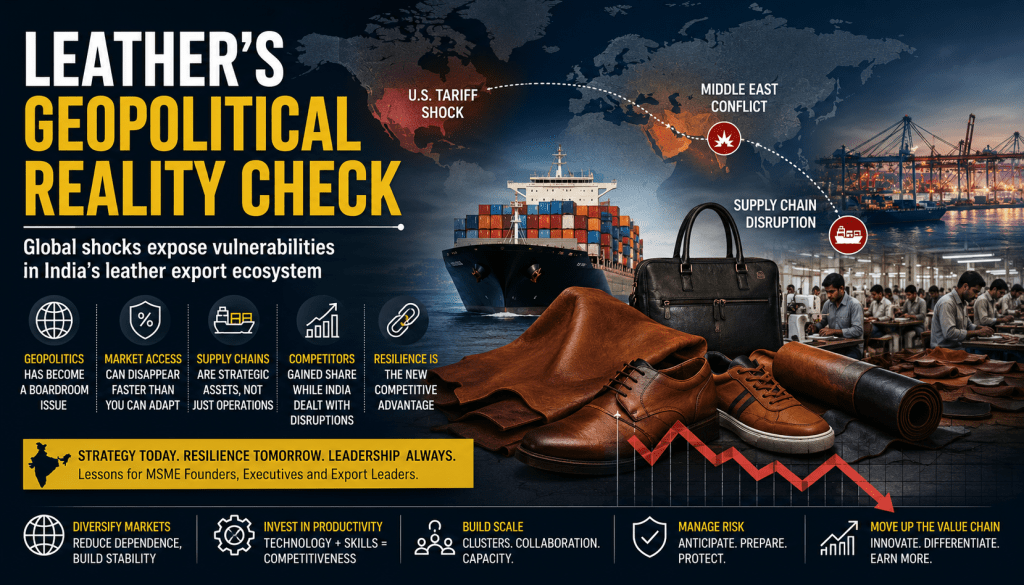
• Geopolitics has become a boardroom issue, not merely a government concern.
• Market access can disappear faster than businesses can adapt.
• Supply chains are increasingly strategic assets rather than operational functions.
• Competitors gained market share while India dealt with disruptions.
• Resilience is becoming a stronger competitive advantage than low-cost production.
THE DAY GLOBALISATION BECAME GEOPOLITICAL
For decades, Indian leather exporters focused on cost, quality and delivery. That formula largely worked. However, recent events demonstrated that global trade is no longer governed solely by economics. Political decisions, regional conflicts and strategic rivalries increasingly shape commercial outcomes.
Businesses that viewed geopolitics as a distant concern suddenly found themselves directly impacted by decisions taken thousands of kilometres away.
A FIVE-MONTH TARIFF THAT MAY COST FIVE YEARS
Temporary trade restrictions can create permanent consequences.
When access to key export markets became uncertain, international buyers did not wait for policymakers to negotiate solutions. They shifted sourcing arrangements elsewhere. Once shelf space, contracts and buyer confidence move to competing suppliers, reclaiming them becomes far more difficult than retaining them.
The lesson for exporters is profound: market diversification is no longer optional.
FROM HORMUZ TO KANPUR: THE SUPPLY CHAIN SHOCK
The Middle East conflict exposed another vulnerability.
Modern footwear manufacturing relies heavily on petrochemical-based materials, specialised chemicals and globally integrated logistics networks. Rising freight rates, extended shipping routes and higher input costs squeezed margins across manufacturing clusters.
A disruption in a distant maritime corridor quickly translated into pressure on factory cash flows, production schedules and employment.
HOW RIVALS CAPTURED INDIA’S LOST OPPORTUNITY
While Indian manufacturers managed uncertainty, competitors moved decisively.
Vietnam, Indonesia and Bangladesh benefited from stronger trade positioning, integrated manufacturing ecosystems and the ability to assure uninterrupted supply. Global buyers rewarded certainty and reliability over historic relationships.
This should concern policymakers and business leaders alike.
WHY RESILIENCE IS THE NEW COMPETITIVE ADVANTAGE
The traditional model of competing primarily on labour cost is becoming outdated.
Future winners will be businesses capable of absorbing shocks, maintaining delivery commitments, diversifying markets and investing in technology. Resilience is no longer a defensive strategy; it is becoming a growth strategy.
FIVE BIG RECOMMENDATIONS
- Establish a formal geopolitical risk review process within every export-oriented business.
- Reduce dependence on single-country markets and actively pursue diversified export destinations.
- Accelerate investment in automation, productivity and technology-driven manufacturing.
- Support the creation of larger integrated manufacturing clusters capable of competing globally.
- Move towards higher-value products, specialised manufacturing and premium market segments.
FINAL THOUGHTS
The recent challenges confronting India’s leather industry should not be viewed as an isolated sectoral issue. They represent a broader warning for the entire MSME ecosystem.
The age when entrepreneurs could focus exclusively on production, pricing and sales is ending. Today’s business leaders must understand trade policy, supply chains, global conflicts and shifting geopolitical realities.
The companies that prosper over the next decade will not necessarily be the largest or the cheapest. They will be the organisations that anticipate disruption, adapt quickly and build resilience into their strategy before the next crisis arrives.


 MSME Briefing
Leave a comment