
By Haresh Jhala
Gujarat’s monsoon crisis exposes three decades of misplaced urban priorities.
Every monsoon, Gujarat’s cities perform the same ritual: rain falls, roads disappear, citizens rage and governments promise action. Yet, when the waters recede, so does public memory. The truth is uncomfortable: urban flooding is not merely an engineering failure; it is a democratic failure. For more than three decades, Gujarat’s electorate has rewarded spectacle over systems, symbolism over services, and announcements over accountability. The bill has now arrived.
Flooded Streets, Forgotten Priorities
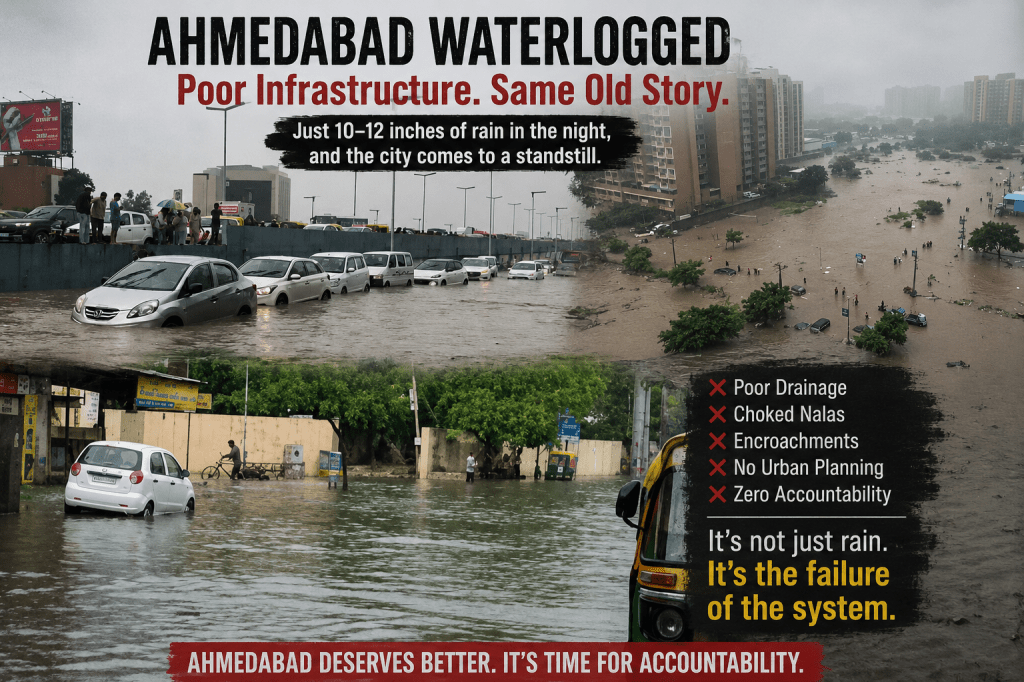
When Valsad received more than 36 inches of rainfall in 24 hours, when parts of Ahmedabad were submerged after barely half a night’s rain, and when Vapi remained waterlogged for days, the immediate reaction was predictable: blame the clouds.
That explanation is convenient. It is also incomplete.
Rain does not create disasters; poor planning does. Monsoons are seasonal events. Storm-water drainage systems exist precisely because cities are expected to receive heavy rainfall. When a city collapses after receiving 8 to 12 inches of rain, the issue is not meteorology. It is governance.
However, governance failures do not occur in a vacuum.
The Missing Question in Every Election
For nearly thirty years, urban Gujarat has voted enthusiastically for projects that are visible, photogenic and politically marketable.
- Riverfronts
- Iconic bridges
- BRTS corridors
- Tourism campaigns
- Vibrant summits
- Statues and festivals
- Religious and identity narratives
There is nothing inherently wrong with any of these initiatives. The problem lies in what citizens chose not to ask.
How many voters have demanded to know:
- The capacity of their ward’s storm-water drainage network?
- Whether drains are designed for current population density?
- Annual desilting expenditure?
- Encroachment on natural water channels?
- Ward-wise flood preparedness audits?
- The names of contractors responsible for drainage works?
The answer, unfortunately, is very few.
Urbanisation Without Infrastructure
There is another missing link in Gujarat’s flooding story: uncontrolled urban expansion.
Ahmedabad’s population has multiplied dramatically over the past three decades. Agricultural land has become residential townships. Lakes have disappeared. Natural water bodies have been reduced, interconnected drainage channels have been blocked, and concrete has replaced permeable surfaces.
Yet, much of the storm-water infrastructure continues to serve cities that existed twenty or thirty years ago.
This is not merely an Ahmedabad problem.
From Surat and Vadodara to Rajkot, Vapi and smaller municipalities, urban planning has frequently lagged behind real-estate growth. Permissions were granted, FSI increased and new projects launched, but the fundamental question remained unanswered:
Can the city’s drainage system carry the additional load?
A Climate Reality Nobody Can Ignore
There is an uncomfortable truth policymakers must acknowledge: extreme rainfall events are becoming more frequent.
Climate variability means that cities must now prepare for rainfall patterns that would once have been considered exceptional. Infrastructure designed for the past will not survive the future.
That raises an important question: are Gujarat’s urban bodies planning for the next fifty years or merely the next election cycle?
The State Must Answer
Citizens are not solely responsible.
When municipal corporations declare “pre-monsoon preparedness” and cities flood within hours, accountability must be immediate and public.
Authorities should publish:
- Ward-wise drainage budgets.
- Annual desilting reports.
- Flood vulnerability maps.
- Contractor performance records.
- Independent infrastructure audits.
- Timelines for upgrading storm-water systems.
Public infrastructure cannot be evaluated through press conferences and social media posts. It must be measured by one simple standard:
Did the city remain functional after the rain?
This year, in many places across Gujarat, the answer was no.
Democracy Comes With Maintenance Costs
There is a lesson hidden beneath every flooded street.
Democracy is not a five-year festival. It is an annual audit.
Citizens who consistently prioritise symbolism over civic performance should not be surprised when their roads resemble rivers. Equally, governments that have enjoyed decades of political stability cannot indefinitely attribute infrastructure failures to unprecedented weather.
Both share responsibility.
The next time Gujaratis enter a polling booth, perhaps they should ask a simpler question—not who built the biggest landmark, but who ensured that their homes remained dry during the monsoon.
Because a city is not defined by what tourists photograph.
It is defined by whether its citizens can reach home when it rains.





 MSME Briefing
Leave a comment