Delayed Response Leaves MSMEs Facing Rising Costs
Three months into the Iran conflict, industry pain deepens as costs rise
Delayed Action, Mounting MSME Pain
By Haresh Jhala
The June 2 review meeting convened by the Union Ministry for MSMEs raises an uncomfortable question: why now?
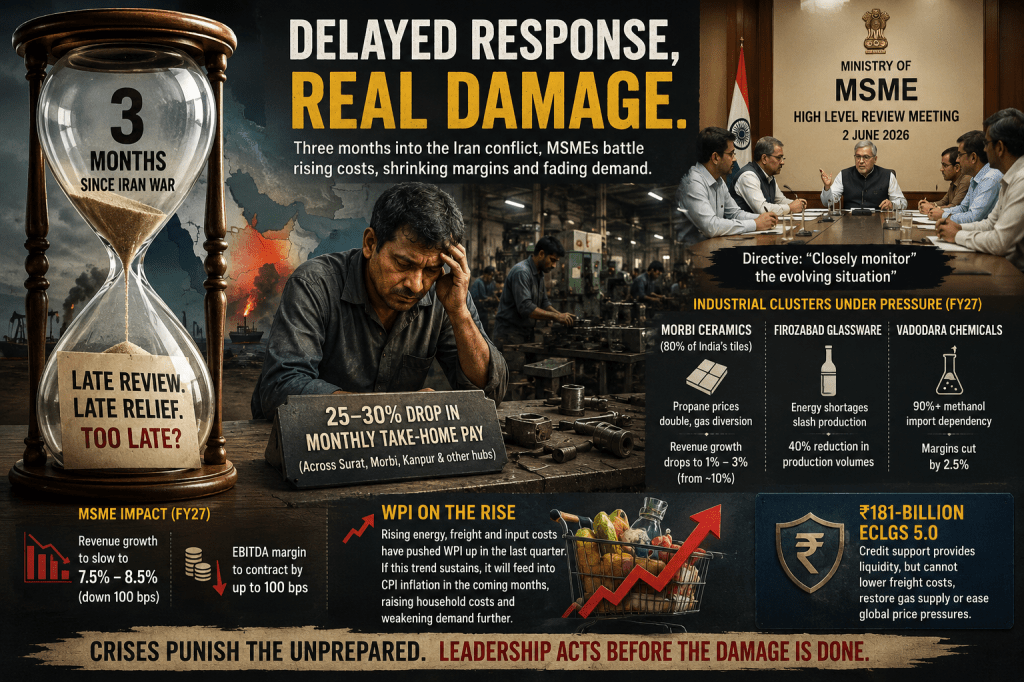
Nearly three months after the outbreak of the Iran-centred West Asia conflict, and after its economic consequences had already rippled through factories, supply chains and export corridors, the official response appears to have arrived well after the damage was done. A directive to “closely monitor developments” may have administrative value, but it offers little reassurance to enterprises already grappling with rising costs, shrinking margins and weakening demand.
The numbers tell a troubling story. According to CRISIL Intelligence, the geopolitical disruption is expected to shave 100 basis points off MSME revenue growth in FY27, reducing expansion to 7.5-8.5 per cent. At the same time, EBITDA margins are projected to contract by up to 100 basis points, reflecting the mounting pressure on operating profitability.
The pain is especially visible across key industrial clusters. In Gujarat’s Morbi ceramic hub, which accounts for nearly 80 per cent of India’s tile production, revenue growth expectations have slumped from around 10 per cent to just 1-3 per cent. The trigger is clear: sharply higher propane prices and disruptions in natural gas availability. In Firozabad, India’s renowned glassware centre, energy shortages have reportedly forced a 40 per cent reduction in production volumes. Meanwhile, chemical manufacturers in Vadodara, heavily dependent on imported methanol, face margin erosion as global supply routes remain vulnerable.
The consequences extend beyond factory gates. Across manufacturing centres such as Surat, Morbi and Kanpur, units operating at barely half capacity have reduced overtime, curtailed shifts and postponed expansion plans. For many blue-collar workers, monthly earnings have already suffered a 25-30 per cent decline.
Adding to these pressures is the steady rise in Wholesale Price Index (WPI) inflation over the past quarter, driven by higher energy, freight and industrial input costs. History suggests that sustained increases in wholesale prices eventually filter through to the Consumer Price Index (CPI) with a lag. If that trend persists, households could face higher living costs in the months ahead, further weakening consumer demand—the very demand on which countless MSMEs depend.
The government’s ₹181-billion ECLGS 5.0 package may provide liquidity support, but credit alone cannot reduce freight costs, restore disrupted supply chains or lower energy prices. Effective leadership is measured not by reviewing a crisis after it has unfolded, but by anticipating it before businesses bear the consequences.
For India’s MSMEs, the economic bill has already arrived. The policy response, unfortunately, appears to be catching up.




 MSME Briefing
Leave a comment