A practical guide to Gujarat’s subsidies, approvals, inspections and funding process
Defence Manufacturing Incentives Decoded
MSME Briefing News Desk
India’s push towards defence indigenisation has opened unprecedented opportunities for entrepreneurs willing to enter the aerospace and defence manufacturing ecosystem. Yet many promising ventures fail to benefit from government incentives simply because they do not know where to apply, whom to approach, what documents are required, or why subsidy claims often get delayed. This guide explains, in simple language, how entrepreneurs planning an aerospace and defence component manufacturing unit in Gujarat can navigate the state’s incentive framework and maximise available benefits.
India’s defence manufacturing ambitions are creating opportunities that did not exist a decade ago. As New Delhi increases its focus on indigenous procurement, exports and self-reliance, Gujarat has steadily emerged as one of the country’s most attractive destinations for Aerospace and Defence (A&D) manufacturing investments.
However, many entrepreneurs discover an uncomfortable reality after establishing a unit: securing government incentives can be almost as challenging as setting up the factory itself.
The information exists within government systems, policy documents and departmental channels, but it rarely reaches first-generation entrepreneurs or companies exploring entry into the sector. Understanding the process before investing can save months of delays and significantly improve the chances of securing eligible benefits.
The First Step: Where Should You Apply?
Gujarat has largely digitised its industrial incentive ecosystem through a centralised, paperless mechanism known as the Investor Facilitation Portal (IFP).
All applications for industrial incentives, including those applicable to aerospace and defence manufacturing units, are routed through this platform.
The authority handling your application depends largely on the size of your project.
For MSME Units
Applications are generally scrutinised and processed by the local District Industries Centre (DIC).
For Large and Mega Projects
Applications are handled at higher levels through the MSME Commissionerate or the Industries Commissionerate located at Udyog Bhavan, Gandhinagar.
Entrepreneurs should therefore clearly determine their project classification before initiating the application process.
Documentation: The Foundation of Every Successful Claim
One of the most common reasons for delays is incomplete or inadequate documentation.
Before uploading documents on the portal, ensure your application package contains all required records and certifications.
Detailed Project Report (DPR)
The DPR should clearly explain:
- Nature of products being manufactured.
- Technical capabilities of the unit.
- Machinery deployment.
- Defence supply chain integration.
- Potential customers, including defence PSUs and private sector defence manufacturers.
Industrial Licence and Regulatory Approvals
Depending on the nature of products being manufactured, applicants may require:
- Industrial Licence (IL) issued through DPIIT.
- Ministry of Home Affairs licence for restricted defence items.
- Any sector-specific permissions applicable to the proposed activity.
Chartered Accountant Certificate
A certified statement detailing actual expenditure incurred on eligible fixed capital investments is mandatory.
Authorities use this document extensively while calculating subsidy eligibility.
Bank Sanction Documents
Applicants should provide:
- Term loan sanction letter.
- Bank appraisal report.
- Loan utilisation records wherever applicable.
Statutory Registrations
The application should also include:
- Udyam Registration.
- Gujarat Pollution Control Board approvals.
- Power connection approvals.
- Other statutory compliances relevant to the project.
A well-prepared document package often determines whether an application moves smoothly or gets trapped in repeated clarification cycles.
Understanding the Four-Stage Approval Process
Every application typically passes through four major stages before subsidy approval.
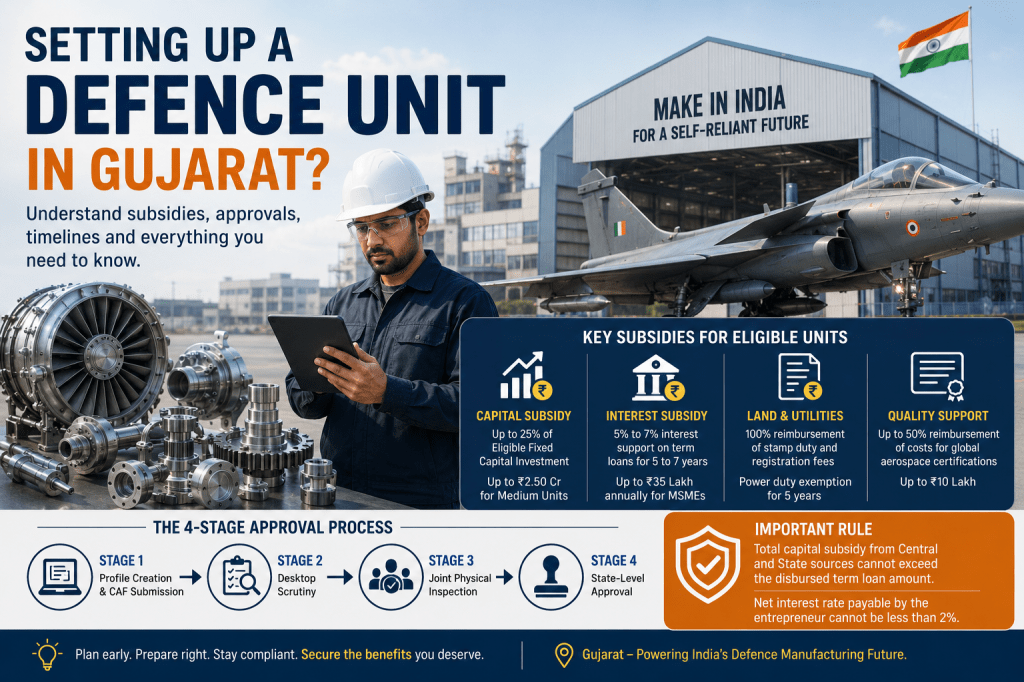
Stage 1: Profile Creation and CAF Submission
The entrepreneur registers on the portal and submits the Common Application Form (CAF) along with supporting documents.
Stage 2: Desktop Scrutiny
Officials examine documents, verify eligibility and raise queries if any discrepancies are found.
Stage 3: Physical Inspection
Once documentary verification is completed, a joint inspection team visits the manufacturing facility.
Stage 4: State-Level Approval
The proposal is placed before the appropriate sanctioning authority or committee for final approval.
Only after successful completion of all four stages can the subsidy claim proceed towards disbursement.
Why Physical Inspection Matters More Than Many Entrepreneurs Realise
Many applicants assume the inspection is a routine formality.
In reality, it is one of the most critical stages of the entire process.
A joint inspection team typically comprises officials from the DIC, technical personnel from industrial development agencies and, in some cases, subject-matter experts.
The inspection goes far beyond checking factory premises.
Officials may verify:
- Serial numbers of imported and domestic machinery.
- Installation status of high-value equipment.
- Production readiness.
- Electricity consumption records.
- Manufacturing capability.
- Quality management systems.
- Aerospace certification preparedness.
For units claiming advanced manufacturing status, inspectors may examine systems linked to standards such as AS9100, particularly where aerospace supply chain participation is being projected.
Any mismatch between submitted documents and physical assets can result in prolonged delays.
When Can You Expect the Subsidy Money?
This is perhaps the most frequently asked question by entrepreneurs.
The answer lies somewhere between official timelines and practical realities.
Official Timeline
The framework generally provides:
- Around 45 days for scrutiny and query management.
- Around 15 days for inspection-related actions.
Practical Timeline
For aerospace and defence projects, the approval cycle often extends to approximately 60 to 90 days, particularly where specialised classifications or defence-related verifications are involved.
Actual Disbursement Timeline
Even after receiving approval, entrepreneurs should prepare for a longer wait before funds reach their accounts.
In practice, subsidy disbursement may take six to twelve months after commencement of commercial production, depending on budget allocations and claim processing cycles.
Understanding this reality is important while planning cash flows and debt servicing commitments.
Why Applications Get Delayed
Most delays can be traced to two recurring issues.
The Dual-Use Verification Challenge
Many manufacturing facilities serve both civilian and defence customers.
For example, a precision engineering company may supply:
- 60% of production to automotive customers.
- 40% to defence organisations such as HAL or BEL.
In such cases, authorities often seek additional evidence to determine whether the unit qualifies for specialised aerospace and defence incentives rather than general industrial incentives.
This verification exercise frequently slows processing.
Budget Allocation Constraints
Even after formal approval, actual fund release depends on budgetary availability.
The Industries Commissionerate receives allocations from the Finance Department and must distribute available resources across multiple approved projects.
When application volumes increase significantly under programmes such as the Aatmanirbhar Gujarat Schemes, disbursements may be staggered across quarters, resulting in unavoidable waiting periods.
Key Subsidies Available to Eligible Units
Gujarat combines defence-focused incentives with broader industrial support schemes, creating a layered support structure for investors.
Capital Subsidy
MSME units can receive support equivalent to 25% of Eligible Fixed Capital Investment (eFCI) covering approved investments in land development, buildings, plant and machinery.
Maximum assistance generally includes:
- Micro Units – Up to ₹12.5 lakh.
- Small Units – Up to ₹1.25 crore.
- Medium Units – Up to ₹2.50 crore.
Large units may receive benefits through structured SGST-linked incentives.
Interest Subsidy
Eligible enterprises may receive 5% to 7% interest support on term loans.
Support may continue for five to seven years.
Indicative ceilings include:
- MSMEs – Up to ₹35 lakh annually.
- Mega Projects – Up to ₹10 crore annually.
Land and Utility Benefits
Entrepreneurs may also benefit from:
- 100% reimbursement of stamp duty.
- 100% reimbursement of registration fees.
- Electricity duty exemption for five years.
- Power tariff support of approximately ₹1 per unit.
Quality and Certification Assistance
For companies targeting global aerospace supply chains, certification costs can be substantial.
The state provides reimbursement of up to 50% of certification expenditure, including internationally recognised aerospace standards such as AS9100.
The assistance is generally capped at ₹10 lakh.
The Rule Every Entrepreneur Must Understand
Many defence entrepreneurs combine state incentives with Central Government programmes such as:
- Technology Development Fund (TDF).
- iDEX initiatives.
- Other Ministry of Defence support schemes.
However, a critical restriction applies.
The Double-Dipping Limitation
The combined capital subsidy received from Central and State Government sources cannot exceed the total disbursed term loan amount.
Similarly, after all subsidies are considered, the entrepreneur’s effective borrowing cost cannot fall below a minimum interest floor of 2%.
Ignoring this provision can lead to incorrect financial projections and unrealistic expectations regarding total assistance.
Final Takeaway
For entrepreneurs planning to enter aerospace and defence manufacturing, Gujarat offers one of India’s most comprehensive incentive ecosystems. However, the benefits are not automatic. Success depends on understanding the process, preparing documentation meticulously, responding quickly to scrutiny queries and maintaining realistic expectations regarding timelines.
The entrepreneurs who benefit most from government incentives are rarely those with the largest investments. They are usually the ones who understand the policy framework in detail, prepare thoroughly and engage with the system well before commercial production begins.
For More Details can visit: https://ifp.gujarat.gov.in/IC/StaticAttachment?AttachmentFileName=/pdf/IncentiveDetails/1_Incentives_under_Aerospace_and_Defence_Policy.pdf




 MSME Briefing
Leave a comment