

MSME BRIEFING | GLOBAL AI POWER EQUATION
How data centres are becoming strategic assets in global power rivalry
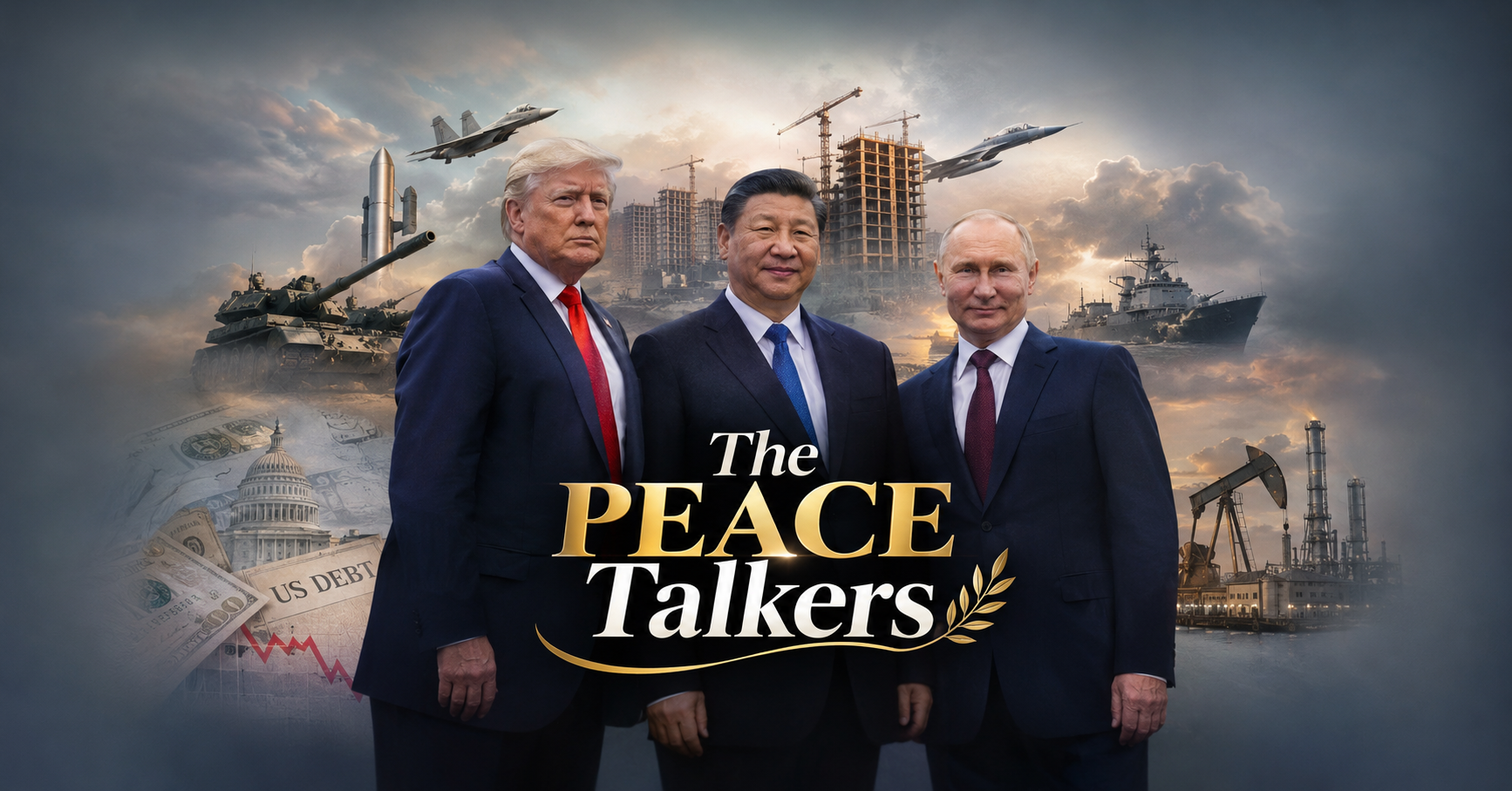
On 19 November 2026, Donald Trump, Xi Jinping and Vladimir Putin endorsed a declaration on strategic stability and nuclear risk in Shenzhen. A day later, Trump threatened severe penalties on American companies building AI data centres overseas,
warning that China could gain access to them. The sequence captures a defining feature of great-power politics: diplomacy may contain the danger of war, while competition for the computing infrastructure that will shape economic and military power accelerates.
DIPLOMACY AT THE TOP, COMPETITION UNDERNEATH
The declaration issued following the 19 November meeting in Shenzhen between US President Donald Trump, Chinese President Xi Jinping and Russian President Vladimir Putin deserves attention beyond its diplomatic language.
The three leaders reaffirmed that a nuclear war cannot be won and must never be fought and committed their countries to dialogue on reducing nuclear risks and preventing nuclear proliferation. They also discussed international security, United Nations reform and stable energy supplies.
It was an important political signal. Three nuclear powers, each pursuing different geopolitical interests, publicly acknowledged the necessity of maintaining strategic stability.
But the declaration did not establish a new strategic partnership. Nor did it resolve the fundamental disagreements separating Washington, Beijing and Moscow. Taiwan, Ukraine, military alliances, sanctions, technology restrictions and the competition for global influence remain unresolved.
The declaration was a commitment to dialogue, not a settlement of strategic rivalry.
Then came Washington’s next signal.
On 20 November, returning from Asia, Trump threatened to impose a “tremendous tax” on American companies building artificial intelligence data centres outside the United States. He argued that overseas facilities could allow China to access computing infrastructure that Washington considers strategically sensitive.
The announcement came without a detailed implementation mechanism, a proposed tax rate or a clear legislative framework. Trump also indicated that he had not yet discussed the proposal with his officials.
It must therefore be treated as a political warning, not an enacted prohibition.
Yet its strategic significance should not be underestimated.
The Shenzhen declaration addressed the risk of military confrontation. Trump’s data-centre warning addressed the infrastructure of future power.
The two developments are not contradictory. They illustrate how diplomacy and technological confrontation can operate simultaneously in contemporary geopolitics.
PUTIN’S 2017 WARNING: AI WOULD DECIDE WHO LEADS
In September 2017, Vladimir Putin told Russian students that artificial intelligence would shape the future of humanity and that the country leading in this field would become exceptionally powerful.
His often-quoted observation was that whoever becomes the leader in artificial intelligence will become the ruler of the world.
At the time, the statement appeared to be a prediction about an emerging technology. Nearly a decade later, it reads more like a strategic assessment.
AI is no longer simply a software industry. It is becoming an enabling layer across national economies, military establishments, intelligence networks, industrial production and critical infrastructure.
A country with advanced AI capabilities can potentially improve:
- Military intelligence, surveillance and reconnaissance.
- Cyber operations and electronic warfare.
- Autonomous drones and unmanned combat systems.
- Missile detection, tracking and targeting.
- Logistics, maintenance and battlefield decision-making.
- Industrial productivity, research and technological innovation.
AI leadership, however, cannot be measured by the quality of a chatbot or the popularity of a consumer application.
It depends on the entire technological ecosystem: advanced semiconductors, computing capacity, memory, networking, software, energy, data centres, research institutions and skilled personnel.
This is where the US–China contest becomes particularly significant.
WHY WASHINGTON IS PROTECTING ITS COMPUTING ADVANTAGE
To understand Trump’s warning, one must understand the strategic value of computing power.
A modern AI data centre is not merely a building housing servers. It is an industrial-scale computing facility containing specialised processors, high-speed networking, advanced memory, power-management systems and cooling infrastructure.
Training a frontier AI model requires enormous quantities of computing power operating in coordinated clusters. The more capable the hardware and the more efficiently it is connected, the greater the potential to develop sophisticated models.
The same infrastructure can support commercial applications, intelligence analysis, military research and advanced industrial systems.
Compute is becoming a strategic resource in much the same way that oil, energy and advanced manufacturing have been strategic resources in earlier periods.
The United States possesses considerable advantages across this technology stack.
American companies lead in advanced AI chip design, GPU software ecosystems, cloud platforms and frontier-model development. Taiwan remains central to leading-edge semiconductor manufacturing, while the Netherlands, South Korea and other US-aligned economies occupy critical positions in semiconductor equipment and advanced memory.
This is not exclusively an American advantage. It is a network of technological dependencies in which Washington holds considerable influence.
The strategic concern is that China could gain access to advanced American-designed processors without physically importing them.
That is the loophole Washington is attempting to close.
THE THIRD-COUNTRY COMPUTE ROUTE: WHY SOUTHEAST ASIA MATTERS
Washington has already moved beyond conventional restrictions on direct semiconductor exports to China.
On 16 November, the US Commerce Department announced new controls designed to restrict Chinese access to advanced American computing technology through overseas data centres.
The interim final rule, effective from 19 November, addresses remote access to advanced computing infrastructure. It introduces licensing requirements for certain advanced semiconductor shipments destined for data centres that provide significant computing capacity to Chinese-headquartered entities.
It also identifies Singapore, Malaysia, Thailand, Indonesia and Brazil as destinations requiring additional licensing scrutiny because of diversion risks.
The underlying concern is straightforward.
A Chinese technology company may be restricted from importing a particular advanced American processor. However, it could potentially rent computing capacity from a data centre in another country where those processors are available.
The company does not need to own the hardware. It needs access to the computing power.
For Washington, that distinction has become strategically unacceptable where the infrastructure could enable restricted Chinese entities to train advanced AI models.
The new controls seek to extend export restrictions from physical chips to the computing capacity those chips provide.
This is an important evolution in American technology policy.
Washington is no longer concerned only about where advanced chips are shipped. It is concerned about who can use the computing power, wherever the hardware is installed.
The distinction matters to international cloud providers, data-centre operators, semiconductor distributors and countries seeking to attract AI infrastructure investment.
It also explains why the Trump administration’s subsequent warning about overseas data-centre construction attracted attention.
The proposed tax and the Commerce Department’s licensing framework are separate policy developments. The former remains an announcement without a defined legal mechanism; the latter is a formal regulatory action.
Together, however, they reveal the direction of American strategic thinking.
WHY CHINA IS NOW A NECK-AND-NECK COMPETITOR
Washington’s concern is not simply that China is building more data centres. It is that Beijing is attempting to establish an independent technological ecosystem capable of competing with American leadership.
China has three significant advantages.
First, industrial scale. Its manufacturing ecosystem, engineering workforce, electronics supply chains and ability to mobilise capital provide a substantial foundation for technological development.
Second, state-directed technological investment. Beijing has treated semiconductor self-sufficiency and AI development as strategic national priorities for years. Export restrictions have intensified that effort.
Third, the ability to innovate around constraints. Chinese developers have demonstrated that competitive AI models can be developed with different combinations of hardware, algorithms and computing resources.
The country’s domestic AI chip industry is also advancing.
Huawei’s Ascend processors and associated computing systems are part of China’s effort to reduce dependence on Nvidia and other foreign suppliers. Chinese companies are developing alternative architectures, chip clusters and software ecosystems.
But China’s progress should not be confused with complete technological parity.
The US–China Economic and Security Review Commission’s November 2026 assessment identifies continuing Chinese weaknesses in advanced logic fabrication, high-bandwidth memory, semiconductor manufacturing equipment and the software ecosystem supporting leading AI processors.
American and allied technological advantages remain substantial.
This is the central paradox of China’s position: it is technologically powerful enough to challenge the United States, but remains dependent on critical technologies that it cannot yet reproduce at comparable scale and efficiency.
That is why Washington sees China as a serious competitor rather than an ordinary commercial rival.
China is not merely seeking access to American technology. It wants to eliminate the strategic dependence that gives Washington leverage over its technological development.
The competition is therefore about much more than market share.
It is about whether the United States can preserve its technological advantage while China builds the capacity to operate independently.
THE DEFENCE EQUATION: WHERE THE BALANCE OF POWER IS CHANGING
The most consequential dimension of this rivalry may not be visible in commercial AI products.
It is emerging in defence establishments.
Military power has traditionally depended on weapons platforms, ammunition, trained personnel, intelligence networks, logistics, communications and industrial capacity.
AI is increasingly connecting these elements.
Consider the changing battlefield environment.
A drone equipped with onboard computer vision can identify objects and navigate with reduced dependence on continuous human control. Satellite imagery can be processed more rapidly to identify military movements. Electronic-warfare systems can analyse signals and adapt to changing battlefield conditions.
AI-supported systems can also assist with predictive maintenance, supply-chain management, threat assessment and command decisions.
The advantage is not necessarily a completely autonomous weapon. It may be the ability to process information and respond faster than an adversary.
The strategic advantage is shifting towards the speed, accuracy and resilience of the entire military decision-making system.
This has implications for the United States, China and Russia, but their positions are different.
The United States: technological depth and integration
American defence advantages extend beyond AI companies.
Its strengths include advanced semiconductor design, cloud computing, military research institutions, satellite infrastructure, intelligence networks and an established defence-industrial ecosystem.
The challenge is integrating these capabilities into operational military systems while protecting sensitive data and maintaining reliable communications in contested environments.
China: scale, industrial capacity and military modernisation
China is combining industrial manufacturing capabilities with investments in AI, robotics, autonomous platforms, surveillance and advanced computing.
Its objective is not simply to match individual American weapons systems. It is to develop an integrated military ecosystem in which sensors, communications, computing and autonomous platforms operate together.
China’s manufacturing scale is particularly important in a prolonged technological or military competition, where the ability to produce and replace equipment can become as important as the sophistication of individual platforms.
Russia: battlefield adaptation rather than frontier AI supremacy
Russia occupies a different position.
It remains a major nuclear and military power, with extensive experience in missile systems, electronic warfare, air defence and battlefield adaptation.
Its war in Ukraine has accelerated the development and deployment of unmanned systems, autonomous navigation and AI-supported battlefield applications.
However, Russia is not competing with the United States and China on comparable terms in frontier AI infrastructure, advanced semiconductor manufacturing or commercial technology ecosystems.
Research by the Centre for Strategic and International Studies in 2026 highlights Russia’s pragmatic approach to AI-enabled drones and tactical autonomy. It also identifies the continued dependence of Russian unmanned systems on globally sourced electronic components, including Western-origin hardware.
Russia’s strategic relevance therefore comes from its nuclear arsenal, military experience, energy resources, cyber capabilities and geopolitical relationships—not from being an equal competitor in the global frontier AI race.
The emerging defence equation is not simply about who possesses the most advanced weapons. It is increasingly about who can combine computing, manufacturing, intelligence and operational decision-making into a resilient military system.
WHY INDIA IS NOT YET A THREAT TO THE TOP THREE
India is an increasingly important technological and strategic power. But it is important to distinguish between a country with considerable potential and one that can challenge established superpowers across the entire AI and defence technology ecosystem.
India is not yet a peer competitor to the United States or China in frontier AI infrastructure, advanced semiconductor manufacturing or military computing at scale.
Nor does it possess Russia’s nuclear and military-industrial capabilities.
The gap is structural.
Computing capacity: India is expanding access to AI infrastructure, but remains behind the scale of the largest American and Chinese computing ecosystems.
The IndiaAI Mission had expanded shared computing capacity to more than 45,000 GPUs by June 2026, according to government figures. This is a significant foundation for research, start-ups and domestic AI development, but it is not equivalent to the concentrated frontier-training infrastructure available to leading American and Chinese technology companies.
Semiconductor manufacturing: India has made progress through the India Semiconductor Mission, approved fabrication and packaging projects, and domestic chip-design initiatives. However, it does not yet possess the advanced manufacturing ecosystem required to compete with Taiwan’s leading-edge foundries or the wider US-aligned semiconductor supply chain.
Energy and data-centre infrastructure: India’s growing electricity demand, grid reliability, land availability, water requirements and cooling infrastructure will influence how rapidly it can expand AI computing capacity.
Military technology: India has a substantial defence-industrial base and is investing in indigenous drones, missiles, surveillance, electronic warfare and AI applications. However, the integration of advanced computing, secure communications, autonomous platforms and military command systems remains a long-term capability-building exercise.
Research and intellectual property: India has a strong engineering workforce and a growing AI developer community. The next challenge is converting that talent into globally competitive semiconductor technologies, foundational models, advanced computing systems and defence applications.
The distinction is important.
India does not currently threaten the technological supremacy of the United States or China’s ambition to achieve it. Nor does it challenge Russia’s nuclear position.
But India does not need to become a direct competitor to all three to become strategically indispensable.
Its opportunity lies in building a different model of technological power.
INDIA’S STRATEGIC OPPORTUNITY: TRUSTED COMPUTE AND DEFENCE AUTONOMY
The global AI contest creates an opening for India.
American companies and policymakers increasingly seek trusted locations for technology infrastructure, resilient supply chains and digital services outside China.
India offers a large domestic market, engineering talent, a growing digital economy, strategic geography and an established relationship with the United States and other technology partners.
However, India must avoid becoming merely a low-cost destination for foreign-owned data centres.
The priority should be sovereign capability, not simply installed capacity.
That requires five parallel investments.
- Domestic computing capacity: Expand access to advanced GPUs, high-performance computing and Indian-controlled infrastructure for strategic applications.
- Semiconductor capability: Move beyond chip design and assembly towards stronger domestic capabilities in fabrication, advanced packaging, materials and semiconductor equipment.
- Energy security: Ensure that data-centre expansion is supported by reliable electricity, grid investment, renewable generation and efficient cooling.
- Defence AI: Develop secure, air-gapped computing, edge AI, autonomous platforms and Indian-controlled data systems for military applications.
- Trusted international partnerships: Attract foreign investment and technology while maintaining transparent rules on ownership, data access, end users and critical infrastructure.
India’s strongest opportunity may lie in AI inference and applications rather than attempting to match American frontier-model training expenditure immediately.
Inference is the process through which a trained model performs tasks and generates outputs. It can support applications across financial services, manufacturing, agriculture, healthcare, logistics, public administration and defence.
This is an enormous economic opportunity.
For India’s defence planners, the lesson is equally clear: essential military AI systems must be capable of functioning securely even when foreign cloud services, external communications or satellite networks become unavailable.
Strategic autonomy means retaining the ability to operate critical systems when international partnerships are disrupted.
India should collaborate internationally, but it must not outsource its strategic nervous system.
THE LARGER GEOPOLITICAL TRUTH
The Shenzhen declaration and Trump’s subsequent warning on overseas AI infrastructure reveal two parallel realities.
The first is that nuclear powers have a shared interest in avoiding catastrophic military escalation. The second is that they have little intention of surrendering their technological, industrial or strategic advantages.
The United States wants to preserve its lead in advanced computing and prevent China from converting access to American technology into military and economic leverage.
China wants to overcome technological dependence, build a self-sufficient semiconductor ecosystem and establish itself as a global AI power.
Russia remains a consequential military and nuclear power, but its technological position is more constrained and increasingly shaped by battlefield adaptation and its relationship with China.
India is not yet in the same competitive league. Its challenge is to build the infrastructure, industrial capabilities and technological independence required to become a major power in its own right.
The next phase of great-power rivalry will not be determined by semiconductors alone, or by the number of data centres a country constructs. It will be determined by the ability to combine compute, energy, manufacturing, research, military integration and strategic control.
That is why Washington is worried about overseas data centres. The hardware may be located thousands of kilometres away, but the strategic consequences of who controls its computing power can be felt on a battlefield, in a factory or inside a national security command centre.
Diplomacy may reduce the risk of war. It cannot eliminate the competition for technological supremacy.
Peace may be declared in Shenzhen. The next generation of global power will still be built in data centres.
SOURCES AND REFERENCE MATERIAL
- The White House – US–Russia–China Heads of State Declaration toward Peace, 19 November 2026.
- Federal Register – Addressing Remote Access to Advanced Semiconductors, US Department of Commerce, 19 November 2026.
- US–China Economic and Security Review Commission – 2026 Annual Report: Silicon to Sovereignty – China’s Bid to Control the AI Stack.
- Brookings Institution – Competing AI Strategies for the US and China.
- Centre for Strategic and International Studies – How Russia Is Building a Sovereign Drone Ecosystem for AI-Driven Autonomy, April 2026.
- Press Information Bureau, Government of India – IndiaAI Mission: Building India’s Sovereign and Inclusive AI Ecosystem, 2026.
- News agencies – Reports on Trump’s overseas data-centre penalty announcement, US restrictions on remote access to advanced AI chips, and China’s response, November 2026.
- News agencies – Reports on China’s domestic AI semiconductor development and the global US–China technology competition, 2026.





Leave a Reply