
MSME BRIEFING | SPECIAL COMMODITY & INDUSTRY REPORT | 2026–27
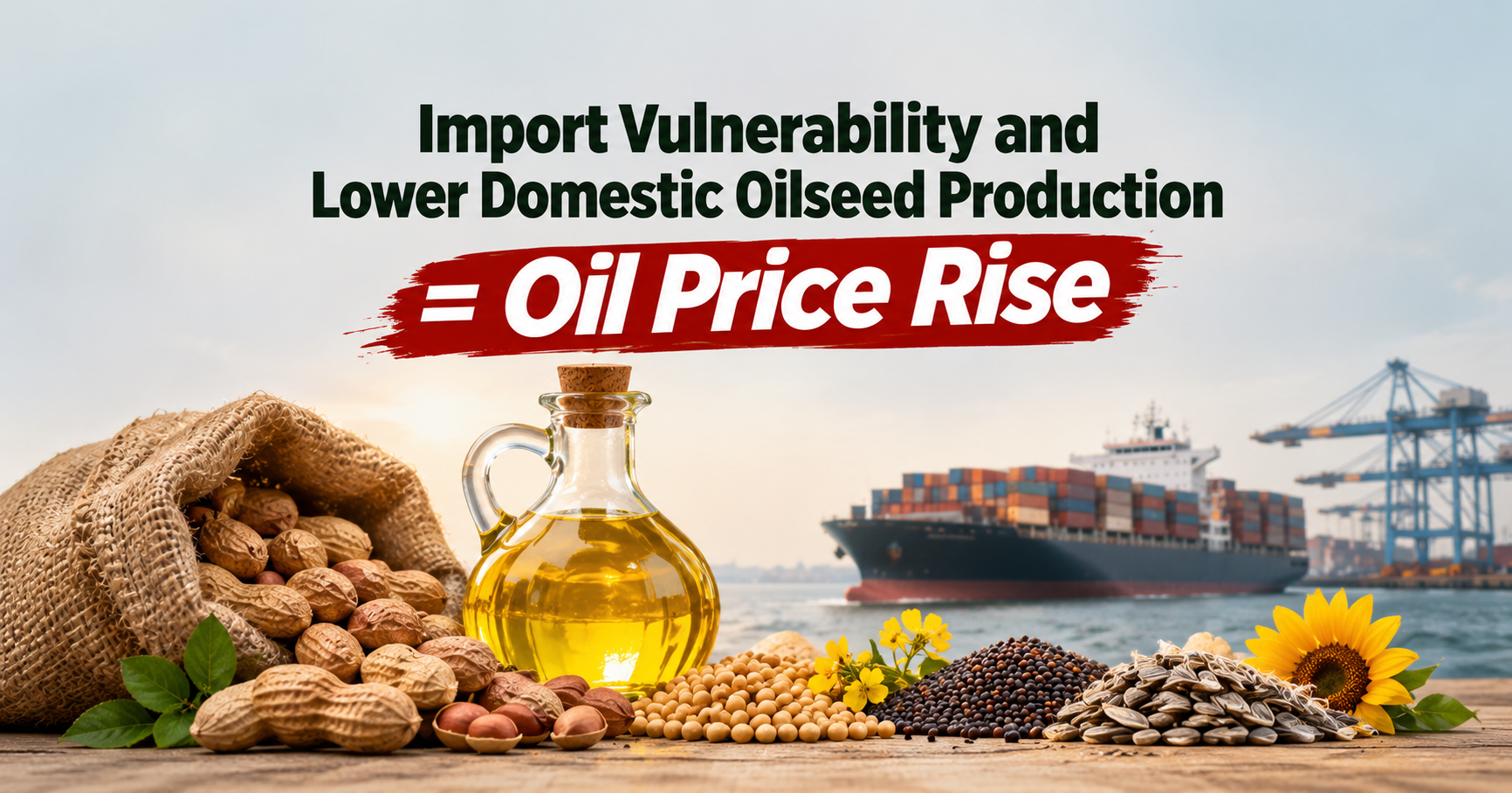
Crop uncertainty, imports and idle mills put India’s oil economy under strain
India’s edible-oil market faces another year of supply and cost pressures. Groundnut oil could rise 8–15% year on year, cottonseed 8–14%, mustard 5–12% and palm 6–10%, while soybean and sunflower oils may increase 2–6%. For manufacturers, the bigger concern is raw-material availability: crushing capacity could remain underutilised even as imports rise. Farmers, millers, food processors and consumers must prepare for uneven price movements, tighter margins and changing procurement economics.
India’s edible-oil dilemma: a major producer, a dependent importer
India’s edible-oil industry enters 2026–27 with a structural contradiction. The country is a significant producer of oilseeds, has a large domestic processing industry and a substantial agricultural workforce, yet remains heavily dependent on imported edible oils to meet consumption requirements.
The problem is not simply inadequate agricultural production. It is the gap between oilseed cultivation, the quantity available for commercial crushing, domestic oil extraction, the economics of processing and the ability of local producers to compete with imported oils.
According to the Government’s sector assessment, domestic edible-oil production in 2023–24 was approximately 12.18 million tonnes, meeting around 44% of domestic demand. The remaining requirement had to be met through imports. This structural dependence exposes India to international commodity prices, freight costs, currency movements, geopolitical developments and the export policies of supplier countries.
The demand pressure is unlikely to disappear. Population growth, urbanisation, rising household incomes, changing food habits and the expansion of restaurants and packaged-food businesses continue to support consumption.
Industry assessments put India’s edible-oil consumption at approximately 25.7 million tonnes in 2025–26, with demand potentially increasing to around 26.5 million tonnes in 2026–27. These are industry projections, rather than final government consumption statistics.
The implication for businesses is important: India needs to manage two objectives simultaneously — ensuring affordable edible oil for consumers and creating a viable domestic oilseed-processing economy.
A policy that achieves one objective at the expense of the other can create problems elsewhere in the value chain.
India’s supply-demand balance: imports remain indispensable
The scale of India’s import dependence is visible in the latest trade figures.
The Solvent Extractors’ Association of India (SEA) reported edible-oil imports of 151.64 lakh tonnes between November 2025 and September 2026, against 146.83 lakh tonnes during the corresponding period a year earlier, an increase of approximately 3.27%.
The composition of imports is equally significant.
| Import category | November 2025–September 2026 |
|---|---|
| Total edible-oil imports | 151.64 lakh tonnes |
| Crude edible oils | 144.24 lakh tonnes |
| Refined edible oils | 7.40 lakh tonnes |
| Crude oil share | Approximately 95% |
| Refined oil share | Approximately 5% |
The shift towards crude imports reflects the importance of domestic refining. Indian refiners import crude palm, soybean and sunflower oils and undertake further processing before selling them into the domestic market.
This creates business opportunities for large refiners and port-based processing companies. It also explains why import duty policy is commercially important: the difference between duties on crude and refined oil influences where value addition takes place.
The SEA figures cover eleven months of the November–October oil year, not a complete year. They should not be confused with financial-year import statistics.
The November 2026 USDA outlook estimates India’s 2026–27 imports of vegetable oils at approximately 17.39 million tonnes, including:
| Oil | USDA import projection |
|---|---|
| Palm oil | 8.40 million tonnes |
| Soybean oil | 5.00 million tonnes |
| Sunflower oil | 3.85 million tonnes |
| Total of three oils | 17.25 million tonnes |
The balance comprises smaller vegetable-oil categories.
The projections indicate that imports will remain central to India’s edible-oil availability. However, the composition of imports is changing, and this will have consequences for refiners, traders and domestic oil mills.
Six oils, six different price trajectories
A common mistake in commodity analysis is to treat edible oil as a single market. Groundnut, cottonseed, mustard, palm, soybean and sunflower oils have different production structures, sourcing patterns, consumer preferences and industrial applications.
Their price movements will therefore differ.
The following are MSME Briefing’s indicative directional price projections for 2026–27, expressed as year-on-year changes. They are editorial assessments based on the crop, import, supply and demand conditions discussed below, not official government or USDA price forecasts. The ranges should be read as an outlook rather than guaranteed price targets.
| Edible oil | Indicative price outlook |
|---|---|
| Groundnut oil | 8–15% increase |
| Cottonseed oil | 8–14% increase |
| Mustard oil | 5–12% increase |
| Palm oil | 6–10% increase |
| Soybean oil | 2–6% increase |
| Sunflower oil | 2–6% increase |
The underlying price benchmark must be kept consistent when these ranges are updated. Actual movements will vary by grade, location, wholesale or retail channel and the comparison period.
Groundnut oil: Gujarat faces the greatest exposure
Groundnut oil faces the highest domestic supply risk, particularly in Gujarat, India’s leading groundnut-producing state.
The SEA’s Kharif 2026 survey estimates Gujarat’s groundnut production at 33.34 lakh tonnes, compared with 41.88 lakh tonnes in 2025. This represents a decline of approximately 20.4%.
The reduction is attributable to both lower acreage and weaker yields.
| Gujarat Kharif groundnut | 2025 | 2026 estimate |
|---|---|---|
| Area | 22.02 lakh hectares | 20.71 lakh hectares |
| Yield | 1,902 kg/hectare | 1,608 kg/hectare |
| Production | 41.88 lakh tonnes | 33.34 lakh tonnes |
The estimated production shortfall is approximately 8.54 lakh tonnes.
The implications extend beyond farmers. Rajkot, Gondal, Amreli, Junagadh, Bhavnagar and neighbouring areas have an extensive network of groundnut traders, oil expellers, solvent extraction units and oilcake manufacturers.
A smaller crop reduces the pool of raw material available to these businesses. Competition among crushers can increase procurement prices, while mills unable to secure sufficient quantities may operate fewer days or reduce throughput.
However, total crop production should not be confused with the quantity available for crushing. Groundnut is also consumed directly, retained for seed, traded for other uses and exported. Quality and moisture content influence its suitability for oil extraction.
The distinction is critical when estimating actual mill supply.
The Government’s MSP for groundnut for the 2026–27 marketing season is ₹7,517 per quintal. MSP provides a procurement reference and a price-support mechanism, but it does not mean every farmer will necessarily realise that price in the open market.
For oil mills, the central issue is not merely the size of the crop. It is the availability of oil-grade groundnut at a price that makes crushing commercially viable.
MSME Briefing outlook: Groundnut oil could rise 8–15% year on year, with Gujarat and western India facing greater regional pressure if market arrivals remain below normal.
Cottonseed oil: the pressure extends to animal feed
Cottonseed oil is another important domestic oil, particularly in Gujarat and parts of western and central India.
Cottonseed is a by-product of cotton ginning. A decline in cotton production therefore reduces the quantity of seed available to oil mills.
The Cotton Association of India’s first estimate places 2026–27 cotton pressing at 280 lakh bales of 170 kg each, compared with 325.69 lakh bales in the preceding season. This indicates a decline of approximately 14%.
The reduction has consequences for more than the edible-oil industry.
Cottonseed processing produces cottonseed oil and oilcake. The latter is an important ingredient in cattle-feed formulations. Reduced availability can therefore influence feed manufacturers, dairy farmers and livestock-feed procurement costs.
The economics of cottonseed processing must be evaluated across both products. A mill’s profitability depends not only on the price of extracted oil but also on the realisation from oilcake, processing costs and the availability of seed.
There is, however, a limit to how far cottonseed oil prices can rise. Commercial buyers may substitute soybean oil, palmolein or other permitted oils depending on product specifications, taste, frying performance and relative prices.
MSME Briefing outlook: Cottonseed oil could rise 8–14% year on year, with Gujarat’s oil mills and cattle-feed businesses exposed to tighter raw-material availability.
Mustard oil: the Rabi crop will determine direction
Mustard oil occupies an important position in India’s domestic edible-oil market, particularly in northern and eastern India.
Its 2026–27 outlook depends on Rabi acreage, soil moisture, winter weather and eventual yields.
Mustard has a different demand profile from palm and soybean oils. Consumer preference for its pungency and traditional culinary applications limits substitution in certain regions.
If acreage and yields remain healthy, domestic mustard supplies can moderate the pressure on other edible oils. A disappointing crop, however, could tighten availability and increase competition for seed.
MSME Briefing outlook: Mustard oil could rise 5–12% year on year, with the actual movement dependent on Rabi sowing and crop development.
Soybean oil: imports offer a partial cushion
Soybean oil is exposed to domestic soybean production, but its import flexibility provides a buffer against a domestic crop shortfall.
India can source crude soybean oil from international suppliers, particularly South America. However, global soybean availability, export taxes, crushing economics, freight and exchange rates influence landed costs.
The November 2026 USDA outlook places India’s soybean-oil imports at approximately 5 million tonnes in 2026–27, against 5.6 million tonnes in 2025–26.
The lower import projection does not necessarily indicate lower domestic demand. It reflects the expected availability of internationally traded soybean oil and the changing balance among competing oils.
Domestic soybean acreage and production also matter. The USDA’s September assessment revised India’s soybean acreage and production estimates down because of erratic monsoon conditions and diversification towards other crops.
MSME Briefing outlook: Soybean oil could rise 2–6% year on year, with imported supply providing a partial cushion.
Sunflower oil: global availability will matter more than domestic production
India’s sunflower-oil market is particularly dependent on imports.
The Black Sea region has historically been an important source of sunflower seed and oil. Geopolitical disruptions, export logistics and changes in production in Ukraine and Russia can influence international prices.
However, the sourcing structure is evolving. Argentina has increased its importance in India’s sunflower-oil imports, partly offsetting lower shipments from traditional suppliers.
The USDA’s November outlook estimates India’s sunflower-oil imports at approximately 3.85 million tonnes in 2026–27, compared with 3 million tonnes in the previous year.
This is an important revision. It suggests that global availability and sourcing diversification could moderate domestic supply concerns, even as international price volatility remains.
MSME Briefing outlook: Sunflower oil could rise 2–6% year on year, although geopolitical and freight disruptions remain important risks.
Palm oil: the largest import channel
Palm oil is India’s largest imported edible oil and a major input for commercial food preparation, restaurants, bakeries, namkeen manufacturers, vanaspati producers and packaged-food businesses.
The USDA projects India’s palm-oil imports at approximately 8.4 million tonnes in 2026–27, compared with 8.1 million tonnes in 2025–26.
The global palm-oil market is dominated by Indonesia and Malaysia. Their production, domestic consumption, export policies and biodiesel programmes influence the quantity available to international buyers.
Indonesia’s increasing biodiesel blending requirements have changed its domestic palm-oil consumption and export availability. Malaysia has benefited from stronger competitiveness and supply availability.
Palm oil prices are also influenced by crude-oil prices through the economics of biofuels, although the relationship is not automatic. Production, inventories, export taxes, weather and competing vegetable oils remain important.
MSME Briefing outlook: Palm oil could rise 6–10% year on year. The impact may be particularly visible among commercial kitchens, food manufacturers and packaged-snack companies.
The agricultural supply problem: production is not the same as market availability
The first stage of the edible-oil supply chain begins with farmers, but the quantity of oilseed produced is not necessarily the quantity available to crushers.
The actual supply chain is affected by:
- Cultivated acreage and yield.
- Seed quality and oil content.
- Moisture and storage losses.
- Farmer retention for household use and sowing.
- Direct consumption and competing industrial applications.
- Export commitments.
- Mandi arrivals and stock availability.
- Procurement prices and credit conditions.
For example, a decline in Gujarat’s groundnut crop does not translate into an identical percentage decline in groundnut-oil production. The final effect depends on the quantity actually sold to mills, the quality of seed and extraction recovery.
The same principle applies to cottonseed.
For business owners, this means that headline production estimates are only the starting point. Market arrivals and procurement availability are more immediate indicators of the raw-material position facing a processing unit.
Farmers also need to understand the difference between MSP and market realisation. MSP is an important policy instrument, but actual procurement access, local market prices, quality deductions, transport expenses and payment timing influence the farmer’s final income.
The Government’s National Mission on Edible Oils–Oilseeds (NMEO-OS), approved in October 2024, aims to increase primary oilseed production from 39 million tonnes in 2022–23 to 69.7 million tonnes by 2030–31.
The Government reported that more than 600 value-chain clusters had been operationalised by August 2026, involving FPOs, cooperatives and other agencies.
The mission is strategically important, but higher production targets alone will not create self-sufficiency. Better seeds, irrigation, extension services, post-harvest infrastructure, price realisation and reliable market linkages are equally necessary.
The international supply chain: India’s dependence is also geopolitical
India’s edible-oil procurement strategy is changing as international suppliers adjust their export policies and domestic consumption.
According to the USDA’s November 2026 report, Argentina and Malaysia have moved ahead of Indonesia as India’s leading vegetable-oil suppliers, with Indonesia falling to third position.
This represents a significant shift from the historical trading relationship.
Indonesia’s expanding biodiesel programme has increased domestic palm-oil consumption, reducing the quantity available for exports. Malaysia and Thailand have increased shipments to India, supported by production and competitive pricing.
Argentina has become increasingly important for soybean and sunflower oil. Changes in its export taxation have also influenced its competitiveness.
Nepal has emerged as another important route for refined soybean oil. Under preferential South Asian trade arrangements, refined oil processed in Nepal can enter India under applicable tariff conditions. The USDA has highlighted the importance of this trade channel.
For Indian importers, these developments create both opportunities and risks.
A diversified sourcing strategy can reduce dependence on one supplier. However, it also requires close monitoring of:
- Export taxes and trade restrictions.
- Biodiesel blending mandates.
- Currency movements.
- Freight and insurance costs.
- Port congestion and shipping availability.
- International inventories and futures prices.
The rupee is particularly important. Even if the international dollar price of crude palm or soybean oil remains unchanged, a weaker rupee increases the domestic landed cost.
Importers and refiners should therefore evaluate their exposure through both commodity prices and currency movements.
The crushing-capacity paradox: machines are available, raw material is not always economical
India’s edible-oil processing industry has substantial installed capacity, but the ability to operate a plant profitably depends on raw-material availability and the economics of crushing.
This distinction is important.
A processing unit may have machinery capable of handling thousands of tonnes of seed annually. However, if local procurement is insufficient, expensive or commercially unviable, the plant cannot operate at its rated capacity.
Industry assessments have historically indicated low utilisation across several segments of India’s oil-processing industry.
A NITI Aayog assessment cited indicative capacity utilisation of approximately 20–30% for oil mills, 40% for solvent-extraction plants and 50% for vegetable-oil refineries. These are historical structural indicators, not a measurement of utilisation in the current season.
For the broader crushing industry, estimates of around 50 million tonnes of installed capacity are often used in industry comparisons. Against a USDA 2026–27 crushing projection of approximately 34.3 million tonnes, the implied utilisation is around 69%.
| India: crushing capacity illustration | Volume |
|---|---|
| Indicative installed capacity | 50 million tonnes |
| Projected crushing | 34.3 million tonnes |
| Implied unused capacity | 15.7 million tonnes |
| Implied utilisation | 68.6% |
| Implied unused capacity | 31.4% |
The 31.4% figure is a calculated national-level illustration, not a Gujarat-specific forecast or a prediction that 31.4% of mills will shut down. Installed-capacity estimates may also differ by plant category and reporting methodology.
The more important issue is the structural difference between large port-based refiners and regional oilseed crushers.
Large refiners can import crude edible oils and process them close to ports. Their raw-material supply is linked to international procurement and shipping.
Smaller groundnut, cottonseed and soybean mills depend more heavily on local agricultural arrivals. They cannot always replace a shortage of domestic seed with imported crude oil because their machinery, business model, financing and market access may be different.
This creates an uneven competitive environment.
A regional mill can face falling utilisation even when India’s total edible-oil imports and refining activity remain substantial.
The problem is not simply excess machinery. It is the mismatch between processing capacity, geographical availability of raw material and commercially viable procurement.
Inside the oil mill: the economics of crushing
An oil mill’s profitability cannot be assessed by looking only at the selling price of edible oil.
A crushing unit earns revenue from the oil extracted and the by-product generated during processing. The value of oilcake or de-oiled meal can make a substantial difference to the economics.
The basic calculation is:
Total realisation = edible-oil sales + by-product sales
Against this revenue, the mill must account for:
- Seed procurement.
- Transport and handling.
- Power and fuel.
- Labour and maintenance.
- Extraction losses.
- Packaging and storage.
- Interest on working capital.
- Finance and administrative costs.
Consider an illustrative crushing calculation.
A mill purchases one tonne of oilseed. It extracts a certain quantity of oil and sells the remaining material as oilcake or meal. The actual recovery depends on the crop, seed quality, moisture, processing technology and extraction method.
If seed prices rise faster than the combined realisation from oil and by-products, the crushing margin contracts.
If oil prices rise while seed procurement remains stable, the mill may benefit. But when raw-material prices increase simultaneously, higher selling prices do not necessarily translate into higher profitability.
This is why oil mills must monitor the crush spread, rather than merely tracking the market price of edible oil.
Working capital adds another complication. A mill that must pay farmers and traders promptly but receives payment from distributors later has to finance the gap. Higher seed prices increase the amount of capital required to maintain the same level of production.
For smaller units, even a short period of low utilisation can raise the cost per tonne because fixed expenses are spread across a smaller production volume.
A mill’s commercial response should therefore be based on actual recovery rates, by-product prices, procurement commitments and financing costs.
There is no universal break-even utilisation percentage applicable to every oil mill. It depends on the technology, capacity, product mix, debt burden and operating costs.
Who gains and who loses? The distribution of economic impact
The edible-oil price cycle does not affect all participants equally.
Higher prices may benefit some producers, but the same movement can increase costs for processors and consumers.
Farmers: A reduction in oilseed supply can improve the bargaining position of farmers who have marketable stocks. However, lower yields may offset the benefit of higher prices. A farmer who produces 20% less seed does not automatically earn more because the market price has risen.
Oil mills: Mills with secure raw-material procurement and efficient operations may protect their margins. Units dependent on spot purchases may face higher costs and lower throughput.
Large refiners: Companies with import access, storage infrastructure and established distribution networks may benefit from the ability to source crude oils internationally. Their margins will still depend on landed costs, refining spreads and competition.
Importers and traders: Volatility creates opportunities, but it also increases inventory and currency risk. Incorrect procurement timing can turn a seemingly profitable stock position into a loss.
Oilcake and feed manufacturers: Changes in cottonseed, soybean and mustard processing affect the supply and prices of feed ingredients. This can influence livestock and dairy economics.
Food manufacturers: Businesses using large quantities of frying oil face direct pressure on their variable costs. Their ability to pass on the increase depends on competition, consumer purchasing power and brand positioning.
Consumers: Households may shift between oils, purchase smaller packs, reduce deep-frying or move towards lower-priced brands. However, substitution is constrained by taste, cooking habits and product suitability.
The distributional effect is important: a higher edible-oil price does not create an equal economic benefit for every participant in the supply chain.
The food-processing MSME challenge: the cost reaches beyond cooking oil
The most immediate business impact may be felt by food-processing MSMEs.
Namkeen and farsan manufacturers, bakeries, biscuit makers, sweet manufacturers, restaurants and packaged-food businesses use different edible oils and vegetable fats according to their product requirements.
For a business that uses 10,000 litres of oil a month, a procurement increase of ₹10 per litre creates an additional monthly expense of ₹1 lakh.
| Increase in oil procurement cost | Additional monthly expense |
|---|---|
| ₹5 per litre | ₹50,000 |
| ₹10 per litre | ₹1,00,000 |
| ₹15 per litre | ₹1,50,000 |
The annualised impact of a ₹10-per-litre increase would be ₹12 lakh, assuming consumption remains unchanged.
For a small manufacturer operating on a narrow gross margin, this is not a minor adjustment.
The impact is not restricted to direct oil consumption. Higher edible-oil prices can influence the cost of fried snacks, restaurant meals, bakery products and packaged foods.
A manufacturer has four broad choices:
- Absorb the higher cost and accept lower margins.
- Increase the selling price.
- Reformulate the product where technically and legally permissible.
- Improve process efficiency and reduce wastage.
Each option has commercial consequences.
Increasing prices may affect volumes. Changing the oil may alter taste, shelf life and consumer acceptance. Reducing oil consumption requires process control rather than arbitrary changes in formulation.
Businesses should therefore calculate edible-oil expenditure as a percentage of total production cost, rather than making procurement decisions solely on the basis of market prices.
For larger manufacturers, procurement contracts and supplier diversification may help. Smaller units can benefit from collective procurement through associations, cooperatives or organised buying groups.
The key management priority is to protect contribution margins without compromising product quality or food safety.
Animal feed and dairy: the second-round impact
The edible-oil economy also has a significant connection with animal nutrition.
Oilseed crushing produces oilcakes and meals that are used in cattle feed, poultry feed and other animal-nutrition products.
Cottonseed availability is particularly relevant to Gujarat’s dairy economy. A reduction in cottonseed supply can influence the availability and pricing of cottonseed cake.
However, the relationship is not one-directional. Higher edible-oil prices do not automatically mean higher oilcake prices. The value of oilcake depends on demand for protein, competing feed ingredients, crushing volumes and livestock economics.
Feed manufacturers should monitor cottonseed cake, soybean meal, mustard cake and other protein ingredients together.
For dairy farmers, the cost of feed is a major operating expense. If feed prices increase, the benefit of higher milk realisations may be partly offset.
This is another reason why the edible-oil market should be assessed as an agricultural and industrial value chain rather than an isolated consumer commodity.
Government policy: balancing farmers, consumers and processors
The Government’s import-duty decisions demonstrate the difficulty of balancing competing interests.
On 24 September 2026, the Government reduced basic customs duty on major crude edible oils:
| Product | Earlier basic duty | Revised basic duty |
|---|---|---|
| Crude sunflower oil | 10% | Nil |
| Crude soybean oil | 10% | 5% |
| Crude palm oil | 10% | 5% |
The Government maintained a 19.25-percentage-point duty differential between crude and refined edible oils to support domestic refining.
The intention was to moderate domestic prices while retaining an incentive for refining and value addition within India.
This is a significant policy instrument.
Lower import duties can reduce landed costs and provide relief to consumers. But if imported oils become substantially cheaper than domestically produced alternatives, domestic oilseed processors may face greater competition.
The Government therefore has to balance three interests:
- Affordable edible oil for consumers.
- Remunerative prices and markets for farmers.
- Commercial viability of domestic processing and refining.
The National Mission on Edible Oils–Oilseeds is an important part of the longer-term response.
Its production target of 69.7 million tonnes of primary oilseeds by 2030–31 is ambitious. However, the success of the mission will depend on productivity, seed quality, market access, farmer returns and investment in processing infrastructure.
The policy challenge is not simply to grow more oilseeds. India must create an economically sustainable chain from farm to consumer.
Three scenarios for India’s edible-oil market in 2026–27
For business planning, it is useful to consider three possible scenarios.
These are analytical scenarios, not official forecasts.
| Scenario | Conditions | Likely market outcome |
|---|---|---|
| Favourable | Better Rabi yields, normal arrivals, stable currency and adequate imports | Price increases moderate; mill utilisation improves |
| Base case | Groundnut and cottonseed remain tight, imports continue and global supply stays available | Domestic oils remain firm; imported oils offer partial relief |
| Adverse | Further crop deterioration, weaker rupee, higher freight or global supply disruption | Sharper price increases, tighter margins and higher working-capital needs |
The base case appears the most appropriate planning assumption at present.
Groundnut and cottonseed oil face relatively greater domestic supply risks. Palm oil remains exposed to global production and biofuel policies. Soybean and sunflower oils have a more diversified import channel, although they are not immune to international volatility.
Businesses should not build their budgets around the most favourable scenario. Nor should they assume that every commodity will rise at the upper end of the forecast range.
A disciplined approach is to prepare a procurement budget under all three scenarios and review it as new crop-arrival and import data become available.
What should businesses do? A practical advisory
For farmers
Monitor local mandi arrivals, MSP procurement arrangements, quality premiums and actual market realisations. Evaluate storage and selling decisions against the cost of holding stocks, not merely expectations of higher prices.
For oil mills
Calculate crushing margins using actual seed procurement prices, extraction recovery and oilcake realisations. Review plant utilisation, power costs, working capital and supplier relationships. Avoid running at a loss simply to maintain production volumes.
For importers and refiners
Diversify sourcing, monitor customs-duty changes, assess currency exposure and avoid excessive inventory positions. Review the economics of crude versus refined imports as tariff structures change.
For food-processing MSMEs
Calculate monthly oil consumption and the cost contribution of edible oil to each product. Review supplier contracts, wastage, filtration and inventory cycles. Test any proposed oil substitution for technical suitability, consumer acceptance and regulatory compliance.
For distributors and retailers
Monitor replacement costs rather than relying exclusively on the historical purchase price of inventory. Keep stock levels aligned with actual sales and avoid speculative accumulation.
For feed manufacturers and dairy businesses
Track oilcake and meal availability alongside competing protein ingredients. Build alternative procurement options without compromising feed quality.
For policymakers
Continue strengthening oilseed productivity, extension services, procurement infrastructure and market linkages. Import-duty changes should be evaluated not only for their immediate consumer impact but also for their consequences for farmers and domestic processors.
The larger question: can India convert agricultural potential into industrial competitiveness?
India’s edible-oil challenge is not simply about rising prices. It is about the structural weakness of a value chain that has significant agricultural potential, substantial processing capacity and a growing consumer market, yet remains dependent on imported oils.
The 2026–27 outlook highlights the vulnerability.
A smaller groundnut crop in Gujarat can affect oil mills in Saurashtra. Reduced cotton production can influence cottonseed availability and cattle-feed costs. Global palm-oil policies can affect the landed cost of cooking oil in India. A change in the rupee can alter import economics. Food manufacturers then face the challenge of protecting margins without losing customers.
These are interconnected developments.
For farmers, the priority is productivity and remunerative market access. For oil mills, it is viable raw-material procurement and efficient crushing. For refiners, it is sourcing and cost management. For food manufacturers, it is procurement discipline and margin protection. For policymakers, it is the difficult task of balancing consumer affordability with domestic agricultural and industrial competitiveness.
India does not need processing capacity alone. It needs a dependable, productive and commercially viable domestic oilseed supply chain.
Until that gap is addressed, the country will remain exposed to international edible-oil prices, even as substantial domestic processing capacity remains underutilised.
For businesses, the message is straightforward: do not treat edible oil merely as another ingredient in the cost sheet. Treat it as a strategic procurement exposure, monitor the supply chain and prepare for price volatility before it reaches the factory gate.
Sources and data credits
- Solvent Extractors’ Association of India (SEA): Edible-oil import statistics, crude and refined import composition, Gujarat Kharif groundnut crop survey and industry assessments. The Economic Times+1
- USDA Foreign Agricultural Service: Oilseeds: World Markets and Trade, November 2026; India oilseed and vegetable-oil supply-demand estimates and international trade outlook. apps.fas.usda.gov+1
- Cotton Association of India: First estimate and cotton balance sheet for the 2026–27 season. CAI Online
- Ministry of Consumer Affairs, Food and Public Distribution: September 2026 customs-duty revisions on imported edible oils. Press Information Bureau
- Ministry of Agriculture and Farmers Welfare: National Mission on Edible Oils–Oilseeds, production targets and implementation updates. Press Information Bureau
- NITI Aayog: Edible-oil industry structure, processing capacity and historical capacity-utilisation assessment.
- Ministry of Statistics and Programme Implementation: Consumer Price Index and food inflation statistics. Press Information Bureau
- Industry research and market intelligence: CRISIL Ratings, commodity-market assessments and relevant industry reporting. Today News





Leave a Reply