
MSME Briefing Bureau
GCC Steel Demand: 11.3% Recovery in 2027
India’s route, product and localisation strategy will shape Gulf trade
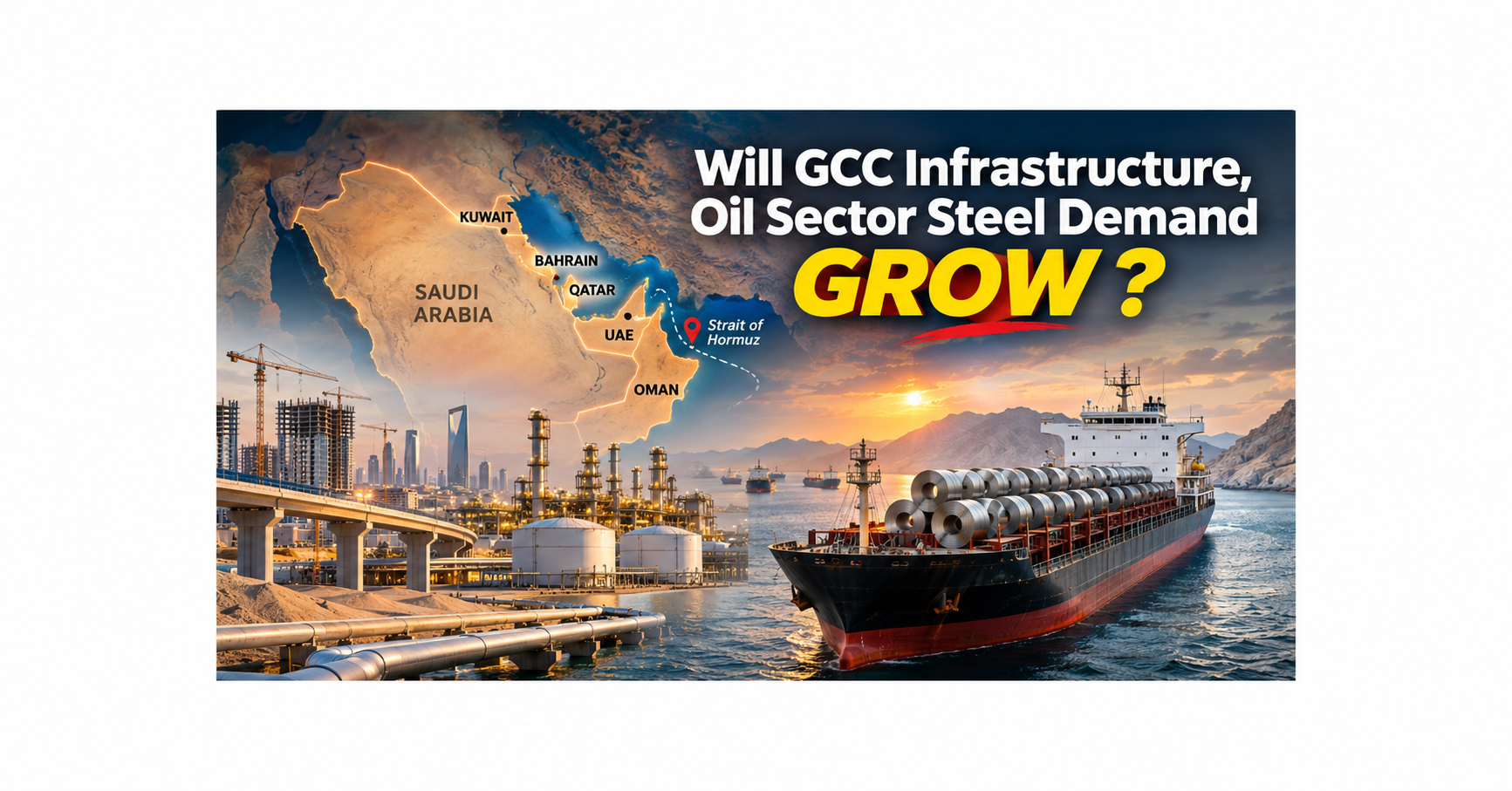
The Gulf’s steel market is not simply waiting for projects to restart; it is reassessing how materials reach them. worldsteel expects GCC demand to fall by about 11% in 2026 before rebounding 11.3% in 2027. For Indian producers and engineering MSMEs, that recovery could open doors—but not uniformly. The commercial prize will depend on what they make, where buyers need it, whether it is certified, and how reliably it can be delivered at viable cost.
THE GULF’S STEEL MARKET: A RECOVERY WITH CONDITIONS
The Gulf Cooperation Council (GCC) steel market is approaching a potentially significant turning point. After expanding by 17.7% in 2025, finished-steel demand across the six-member bloc is forecast to contract by approximately 11% in 2026, according to the World Steel Association’s (worldsteel) October 2026 Short Range Outlook.
The reversal reflects the economic and logistical consequences of regional conflict, particularly disruption around the Strait of Hormuz, rather than a fundamental collapse in the region’s underlying infrastructure and industrial requirements.
More importantly, worldsteel forecasts an 11.3% recovery in GCC steel demand in 2027, effectively bringing consumption back towards its 2025 level.
This is a critical distinction for exporters. The Gulf’s steel requirement has not necessarily disappeared; a significant proportion of project awards, construction starts, procurement commitments and financing decisions has been deferred.
For Indian steel producers, processors, fabricators and engineering exporters, the opportunity is substantial. But it will not translate automatically into higher export volumes.
The next phase of Gulf steel procurement will be determined by five commercial variables: product specification, total landed cost, logistics resilience, certification and local-content compliance.
India’s competitive advantage will not simply be its geographical proximity to the Gulf. It will depend on its ability to supply the right products through dependable routes, meet international technical standards and integrate with the region’s expanding manufacturing ecosystem.
1. A MARKET PAUSED, NOT DESTROYED
The 2025 surge in GCC steel consumption was supported by economic diversification programmes, infrastructure investment, housing activity and an unusually large project pipeline.
Saudi Arabia’s Vision 2030, the UAE’s industrial expansion and large-scale transport, energy, utilities and real-estate developments supported demand for construction steel, structural sections, plates, pipes and fabricated components.
The momentum reversed in 2026.
worldsteel forecasts GCC demand to decline by approximately 11%, while the broader Middle East region, which includes non-GCC economies, is expected to contract by 13.9%.
The broader Middle East steel-demand estimates are:
| Year | Steel demand |
|---|---|
| 2025 | 63.7 million metric tonnes |
| 2026 forecast | 54.8 million metric tonnes |
| 2027 forecast | 59.6 million metric tonnes |
The regional market is therefore expected to lose approximately 8.9 million metric tonnes of demand in 2026, before recovering by approximately 4.8 million metric tonnes in 2027.
The GCC and broader Middle East figures must not be confused: the latter includes economies outside the six GCC countries.
The underlying problem is primarily one of deferred decisions.
Developers, contractors, project owners and financiers have postponed tender awards, construction starts, procurement commitments and inventory replenishment as security risks have increased and shipping costs have become volatile.
For steel suppliers, the distinction between a cancelled project and a deferred project is commercially significant.
A cancelled project removes future demand. A deferred project preserves the potential requirement but changes its timing, procurement pattern and risk profile.
When security conditions improve, procurement could restart quickly. However, suppliers that are not already qualified, competitively priced and logistically prepared may find themselves excluded from the first round of orders.
2. THE 2027 REBOUND: A BASE-CASE SCENARIO, NOT A GUARANTEE
worldsteel’s forecast of an 11.3% GCC recovery in 2027 should be viewed as a conditional base-case scenario.
It assumes:
- Regional security conditions stabilise.
- Maritime access and shipping supply chains normalise.
- War-risk insurance premiums moderate.
- Financing confidence improves.
- Deferred construction and infrastructure projects resume.
The global steel market provides a useful backdrop.
worldsteel forecasts global steel demand at 1,722 million metric tonnes in 2026, broadly unchanged, before increasing by 1.7% to 1,752 million metric tonnes in 2027.
Outside China, demand is forecast to grow by 1.5% in 2026 and accelerate to 4.0% in 2027.
India, ASEAN and the Middle East are expected to contribute to this recovery.
India’s own steel-demand outlook is particularly important. worldsteel forecasts Indian steel demand to increase by 7.9% to 172.4 million metric tonnes in 2026, followed by another 8.0% increase to 186.2 million metric tonnes in 2027.
This creates an important consideration for Indian exporters: the domestic market itself will remain a significant and expanding consumer of steel. Exporters cannot assume that all available production will be competitively priced or freely available for overseas commitments.
Where will the GCC recovery originate?
Construction and infrastructure are likely to lead the initial recovery in volume terms.
The major demand centres will include:
- Residential and commercial construction.
- Transport infrastructure and logistics facilities.
- Ports, airports and industrial corridors.
- Power generation and transmission.
- Water infrastructure and desalination.
- Oil, gas, petrochemicals and refining.
- Industrial buildings and manufacturing facilities.
Construction activity will generate demand for rebar, wire rod, structural sections, hollow sections and fabricated steel.
Oil and gas, petrochemical, desalination and power projects may recover later, but their material requirements can command substantially higher realisations per metric tonne.
These projects require specialised materials such as heavy plates, seamless pipes, alloy steel, stainless steel, corrosion-resistant products and engineered components.
For Indian suppliers, the distinction between volume recovery and value recovery will be decisive.
3. WHY THE STRAIT OF HORMUZ CHANGES THE ECONOMICS
The Strait of Hormuz is not simply a geopolitical headline. It is a commercial chokepoint influencing freight, transit time, insurance, port access, working capital and delivery certainty.
The 2026 disruption demonstrated how rapidly a logistics shock can become a demand shock.
Iranian forces declared the Strait closed in early March 2026. Attacks on shipping and threats to commercial vessels led to a substantial reduction in maritime transits.
Shipping companies reassessed routes, insurers increased war-risk premiums and cargo owners faced longer, more expensive and less predictable supply chains.
For GCC steel buyers, the immediate concern was not merely higher landed cost. It was uncertainty.
A construction contractor cannot confidently award a steel package if the supplier cannot guarantee when the material will arrive, what the final landed cost will be or whether delivery will meet project milestones.
This uncertainty affects procurement decisions, inventory planning and financing.
For Indian exporters, the commercial implication is clear:
The route matters almost as much as the product.
A supplier offering a lower ex-mill price may lose a contract if the shipment faces high insurance costs, uncertain transit times, additional port handling or delays that disrupt construction schedules.
4. INDIA’S ALTERNATIVE LOGISTICS CORRIDORS
Not all GCC access depends on vessels entering the Strait of Hormuz.
India’s western ports—particularly Mundra, Kandla, Hazira and Nhava Sheva—can serve Gulf markets through alternative maritime corridors.
However, these routes should be evaluated on total landed cost rather than simply on the distance travelled by sea.
A. Gulf of Oman: The immediate alternative gateway
The most immediate alternative lies along the Gulf of Oman.
Sohar in Oman and Fujairah and Khor Fakkan in the UAE are located outside the Strait of Hormuz.
Cargo discharged at these ports can be moved inland by road and, where available and operationally suitable, rail.
The corridor can provide access to UAE markets and, subject to customs and inland transportation arrangements, onward distribution to other GCC destinations.
It is particularly relevant for high-value and time-sensitive cargo:
- Stainless and alloy steel.
- Pipes and tubes.
- Flanges and fittings.
- Heavy plates.
- Structural sections.
- Project-specific engineered components.
These products can generally absorb additional handling and inland transport costs more readily than low-margin commodity rebar.
The principal advantage is route optionality.
Indian exporters operating from Gujarat and Maharashtra can access these gateways without requiring their vessels to transit the Strait.
The limitations are equally important. Inland haulage, border procedures, customs clearance, port congestion, handling charges and transport capacity can erode the apparent advantage.
B. Red Sea: Access to western and central Saudi Arabia
The second major alternative is the Red Sea corridor.
Indian cargo can move through the Arabian Sea and Bab el-Mandeb into the Red Sea, reaching Saudi Arabia through:
- Jeddah Islamic Port.
- King Abdullah Port.
- Yanbu.
This corridor is particularly relevant to projects in western Saudi Arabia, including Jeddah, the Red Sea coast, Makkah and Madinah.
It can also provide access to central Saudi markets, including Riyadh, through inland road transport and existing rail connections where operationally available.
The commercial trade-off is transit time and inland distribution cost.
A Red Sea routing may add several days compared with some direct Persian Gulf routes. Transportation from the coast to interior destinations can further increase the delivered cost.
Moreover, Bab el-Mandeb and the Red Sea have their own maritime security risks. Bypassing Hormuz does not eliminate geopolitical exposure.
Nevertheless, for project-critical cargo, where delivery reliability is more important than marginal freight savings, the corridor can remain commercially viable.
C. Saudi inland distribution: The Landbridge opportunity
For engineered steel articles, fittings, valves, fasteners, prefabricated structures and project-specific packages, inland distribution from Red Sea ports could be commercially attractive.
Cargo arriving at Jeddah or Yanbu can be moved towards central Saudi Arabia using existing road networks and available rail connections.
However, an important distinction is necessary.
The proposed Saudi Landbridge railway linking Jeddah and Riyadh is not yet an operational end-to-end freight corridor. Saudi Railway Company has indicated phased development, with completion expected before 2034.
Exporters should therefore base present-day logistics calculations on existing road and operational rail infrastructure, treating the proposed Landbridge as a longer-term opportunity.
This route is less attractive for low-value bulk rebar, where additional inland freight can erode margins.
It may be more viable for high-value products where technical compliance, delivery certainty and project schedules justify the additional cost.
The objective for Indian exporters should not be to abandon Hormuz-dependent shipping. It should be to avoid excessive dependence on any single corridor.
5. THE REAL OPPORTUNITY: MOVE BEYOND COMMODITY STEEL
India should not attempt to compete across the entire GCC steel market.
Its strongest opportunity lies in selected segments where technical qualification, product complexity, delivery reliability and documentation matter more than the lowest headline price.
A. Rebar and wire rod: Volume with intense competition
Rebar, wire rod and basic structural steel are likely to experience the largest volume recovery as housing, commercial construction and infrastructure projects restart.
However, these are also the most competitive segments.
GCC producers, Chinese suppliers, Omani mills and other regional manufacturers already compete aggressively in commodity long products.
Saudi Arabia, in particular, has considerable domestic long-steel capacity.
According to Saudi Arabia’s official mining-sector industry assessment, approximately 80% of the Kingdom’s finished-steel capacity is concentrated in long products. Rebar capacity is estimated to have close to 100% overcapacity, while wire rod capacity exceeds requirements by more than 50%.
This is a structural competitive constraint for overseas suppliers.
Indian exporters may still find opportunities where delivery schedules, specific grades, project requirements or temporary supply shortages create an opening.
But commodity rebar alone is unlikely to offer the most attractive long-term margin opportunity.
B. Flat steel: A stronger Indian competitive proposition
Hot-rolled coil (HRC), cold-rolled coil (CRC), galvanised and coated products, plates and heavy structural sections offer a more compelling opportunity.
These products supply:
- Fabrication yards.
- Pipe manufacturers.
- Construction contractors.
- Industrial equipment manufacturers.
- Infrastructure developers.
- Engineering and fabrication companies.
Saudi Arabia’s domestic steel industry has relatively limited flat-product capability compared with its long-product capacity.
Its official industry assessment identifies Hadeed as the Kingdom’s only producer of flat products and notes that imports of HRC, plates and tinplate remain elevated because of limited domestic capacity.
This provides a more credible basis for Indian suppliers to target selected flat-steel categories.
Indian producers with established export capabilities, approved-mill status, international certifications and western-port logistics can compete where buyers prioritise consistent quality, traceability and dependable delivery.
C. Pipes, fittings and engineered products: The MSME opportunity
The most interesting opportunity for Indian MSMEs may lie in pipes, tubes, flanges, fittings, fasteners and fabricated steel articles.
These products serve:
- Oil and gas exploration and processing.
- Refineries and petrochemical plants.
- Water infrastructure.
- Desalination facilities.
- Power generation.
- Industrial construction.
- Manufacturing facilities.
They are often procured in smaller quantities than bulk rebar, but can command higher realisations per metric tonne and require greater technical compliance.
Indian manufacturers can compete by offering project-ready packages rather than simply supplying individual products.
A package could include pipes, fittings, flanges, fasteners, fabrication, testing certificates, material traceability and delivery documentation.
This is where the Hormuz bypass becomes commercially meaningful.
A high-value engineered package can absorb additional freight and handling costs more easily than commodity steel.
For a precision engineering MSME, the opportunity may be a specialised order worth considerably more commercially than a much larger tonnage of basic steel.
D. Stainless, alloy and speciality steel
Desalination plants, refineries, petrochemical facilities, green-hydrogen projects, solar infrastructure and power utilities require corrosion-resistant and high-performance materials.
Potential products include:
- Duplex and super-duplex stainless steel.
- Nickel alloys.
- Speciality plates.
- High-specification tubes.
- Corrosion-resistant pipes and fittings.
- Alloy-steel components.
These products represent smaller volumes than conventional construction steel but can command disproportionately higher value.
India’s opportunity depends less on production scale and more on capability.
Metallurgical quality, certification, testing, traceability, technical service and delivery reliability are essential.
These are segments where a well-prepared Indian supplier can differentiate itself from commodity competitors.
6. LOCALISATION: THE POLICY CONSTRAINT INDIA CANNOT IGNORE
The GCC’s steel recovery will take place within a policy environment that increasingly favours domestic value creation.
Saudi Arabia’s Vision 2030, industrial localisation initiatives and procurement frameworks, alongside the UAE’s manufacturing agenda, seek to deepen domestic industrial capabilities.
This does not mean imports will disappear.
The GCC continues to require imported flat steel, speciality products, high-grade pipes, alloy materials and certain engineered components.
However, Indian exporters cannot assume that a recovery in steel consumption will automatically translate into a corresponding increase in imports.
The strategy must shift from competing against localisation to participating in it.
Indian manufacturers can consider:
- Local partnerships: Working with GCC-based fabricators, service centres, distributors and industrial suppliers.
- Intermediate supply: Supplying steel inputs that local manufacturers can process into finished products.
- Local processing: Establishing or expanding warehousing, cutting, bending, coating and fabrication capabilities.
- Vendor qualification: Participating in approved-vendor programmes and project-specific qualification processes.
- Technical support: Providing testing, traceability, documentation, installation assistance and after-sales service.
- Capacity gaps: Targeting products where local production capacity is insufficient or where specialised imported materials remain necessary.
India’s opportunity is therefore not simply to export more steel.
It is to become an integral part of the Gulf’s industrial supply chain.
7. WHERE INDIA STANDS: THE EXISTING TRADE OPPORTUNITY
India’s competitive position needs to be examined against actual trade figures rather than geographical proximity alone.
According to worldsteel’s World Steel in Figures 2026, India exported approximately 9.9 million metric tonnes of steel in 2025, ranking 14th among the world’s steel exporters.
The UAE and Saudi Arabia were among the world’s significant steel-importing markets.
Their 2025 trade positions were:
| Market | Gross steel imports | Net steel imports |
|---|---|---|
| UAE | 13.4 million metric tonnes | 11.0 million metric tonnes |
| Saudi Arabia | 8.3 million metric tonnes | 7.6 million metric tonnes |
These are worldsteel’s reported steel-trade figures. Gross imports and net imports represent different measures and must not be treated as interchangeable.
India’s position in Saudi Arabia
The World Bank’s World Integrated Trade Solution (WITS), using UN Comtrade data, reports that Saudi Arabia imported ₹63,106 crore (US$6.71 billion) of iron and steel under HS Chapter 72 in 2025.
The leading suppliers were:
| Supplier | Import value |
|---|---|
| China | ₹32,340 crore (US$3.44 billion) |
| Oman | ₹8,135 crore (US$864.36 million) |
| Bahrain | ₹4,131 crore (US$438.94 million) |
| Sweden | ₹3,971 crore (US$421.88 million) |
| India | ₹2,034 crore (US$216.08 million) |
India accounted for approximately 3.2% of Saudi Arabia’s reported HS Chapter 72 import value.
This is an important indicator of India’s existing market presence, but it also highlights the scale of competition.
China’s shipments alone accounted for more than half the reported import value.
These figures cover HS Chapter 72, which includes iron and steel products. They should not be confused with the wider market for fabricated steel articles, machinery, valves, fittings and downstream engineering products.
A closer look at downstream steel articles
The opportunity for Indian engineering MSMEs becomes more interesting when downstream trade is examined separately.
In 2025, Saudi Arabia imported approximately 419,162 metric tonnes, valued at ₹7,042 crore (US$748.27 million), under HS 732690, covering other articles of iron or steel, not elsewhere specified.
India supplied approximately 39,625 metric tonnes, valued at ₹539 crore (US$57.26 million).
Other major suppliers included:
| Supplier | Quantity | Import value |
|---|---|---|
| China | 176,404 MT | ₹2,776 crore (US$294.97 million) |
| UAE | 116,035 MT | ₹1,234 crore (US$131.10 million) |
| India | 39,625 MT | ₹539 crore (US$57.26 million) |
| Oman | 37,446 MT | ₹312 crore (US$33.21 million) |
This is particularly relevant to Indian engineering MSMEs because it provides a measurable indication of an existing market for downstream steel articles.
However, HS 732690 is a broad residual product classification. It does not represent a single homogeneous product market, nor does it establish the precise addressable market for any one Indian manufacturer.
The figures do demonstrate that Indian suppliers already participate in this market and have scope to compete in selected product categories.
India’s structural advantages
India has four important advantages.
First, geography. Western Indian ports are relatively close to Gulf markets, potentially offering competitive lead times compared with more distant Asian and European suppliers.
Second, product breadth. India has manufacturing capabilities across flat products, long products, plates, pipes, tubes, stainless steel, alloy materials and engineered components.
Third, trade agreements. The India-UAE Comprehensive Economic Partnership Agreement (CEPA) can improve access for eligible products. However, exporters must not treat it as a blanket zero-duty arrangement. Preferential treatment depends on HS classification, rules of origin, documentation and product-specific conditions.
Fourth, engineering capability. India’s established engineering and manufacturing base offers opportunities to supply certified, traceable and project-ready products.
There are also constraints.
Chinese suppliers remain highly competitive in volume segments. GCC localisation policies can favour domestic or regional suppliers. Certification and approval processes can be lengthy. Payment terms, currency exposure, freight volatility and working-capital requirements can place pressure on smaller exporters.
The realistic conclusion is that India is well positioned, but only in segments where quality, compliance, delivery and technical service can outweigh pure price competition.
8. WHICH INDIAN MANUFACTURING CLUSTERS COULD BENEFIT?
The opportunity is not confined to large integrated steel producers.
Several Indian engineering and manufacturing clusters have capabilities relevant to the Gulf’s industrial and infrastructure requirements.
Gujarat
Ahmedabad, Vadodara, Anand, Rajkot and surrounding industrial centres have engineering, fabrication, casting, machining, pipe, fitting, fastener and industrial-equipment capabilities.
For manufacturers in these clusters, the opportunity lies in supplying project-specific components, fabricated structures, industrial fittings and precision-engineered products.
The proximity of Gujarat’s western ports provides an additional logistical advantage, although actual freight economics must be established product by product.
Maharashtra
Mumbai, Pune and Nashik have established industrial and engineering ecosystems serving automotive, industrial equipment, steel processing and infrastructure supply chains.
Specialised fabrication, precision components and industrial equipment could find applications in Gulf projects.
Punjab
Ludhiana’s engineering and fastener industries provide potential supply capabilities in industrial fasteners, forgings and related engineering components.
Other manufacturing centres
India’s wider manufacturing ecosystem, including specialised pipe, tube, valve, forging and stainless-steel clusters, can also participate.
However, the presence of a manufacturing cluster does not automatically establish export readiness.
Each manufacturer must assess product specifications, international certifications, capacity, consistency, delivery commitments and customer qualification requirements.
For MSMEs, the most realistic strategy may be to enter as an approved component supplier to established GCC distributors, fabricators and EPC contractors rather than attempting to secure large turnkey contracts immediately.
9. WHAT THE DATA CAN — AND CANNOT — TELL US
A credible market assessment must distinguish between official forecasts, reported trade figures and analytical estimates.
The principal worldsteel forecasts are:
| Indicator | 2025 | 2026 forecast | 2027 forecast |
|---|---|---|---|
| GCC steel demand growth | +17.7% | -11.0% | +11.3% |
| Global steel demand | — | 1,722 Mt | 1,752 Mt |
| Broader Middle East demand | 63.7 Mt | 54.8 Mt | 59.6 Mt |
| Broader Middle East growth | — | -13.9% | +8.8% |
Mt means million metric tonnes.
These figures establish the scale of the demand shock and the potential recovery.
They do not establish:
- The precise dollar or rupee value of the GCC steel market.
- The exact incremental import requirement in 2027.
- India’s future export share.
- The distribution of demand across individual steel products.
- The amount of demand that domestic GCC producers will satisfy.
- The value of contracts available to Indian MSMEs.
A market valuation calculated by multiplying estimated consumption by an assumed average steel price is a modelled estimate, not an official market-size figure.
Similarly, country-wise export forecasts and sectoral demand splits should be labelled as analytical estimates unless supported by customs data, company disclosures or recognised market research.
This distinction is essential because steel is not a homogeneous commodity. Rebar, HRC, heavy plates, stainless steel, alloy products and engineered components have different prices, specifications, margins and procurement cycles.
The article’s commercial thesis must therefore be based on product-level opportunities, not an assumed single GCC steel market value.
10. A FIVE-POINT COMMERCIAL STRATEGY FOR INDIAN EXPORTERS
Indian companies should approach the 2027 opportunity through a disciplined commercial framework.
1. Segment by product, not merely by country
Rather than asking how much steel Saudi Arabia or the UAE imports, exporters should ask:
Which certified products, specifications and delivery windows can we reliably supply?
A heavy-plate manufacturer, a pipe producer and a rebar exporter face very different competitive dynamics.
Treating them as one market obscures the real opportunity.
2. Build logistics resilience
Develop contingency arrangements across multiple gateways:
- Direct Persian Gulf routes where commercially and operationally viable.
- Gulf of Oman routes through Sohar, Fujairah and Khor Fakkan.
- Red Sea routes through Jeddah, King Abdullah Port and Yanbu.
- Inland road and operational rail distribution options for project-critical cargo.
The objective is to avoid dependence on a single route while maintaining competitive landed costs.
3. Prioritise international certification
In the GCC, certification is a commercial gateway, not an administrative formality.
ASTM, ASME, API, EN and project-specific standards can determine whether a supplier is eligible to bid.
Indian firms should invest in qualification, testing, material documentation, traceability and technical support before projects restart.
A supplier already approved by a buyer or EPC contractor has a meaningful advantage over one that begins the process after demand returns.
4. Price on total landed cost
The commercial offer must account for:
- Ex-mill price.
- Freight and marine insurance.
- War-risk premiums, where applicable.
- Port handling and customs.
- Inland transport.
- Financing and working-capital costs.
- Potential delivery delays.
A lower ex-mill price can quickly become uncompetitive when additional logistics and financing costs are included.
5. Align with localisation
Indian firms should treat Saudi and UAE localisation policies as commercial conditions to plan around.
Partnerships, local processing, warehousing, service presence and supply-chain integration can convert policy constraints into market-access opportunities.
11. RECOMMENDATIONS: WHERE INDIAN COMPANIES SHOULD PLACE THEIR BETS
The GCC’s potential 2027 recovery presents different opportunities for different categories of Indian businesses.
For primary steel producers
Prioritise certified flat products, heavy plates, selected structural sections and speciality steel rather than relying exclusively on commodity rebar exports.
Build relationships with approved buyers and EPC contractors, and develop alternative shipping arrangements before project procurement accelerates.
For steel processors and engineering MSMEs
Focus on project-ready packages involving pipes, fittings, flanges, fasteners, fabricated structures, valves and engineered components.
These products can offer better value per metric tonne and are more compatible with logistics arrangements involving additional handling and inland distribution.
For Gujarat’s manufacturing sector
Manufacturers should assess their ability to supply internationally certified products to UAE and Saudi buyers.
The first commercial objective should be approved-vendor status, distributor relationships and repeat orders, rather than speculative capacity expansion.
For GCC buyers and EPC contractors
Diversify supply routes, qualify alternative suppliers and assess procurement resilience alongside procurement cost.
The 2026 disruption has demonstrated that delivery certainty can be as important as the purchase price.
For Indian policymakers
Strengthen India-GCC trade resilience through standards recognition, customs facilitation, export finance, certification support and logistics cooperation.
The policy priority should be value-added, compliant exports rather than volume-led commodity shipments.
12. CAUTION: A DEMAND RECOVERY IS NOT AN EXPORT GUARANTEE
There are four risks Indian exporters must not underestimate.
First, the 2027 rebound is conditional. If regional security risks persist, maritime access remains constrained or project financing continues to weaken, the recovery could be delayed, uneven or materially weaker than worldsteel forecasts.
Second, higher steel consumption does not guarantee higher imports. GCC producers may increase domestic output, buyers may draw down existing inventories, and localisation policies may redirect procurement towards domestic and regional manufacturers.
Third, alternative logistics routes do not eliminate geopolitical risk. Gulf of Oman and Red Sea corridors have their own maritime security exposure, insurance costs, port congestion, customs procedures and inland transportation challenges.
Fourth, exporters must avoid speculative capacity expansion. A forecast is not a purchase order. Indian manufacturers should not commit substantial capital or working capital solely on the assumption that delayed Gulf projects will automatically restart.
Credit exposure, payment cycles, currency movements, buyer qualification and contract terms require careful assessment.
THE FINAL WORD: COMPETE ON CAPABILITY, NOT TONNAGE
The GCC steel market is likely to recover in 2027, but the commercial beneficiaries will not necessarily be the suppliers shipping the largest volumes.
The next phase of Gulf procurement will reward companies that understand the relationship between product specification, logistics economics, technical certification, localisation and delivery reliability.
For India, this is an opportunity to move beyond the conventional role of a commodity steel exporter and become a more integrated supplier to the Gulf’s industrial and infrastructure ecosystem.
For Indian MSMEs, the opportunity could be even more interesting: supplying the pipes, fittings, fasteners, fabricated structures, precision components and engineered products that make large infrastructure and industrial projects possible.
Our recommendation is that Indian manufacturers prepare now, qualify early, establish local partnerships and build logistics flexibility.
My caution is equally clear: do not confuse an 11.3% demand recovery forecast with an 11.3% increase in import opportunities.
The Gulf’s recovery may restore demand. India’s ability to capture it will depend on industrial capability, commercial discipline and execution.
The winning proposition will not be the cheapest tonne of steel. It will be the most dependable, technically qualified and commercially viable supply.
SOURCES AND RESEARCH CREDITS
- World Steel Association (worldsteel) — Short Range Outlook, October 2026. GCC, Middle East and global steel-demand forecasts for 2025–2027; India steel-demand outlook.
https://worldsteel.org/media/press-releases/2026/worldsteel-short-range-outlook-october-2026/ - World Steel Association — Short Range Outlook October 2026: Statistical Tables.
https://worldsteel.org/wp-content/uploads/SRO-October-2026-tables.pdf - World Steel Association — World Steel in Figures 2026. Global steel production, trade, exports and imports for 2025.
https://worldsteel.org/data/world-steel-in-figures/world-steel-in-figures-2026/ - Saudi Arabia – Daleel, Mining Downstream: Steel. Domestic production capacity, product mix, long-steel overcapacity and flat-steel import dependence.
https://daleel.gov.sa/en/market-insight/mining-downstream-steel - World Bank – World Integrated Trade Solution (WITS) / UN Comtrade — Saudi Arabia’s 2025 imports of iron and steel, HS Chapter 72, including supplier-country values.
https://wits.worldbank.org/trade/comtrade/en/country/SAU/year/2025/tradeflow/Imports/partner/ALL/product/72 - World Bank – WITS / UN Comtrade — Saudi Arabia’s 2025 imports of other articles of iron or steel, HS 732690, including quantities and supplier-country values.
https://wits.worldbank.org/trade/comtrade/en/country/SAU/year/2025/tradeflow/Imports/partner/ALL/product/732690 - Congressional Research Service — Reporting on the 2026 Strait of Hormuz disruption, Iranian declaration of closure, attacks on shipping and impact on maritime transits.
- International Institute for Strategic Studies (IISS) — The Gulf at War. Regional security, maritime disruption and shipping exposure.
- Arab News — Saudi Arabia plans Riyadh-Jeddah railway by 2034, 21 January 2026. Saudi Landbridge development status.
https://www.arabnews.com/saudi-arabia/saudi-arabia-plans-riyadh-jeddah-railway-by-2034-2630157 - CNBC — Reporting on reduced vessel traffic through the Strait of Hormuz, March 2026.
https://www.cnbc.com/2026/03/18/hormuz-bottleneck-vessel-tanker-tracker-shipping-strait-of-hormuz.html - Canadian International Freight Forwarders Association (CIFFA) — March 2026 maritime review, container rerouting and Persian Gulf shipping disruption.
https://www.ciffa.com/ffo/month-in-review-march-2026/ - Reserve Bank of India / Financial Benchmarks India Pvt Ltd (FBIL) — USD/INR reference rate of ₹94.1159 per US dollar, 16 November 2026. Used for indicative conversions of 2025 Saudi import values.
https://www.rbi.org.in/
Data and methodology note: Monetary conversions use the RBI/FBIL reference rate of ₹94.1159 per US dollar as at 1 pm on 16 November 2026. These are indicative rupee equivalents of 2025 trade values, not historical transaction-date conversions. HS Chapter 72 and HS 732690 represent different customs classifications and must not be added together. Demand forecasts, reported trade values and production figures retain their respective reporting periods and statistical definitions. No projected 2027 import-market value has been presented as an established fact.







Leave a Reply