
GLOBAL POWER: THE MIDDLE-POWER RESPONSE!
By Haresh B. Jhala
A coalition strategy to turn middle-power assets into global leverage.
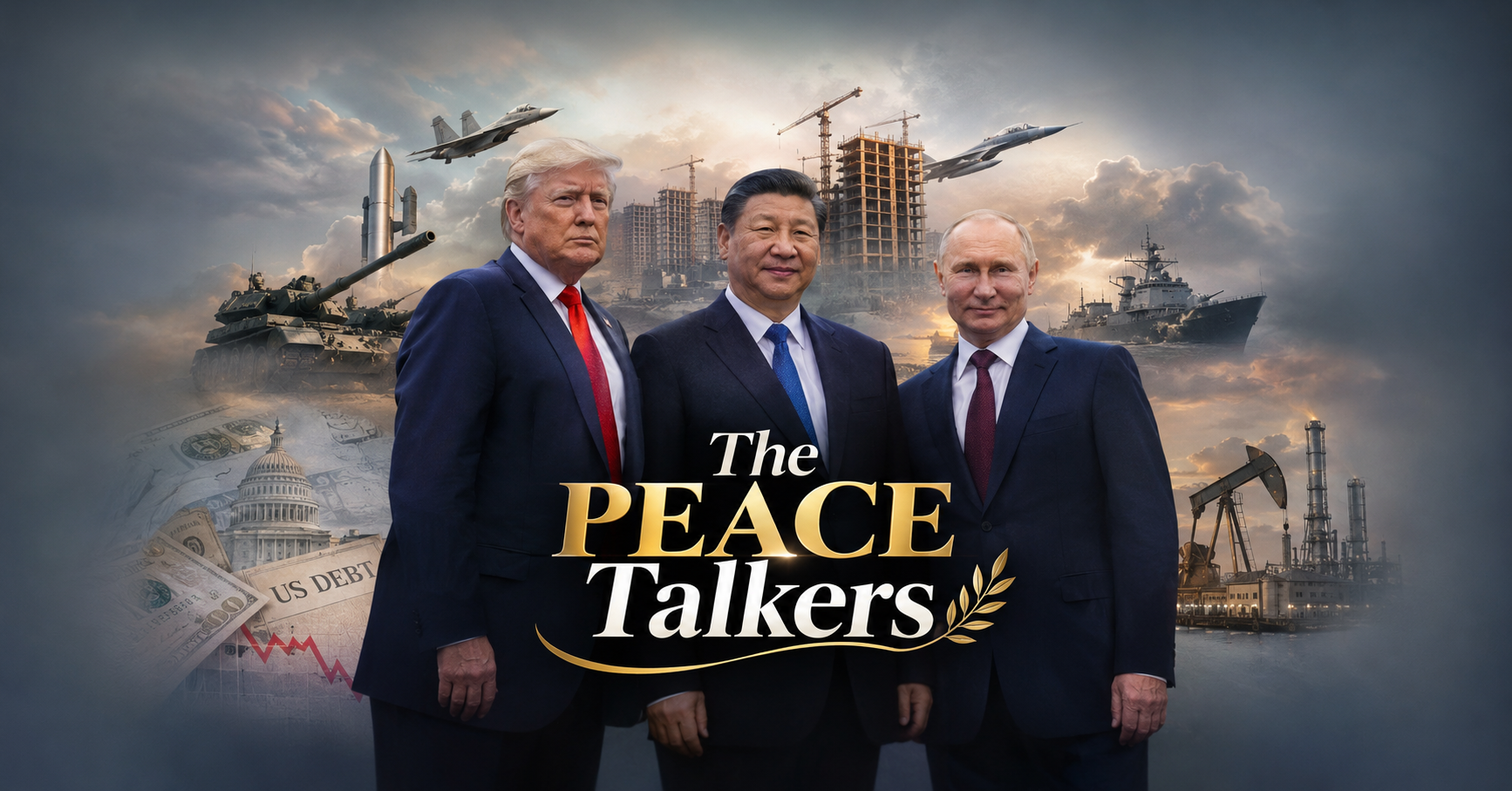
When Donald Trump, Xi Jinping and Vladimir Putin share a platform to speak about peace, listen—but do not mistake choreography for settlement. Their Shenzhen declaration offers dialogue and principles, but no commitments on the wars that expose their rivalries. The three leaders are neither a unified bloc nor economically invulnerable. Each arrives with leverage, liabilities and conflicting ambitions. That is why middle powers must stop treating coordination among the giants as an instruction to comply.
THE SHENZHEN MOMENT: POWER ON DISPLAY
On 19 November 2026, Donald Trump, Xi Jinping and Vladimir Putin met in Shenzhen for an unprecedented trilateral summit. The three leaders, representing the United States, China and Russia, issued a joint declaration towards peace, committing themselves to strategic stability, international security, United Nations reform, energy cooperation and dialogue on reducing nuclear risks.
It was a remarkable diplomatic spectacle. Three countries with enormous military capabilities, competing economic ambitions and fundamentally different geopolitical interests presented themselves as custodians of international stability.
Yet the declaration contained no binding commitment to end the wars in Ukraine and Iran, no timetable for trilateral nuclear arms-control negotiations and no mechanism for restraining international arms transfers.
The significance of Shenzhen, therefore, lies as much in what was absent as in what was announced.
The meeting should not be interpreted as the emergence of a new strategic alliance. Washington, Moscow and Beijing remain competitors, with conflicting interests over Taiwan, Ukraine, NATO, sanctions, technology, energy markets and the future of international institutions.
But something important happened nevertheless: three competing powers demonstrated that they could coordinate their diplomatic messaging and manage selected differences without resolving their fundamental disagreements.
For the rest of the world, that is a strategic warning.
The question is not whether the three will become allies. They are unlikely to. The question is whether their ability to manage their differences will increasingly allow them to determine the terms on which everybody else operates.
The answer should not be confrontation. It should be coordinated bargaining.
SUN TZU’S LESSON: APPEAR STRONG, MANAGE THE WEAKNESSES
The ancient Chinese military strategist Sun Tzu is often paraphrased as advising commanders to appear weak when strong and strong when weak. His underlying lesson concerns deception, perception and the management of an opponent’s calculations.
Applied to Shenzhen, the principle offers an interesting perspective.
The three leaders are not weak nations. They possess extraordinary military capabilities, technological advantages, financial resources and international influence. But their economic and strategic positions are under different forms of pressure.
Their vulnerabilities are not identical. Nor are their interests.
Russia needs economic breathing space and diplomatic recognition. China needs economic stability and strategic room to manoeuvre. The United States needs to manage its fiscal exposure while maintaining its international leadership.
A common diplomatic platform offers each leader an opportunity to project influence without necessarily making concessions on the issues that divide them.
The photograph conveys unity. The declaration conveys common principles. The underlying geopolitical competition remains intact.
This distinction is essential to understanding Shenzhen.
THREE GIANTS, THREE ECONOMIC VULNERABILITIES
To understand why this meeting matters, one must look beyond military strength and examine the economic circumstances in which the three leaders arrived.
The October 2026 World Economic Outlook of the International Monetary Fund provides an important comparative starting point.
IMF GDP growth projections
| Country | 2026 forecast | 2027 forecast |
|---|---|---|
| United States | 2.5% | 2.1% |
| China | 4.3% | 4.0% |
| Russia | 0.9% | 0.7% |
Source: IMF, World Economic Outlook, October 2026.
These projections do not suggest that all three economies are contracting. They reveal something more nuanced: different levels of economic resilience, slowing momentum and structural pressure.
RUSSIA: MILITARY POWER, ECONOMIC STAGNATION
Russia’s economic position is perhaps the most immediately constrained of the three.
The IMF projects growth of just 0.9% in 2026 and 0.7% in 2027. The Bank of Russia’s October 2026 survey puts average inflation at 6.2% for 2026, with the December-on-December measure at 7.1%. Its estimated average policy rate for the year is 14.6%.
These figures point towards an economy struggling to balance inflation, borrowing costs, investment and growth.
The war in Ukraine has also reshaped Russia’s economic structure. Defence production and government expenditure have supported industrial activity, but a prolonged wartime economy carries substantial opportunity costs.
Labour shortages, sanctions, restrictions on technology access and the reorientation of energy exports towards alternative buyers complicate the longer-term outlook.
Russia remains a major energy producer and nuclear power. It also retains considerable influence in international arms markets.
However, its diplomatic isolation and declining arms-export position have weakened some of the traditional instruments through which Moscow exercised international influence.
For Putin, Shenzhen offers something that economic statistics cannot provide: international recognition and a demonstration that Russia cannot simply be excluded from the management of global affairs.
CHINA: THE SHOWCASE ECONOMY AND ITS DOMESTIC CONTRADICTIONS
China’s economic challenge is different.
It remains the world’s second-largest economy, a manufacturing powerhouse and a formidable competitor in electric vehicles, batteries, solar technology, electronics and advanced industrial production.
But the domestic economy is experiencing significant structural difficulties.
The World Bank’s October 2026 East Asia and Pacific Economic Update reported that:
- China’s GDP growth moderated to 4.3% year-on-year in the second quarter of 2026, compared with 5% in the first quarter.
- Retail sales contracted by an average of 4% year-on-year during April–July.
- Real-estate investment declined 18% year-on-year during January–June.
- Real house prices remained approximately 23% below their 2021 peak.
- Consumer-price inflation averaged just 1% year-on-year during April–July.
The property correction has affected household wealth, local-government finances and consumer confidence.
China’s export strength, particularly in high-technology manufacturing, continues to provide an important counterweight. But an economy that depends heavily on external demand while domestic consumption remains subdued faces a difficult rebalancing exercise.
Hosting the summit in Shenzhen, one of the most visible symbols of China’s industrial and technological rise, was therefore strategically meaningful.
Beijing could demonstrate diplomatic centrality while offering Washington an opportunity to manage tensions.
China’s immediate objective is not necessarily to defeat American influence. It is to secure sufficient economic and strategic space to strengthen its own position.
UNITED STATES: THE WORLD’S STRONGEST ECONOMY, WITH A GROWING FISCAL BURDEN
The United States is in a different category.
It would be misleading to describe the American economy as weak. The IMF projects growth of 2.5% in 2026, supported by private consumption, investment and technology-related activity.
But its fiscal position presents a serious structural vulnerability.
According to the US Congressional Budget Office’s November 2026 review:
- The federal budget deficit reached US$2 trillion in fiscal year 2026.
- The deficit amounted to 6.2% of GDP.
- Federal debt held by the public reached approximately 100% of GDP.
The deficit increased by 12% over the previous fiscal year.
This does not imply an imminent American financial crisis. The United States has the world’s dominant international reserve currency, deep capital markets and substantial borrowing capacity.
Nevertheless, persistent deficits and rising interest obligations constrain future fiscal choices.
Washington must simultaneously finance defence commitments, maintain technological leadership, manage competition with China and sustain its international security architecture.
For Trump, a high-profile diplomatic initiative offers an opportunity to demonstrate that American leadership can still bring competing powers to the negotiating table.
The challenge is converting diplomatic visibility into durable outcomes.
THE COMMON THREAD
The economic circumstances of the three countries are fundamentally different.
Russia is approaching economic stagnation under wartime pressures. China is managing a difficult domestic rebalancing while protecting its manufacturing and export strengths. The United States retains substantial economic momentum but faces a deteriorating fiscal trajectory.
They are not three collapsing economies. They are three powerful states confronting different constraints on their strategic freedom.
That distinction matters because economic vulnerability does not automatically produce geopolitical weakness. It creates incentives to negotiate, manage risks and protect existing advantages.
Shenzhen offered an opportunity to do precisely that.
THE PEACEMAKERS WHO DOMINATE THE ARMS TRADE
There is another contradiction at the centre of the summit.
The three countries that presented themselves as guardians of international peace are also among the world’s largest suppliers of major conventional weapons.
The latest comprehensive five-year assessment from the Stockholm International Peace Research Institute (SIPRI), published in March 2026 and covering 2021–25, provides compelling evidence.
GLOBAL SHARE OF MAJOR ARMS EXPORTS, 2021–25
| Country | Global export share | Global rank |
|---|---|---|
| United States | 42% | 1 |
| Russia | 6.8% | 3 |
| China | 5.6% | 5 |
Source: SIPRI, Trends in International Arms Transfers, 2025.
Together, these three countries accounted for 54.4% of the global volume of major conventional arms transfers during the five-year period.
The trends are equally revealing.
The United States increased its arms-export volume by 27% between 2016–20 and 2021–25. Its 42% global share was greater than the combined shares of the next seven suppliers.
Russia’s arms exports declined by 64%, reducing its global share from 21% to 6.8%.
China’s arms exports increased by 11%, taking its share to 5.6%.
These are SIPRI volume indicators, not dollar values of arms sales. Nevertheless, they establish the extraordinary concentration of the international arms supply market.
THE DIFFERENT ARMS-TRADE INTERESTS
The three countries do not operate identical defence-export models.
The United States: Its defence industry has a global customer base. SIPRI records 99 recipient states for American major arms during 2021–25. Europe accounted for 38% of US arms exports, while Saudi Arabia accounted for 12%.
Russia: Its arms-export position has deteriorated sharply. India accounted for 48% of Russian major arms exports, while China and Belarus accounted for 13% each. The decline in exports reflects a combination of reduced deliveries, changing customer preferences and the demands of Russia’s own war.
China: Its defence exports are concentrated in Asia and Oceania, which accounted for 77% of its major arms exports. Pakistan alone accounted for 61% of Chinese exports.
The distinction is important. These countries have different defence customers, strategic priorities and commercial interests.
It would be inaccurate to suggest that all arms transfers are intended to perpetuate conflict. States have legitimate security requirements, and defence exports can be part of lawful international partnerships.
But there is a genuine structural contradiction when major arms suppliers present themselves as international peacekeepers without addressing the relationship between weapons transfers, conflict escalation and accountability.
A credible peace initiative should address that contradiction.
A TEST OF PEACE THAT COSTS SOMETHING
If the Shenzhen declaration is intended to be more than a diplomatic statement, the three governments should consider four measurable commitments:
- Conflict-zone transparency: Publish detailed information on arms transfers to countries involved in active conflicts, including end-use monitoring.
- Proxy-war accountability: Disclose and review military assistance to non-state armed groups and external proxy forces.
- Independent verification: Strengthen reporting mechanisms for international arms transfers.
- Nuclear risk reduction: Establish a timetable for meaningful arms-control discussions, including the future of strategic nuclear limitations following the expiry of New START in February 2026.
These measures would provide an objective basis for evaluating the sincerity of their peace commitments.
Without them, the declaration remains a diplomatic statement rather than a framework for changing behaviour.
SHENZHEN’S UNCOMFORTABLE MESSAGE: THE GREAT POWERS ARE STILL THE GATEKEEPERS
The declaration deserves attention not merely for its omissions but also for what it includes.
Three elements stand out.
1. International accountability
The declaration emphasises state consent and immunity for state officials, while questioning the exercise of jurisdiction by the International Criminal Court.
For Moscow, this language has obvious political significance. Vladimir Putin has faced an ICC arrest warrant since 2023 over alleged war crimes in Ukraine.
The provision should be examined in its legal context. But its political implications cannot be ignored: the world’s most powerful states are signalling a preference for greater control over the international accountability framework.
2. Energy cooperation
The commitment to increase the production and supply of refined petroleum products is significant.
Russia benefits from opportunities to expand energy exports. China benefits from stable energy supplies, while Washington has its own interest in energy prices and market stability.
However, the interests of the three are not identical. Greater energy supply may benefit consumers while putting pressure on competing producers.
The declaration does not establish an energy alliance or a common pricing policy.
3. Nuclear stability
The three countries have committed themselves to dialogue on reducing nuclear risks and preventing proliferation.
This is not insignificant. The world needs communication between nuclear powers.
But dialogue is not arms control.
There are no announced binding ceilings, verification arrangements or trilateral negotiations with an agreed timetable.
The distinction between diplomatic engagement and enforceable restraint must remain clear.
Taken together, these provisions suggest that the three countries are willing to coordinate on selected principles while preserving considerable freedom of action.
This is not evidence of a formal alliance. It is evidence of selective great-power coordination.
And that is precisely where the rest of the world must become more organised.
WHY MIDDLE POWERS SHOULD BE CONCERNED
For decades, smaller and middle-sized economies have managed great-power competition by negotiating bilaterally.
India engages Washington for technology and defence cooperation, Moscow for energy and legacy defence supplies, and Beijing for trade despite its unresolved border dispute.
Gulf countries combine American security partnerships with Chinese trade and investment and Russian cooperation on energy.
African nations negotiate access to minerals and infrastructure financing with competing international powers.
Southeast Asian countries depend on global trade routes and external markets while seeking to preserve strategic autonomy.
Europe remains economically powerful but continues to confront questions about its security dependence on the United States.
This system of competing relationships gives middle powers room to negotiate.
But if Washington, Moscow and Beijing increasingly coordinate their positions on selected international issues, the negotiating environment could become more difficult.
The danger is not necessarily a formal division of the world into spheres of influence.
It is a quieter process in which decisions about security, energy, technology, trade and infrastructure are negotiated by the most powerful states before other countries are invited to accept the consequences.
The world should not mistake diplomatic coordination among great powers for a commitment to protect the interests of everyone else.
THE STRATEGIC COUNTERWEIGHT: WHY THE GIANTS NEED THE REST OF THE WORLD
There is, however, an important weakness in the assumption that the three countries can determine the global order independently.
They depend on the rest of the world.
The United States needs access to international markets, manufacturing ecosystems, strategic minerals and secure maritime routes.
China needs energy imports, external markets, critical minerals and access to international technology and financial networks.
Russia needs energy customers, industrial inputs, technology access and international commercial channels.
All three depend on the functioning of global trade.
Their military power may be concentrated. Their economic interdependence is not.
Consider five areas where the rest of the world possesses significant negotiating leverage.
Critical minerals: Lithium, cobalt, nickel, copper and rare earths are essential to electric vehicles, batteries, advanced electronics, defence systems and artificial intelligence infrastructure.
Energy: Oil, natural gas, refined products and renewable energy supply chains remain central to industrial competitiveness.
Maritime geography: The Strait of Malacca, Strait of Hormuz and Bab el-Mandeb are critical to international commerce. Their security depends on regional cooperation.
Manufacturing and markets: India, Southeast Asia, Africa, Latin America and Europe provide substantial manufacturing capacity, consumer demand and investment opportunities.
Financial infrastructure: Payment systems, sovereign wealth funds, regional development banks and local-currency settlement mechanisms can reduce excessive dependence on individual financial centres.
These are not abstract advantages.
They represent assets that can be translated into bargaining power.
The challenge is that countries often negotiate separately, allowing major powers to extract bilateral advantages without offering equivalent collective benefits.
That must change.
NON-ALIGNMENT 2.0: FROM POLITICAL NEUTRALITY TO ECONOMIC BARGAINING
The Non-Aligned Movement was born during the Cold War, when newly independent countries sought to avoid being absorbed into the American or Soviet military blocs.
Its historical contribution was considerable. It provided political space for countries that wanted independence in foreign policy.
But the international system has changed.
Today’s contest is not simply between two ideological camps. It involves competition over semiconductors, artificial intelligence, energy, critical minerals, maritime corridors, financial infrastructure, defence technology and global supply chains.
A revival of non-alignment cannot simply reproduce the political language of the 1960s.
It needs a more practical economic and strategic foundation.
Non-Alignment 2.0 should be a framework for coordinated bargaining, not a declaration of neutrality.
Its objective should be straightforward: enable countries to trade with all major powers, cooperate with different partners and protect their strategic autonomy without becoming excessively dependent on any one of them.
Seven strategic options deserve consideration.
1. BUILD ISSUE-BASED COALITIONS, NOT ANOTHER BLOC
The existing Non-Aligned Movement has approximately 120 members. Its strength lies in representation, but its size and diversity make coordinated action difficult.
A new framework should not attempt to create another rigid international organisation.
Instead, countries should form coalitions around specific shared interests.
For example:
- Mineral-producing countries should coordinate processing and investment standards.
- Major energy producers and importers should develop transparent supply arrangements.
- Defence-importing countries should establish common procurement and end-use standards.
- Emerging economies should coordinate positions on digital trade and payment infrastructure.
Membership should depend on the issue, not ideology.
India and Indonesia need not agree on every geopolitical question to cooperate on critical minerals. Gulf countries and African producers need not share identical security policies to coordinate energy investment.
The objective is practical cooperation where interests overlap, not artificial unity where they do not.
2. TURN CRITICAL MINERALS INTO INDUSTRIAL LEVERAGE
The concentration of mineral resources gives developing economies an important opportunity.
Indonesia’s restrictions on raw nickel ore exports provide a useful example of resource nationalism being used to attract downstream investment and processing capacity.
The strategy is not without costs or controversy, but it demonstrates how resource-owning countries can influence where industrial value is created.
African, Latin American and Southeast Asian producers should explore coordinated frameworks for:
- Local mineral processing.
- Long-term investment agreements.
- Technology transfer.
- Environmental and labour standards.
- Transparent royalty and taxation arrangements.
- Greater participation in downstream manufacturing.
The objective should not be to establish another commodity cartel.
It should be to ensure that countries supplying the raw materials are also participants in the higher-value industrial ecosystem.
For example, a lithium-producing country should aspire to participate in battery chemicals and battery manufacturing rather than remain permanently dependent on raw-material exports.
Similarly, cobalt, nickel, copper and rare-earth producers should negotiate investment terms that generate domestic industrial capacity.
3. BUILD PAYMENT SYSTEMS THAT REDUCE DEPENDENCE
International trade remains heavily dependent on established financial networks and major reserve currencies.
There is nothing inherently wrong with this arrangement. The dollar continues to provide unmatched liquidity, market depth and international acceptance.
However, excessive dependence on a single financial system can create exposure to sanctions, financial restrictions and external policy decisions.
India’s UPI demonstrates how domestic payment infrastructure can achieve scale and international interoperability.
Middle powers should explore:
- Local-currency trade settlement.
- Interoperable payment systems.
- Regional financial cooperation.
- Stronger development-bank mechanisms.
- Transparent cross-border digital payment infrastructure.
The objective is not to replace dollar dependence with yuan dependence.
It is to expand financial choices and reduce the ability of any single country to weaponise financial interdependence.
4. ESTABLISH A COMMON ARMS-PROCUREMENT STANDARD
The SIPRI figures provide a powerful negotiating opportunity.
The United States, Russia and China collectively account for more than half of global major-arms transfers by volume.
Many developing countries remain heavily dependent on external suppliers for defence equipment, spare parts, ammunition, maintenance and technology.
This creates long-term strategic vulnerabilities.
India, Gulf countries, Indonesia and other major buyers should consider a common procurement framework demanding:
- Greater transparency in defence contracts.
- Reliable end-use monitoring.
- Technology-transfer provisions.
- Domestic maintenance and manufacturing capabilities.
- Diversification of critical defence suppliers.
- Greater access to spare parts and upgrade technologies.
The objective is not to undermine legitimate defence partnerships.
It is to ensure that no supplier can use a country’s security dependence as an instrument of political pressure.
5. DEFEND INTERNATIONAL INSTITUTIONS THAT PROTECT SMALLER COUNTRIES
International institutions are imperfect. The United Nations Security Council, in particular, reflects a power structure established after the Second World War.
But weakening international institutions without replacing them with more representative arrangements would primarily benefit countries that already possess overwhelming military power.
Middle powers should collectively pursue:
- Greater representation of developing regions in global institutions.
- Reform of the UN Security Council.
- Stronger international legal accountability.
- Transparent rules governing sanctions and international interventions.
- More effective multilateral conflict-resolution mechanisms.
The objective should be institutional reform, not institutional destruction.
A world governed only by bilateral arrangements among powerful states is unlikely to protect the interests of smaller countries.
6. BUILD REGIONAL SECURITY ARCHITECTURES
External military intervention often becomes more attractive when regional countries cannot manage their own disputes.
ASEAN, the African Union and regional Gulf mechanisms should strengthen permanent security dialogues.
India should support regional cooperation that reduces strategic uncertainty in the Indian Ocean.
African nations should strengthen collective maritime security and conflict-resolution arrangements.
Gulf countries should pursue mechanisms that reduce the risk of regional escalation, including sustained engagement with Iran.
These arrangements will not eliminate external military influence.
But they can reduce the opportunities for major powers to exploit regional divisions.
7. HEDGE STRATEGICALLY, NOT OPPORTUNISTICALLY
Multi-alignment is useful only when countries possess the institutional and economic capacity to sustain it.
Trading with several powers is not the same as strategic autonomy.
A country that depends on one supplier for defence technology, another for energy and a third for critical industrial inputs may still be highly vulnerable.
Middle powers should identify strategic dependencies in:
- Semiconductors.
- Telecommunications.
- Artificial intelligence infrastructure.
- Defence equipment.
- Energy supplies.
- Ports and logistics.
- Digital infrastructure.
- Critical minerals.
They should establish diversification targets, domestic capacity-building programmes and common regional standards.
Trade with everyone. Cooperate with everyone. Become indispensable to no single power—and dependent on none.
WHO SHOULD LEAD NON-ALIGNMENT 2.0?
No single country can lead such a movement.
Leadership should be distributed according to the economic and strategic leverage each country possesses.
| Country or grouping | Potential leadership role | Principal constraint |
|---|---|---|
| India | Payment systems, defence procurement, strategic diplomacy | Defence dependence and unresolved China tensions |
| Indonesia | Nickel, critical minerals and maritime security | Investment dependence and limited financial scale |
| Brazil | Food, energy and Latin American diplomacy | Domestic political priorities |
| South Africa | African representation and international accountability | Domestic economic constraints |
| Gulf states | Energy security, sovereign investment and logistics | External security dependence |
| African Union | Critical minerals and demographic leverage | Institutional fragmentation |
| EU and UK | Market access, regulation, finance and technology standards | Security dependence and differing China policies |
A sensible division of responsibilities would emerge.
Indonesia and African producers could lead critical-mineral cooperation.
India could take a leading role in digital payment interoperability, defence procurement standards and strategic diplomacy.
Brazil and South Africa could strengthen the diplomatic voice of developing economies.
Gulf states could contribute sovereign capital, energy security and infrastructure investment.
The European Union could bring regulatory influence, technological capabilities and access to large consumer markets.
The strength of this arrangement would come from shared interests rather than common ideology.
There is, however, one essential condition: credibility.
Countries demanding transparency from major powers must demonstrate transparency themselves. Countries defending international law must respect it. Countries demanding technology transfer must offer investors predictable regulatory environments.
Non-Alignment 2.0 cannot become another platform for selective criticism.
THE ROADMAP: SIX MONTHS, TWO YEARS AND TEN YEARS
A new geopolitical framework cannot be built through declarations alone.
It needs measurable actions and a realistic timetable.
THE FIRST SIX MONTHS: ESTABLISH THE FOUNDATION
- Bring together a small group of middle powers to formulate common positions on arms-transfer transparency and strategic autonomy.
- Establish a working group on critical-mineral processing among Indonesia, India and interested African producers.
- Identify strategic dependencies in defence, digital infrastructure and energy.
- Initiate discussions on interoperable local-currency payment systems.
- Use upcoming multilateral meetings to test whether the Shenzhen declaration produces measurable changes in policy.
WITHIN TWO YEARS: BUILD THE INSTRUMENTS
- Establish pilot cross-border payment arrangements among participating countries.
- Introduce common defence procurement and end-use transparency standards.
- Negotiate long-term mineral-processing and technology-transfer agreements.
- Establish permanent regional security dialogue mechanisms.
- Publish an annual assessment of major-power commitments and their implementation.
WITHIN TEN YEARS: CHANGE THE STRUCTURE
- Move a meaningful share of mineral processing and associated manufacturing into resource-owning countries.
- Reduce excessive dependence on individual defence suppliers.
- Develop regional financial and payment infrastructure.
- Convert energy wealth into investments in advanced manufacturing, computing and logistics.
- Strengthen developing countries’ representation in international institutions.
The objective is not to create a rival superpower.
It is to create an international system in which the ability to negotiate is distributed more widely.
THE REALITY CHECK: WHY THIS WILL NOT BE EASY
There are legitimate reasons to question the feasibility of Non-Alignment 2.0.
India and China have unresolved territorial disputes. Gulf countries have competing security interests. African nations differ in their economic priorities and relationships with external creditors.
Mineral markets are not identical. Nickel, lithium, cobalt and rare earths have different supply structures, processing technologies and substitution possibilities.
Even the world’s largest middle powers have substantial dependencies on the very countries they would seek to bargain with.
There is also a danger of replacing one form of dependency with another.
For example, restricting mineral exports without building domestic processing capacity may simply discourage investment. Local-currency settlements without sufficient liquidity may increase transaction costs. Defence diversification without technological capabilities may create new operational vulnerabilities.
These are real obstacles.
But they argue for a gradual, issue-based approach rather than inaction.
The objective is not economic isolation, protectionism or confrontation with the three major powers. It is a more balanced distribution of negotiating power.
That is a realistic ambition.
CONCLUSION: THE WORLD DOESN’T HAVE TO KNEEL
The Shenzhen meeting should neither be dismissed as an inconsequential photo opportunity nor exaggerated into the formation of a new geopolitical alliance.
It demonstrated something more subtle.
Three countries with conflicting strategic ambitions and different economic vulnerabilities can still coordinate selected positions when doing so serves their interests.
Their differences have not disappeared. Their competition continues. But they have demonstrated that they can manage aspects of that competition while presenting a common diplomatic face to the rest of the world.
The response must be equally sophisticated.
Middle powers cannot afford to organise themselves around opposition to Washington, Moscow or Beijing. Such a strategy would be neither sustainable nor economically sensible.
They must organise around their own assets, interests and negotiating capabilities.
India’s industrial ambitions, Indonesia’s mineral resources, Africa’s critical-mineral reserves, Brazil’s food and energy strength, Gulf sovereign capital and Europe’s technological and regulatory capabilities collectively represent substantial economic leverage.
But leverage that remains fragmented has limited value.
The next phase of global diplomacy must therefore move beyond declarations of neutrality towards practical economic cooperation.
It must connect resource ownership with industrial development, financial independence with technological interoperability, and regional security with collective bargaining.
The United States, China and Russia will remain formidable powers. Their military capabilities cannot be wished away, and their economic influence cannot be ignored.
But neither can they function independently of the markets, minerals, manufacturing ecosystems, maritime routes and international partnerships provided by the rest of the world.
The future of global power will not be determined exclusively by who possesses the largest military or the biggest economy. It will also depend on who controls the essential networks on which the global economy and security system operate.
The three giants do not need to be defeated. They need to negotiate with a world that has learnt to negotiate together.
That is the promise of Non-Alignment 2.0: not a world without great powers, but a world in which great powers no longer assume that everyone else must accept their terms.
The world does not have to kneel.




Leave a Reply