
MSME Briefing | Sunday Musings
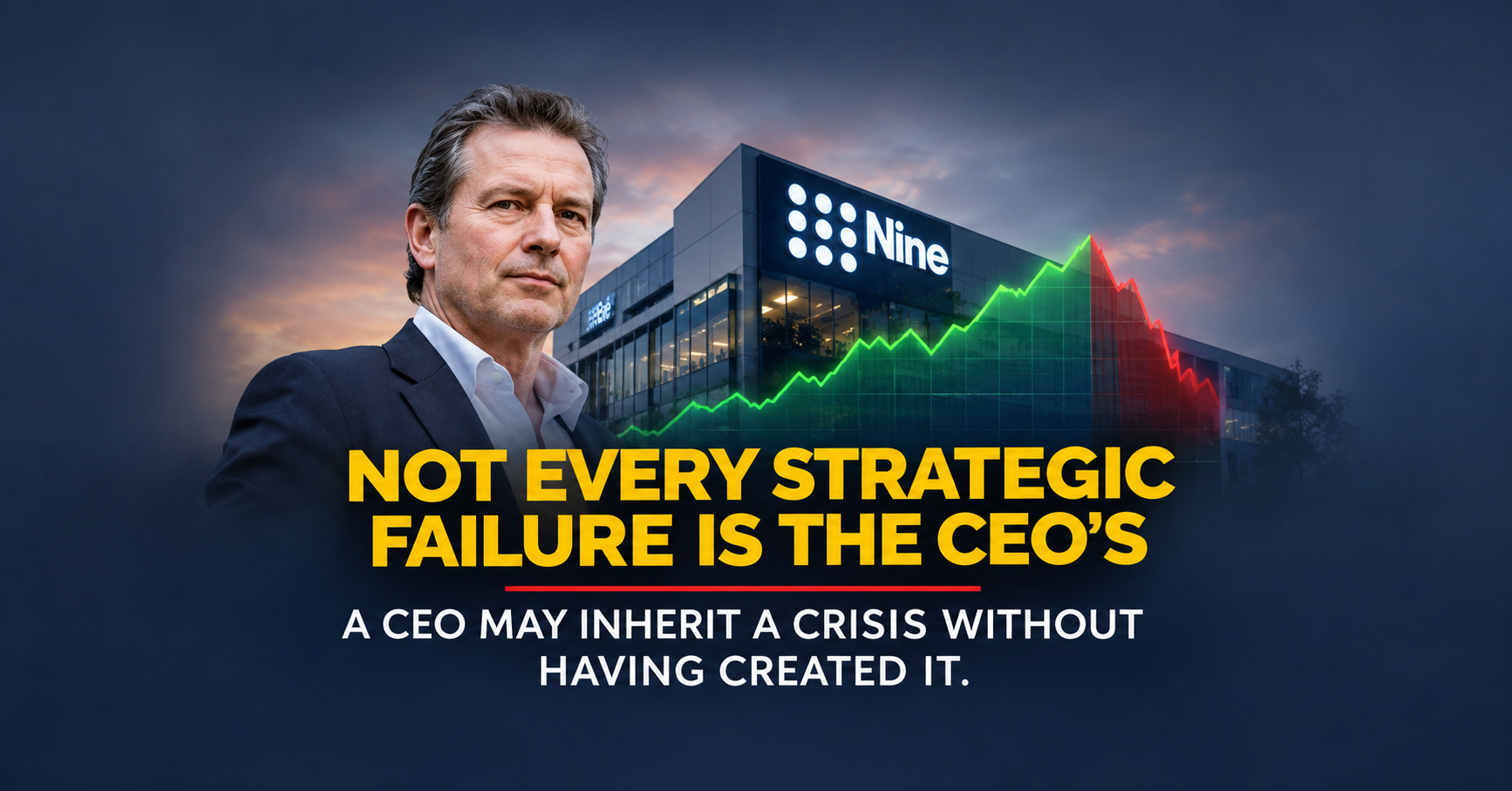
David Gyngell’s Nine: ratings, debt and industry-wide change
Nine Entertainment was winning viewers, strengthening its advertising position and rebuilding its television dominance. Yet beneath this operational success lay an acquisition-related debt burden exceeding A$3 billion, mounting refinancing pressure and a media industry undergoing structural change. David Gyngell inherited a financial predicament he had not created, but was required to navigate its consequences. Nine survived through a creditor-led restructuring that changed ownership and restored financial flexibility. Its journey offers important lessons about leadership, leverage and strategic renewal.
A ratings winner with a financial weakness
Business success is often measured through market share, revenue growth, brand strength and competitive positioning. But these indicators can conceal a more fundamental weakness: the financial architecture supporting the enterprise.
Nine Entertainment, one of Australia’s most influential media groups, offers a compelling illustration.
Under David Gyngell’s leadership, Nine strengthened its television audience and advertising position. Its aggregated metropolitan audience share increased from 34.6 per cent in 2007 to 39 per cent in October 2013. Its advertising revenue share rose from 32.4 per cent to 39.1 per cent over the corresponding period.
Yet behind this competitive recovery was a company burdened by more than A$3 billion in acquisition-related debt. The business was commercially relevant, but its capital structure had become increasingly vulnerable.
The distinction matters. Operational performance and financial resilience are not interchangeable. A company can win customers, improve market share and generate operating profits while remaining dangerously exposed to debt obligations.
The debt trap was created before the turnaround
Nine’s financial predicament originated in its ownership and acquisition structure.
Funds managed by CVC Capital Partners acquired control of Nine through Red Earth Holdings. The transaction was financed substantially through borrowing, leaving the business with significant senior and mezzanine debt.
The subsequent deterioration in advertising conditions, combined with refinancing pressures and the changing economics of television broadcasting, intensified the problem.
By 2012, Nine was facing the prospect of receivership.
It is important to distinguish between the decisions of the acquiring investors and those of the operating management. Gyngell did not create the acquisition-related debt burden. He inherited a business whose financial obligations had become a threat to its continued independence.
This distinction is central to understanding the leadership challenge. A CEO may be accountable for operational performance without having originated the capital structure that ultimately threatens the enterprise.
Leadership without authority is a liability
Gyngell’s own career offers an earlier lesson about organisational governance.
He joined Nine in 1999, became chief executive of Nine Network in 2004 and resigned in May 2005, citing what he described as unhelpful and multilayered management systems between the network and its parent, Publishing and Broadcasting Limited.
He subsequently moved to the United States to lead Granada Television before returning to Nine in 2007. In November 2010, he became chief executive of Nine Entertainment Company.
His return was significant because it brought operational leadership back to a business undergoing substantial change.
For founders and promoters, this episode raises an important governance question: Can a professional CEO deliver results when decision-making authority is fragmented between the board, promoters, holding company and operating management?
Accountability without authority creates organisational paralysis. Businesses appoint experienced leaders to make decisions, but those leaders must also receive clearly defined authority to execute them.
Survival required surrendering ownership
By October 2012, Nine’s creditors had become central to the company’s future.
An agreement with lenders helped the company avoid receivership. Contemporary reporting by ABC News described approximately A$3.2 billion of debt being wiped in exchange for creditors accepting a substantial ownership stake.
The final court-approved restructuring, implemented on 6 February 2013, involved approximately A$3.4 billion of senior and mezzanine debt obligations being discharged.
The ownership consequences were substantial. Senior creditors received approximately 95.5 per cent of the restructured company, mezzanine lenders received 3.75 per cent, while CVC retained just 0.75 per cent.
This was more than a refinancing exercise. It was a fundamental redistribution of ownership and control.
Nine was not entirely debt-free after the restructuring. New financing facilities were established, including a US$735 million term facility and an A$100 million working-capital facility.
Nevertheless, the legacy debt burden had been reset, providing the company with greater financial flexibility.
The price of survival was the loss of control by the previous owners.
For business promoters, this is an uncomfortable but necessary lesson. Protecting ownership at any cost can sometimes destroy the enterprise whose ownership they are trying to preserve.
Financial restructuring restored breathing space
Nine’s subsequent performance demonstrated the benefits of repairing the balance sheet.
The company listed on the Australian Securities Exchange in December 2013. Its FY2014 annual report presented the following pro-forma financial comparison:
| Financial indicator | FY2013 | FY2014 |
|---|---|---|
| Revenue (A$m) | 1,493.0 | 1,578.3 |
| Group EBITDA (A$m) | 297.2 | 311.0 |
| Pro-forma net profit (A$m) | 136.7 | 144.2 |
| Operating free cash flow (A$m) | 234.1 | 271.9 |
| Net debt (A$m) | 601.7 | 537.3 |
| Net leverage | 2.0x | 1.7x |
Revenue increased by approximately 5.8 per cent, while EBITDA improved by 4.7 per cent. Operating free cash flow increased by approximately 16.2 per cent, and net debt declined by A$64.4 million.
These were encouraging developments.
But the more important indicator was the improvement in cash generation and leverage. The company was gaining greater capacity to meet its obligations and invest in its operations.
For MSME founders, the implication is straightforward: turnover growth is not enough; the quality of cash flow determines how much freedom a business actually has.
A business generating higher revenue but consuming increasing amounts of working capital may be growing towards a liquidity crisis rather than financial strength.
Winning today’s market does not guarantee tomorrow’s relevance
Perhaps the most important strategic lesson lies beyond Nine’s debt restructuring.
Its 2013 prospectus disclosed that advertising accounted for more than 89 per cent of Nine Network revenue across FY2011 to FY2013.
This dependence exposed the company to fluctuations in advertising expenditure, changing audience preferences, competition from digital platforms and the escalating cost of content and sports broadcasting rights.
In other words, Nine was strengthening its position in a market whose underlying economics were changing.
This is a familiar strategic dilemma. A company may continue to dominate its existing category while the customer, technology and distribution models around it evolve.
Nine’s subsequent digital initiatives reflected an understanding of this challenge.
After acquiring Microsoft’s stake in the Ninemsn venture in 2013, the business was rebranded Nine.com.au. Nine and Fairfax established a streaming joint venture in 2014 and launched Stan in 2015, extending their presence into subscription-based video streaming.
These initiatives represented an attempt to build new distribution channels around existing content and audience capabilities.
However, diversification was not an immediate substitute for the economics of traditional broadcasting. It was a longer-term response to structural industry change.
The lesson for business leaders is that market leadership must be continuously renewed. Defending an established position is important, but investing in the next business model is essential.
What founders and CEOs must learn
David Gyngell’s journey at Nine Entertainment offers several strategic lessons that extend well beyond the media industry.
1. Market share is not financial strength.
A growing customer base, rising sales and competitive dominance cannot compensate for poor cash conversion, excessive leverage or weak debt-servicing capacity.
2. Never allow acquisition debt to endanger the operating business.
Before undertaking an acquisition, stress-test the financing against lower sales, delayed receivables, rising interest rates and slower integration.
3. Give leaders authority, not merely accountability.
Clearly defined decision rights and governance structures are essential. A CEO cannot be expected to deliver results when authority remains fragmented.
4. Recognise when restructuring becomes unavoidable.
Early engagement with lenders can preserve productive assets, employment and customer relationships. Delaying difficult decisions can leave a business with fewer choices.
5. Understand the price of financial rescue.
Debt-for-equity restructuring may save an enterprise, but founders and promoters must recognise that control and ownership can become the price of survival.
6. Do not confuse market leadership with future relevance.
Established products and customer relationships can lose value when technology, distribution and customer preferences change.
7. Diversify from existing strengths.
New businesses should build on existing capabilities, customer relationships and distribution advantages rather than represent unrelated expansion.
8. Convert financial recovery into strategic investment.
Improved cash flow should strengthen technology, people, product development, maintenance and distribution. Lower debt is an opportunity, not the final destination.
9. Build leadership succession before it becomes urgent.
Gyngell stepped down in November 2015 and was succeeded by Hugh Marks. Resilient organisations develop leadership depth rather than relying indefinitely on one individual.
10. Repair the balance sheet and reinvent the business together.
Financial restructuring buys time. Sustainable customer relevance, innovation and operational adaptability create long-term enterprise value.
The final word: growth must be financially sustainable
David Gyngell’s Nine is neither a straightforward corporate failure nor a conventional turnaround success story.
It is a case study in the complex relationship between leadership, ownership, leverage and industry disruption.
Gyngell strengthened Nine’s competitive position and helped steer it through an existential financial crisis. But its survival required a creditor-led restructuring that fundamentally changed ownership, while the underlying television business still needed to adapt to a rapidly evolving media landscape.
For MSME founders and CEOs, the message is direct.
Growth is not resilience. Market share is not solvency. Profit is not cash.
A business may spend years building its reputation, customer relationships and market position. Yet excessive borrowing, poor capital allocation and an inability to adapt can put that entire achievement at risk.
The responsibility of a founder is therefore not simply to build a bigger business. It is to build an enterprise that can withstand financial pressure, changing markets and leadership transitions without compromising its future.
Sources and further reading
- Nine Entertainment Company – 2013 ASX Prospectus. Debt restructuring, acquisition financing, audience share, advertising revenue and business risks.
- Nine Entertainment Company – 2014 Annual Report. Pro-forma financial performance, operating free cash flow, net debt and leverage.
- ABC News – 9 May 2005. David Gyngell resigns as head of Nine.
- ABC News – 26 September 2007. Gyngell returns as CEO of Nine.
- ABC Lateline – 17 October 2012. Nine avoids receivership following creditor agreement.
- ABC News – 21 January 2013. Nine’s debt restructuring agreement accepted by lenders.
- ABC News – 29 January 2013. Federal Court approves Nine’s debt restructuring.
- Darden School of Business / SSRN – Debt-for-Control Investing in Asia: Nine Entertainment Company. Analysis of leveraged acquisition financing and creditor negotiations.
- Nine for Brands – Corporate history and developments in Nine.com.au, Stan and the Fairfax merger.
- FIIG Research – Channel 9 and the Capital Structure. Analysis of Nine’s acquisition financing and capital structure.







Leave a Reply