
MSME Briefing Bureau
India’s drone supply chain: opportunity, investment and risks for MSMEs
India’s drone industry is creating a multi-thousand-crore market for components, sub-systems and replacement parts. Yet a large import bill does not automatically translate into a profitable manufacturing opportunity. For existing industrialists, the opportunity lies in adapting engineering capabilities to a new customer base. For aspiring founders, the challenge is greater: technical competence, OEM qualification, imported raw materials and working capital can determine survival. The winning strategy is to enter selectively, engineer deeply and secure customers before committing capital.
India’s drone opportunity is moving beyond assembly
India’s drone industry is entering a more demanding phase. The initial emphasis on assembling complete unmanned aerial vehicles (UAVs) is giving way to a larger strategic requirement: building a domestic supply chain for the components that make these aircraft operational, reliable and secure.
The opportunity is significant. India has more than 400 registered drone manufacturers, according to the research compiled for this assessment. The number of registered drones, measured through Unique Identification Numbers (UINs), reached 44,577 by October 2026, compared with 38,575 in February. This represents an addition of more than 6,000 registrations in eight months.
The research estimates India’s annual production at approximately 15,000–25,000 commercial and defence UAVs. This is an industry estimate, not a figure derived from UIN registrations. Production varies considerably by category: agricultural and survey drones can be manufactured in large batches, while defence and heavy-lift platforms are produced in smaller numbers against specific requirements and contracts.
The economics are equally diverse. Commercial agricultural and survey drones are typically priced at ₹3.5 lakh–₹12 lakh. Heavy-lift logistics drones can cost ₹10 lakh–₹45 lakh, while small tactical defence UAV systems may command ₹15 lakh–₹60 lakh or more. Larger MALE and specialised military platforms can cost several crores.
The market is therefore not a single manufacturing opportunity. It is a collection of different supply chains, each with its own technical requirements, production volumes, customer profiles and entry barriers.
The defence market is particularly important. The research estimates 45–60 active defence-grade UAV OEMs and public-sector manufacturers, alongside approximately 15–25 specialised logistics and cargo-drone OEMs. These estimates cover different categories of manufacturers and should not be interpreted as a verified count of active purchasing customers.
The strategic shift is being driven by defence indigenisation, the need for secure sourcing, and the vulnerability of critical supply chains to export restrictions. The Drone Federation of India’s November 2026 whitepaper, Making the Swadeshi Switch, has brought this issue into sharper focus. Its recommendations include stronger domestic-content requirements, support for component manufacturers and indigenous testing and certification.
For MSMEs, the implication is clear: the next opportunity may not be to build another drone, but to supply the motors, electronics, power systems, structures and precision components that drone manufacturers need.
The component market: where the money is
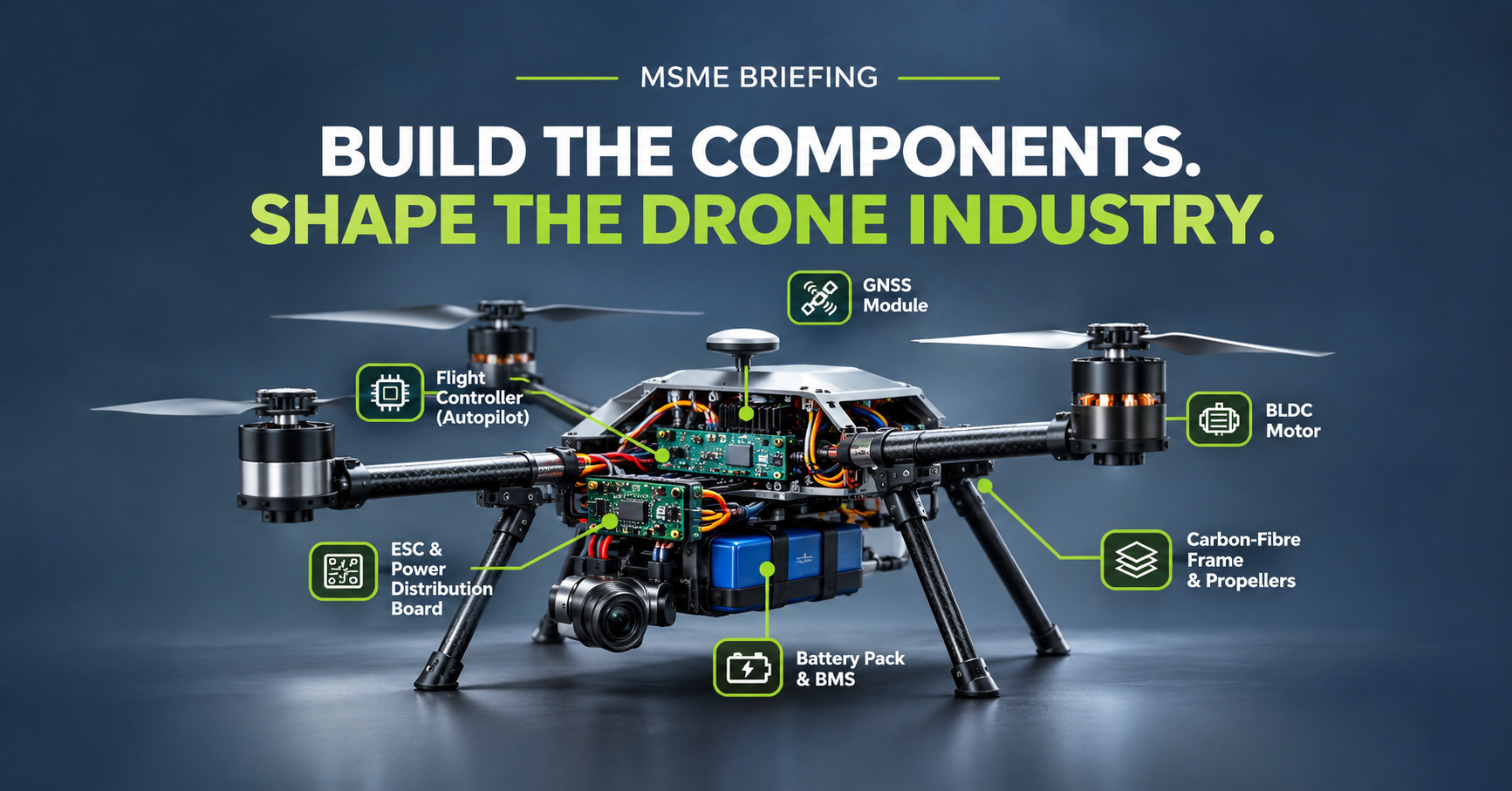
The most commercially relevant figures in the research are the estimated procurement values of seven component categories.
Estimated annual Indian procurement market, 2026
| Component category | Estimated annual value | Indicative annual demand |
|---|---|---|
| Flight controllers and autopilots | ₹550–800 crore | 25,000–40,000 units |
| Battery packs and smart BMS | ₹450–650 crore | 90,000–1,50,000+ packs |
| BLDC motors | ₹380–550 crore | 1,20,000–2,20,000+ motors |
| Carbon-fibre airframes, arms and propellers | ₹350–520 crore | 18,000–30,000 frame kits; 1,50,000+ propellers |
| GNSS modules and secure RF links | ₹450–700 crore | 25,000–45,000 sets |
| ESCs and power distribution boards | ₹250–380 crore | 1,20,000–2,20,000+ units |
| Wiring harnesses and CNC assemblies | ₹200–320 crore | 50,000+ sets and assemblies |
| Combined estimate | ₹2,630–3,920 crore | — |
Source: Component-level estimates in the November 2026 research dossier. The combined figure is an arithmetic aggregation of the seven ranges, not an independently published market-size statistic. The categories must be checked for overlapping subsystem values before the total is treated as a definitive addressable market.
This estimated procurement pool is substantial, but the import profile is more revealing than the headline value.
The research, drawing on the DFI assessment, estimates that 80–90% of flight controllers and 90–95% of GNSS modules are imported. It also places import dependence for BLDC motors at 70–80%, and for ESCs and PDBs at approximately 60–70%.
Battery manufacturing presents a different picture. Indian companies are increasingly undertaking pack assembly and BMS integration, with the research estimating localisation of approximately 60–70% in these activities. However, the underlying lithium-ion cells remain imported. In carbon-fibre structures, domestic moulding and lay-up are more established, but raw carbon tow and prepreg remain important imported inputs.
Wiring harnesses and CNC-machined assemblies are estimated to be more than 80% localised. This is a crucial distinction: the largest import dependence does not necessarily identify the easiest opportunity for a new manufacturer.
The best entry point is where domestic demand, technical capability, achievable localisation and a realistic customer-acquisition route intersect.
Seven component opportunities, seven different businesses
The component market should not be approached as one homogeneous manufacturing segment. Each category has different capital requirements, technical barriers and competitive conditions.
1. Flight controllers and autopilots
With an estimated annual procurement value of ₹550–800 crore, flight controllers represent one of the largest component categories. Annual demand is estimated at 25,000–40,000 units, with 80–90% currently imported.
The opportunity is strategically attractive, particularly for defence platforms seeking trusted, non-Chinese supply chains. However, it is not an obvious first venture for a conventional engineering MSME. Flight-control systems require embedded software, sensor fusion, navigation, electronics design, cybersecurity and extensive validation.
A manufacturer may be able to assemble a PCB, but that does not establish the ability to design and qualify a reliable autopilot. This is a technology-led business, not simply an electronics assembly opportunity.
2. Battery packs and Battery Management Systems
The estimated market is ₹450–650 crore, with annual demand of 90,000–1,50,000 or more packs.
Battery packs offer an attractive combination of manufacturing and replacement demand. An MSME can create value through cell matching, pack design, spot welding, thermal management, protective enclosures and smart BMS integration.
The constraint is upstream sourcing. The research identifies imported lithium-ion cells as a major dependency, including high-discharge cells required for demanding UAV applications. Energy density, temperature performance, charging cycles and safety are critical.
For an existing battery or power-pack assembler, this may be a logical diversification. A new entrant, however, must budget for cell sourcing, testing, safety infrastructure and transport compliance. Relevant BIS requirements and UN 38.3 transport testing must be assessed for the product and its intended market.
3. BLDC motors
The estimated annual procurement market is ₹380–550 crore, with demand of 1.2–2.2 lakh motors. Approximately 70–80% are estimated to be imported.
A multi-rotor drone typically uses four to eight motors. Heavy-lift platforms require higher-thrust motors, making propulsion a critical part of performance and reliability.
Rajkot’s motor-winding, machining and precision-engineering capabilities provide a possible industrial base. Existing motor and pump manufacturers could explore stators, housings, shafts, rotor balancing, winding and testing.
But the challenge is not merely winding a motor. Drone motors must meet demanding requirements for weight, thrust, thermal performance, vibration and endurance. Neodymium-iron-boron (NdFeB) permanent magnets are a significant upstream dependency. The DFI assessment cited in the research attributes approximately 94% of global permanent-magnet production to China.
A motor manufacturer must therefore develop a credible sourcing strategy alongside its production capability.
4. Carbon-fibre structures and propellers
The estimated market is ₹350–520 crore, covering 18,000–30,000 frame kits and more than 1,50,000 propellers annually.
Indian manufacturers already undertake moulding and composite lay-up, but raw carbon tow and prepreg remain important imported materials.
The opportunity includes carbon-fibre tubes, arms, fuselages, landing gear, propellers and specialised structural assemblies. Existing FRP, composites and industrial fabrication units could evaluate this segment.
The difficulty lies in tooling, material consistency, curing processes, dimensional accuracy and structural testing. A lightweight component must withstand vibration, impact and repeated operating stress without compromising flight performance.
5. GNSS modules and secure RF data links
At an estimated ₹450–700 crore annually, this category is strategically important. The research estimates that 90–95% of GNSS modules are imported.
NavIC integration, secure communications, encrypted data links and reliable navigation are important development priorities. However, the semiconductor and RF component ecosystem remains a major constraint.
This is a high-technology opportunity. It is better suited to specialised electronics and embedded-systems companies than to a first-time investor without an experienced technical team.
6. ESCs and power distribution boards
The estimated annual market is ₹250–380 crore, with demand of approximately 1.2–2.2 lakh units.
Electronic Speed Controllers regulate motor operation, while Power Distribution Boards manage electrical power across the drone. The research estimates that 60–70% of these components are imported.
Existing electronics and industrial-control manufacturers could explore PCB assembly, power switching, DC-DC converters, thermal design, firmware tuning and testing.
However, the supplier must demonstrate reliable performance under peak current, heat, vibration and electrical interference. A board that works on a test bench may still fail under actual flight conditions.
7. Wiring harnesses, connectors and CNC assemblies
This category has an estimated annual procurement value of ₹200–320 crore. The research places domestic localisation above 80%.
At first glance, the higher localisation level may appear less attractive than the import dependence in flight controllers or GNSS modules. Yet this is precisely where existing Indian precision-engineering MSMEs may have a practical advantage.
Custom harnesses, connectors, motor mounts, gimbal housings, payload brackets, landing gear and precision-machined assemblies are required across multiple drone categories.
The business is less about inventing a new technology and more about delivering consistent engineering quality, traceability, dimensional accuracy and dependable supply.
For a new MSME, this category deserves serious consideration as an initial entry point.
India’s supply-chain opportunity still has a China problem
Domestic assembly should not be confused with complete indigenisation.
An Indian manufacturer may wind a BLDC motor, assemble a battery pack, mould a carbon-fibre structure or populate a PCB. Yet the underlying magnets, cells, chips, sensors and specialised materials may still be imported.
The DFI assessment identifies three particularly important dependencies:
- Rare-earth magnets: China accounts for approximately 94% of global permanent-magnet production, according to the assessment.
- Lithium-ion cells: Indian battery-pack assemblers continue to rely on imported cells for high-performance UAV applications.
- Semiconductors and sensors: MEMS inertial measurement units, gyroscopes, GNSS chipsets and RF transceivers remain important imported inputs.
This creates a paradox. India wants to reduce dependence on Chinese components, but Indian manufacturers may themselves depend on imported materials and electronic inputs.
China’s export-control measures have made this vulnerability more visible. Restrictions introduced in September 2024 and April 2025 were followed by an expansion covering additional drone-related technologies and components in November 2026, according to the DFI assessment and industry reporting.
The commercial lesson is that local value addition is necessary, but supply-chain resilience requires more than domestic assembly.
An MSME entering this sector should identify alternative suppliers, establish inventory policies for critical inputs and assess the effect of export restrictions on delivery commitments.
Gujarat: an existing industrial base can be redirected
Gujarat’s advantage is not simply the presence of drone companies. It is the state’s existing engineering and manufacturing ecosystem.
The research identifies approximately 15–20 active UAV and drone-subsystem companies in the state, although this should be treated as an industry estimate rather than a formal government count.
The emerging ecosystem includes OEMs and system integrators such as Enercomp Solutions in Ahmedabad, Swallow Systems in the Vadodara–Halol belt, Doctor Drone Industries in the Gandhinagar region and Kalptru Drones & Robotics in Ahmedabad.
The component landscape includes IINDEPRO Dynamics and Xenhester Innovation in Rajkot for motor-related activity, XLR8 Aerospace in Ahmedabad for power distribution and drone electronics, and Voltherm Technologies in Gandhinagar for lithium battery packs. These company descriptions should be confirmed directly with the respective businesses before any commercial approach or investment decision.
The wider industrial geography is particularly relevant.
Rajkot: Its precision-engineering, motor-winding, machining and electro-mechanical capabilities could support BLDC motor components, shafts, housings, mounts and payload hardware.
Ahmedabad–Sanand: Electronics, PCB assembly, industrial controls, plastics and fabrication provide a base for ESCs, PDBs, harnesses, DC-DC converters and enclosures.
Vadodara and the surrounding industrial belt: Instrumentation, electrical systems, industrial fabrication and engineering capabilities could support specialised assemblies and structural components.
The strategic opportunity is to encourage existing industrial units to add a drone-component business line rather than build an entirely new factory.
Gujarat’s 2026 policy advantage
The Viksit Gujarat Industrial Policy 2026 identifies drone manufacturing as a selected thrust sector. The incentive framework provides eligible units with combinations of capital subsidy, interest subsidy and power-tariff assistance, subject to the applicable scheme, enterprise category, taluka classification and eligible fixed capital investment.
For eligible micro and small units, the published policy analysis indicates a maximum combined incentive ceiling of up to 45% in Category A and 35% in Category B. Other categories have different ceilings and conditions.
This is not a blanket 45–50% capital subsidy. The ceiling represents a combination of eligible support instruments, and the actual benefit depends on the unit’s classification and compliance with the scheme.
For an investor, the correct sequence is to establish the project’s eligibility, location, investment base and application conditions before incorporating incentives into the financial model.
The policy can improve project economics. It cannot substitute for a viable product, a qualified supplier relationship or a paying customer.
Where should an MSME invest?
The entry strategy should differ depending on whether the entrepreneur already owns a manufacturing unit or is starting from scratch.
For existing industrialists, diversification is the more practical route.
The research provides the following indicative investment ranges:
| Existing business capability | Potential drone-component entry | Indicative investment |
|---|---|---|
| CNC machining, precision turning, motor/pump manufacturing | Motor housings, shafts, mounts, gimbal brackets, payload-release hardware | ₹40 lakh–₹1.5 crore |
| Electronics, PCB assembly and industrial controls | ESCs, BMS, PDBs, wiring harnesses | ₹35 lakh–₹1.2 crore |
| Plastics, FRP and composites | Carbon-fibre tubes, arms, landing gear, airframe shells | ₹50 lakh–₹2 crore |
| Battery and power-pack assembly | Smart battery packs and BMS integration | ₹50 lakh–₹2.5 crore |
These are indicative diversification budgets. Actual capital expenditure will depend on the existing machinery, automation level, outsourced processes, testing requirements and production volumes.
For example, a Rajkot motor manufacturer may not need to establish a completely new facility. It may need specialised winding and assembly jigs, precision tooling, dynamic balancing and thrust-testing equipment.
An electronics unit may be able to use its existing PCB and industrial-control infrastructure, adding programmable DC loads, oscilloscopes, thermal testing and firmware-validation facilities.
A composite manufacturer may need dedicated moulds, vacuum bagging, curing capability and dimensional inspection equipment.
The principle is straightforward: use existing assets, acquire the missing capabilities and avoid duplicating infrastructure unnecessarily.
The new founder’s entry route
A new founder without an existing factory should resist the temptation to begin with a complete drone manufacturing plant.
The research identifies three broad investment models:
| Entry model | Indicative investment | What it covers |
|---|---|---|
| Asset-light / fabless sub-assembly startup | ₹15–50 lakh | Design, prototyping, test benches, jigs, outsourced manufacturing and working capital |
| Existing-unit diversification | ₹40 lakh–₹2 crore | Dedicated production cell, tooling, testing and qualification |
| Greenfield component manufacturing | ₹5–25 crore+ | Facility, machinery, testing infrastructure, production systems and working capital |
The ₹15–50 lakh model does not buy land, an industrial shed, a CNC centre, an SMT line or a carbon-fibre autoclave.
It is an asset-light or micro-assembly model. The founder may operate from a leased 500–1,000 sq. ft. workspace or an incubator facility, retain design and quality control in-house, and outsource specialised machining, PCB fabrication or composite production.
A small dedicated workshop may require ₹60 lakh–₹2 crore, depending on its scope. An integrated greenfield manufacturing unit can require ₹5 crore–₹25 crore or more.
For a new founder, three entry points deserve priority:
- Custom wiring harnesses and power sub-assemblies: Lower initial tooling requirements than a complete motor or composite manufacturing operation, with demand across several drone categories.
- Application-specific mounts, brackets and spares: A practical route for engineering entrepreneurs with CAD, CNC and fabrication experience.
- Battery-pack assembly and BMS integration: Attractive replacement demand, but dependent on cell sourcing, safety engineering and compliance.
The founder’s background matters. A technically capable mechanical, electrical or embedded-systems engineer can lead product development. A business-oriented investor should secure a committed technical co-founder or partner with an established engineering unit before investing in tooling.
In this sector, engineering competence is a form of capital.
The price test: Can Indian MSMEs compete?
Import dependence alone does not guarantee that an Indian manufacturer can win an order. The buyer will compare performance, reliability, landed price, delivery time and after-sales support.
The research’s indicative B2B price comparisons provide a useful starting point.
| Component | Typical landed import price | Indicative Indian MSME offer |
|---|---|---|
| Small FPV/light tactical BLDC motor | ₹900–1,800 | ₹1,500–2,500 |
| Heavy-lift BLDC motor | ₹8,500–18,000 | ₹9,500–20,000 |
| 30A–40A ESC | ₹600–1,600 | ₹950–1,800 |
| 100A ESC | ₹3,500–7,500 | ₹4,200–8,500 |
| 6S/12S smart battery pack | ₹14,000–38,000 | ₹12,750–45,500 |
| Carbon-fibre foldable frame kit | ₹15,000–35,000 | ₹16,000–38,000 |
Indicative prices from the research dossier, based on B2B catalogue and tender benchmarks. They are not verified transaction prices or firm supplier quotations.
The table reveals that domestic suppliers may not always win on price. In several categories, Indian offers carry a premium.
That premium must be justified.
A domestic motor supplier may offer a customised shaft or mounting arrangement, local warranty and faster replacement. An Indian ESC manufacturer may tune firmware for a specific motor-propeller combination. A frame manufacturer may deliver a customised payload mount without the minimum order quantities or lead times associated with imports.
For defence and security customers, origin declarations and trusted sourcing can be decisive.
The competitive proposition should be reliability, customisation, shorter lead times and customer support—not merely the claim that the product is made in India.
The guardrails: quality, certification and vendor qualification
Drone components operate in conditions that are significantly more demanding than many conventional industrial applications.
Weight directly affects flight time and payload capacity. Vibration can fatigue solder joints, loosen connectors and damage structures. Heat, dust, moisture and temperature changes affect electronics and batteries.
A component failure in a ground machine may stop production. A failure in the air can cause a crash, damage expensive payloads or create a safety risk.
Consequently, OEMs do not qualify suppliers simply by inspecting a finished sample. They want evidence of engineering discipline and repeatable manufacturing.
For commercial components, this can include:
- ISO 9001 quality-management systems, where required by the buyer.
- Batch and lot traceability.
- Thrust-stand and motor-dyno performance curves.
- Thermal-rise measurements under peak electrical load.
- Vibration and endurance testing.
- Documented inspection and quality-control procedures.
Battery suppliers face additional product-specific safety and transport requirements, including applicable BIS standards and UN 38.3 testing.
Defence and aerospace supply chains may require more demanding standards and buyer-specific qualification, including AS9100 quality systems, JSS 55555 environmental testing, EMI/EMC compliance, supply-chain security checks and country-of-origin declarations.
The research estimates that initial prototype and qualification orders may involve 5–25 units. Commercial orders may rise to 100–500 or more units per quarter for agricultural and survey OEMs, while defence and heavy-lift buyers may begin with smaller batches.
Indicative vendor-approval timelines are:
| Customer category | Indicative qualification period |
|---|---|
| Civil and agricultural OEMs | 2–4 months |
| Defence OEMs and DPSUs | 6–12 months or longer |
| Type-certified platform changes | Depends on the nature of the modification and approval process |
The DGCA’s October 2025 manufacturing circular distinguishes between changes that do not affect safety or security, major modifications requiring delta certification, and substantial changes that may require a new type-certificate application. Replacement of manufacturer-approved components that does not violate the type certificate is not automatically treated as a modification.
For an ancillary manufacturer, the commercial implication is important: approach the OEM early, understand its approved configuration and become part of the design and qualification process before investing in dedicated production tooling.
GST and policy incentives: understand the fine print
Tax treatment can influence the working-capital requirements of a component manufacturer, particularly where input taxes accumulate before the finished product is sold.
The GST Council’s September 2025 decision recommended a uniform 5% GST rate on drones. That rate applies to the drone as a product; it should not be assumed that every motor, battery, electronic board, connector or other component automatically attracts 18%.
The applicable rate depends on the product’s HSN classification and relevant notifications. Therefore, the research’s reference to an 18% component rate should be checked item by item before calculating an inverted-duty impact.
Where input GST exceeds output GST, an eligible manufacturer may face accumulated input tax credit and a cash-flow burden. The availability and treatment of refunds depend on the applicable GST provisions and the specific transaction structure.
The earlier Central PLI scheme also needs careful treatment. It offered a 20% incentive on eligible domestic value addition, subject to a minimum 40% value-addition requirement. The annual sales threshold for MSME component manufacturers was ₹50 lakh. However, the original scheme had a three-year tenure beginning in FY2021–22 and ending in FY2023–24.
It should therefore be treated as historical policy context, not as an incentive available to a new entrant today unless a successor scheme is officially notified.
For a Gujarat project, the Viksit Gujarat Industrial Policy 2026 may provide a more relevant current incentive framework, subject to eligibility and the applicable government resolutions.
Neither a subsidy nor a tax advantage should be included in a project’s base-case economics until eligibility, approval and disbursement conditions are understood.
Working capital: the risk that machinery cannot solve
A component manufacturer may have a technically sound product, a qualified customer and a healthy order book, yet still run into financial distress.
The reason is the gap between paying suppliers, manufacturing and dispatching components, completing inspection and receiving payment.
The research indicates that sample and tooling orders may involve 50% advance payment and 50% on dispatch. Production orders from private agricultural and commercial OEMs may carry payment terms of 45–60 days. Defence contractors and public-sector buyers may take 60–120 days after inspection.
These are indicative terms, not universal contractual conditions.
For an MSME, the consequences can be serious. Imported cells, magnets, chips and other inputs may require advance payment or limited supplier credit. Production costs must be funded before dispatch. Inspection and acceptance may delay invoicing or payment.
Consider an illustrative ₹25 lakh production order. The supplier must finance materials, labour, outsourced processes, testing, packaging and dispatch. Even after delivery, the payment clock may not begin until the customer completes inspection and accepts the batch.
The business may report a profit on the order while having insufficient cash to execute the next one.
This is why working capital must be modelled alongside machinery and fixed capital investment.
A prudent founder should prepare a cash-conversion model covering:
- Supplier advances and credit periods.
- Raw-material inventory and imported-input lead times.
- Production and testing duration.
- Customer inspection and acceptance.
- Invoice submission and actual payment terms.
- Warranty obligations and replacement stock.
The research suggests that three to four months of working-capital provision may be a useful planning benchmark for an asset-light operation, but the actual requirement must be calculated from the product, order size, supplier terms and customer contract.
In drone ancillaries, liquidity can be as important as engineering.
The aftermarket: revenue after the first sale
The opportunity does not end when a drone leaves the factory.
Agricultural drones operate in dust, heat, humidity and chemically exposed environments. Logistics and defence platforms face demanding operating conditions, while survey fleets may accumulate substantial flight hours.
The research estimates that replacement and maintenance demand could represent 20–35% of hardware value annually. This is an industry estimate and should not be applied uniformly across every fleet or component.
Indicative component life and replacement benchmarks include:
| Component | Indicative lifespan or replacement trigger | Estimated repeat demand |
|---|---|---|
| Battery packs | 150–300 charge cycles; intensive agricultural use may require replacement in 12–18 months | 4–6 replacement packs per drone annually in intensive-use assumptions |
| Propellers | 300–500 flight hours, or earlier after damage | 2–4 full sets per drone annually |
| BLDC motors and bearings | 400–600 flight hours, subject to operating conditions | 1–2 replacement motors per drone annually |
| Landing gear, arms and vibration dampers | Damage, hard landings and wear; indicative 6–12-month cycle | 1–2 spare kits annually |
| Wiring harnesses, connectors and ESCs | Vibration, moisture and electrical stress | Approximately 15–20% annual fleet replacement rate |
These are indicative benchmarks from the research dossier and referenced maintenance material. Actual replacement rates depend on operating intensity, drone design, maintenance practices, environment and fleet age.
For a component supplier, this creates a second commercial route. Instead of depending entirely on new drone production, the business can develop relationships with OEMs, fleet operators, maintenance providers and authorised service networks.
Battery packs, propellers, motors, connectors and structural spares may offer repeat sales. But the aftermarket requires product compatibility, reliable availability and a distribution or service network.
A recurring-revenue model is possible, but only when the supplier has established product quality and access to the operating fleet.
Which component should an MSME choose?
The size of the market is only one factor. An investment decision must consider capital, technical complexity, competition, qualification time and repeat demand.
The following is a strategic assessment based on the research, rather than a verified industry ranking.
| Component opportunity | Capital intensity | Technical complexity | Competitive / sourcing challenge | Strategic assessment |
|---|---|---|---|---|
| Wiring harnesses and connectors | Low–medium | Medium | Established suppliers; quality and traceability | Practical first entry |
| CNC mounts, brackets and payload hardware | Low–medium for existing units | Medium | Precision, tolerances and OEM-specific design | Strong diversification opportunity |
| PDBs and DC-DC assemblies | Medium | Medium–high | Electronics reliability and thermal performance | Promising for existing electronics units |
| Carbon-fibre structures | Medium–high | High | Materials, tooling and process control | Selective opportunity |
| BLDC motors and ESCs | Medium–high | High | Magnets, electronics, balancing and endurance | Attractive but technically demanding |
| Battery packs and BMS | Medium–high | High | Imported cells, safety and testing | Potentially recurring, but capital and compliance intensive |
| Flight controllers and GNSS | High | Very high | Semiconductors, firmware and systems validation | Not a suitable first venture for most MSMEs |
The ranking is not a substitute for customer validation. A manufacturer with existing motor expertise may find BLDC motors more accessible than harnesses. An electronics company with embedded-systems capability may have a genuine advantage in ESCs or BMS.
The correct question is not simply, “Which component has the highest import dependence?”
It is: Which component can this particular enterprise manufacture reliably, qualify with an OEM, price competitively and finance until payment?
Recommendations: build the customer relationship before the factory
India’s drone ancillary market offers a credible opportunity for existing industrialists and aspiring founders. But it is not a sector where an investor should begin by buying machinery and then searching for customers.
For existing MSMEs, the recommended route is adjacent diversification. A motor manufacturer should examine propulsion components; an electronics unit should evaluate power electronics and harnesses; a precision machine shop should explore mounts, brackets and payload assemblies. The objective should be to leverage existing infrastructure and technical competence.
For new founders, an asset-light Tier-2 sub-assembly model is more prudent than a greenfield factory. Start with a narrowly defined product, retain engineering and quality control in-house, outsource capital-intensive processes and secure paid prototype orders before expanding capacity.
Before committing capital, prospective suppliers should conduct structured discussions with at least 8–10 drone OEMs and component buyers. They should seek actual bills of materials, annual procurement requirements, target prices, minimum order quantities, qualification procedures, vendor approval timelines and payment conditions.
The next step should be a paid prototype or pilot order, not a large machinery purchase based on market projections.
The risks deserve equal attention. Imported magnets, cells and semiconductors can disrupt production. OEM qualification can take months. Certification and testing can consume capital. Customer concentration can weaken bargaining power. Delayed payments can turn profitable orders into a liquidity crisis. Subsidies may improve project economics, but they do not eliminate these risks.
India’s drone industry needs a deeper domestic component ecosystem. Gujarat’s precision engineering, electronics, motor and fabrication clusters offer a useful starting base. Yet the opportunity will reward disciplined suppliers rather than speculative entrants.
The final recommendation is to invest in capability before capacity: identify the customer, validate the component, secure technical leadership, qualify the product and finance the order cycle.
In this market, the strongest competitive advantage may not be the factory with the most machines. It may be the supplier that understands the OEM’s design, delivers a reliable component repeatedly and has enough working capital to remain in business while the customer pays.
Sources and research credits
Primary industry research and policy material
- Drone Federation India (DFI): Making the Swadeshi Switch whitepaper; Bharat Drone Stack Conference 2026 proceedings; Bharat Drone Stack supplier directory and component ecosystem mapping.
- Ministry of Civil Aviation / Press Information Bureau: PLI Scheme for Drones and Drone Components; original eligibility, value-addition and tenure provisions.
- Government of Gujarat: Viksit Gujarat Industrial Policy 2026 and relevant scheme resolutions for eligible manufacturing units and selected thrust sectors.
- Directorate General of Civil Aviation: Drone Manufacturing Circular dated 30 October 2025; type-certificate modification and replacement provisions.
- Ministry of Finance / GST Council: 56th GST Council decisions and September 2025 clarification on the uniform 5% GST rate for drones.
Industry, market and company research
- IMARC Group: India Drones Market Size, Share & Industry Report, September 2026.
- MarketsandMarkets: India Military Drones Market, 2026–2031.
- CareEdge Advisory, Mordor Intelligence and sector trackers: Market and segment estimates referenced in the research dossier.
- Zetwerk Aerospace & Defence: India’s Drone & UAV Manufacturing Ecosystem Guide, 2026.
- Business Standard and The Week: Reporting on DFI’s November 2026 whitepaper, import dependence and Chinese export controls.
- TendersOnTime: UAV component tender and bill-of-quantity benchmarks referenced in the research.
- Indian B2B component catalogues: mPower Lithium, GenX UAV Battery, Indian Robo Store and Robu.in.
- UAV maintenance references: Sooryauday Aerial Vehicles, Flyby Guys and KDE Direct maintenance and lifecycle material.
- Company and ecosystem references: Adani Defence & Aerospace, ideaForge, Garuda Aerospace and the Gujarat-based drone and component companies identified in the research dossier.
Market sizes, component procurement values, production capacities, company counts, prices, investment ranges, margins, qualification periods and replacement cycles are estimates or benchmarks unless specifically identified as official figures. They should be validated with OEMs, suppliers, laboratories and relevant government authorities before being used in an investment appraisal or project-finance proposal.






Leave a Reply