
MSME Briefing Bureau
The ₹57,000-crore post-harvest problem opens new markets for MSMEs
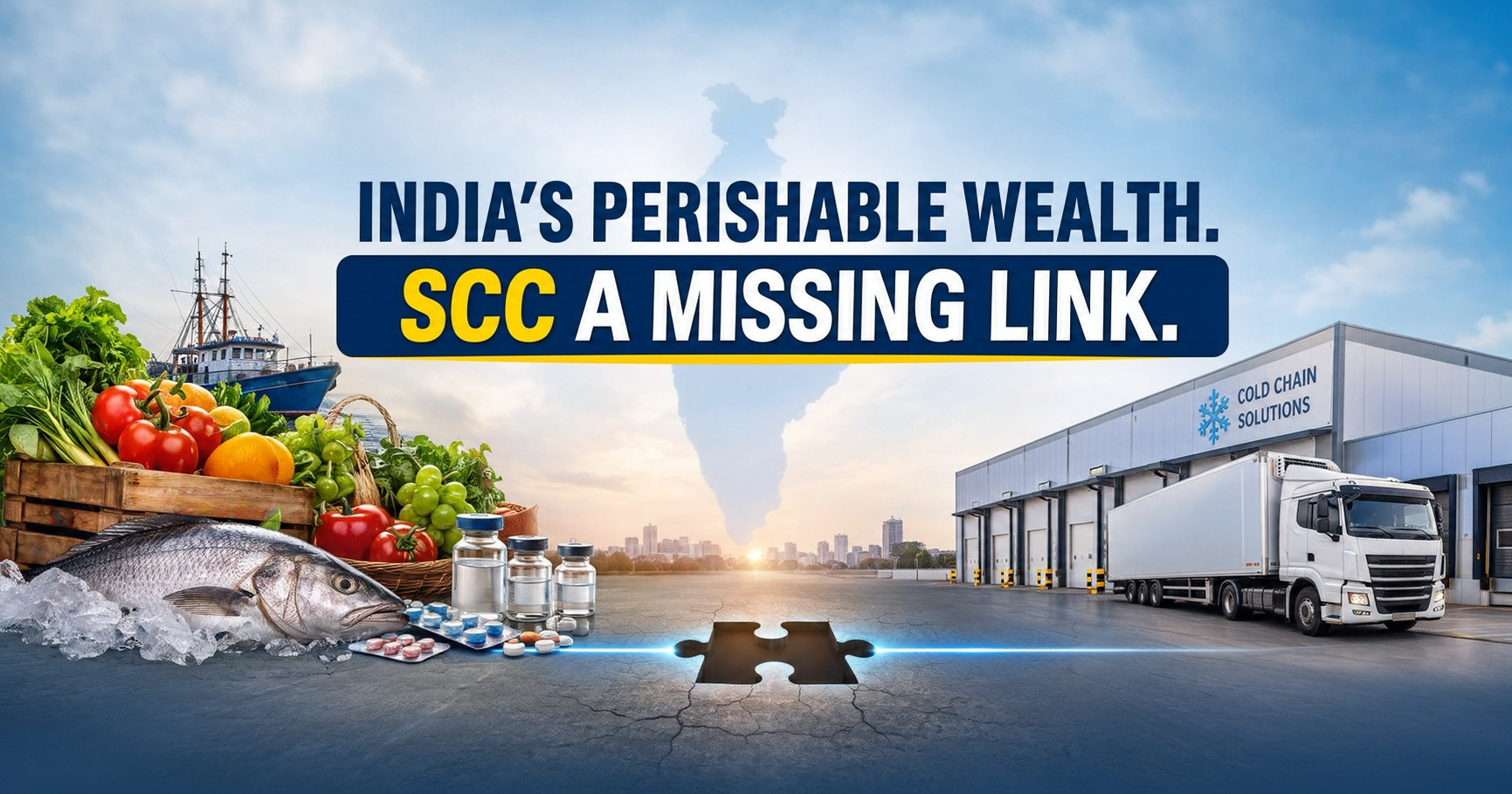
India produces hundreds of millions of tonnes of perishable commodities, yet inadequate first-mile infrastructure, fragmented transportation and limited specialised storage continue to erode value before products reach consumers. A government-commissioned study estimates annual fruit and vegetable losses at ₹57,004 crore. This is more than an agricultural problem: it is a business opportunity spanning pre-cooling, packhouses, reefer logistics, pharmaceutical storage, refrigeration equipment, IoT monitoring and maintenance. For MSMEs, the challenge is to capture this opportunity without overinvesting.
Understanding the opportunity: What is SCC?
SCC stands for Specialised Cold Chains—temperature-controlled storage, transportation, handling and monitoring systems designed around the specific requirements of products and industries.
Unlike conventional cold storage, which may serve a single commodity or seasonal agricultural cycle, SCC infrastructure caters to products as diverse as fresh fruits, seafood, pharmaceuticals, biologics, dairy, frozen foods, flowers and certain industrial materials. Each requires different temperature conditions, humidity levels, handling procedures, equipment and monitoring systems.
India’s cold-chain opportunity is therefore much larger than the construction of refrigerated warehouses. It includes the infrastructure required to preserve a product from the point of harvest or manufacture to its final destination.
The market is already substantial. According to estimates cited by the India Brand Equity Foundation (IBEF), India’s cold-chain logistics market was valued at approximately ₹1.09 lakh crore in 2025 and is estimated to reach ₹1.32 lakh crore in 2026. It is projected to expand to around ₹2.56 lakh crore by 2034, implying a compound annual growth rate of approximately 8.62% between 2026 and 2034. These estimates cover a broad market; individual segments will grow at different rates. India Brand Equity Foundation
For MSME founders and investors, the important question is not simply whether this market will expand. It is which part of the value chain offers a commercially viable entry point, who will pay for the service, and what capabilities are required to compete?
The ₹57,000-crore problem: A market waiting to be served
The economic case for specialised cold chains becomes clearer when we examine India’s post-harvest losses.
A study commissioned by the Ministry of Food Processing Industries (MoFPI) and conducted by NABARD Consultancy Services (NABCONS), covering the reference period 2020–22, assessed post-harvest losses across 54 commodities, 15 agro-climatic zones and 292 districts.
Its findings are significant.
The annual fruit and vegetable loss estimate
₹57,004 Cr
Estimated monetary loss
19.33 MMT
Estimated quantity lost
₹29,545 Cr
Fruit losses
₹27,459 Cr
Vegetable losses
Source: MoFPI–NABCONS study, reference period 2020–22; figures reported by the Government of India in December 2025. Press Information Bureau+1
The study estimated annual losses of 7.36 million tonnes of fruits valued at ₹29,545.07 crore, and 11.97 million tonnes of vegetables valued at ₹27,459.08 crore.
The percentage losses are equally revealing:
| Commodity | Estimated post-harvest loss |
|---|---|
| Fruits | 6.02%–15.05% |
| Vegetables | 4.87%–11.61% |
| Marine fisheries | 8.76% |
| Inland fisheries | 4.86% |
| Meat | 2.34% |
| Poultry | 5.63% |
| Eggs | 6.03% |
| Milk | 0.87% |
Press Information Bureau+1
Individual commodities face particularly high losses. The study reported 15.05% for guava, 11.61% for tomato and 9.51% for apple.
These are not losses attributable exclusively to the absence of refrigeration. Harvesting, collection, grading, sorting, packaging, transportation, storage and handling all contribute. Nevertheless, the findings expose a substantial opportunity for infrastructure that can preserve product quality and reduce avoidable losses.
Consider the commercial implications. A fruit or vegetable producer may lose value because produce cannot be cooled quickly, graded, packed or moved to a suitable market. A processor may face inconsistent raw-material quality. An exporter may lose a shipment because the product does not meet the required condition on arrival.
The opportunity for MSMEs lies in providing the missing services that preserve value between production and consumption.
India’s paradox: More cold-storage capacity, but an incomplete cold chain
India has built a substantial cold-storage network. According to information supplied by the Ministry of Agriculture and Farmers Welfare in Parliament, the country had 8,831 operational cold-storage facilities with a combined capacity of 402.87 lakh metric tonnes as of January 2026. Gazette Notification PDF
However, storage capacity alone does not establish that a functioning cold chain exists.
A FICCI–Grant Thornton Bharat report, India’s Cold Chain Infrastructure: From Storage to a Chain, published in 2026, makes an important distinction. It reports that India had 40.22 million tonnes of cold-storage capacity across 8,815 facilities as of June 2025, but approximately three-quarters of that capacity was used for potatoes. Grant Thornton Bharat
The figures refer to different reporting dates and should not be treated as contradictory. More importantly, they reveal the concentration of infrastructure in particular commodities.
A potato cold store is not automatically suitable for frozen seafood, ice cream, vaccines or temperature-sensitive biologics. Nor does a warehouse solve the problem of getting produce from a farm to the first point of cooling.
The FICCI–Grant Thornton report identifies the more serious gaps in the first-mile and distribution infrastructure:
The infrastructure gap: What remains underdeveloped?
Packhouses
1.05%
Reported infrastructure: 1,312
Report benchmark: 1,25,000
Reefer vehicles
4.85%
Reported infrastructure: 19,400
Report benchmark: 4,00,000
Ripening chambers
11.6%
Reported infrastructure: 1,630
Report benchmark: 14,000
Source: FICCI–Grant Thornton Bharat, 2026. These are report benchmarks, not a verified count of currently unserved commercial projects. Grant Thornton Bharat
The report estimates that closing the identified distribution-infrastructure gaps could require investment of approximately ₹1.75 lakh crore by 2037–38, or around ₹8,800 crore annually. Grant Thornton Bharat
This is a more useful investment signal than simply quoting the country’s total cold-storage capacity.
The next opportunity is to connect farms, packhouses, refrigerated vehicles, distribution hubs and markets through an uninterrupted and measurable temperature-controlled chain.
The first-mile opportunity: Build closer to the farm gate
The first commercial opportunity may lie before the produce reaches a warehouse.
Fruits and vegetables are often harvested, collected, graded and transported without access to appropriate pre-cooling and temperature-controlled handling. The time between harvesting and the first cooling point can materially affect quality and shelf life.
An earlier National Centre for Cold-chain Development (NCCD) infrastructure assessment estimated a requirement of 70,080 packhouses, against just 249 recorded as created in that assessment, leaving a historical gap of 69,831. It also estimated gaps of 52,826 reefer vehicles and 8,319 ripening chambers. These are 2015 benchmarks, not current shortage estimates; the more recent FICCI–Grant Thornton assessment provides updated infrastructure indicators. nccd.gov.in+1
For an MSME, a packhouse need not be an enormous integrated project. A strategically located facility can offer:
- Sorting and grading.
- Washing and packing.
- Forced-air or hydro pre-cooling, where suitable.
- Short-duration cold storage.
- Ripening services for selected commodities.
- Refrigerated dispatch.
The business model can generate revenue from several activities rather than relying solely on storage charges.
A packhouse near a horticulture cluster could serve farmers, Farmer Producer Organisations (FPOs), exporters, wholesalers and food processors. The entrepreneur may begin with a leased facility and modular equipment, then expand as volumes become predictable.
The business opportunity begins where the produce is harvested, not where it eventually enters a warehouse.
Agricultural market yards: A potential location for specialised hubs
India’s agricultural marketing network provides another way to identify locations where cold-chain infrastructure may be commercially relevant.
According to PRS Legislative Research, India had 7,085 regulated APMC mandis in 2023. By 31 January 2026, 1,522 mandis across 23 states and four Union Territories had been integrated with the electronic National Agriculture Market (e-NAM). The platform had 1.79 crore registered farmers at that date. PRS Legislative Research+1
Digital market integration improves price discovery, access to buyers and trading transparency. But electronic auctions do not themselves provide pre-cooling, controlled-atmosphere storage, ripening chambers or refrigerated transportation.
Gujarat offers a relevant illustration. A state government tender document identifies 224 APMC market committees in the state. Gujarat Information Link
For MSMEs, the opportunity is to examine high-volume market yards and nearby production clusters for specialised facilities offering grading, pre-cooling, packing, ripening, storage and refrigerated dispatch.
This does not mean that every mandi requires a cold-storage facility. The investment case must be established through daily arrivals, commodity mix, seasonal variation, existing infrastructure and the presence of buyers willing to pay for the service.
A specialised hub near a high-volume market can be commercially more attractive than a larger facility built without assured cargo movement.
Eight industries creating demand for specialised cold chains
The SCC market is not confined to agriculture. It spans several industries with different temperature, humidity, handling and compliance requirements.
1. Fruits and vegetables: The largest first-mile opportunity
India’s horticulture production reached 370.74 million tonnes in 2024–25, according to final estimates released by the Department of Agriculture and Farmers Welfare. The second advance estimates for 2025–26 projected production at approximately 377.78 million tonnes. Press Information Bureau
This scale of production creates demand for pre-cooling, packhouses, controlled-atmosphere storage, ripening chambers and refrigerated transportation.
Different crops need different treatment. Apples, grapes and pomegranates may benefit from controlled-atmosphere storage, while bananas and mangoes require carefully managed ripening. Chilling-sensitive produce cannot simply be placed in a very cold chamber.
Potential MSME opportunities include:
- Farm-gate packhouses.
- Pre-cooling facilities.
- Controlled-atmosphere chambers.
- Ripening rooms.
- Sorting, grading and packing equipment.
- Reefer transportation.
For Gujarat, horticulture clusters in North Gujarat and Saurashtra deserve attention, particularly where production can be aggregated and linked to organised buyers.
2. Seafood: A major opportunity for coastal Gujarat
India’s fish production increased from 95.79 lakh tonnes in FY2013–14 to 197.75 lakh tonnes in FY2024–25, a rise of more than 100%. Press Information Bureau+1
The cold-chain requirement begins at the landing centre and continues through processing, freezing, storage, transportation and export.
The MoFPI–NABCONS study estimated post-harvest losses of 8.76% in marine fisheries and 4.86% in inland fisheries. Press Information Bureau
The export opportunity is equally significant. India exported 19.72 lakh tonnes of seafood valued at ₹73,890.46 crore in FY2025–26, according to MPEDA. Frozen shrimp alone generated ₹49,037.93 crore, representing 66.52% of total seafood export earnings in US-dollar terms. Press Information Bureau+1
For Gujarat’s coastal MSMEs, this creates opportunities in:
- Ice plants and insulated fish boxes.
- Blast-freezing equipment.
- Individual Quick Freezing (IQF) systems.
- Frozen storage.
- Reefer vehicle fabrication.
- Temperature monitoring and maintenance.
The coastal clusters around Veraval, Porbandar and Mangrol are natural locations to investigate. But exporters face international competition, quality requirements, tariffs, freight costs and market concentration. An entrepreneur should secure relationships with processors and exporters before investing in specialised facilities.
3. Floriculture: A specialised niche with high perishability
Flowers are among the most time-sensitive agricultural products. Their commercial value depends on freshness, appearance, handling and the time taken to reach wholesale markets, retailers or export destinations.
Cut flowers may require forced-air pre-cooling, high-humidity storage, ethylene management and specialised refrigerated transport. Temperature requirements vary: temperate flowers and tropical varieties cannot automatically be stored under the same conditions.
For MSMEs, the opportunity lies in small pre-cooling facilities, flower cold rooms, packaging, refrigerated distribution and export-handling services.
A facility serving flower growers, wholesalers, event suppliers and exporters could generate revenue from daily handling and dispatch. However, the business depends on production concentration, seasonal volumes, proximity to consumption centres and access to reliable distribution.
4. Pharmaceuticals, biologics and vaccines: Compliance-led demand
Pharmaceutical cold chains are among the most specialised segments.
Vaccines, insulin, certain biologics, diagnostic products and advanced therapies may require controlled temperature conditions such as +2°C to +8°C, frozen storage around -20°C, or ultra-low-temperature environments for selected products.
The requirements are product-specific and must be based on manufacturer specifications and applicable regulations.
The opportunity extends beyond storage to:
- Qualified temperature-controlled chambers.
- Validated transportation and packaging.
- Continuous temperature monitoring.
- Thermal mapping and calibration.
- Data logging and audit trails.
- Backup power and emergency-response systems.
The customer buys product integrity, traceability and compliance—not simply refrigerated space.
For an MSME, the entry point may be monitoring equipment, data loggers, calibration, specialised packaging or maintenance services to established pharmaceutical logistics providers. Directly operating a qualified pharmaceutical facility requires deeper technical, regulatory and customer-qualification capabilities.
5. Dairy and ice cream: Different products, different cold chains
India’s organised dairy sector requires chilling, processing, storage and distribution infrastructure. Milk collection and chilling, processed dairy products and frozen desserts have different requirements.
The NABCONS study estimated post-harvest milk losses at 0.87%, considerably lower than the loss ranges for fruits and vegetables. This comparison highlights the importance of organised collection, chilling and distribution systems, although refrigeration alone cannot be credited for the difference. Press Information Bureau
Potential MSME opportunities include bulk milk chillers, refrigeration systems, insulated tankers, cold rooms and ice-cream distribution vehicles.
Anand and Mehsana are relevant locations to study because of their dairy and food-processing ecosystems.
6. Meat, poultry and eggs: An organised protein supply chain
The NABCONS study estimated losses of 2.34% in meat, 5.63% in poultry and 6.03% in eggs. Press Information Bureau
As processing, organised retail and food-service distribution expand, the need for hygienic chilled handling and frozen transportation becomes more important.
The business opportunities include chilled processing rooms, insulated distribution vehicles, frozen storage, refrigeration systems and monitoring.
This segment requires strict attention to hygiene, food-safety procedures, traceability and product-specific storage requirements.
7. Frozen foods, QSR and quick commerce: The urban distribution market
Frozen snacks, ready-to-cook products, processed vegetables, restaurant ingredients and convenience foods require uninterrupted temperature control from factory to consumer.
Organised food retail, quick-commerce distribution and restaurant chains create demand for multi-temperature hubs, cross-docking, refrigerated vehicles and last-mile delivery.
A smaller MSME could begin by serving a limited group of manufacturers, distributors or retail customers rather than constructing a large warehouse.
The critical variable is route density. A refrigerated vehicle that delivers a full load in one direction but returns empty can quickly erode its economics.
8. Speciality chemicals, enzymes, flavours and hybrid seeds
Not all temperature-controlled demand comes from food or pharmaceuticals.
Certain enzymes, flavours, probiotics, hybrid seeds, specialty chemicals and industrial materials require controlled temperature, humidity or protection from degradation.
These products have different storage specifications. Some require refrigeration; others need only controlled ambient conditions or dehumidification.
For MSMEs, the opportunity may lie in specialised storage, monitoring, packaging, material handling and traceability.
This is a niche worth investigating with manufacturers and distributors rather than assuming that all such products need the same cold-storage infrastructure.
Gujarat’s opportunity map: Follow production and cargo movement
Gujarat offers a combination of pharmaceutical manufacturing, dairy, food processing, seafood exports, engineering capabilities and port infrastructure.
| Potential cluster | Demand drivers | Business opportunities |
|---|---|---|
| Ahmedabad–Sanand–Changodar–Vadodara | Pharmaceuticals and healthcare | Qualified storage, monitoring, refrigeration and specialised transport |
| Anand–Mehsana | Dairy and food processing | Milk chillers, cold rooms and refrigerated distribution |
| Veraval–Porbandar–Mangrol | Seafood processing and exports | Blast freezing, frozen storage, reefer bodies and maintenance |
| Mundra–Kandla | Port-linked export cargo | Reefer logistics, container monitoring and temperature-controlled handling |
| North Gujarat and Saurashtra | Horticulture and agricultural processing | Pre-cooling, packhouses, ripening and controlled-atmosphere storage |
These are potential business corridors, not automatic investment recommendations.
The location decision should be based on customer concentration, existing capacity, commodity volumes, power availability, road connectivity, port access and competing suppliers.
A smaller facility close to a reliable customer base can be more profitable than a large warehouse in a low-cost location with uncertain utilisation.
The ancillary opportunity: Five businesses that supply the cold chain
This is particularly relevant to Gujarat’s engineering and manufacturing MSMEs. An entrepreneur does not necessarily need to own a warehouse or a fleet. The expanding ecosystem needs specialised equipment, components, technology and services.
1. Insulated panels and cold-room doors
PUF and PIR panels, modular enclosures, airtight doors and insulation systems are essential components of cold rooms.
Companies such as Krupashree PEB in Vadodara operate in this product category. MSME opportunities include panel manufacturing, door fabrication, installation, repairs and insulation replacement.
An entrepreneur with fabrication or construction capabilities could initially enter through installation and project execution before moving into specialised manufacturing.
2. Refrigeration equipment and components
Cold-chain facilities require compressors, condensers, evaporators, chillers, refrigeration controls, blast freezers and associated systems.
Ice Make Refrigeration, with its established Gujarat presence, illustrates the potential to build a substantial business around refrigeration equipment and cold-chain solutions. Its FY2025–26 consolidated revenue was approximately ₹668.2 crore, according to its financial disclosures. This is an established-company example, not an MSME benchmark.
Smaller businesses can explore component manufacturing, system assembly, installation, servicing and specialised refrigeration solutions. NSE India+1
3. Reefer vehicle-body fabrication
A refrigerated vehicle requires appropriate insulation, body construction, doors and refrigeration systems suited to the cargo and route.
Opportunities include insulated truck bodies, refrigerated containers, multi-temperature compartments and specialised delivery vans.
Ahmedabad-based Keon Reftec is an example of a company operating in insulated and refrigerated vehicle solutions. Trusted Manufacturer
4. Temperature sensors, data loggers and IoT monitoring
A cold-chain operator must know whether the required temperature is being maintained throughout storage and transportation.
This creates demand for sensors, data loggers, humidity monitoring, remote alerts, dashboards, calibration and data-management systems.
Vadodara-based G-Tek Corporation operates in data loggers and temperature-monitoring equipment. Its NABL-accredited calibration laboratory is relevant to customers requiring traceable measurement and calibration services. Accreditation applies to the laboratory’s approved scope, not automatically to every product sold by the company. G-tek+2
MSMEs in electronics, instrumentation and software can enter through equipment supply, integration, monitoring subscriptions and technical support.
5. Installation, commissioning and maintenance
Refrigeration systems require specialised installation and regular servicing. A breakdown can damage inventory, interrupt deliveries and create substantial customer losses.
An MSME with mechanical, electrical or refrigeration expertise could begin with servicing existing cold rooms, dairy chillers and industrial refrigeration systems.
It can gradually expand into turnkey installation, preventive maintenance contracts, emergency repairs, refrigeration upgrades and energy-efficiency services.
This is an entry route based on technical capability and customer relationships rather than large asset ownership. It still requires trained manpower, spare-parts availability, response capability and clearly defined contractual responsibilities.
How much capital is required to enter the SCC business?
The investment requirement depends on the business model. A founder should not begin by asking how much it costs to construct a cold-storage facility. The more useful question is:
What is the smallest commercially credible service I can offer to an identified customer?
The following are indicative planning ranges, not vendor quotations, bankable project estimates or guaranteed project costs.
| Business model | Indicative investment | Potential entry route |
|---|---|---|
| Asset-light aggregation and services | Depends on operating model | Connect customers with existing reefer fleets, warehouses and service providers |
| Reefer fleet | ₹60 lakh–₹1.2 crore | Operate 2–3 GPS/IoT-enabled refrigerated vehicles |
| Modular or built-to-suit cold hub | ₹1.5–5 crore | Lease a suitable shed and install modular cold rooms |
| Integrated export/value-add hub | ₹8–20 crore or more | Combine storage with blast freezing, IQF or processing infrastructure |
Actual expenditure will depend on vehicle specifications, refrigeration capacity, land or shed arrangements, civil work, power infrastructure, technology and working capital.
The lowest-investment entry point
The lowest-capital route may not involve purchasing a refrigerated vehicle at all.
An entrepreneur with industry relationships and technical knowledge could begin with:
- Reefer logistics aggregation.
- Cold-room installation.
- Temperature-monitoring equipment.
- Calibration and maintenance services.
- Insulated-panel installation.
- Refrigeration components and spares.
- Software for monitoring and traceability.
These models allow an MSME to build customer relationships and understand the market before committing substantial capital.
However, asset-light does not mean risk-free. The business still needs reliable partners, customer acquisition, working capital, service accountability and insurance.
From market entry to expansion: A disciplined strategy
The cold-chain sector rewards operational consistency. An entrepreneur should build the business in stages rather than invest in a large facility at the outset.
Stage 1: Identify a specific customer problem
Choose one segment—pharmaceutical distribution, seafood processing, dairy, frozen food or horticulture. Understand what customers currently outsource, where existing suppliers fall short and what additional service they would pay for.
Stage 2: Secure an anchor customer
Before investing in a fleet or facility, seek a written expression of interest, pilot engagement, service contract or credible volume commitment.
Understand the customer’s cargo volume, temperature specifications, delivery routes, quality requirements, payment terms and minimum service expectations.
For a warehouse, model conservative occupancy. For a reefer fleet, calculate the economics of the complete round trip. For an equipment manufacturer, establish likely repeat orders.
Stage 3: Build a specialised capability
Invest in the equipment, trained personnel, technology and procedures required for the chosen segment. Do not attempt to serve every product category from the beginning.
Stage 4: Expand through repeat business
Once the first operation is stable, add capacity in response to proven demand. A reefer operator can add vehicles on established routes. A cold-room installer can move into fabrication. A monitoring-system provider can add analytics and multi-site services.
Stage 5: Build an integrated offering
The long-term opportunity lies in combining complementary services. An equipment supplier could add installation and maintenance. A reefer operator could add cross-docking and regional storage. A monitoring-system provider could offer calibration, analytics and compliance documentation.
The objective is to become a dependable specialist with repeat customers, measurable service quality and controlled capital requirements.
The economics: What can undermine profitability?
Cold-chain businesses serve essential industries, but that does not make them automatically profitable. Their economics are affected by several operational and financial risks.
1. Electricity and energy costs
Refrigeration systems operate continuously. Poor insulation, inefficient equipment, frequent door openings and inadequate maintenance can increase operating costs. Energy-efficient refrigeration, appropriate panel specifications, variable-frequency drives, temperature zoning, preventive maintenance and solar integration may improve economics. Savings must be calculated for the specific facility.
2. Low utilisation
A cold-storage facility has fixed costs even when occupancy is low. A facility designed for one commodity may struggle to attract other customers without additional investment. Secure customer commitments and model conservative utilisation before construction.
3. Empty return journeys
A reefer vehicle may generate revenue on its outbound journey but return empty. Fuel, driver costs, maintenance and refrigeration continue to affect economics. Route planning, backhaul partnerships and cargo aggregation are essential.
4. Customer concentration and delayed payments
A business dependent on one exporter, pharmaceutical company or food distributor is exposed to changes in that customer’s volumes, pricing and payment cycle. Diversification and credit assessment are important.
5. Compliance and product liability
A temperature excursion can damage valuable cargo. Pharmaceutical logistics may also involve product-quality and regulatory consequences. Insurance, temperature records, alarm systems, backup power, operating procedures and clearly defined contractual responsibilities are essential.
6. Technology and maintenance failures
Sensors, refrigeration systems, generators, software and vehicle equipment all require maintenance. Calibration, spare parts, technical manpower and emergency response must be included in the operating budget.
7. Subsidy dependence
Government incentives can improve project economics, but they cannot compensate for an unviable business model. Subsidies may be conditional, credit-linked or released in instalments after specified project expenditure and verification.
Government support: An enabler, not the business model
The Ministry of Food Processing Industries’ Integrated Cold Chain and Value Addition Infrastructure scheme supports eligible projects connecting farm-gate infrastructure, processing and distribution.
The scheme covers components such as pre-cooling, multi-product and multi-temperature storage, controlled-atmosphere facilities, individual quick freezing, blast freezing and reefer vehicles. GOI+1
The published pattern of assistance provides:
- 35% grant assistance for eligible storage, packhouse, pre-cooling, ripening and transport infrastructure in general areas.
- 50% grant assistance for eligible value-addition and processing infrastructure in general areas.
- A maximum grant-in-aid of ₹10 crore per project, subject to scheme conditions.
The grant is released in stages against eligible project expenditure and promoter and term-loan contributions. This is not a blanket subsidy for every standalone cold room or refrigerated vehicle. Ministry of Food Processing Industries
Entrepreneurs should also examine relevant components of:
- Mission for Integrated Development of Horticulture (MIDH).
- Agriculture Infrastructure Fund (AIF).
- National Horticulture Board (NHB) assistance, where applicable.
- Relevant Gujarat government industrial and food-processing incentives.
The Agriculture Infrastructure Fund provides for 3% interest subvention on eligible loans up to ₹2 crore, subject to the scheme’s conditions. The government has also described collateral-free term-loan support under the programme. Gazette Notification PDF
The exact assistance, technical requirements, application windows and possibility of combining benefits must be checked against current official guidelines before being included in a financial model.
The correct approach is to establish commercial viability without assuming a subsidy. Government assistance should improve project economics, not create the business case.
The strategic verdict: Follow the customer, not the warehouse
India’s specialised cold-chain opportunity is not one business. It is a network of connected markets with different customers, technologies, investment requirements and operating risks.
The numbers make the opportunity difficult to ignore: a ₹57,004-crore estimated annual loss in fruits and vegetables, a horticulture economy exceeding 370 million tonnes, seafood exports of ₹73,890 crore, and an infrastructure investment requirement estimated at ₹1.75 lakh crore by 2037–38.
But these figures do not mean that every proposed cold-storage facility will be commercially successful. The opportunity is distributed across specific commodities, locations and services. It must be converted into a viable business one customer requirement at a time.
For Gujarat’s MSMEs, the ancillary engineering and manufacturing opportunity deserves as much attention as warehouse construction. It draws on existing capabilities in fabrication, electrical engineering, instrumentation, refrigeration and industrial services.
The winning business will not necessarily own the largest warehouse or the biggest fleet. It will be the one that solves a specific customer problem, delivers consistently, protects operating margins and expands only when repeat demand justifies the next investment.
Before investing: A five-point decision test
- Customer: Who will pay for the service? Is there a written commitment?
- Cargo: What product will move, and what temperature and handling conditions does it require?
- Utilisation: What volume or capacity will be used under a conservative scenario?
- Economics: Have electricity, maintenance, labour, finance, insurance and working capital been included?
- Risk: What happens if the customer exits, cargo volumes fall, equipment fails or subsidy approval is delayed?
If these questions do not have credible answers, the project is not ready for capital expenditure.
A call to Gujarat’s MSME founders and investors
Do not begin by asking how much it costs to build a cold-storage facility. Begin by identifying a customer whose temperature-controlled supply chain is not being served adequately.
Map the customers, cargo flows and existing suppliers in your chosen cluster. Identify one unmet requirement. Validate the willingness to pay. Start with the smallest model capable of delivering the promised service reliably.
Then build the technology, operating capability and customer base required to upscale.
The opportunity in SCC is not restricted to large infrastructure developers. It is open to engineering entrepreneurs, equipment manufacturers, logistics operators, instrumentation companies, software providers and specialised service businesses.
The first investment should be in understanding the customer. The capital investment should follow.
Sources and references
Government studies and official data
- Ministry of Food Processing Industries / NABARD Consultancy Services, Study to Determine Post-Harvest Losses of Agricultural Produce in India, reference period 2020–22; Government of India, PIB releases of 1 August and 12 December 2025. Press Information Bureau+2
- Ministry of Agriculture and Farmers Welfare, Parliamentary information on operational cold-storage facilities, 6 February 2026. Gazette Notification PDF
- Department of Agriculture and Farmers Welfare, horticulture production estimates for 2024–25 and 2025–26. Press Information Bureau
- Department of Fisheries, Ministry of Fisheries, Animal Husbandry and Dairying, fish production data. Press Information Bureau+1
- Marine Products Export Development Authority (MPEDA), India’s Seafood Exports Reach Record High in FY2025–26, 1 June 2026. Press Information Bureau+1
Infrastructure, market and policy research
- FICCI–Grant Thornton Bharat, India’s Cold Chain Infrastructure: From Storage to a Chain, 2026. Grant Thornton Bharat
- National Centre for Cold-chain Development, All India Cold-chain Infrastructure Capacity Assessment, 2015. nccd.gov.in
- PRS Legislative Research, Demand for Grants 2026–27: Agriculture and Farmers Welfare. PRS Legislative Research
- Government of India, e-NAM mandi integration data, 31 January 2026. Press Information Bureau
- Ministry of Food Processing Industries, Integrated Cold Chain and Value Addition Infrastructure Scheme. GOI+1
- India Brand Equity Foundation, cold-chain market estimates citing IMARC Group. India Brand Equity Foundation
Company examples
- Ice Make Refrigeration, FY2025–26 financial disclosures. NSE India+1
- G-Tek Corporation, product portfolio and calibration-laboratory information. G-tek+2
- Keon Reftec, company information and product portfolio. Trusted Manufacturer
- Krupashree PEB, company and product information. krupashreepeb.in+1
Editorial and investment note: Post-harvest loss estimates cover several stages of the supply chain and should not be attributed exclusively to inadequate cold-chain infrastructure. Infrastructure-gap figures from the 2015 NCCD assessment are historical benchmarks. Investment bands in this article are indicative planning estimates, not official cost norms or vendor quotations. The article is a strategic opportunity assessment, not a project-feasibility report or investment recommendation.





Leave a Reply