
MSME Briefing Bureau
How Sonalika turned farmer goodwill into manufacturing scale
Case File | Leadership, Manufacturing & Growth Strategy
Before venture capital became the preferred language of entrepreneurship, Lachhman Das Mittal built something arguably more valuable: a business ecosystem that trusted him. After an early thresher failure, he corrected his technical shortcomings, continued his career at LIC and spent decades building credibility in agricultural implements. At 65, he entered tractor manufacturing with Sonalika. His dealer network reportedly contributed around ₹22 crore towards the initial manufacturing facility, while six months of farmer field trials preceded commercial sales. For MSME founders and investors, his journey offers a practical study in product validation, relationship capital and customer-led manufacturing.
The entrepreneur who did not begin with a factory
In the conventional startup narrative, a founder begins with an idea, raises capital, builds a product and then searches for customers. Lachhman Das Mittal’s journey followed a markedly different sequence. He spent decades building relationships with customers and distributors before entering the tractor business. By the time he sought to manufacture tractors, he was not approaching the market as an unknown entrant. He was responding to demand from a network that already knew his products and trusted his business.
That distinction is central to understanding Sonalika. The company’s tractor business did not emerge from a sudden entrepreneurial impulse or an attempt to imitate established manufacturers. It grew out of an agricultural implements business, a hard lesson in product failure and a distribution network that had accumulated confidence over many years.
Mittal’s story also challenges the assumption that a manufacturing entrepreneur must begin with an engineering qualification, a metropolitan address or institutional capital. His formal education was in English and Urdu. He spent approximately 35 years in the Life Insurance Corporation of India (LIC), rising through a career in sales and management. His eventual move into tractor manufacturing came after retirement, at an age when most professionals would have considered their principal working life complete.
The more instructive question is not how a man began manufacturing tractors at 65. It is what he had built before he turned to tractors.
Act I: The first factory lesson came from failure
Mittal’s entry into manufacturing began in the early 1960s, while he was still employed at LIC. The family had its roots in foodgrain and seed trading in Hoshiarpur. This was not an established industrial house handing a factory to the next generation. The move into agricultural machinery was a new venture, undertaken with limited resources and considerable risk.
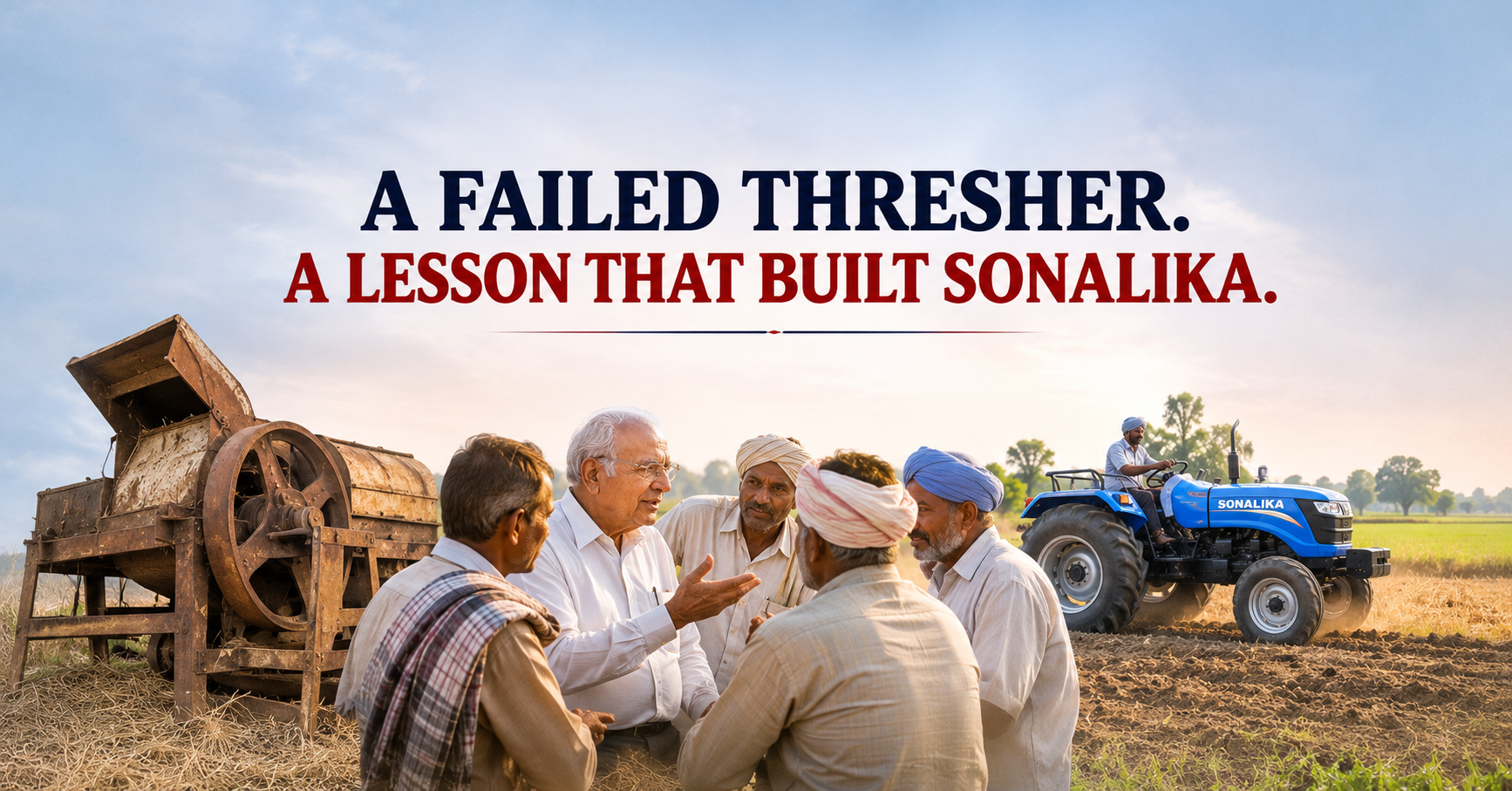
Around 1962–63, Mittal initiated the family’s move into wheat-thresher manufacturing, working with local blacksmiths. The first attempt failed because the machines used straight cutters, whereas wheat required curved cutters. The design flaw was not a minor technical inconvenience: machines failed in the field, farmers returned them and the family suffered a devastating financial setback.
A 2007 Business Standard profile records that the family went bankrupt in 1963. By 1970, the combined net worth of three generations, including the value of their clothes, was reportedly around ₹1 lakh. The detail is striking because it conveys the scale of the setback more effectively than a generic description of financial difficulty. Business Standard
The response to failure, however, is more important than the failure itself. Mittal sought help from a friend associated with agricultural research in Ludhiana, who helped identify the design problem. The family corrected the machine and rebuilt the business. The farm-implements operation was formalised as Sonalika Agro Industries in 1969, according to the company’s own history. international.sonalika.com+1
There is a useful distinction here for aspiring entrepreneurs. The lesson was not that persistence alone could rescue a defective product. It was that persistence had to be accompanied by diagnosis, technical assistance and a willingness to correct the original design.
The family also had to survive the period between failure and recovery. Mittal retained his LIC career, providing the household with a source of income while the manufacturing activity was rebuilt. The family shared the operational responsibilities; it would be inaccurate to portray him as personally running every aspect of the workshop while holding a full-time position. His father and other family members contributed to the business on the ground, while Mittal brought commercial judgement and technical problem-solving to the effort.
For an entrepreneur, this is a lesson in risk containment. A founder does not always have to abandon a stable source of income to pursue a manufacturing idea. Equally, a failed venture should not be romanticised. The first responsibility after a commercial failure is to understand what went wrong, protect the household and preserve the capacity to try again.
Failure should improve the operating system
The thresher episode appears to have left a lasting imprint on the way the tractor venture was approached decades later. A product failure in agricultural machinery can do more than generate warranty costs. It can damage a manufacturer’s standing in a closely connected rural market, where farmers, mechanics, dealers and local traders exchange information quickly.
The family had learnt this lesson at considerable cost. The subsequent tractor launch would place unusual emphasis on testing the product in actual farming conditions before commercialisation.
The point for investors is equally important. When assessing a manufacturing founder, do not merely ask how many times the entrepreneur has failed. Ask whether the organisation has converted those failures into better product-development procedures, quality controls and investment decisions.
Act II: Thirty years of groundwork before the tractor
Sonalika’s tractor business is often narrated as though it began when Mittal retired from LIC. That interpretation overlooks the commercial foundation already in place.
The family had spent decades manufacturing and selling agricultural implements. Threshers, seed drills and other farm equipment created relationships with farmers and dealers. These relationships were not incidental to the future tractor business; they became its most valuable starting assets.
Mittal retired from LIC around 1990, after approximately 35 years in the insurance business. International Tractors Limited (ITL), the company associated with the tractor venture, was incorporated in October 1995. Sonalika’s first tractor was launched in 1996, when Mittal was approximately 65. The company’s own history confirms the 1969 farm-implements beginning and the 1996 entry into tractor manufacturing. international.sonalika.com+1
This timeline matters. The tractor venture may have taken roughly a year to move from incorporation to its first commercial product, but the business relationships supporting it had been built over decades.
The market, in effect, was not entirely new to Sonalika. The product category was.
The distinction offers a valuable lesson in diversification. A company moving into an adjacent product category should first identify which existing assets can be transferred: customer relationships, dealer access, service capabilities, brand recognition, supplier contacts and knowledge of the buyer’s operating environment. These assets can reduce the cost and risk of entering a new market.
There is also a warning. A trusted brand does not automatically guarantee acceptance of a new product. Reputation may open the door, but the product must still perform. Sonalika needed to prove that it could manufacture a reliable tractor, not merely rely on the goodwill earned through farm implements.
Act III: When the distribution network became a source of capital
The most distinctive financial element in the Sonalika story is the reported contribution of approximately ₹22 crore from its existing dealer network towards the initial tractor manufacturing workshop at Hoshiarpur.
According to Outlook Business, dealers who had worked with the company in agricultural implements backed the tractor project. The account includes a memorable anecdote: dealers arrived with cash, with one reportedly taking money from his turban and placing it on the table. The story is striking, but its strategic significance is much greater than the anecdote. Outlook Business
These dealers were not simply distributors being asked to stock a new product. They were stakeholders who had experienced the company’s business conduct over many years. They had seen its products, understood its market and had a commercial reason to believe that a Sonalika tractor could find buyers.
This is relationship capital converted into financial support.
A conventional financing analysis would focus on the cost of capital, collateral, repayment capacity and the availability of institutional credit. Those questions remain essential. But Mittal’s experience highlights another dimension: a business can develop financial credibility through the quality of its relationships with the people who depend on it.
For an MSME founder, the value-chain ecosystem may contain potential sources of support that are often overlooked:
- Dealers may provide advances, commit to initial volumes or participate in a carefully structured expansion.
- Suppliers may extend credit when they trust the buyer’s payment discipline and business continuity.
- Large customers may support tooling, product development or capacity expansion through long-term procurement commitments.
- Distributors may invest in service infrastructure when the product has a credible market and the manufacturer stands behind it.
However, there is an important qualification. Dealer funding is not free money. It creates obligations. A founder who accepts financial support from the distribution network must protect the commercial interests of those partners through reliable products, transparent terms, timely supply and fair treatment.
The ₹22 crore story is therefore not a prescription to raise money informally from dealers. It is a demonstration of what earned credibility can make possible when a business is ready to expand.
The real asset was the network, not the cheque
The dealer contribution should also be understood in the context of the tractor market. A manufacturer entering a sector dominated by established players needs more than a factory and a product. It needs market access, local relationships, service capability and confidence among prospective buyers.
Sonalika already had a dealer ecosystem familiar with its agricultural implements. That network could help introduce the new product, explain its utility, connect the manufacturer with farmers and provide local market intelligence.
In other words, the company was not building its distribution system from zero at the same time as it was building its tractor factory.
For investors evaluating an emerging manufacturer, this is an important due-diligence question: Does the business have a route to market, or is it merely financing production capacity? A factory without distribution can become an expensive fixed-cost burden. A product backed by a committed and capable channel has a better chance of converting capacity into revenue.
Act IV: Test the product before asking the market to trust it
Mittal did not originally set out to become a tractor manufacturer. According to his account in Outlook Business, the demand came from farmers and dealers who already bought Sonalika’s agricultural implements and wanted the company to complete its product range. The market was asking for a tractor from a manufacturer it already knew. Outlook Business
The company built two tractor prototypes in 1995 and sent them for six months of field trials. The tests were conducted on farms, where tractors had to demonstrate their performance under actual operating conditions. The prototypes reportedly returned with zero-defect reports; a government testing facility in Bhopal also produced a positive assessment. One farmer who had tested a tractor subsequently visited Mittal and booked the first machine. Outlook Business
That sequence is important. Sonalika did not treat dealer enthusiasm as a substitute for product validation. Nor did it assume that a successful agricultural-implements business automatically qualified it to manufacture tractors. It tested the product, sought independent technical assessment and allowed the user experience to influence the decision to commercialise.
The commercial response was encouraging. Outlook Business records 356 tractors in FY1996–97. An Indian Institute of Management Ahmedabad study, however, lists 396 units for the same year. The difference should be acknowledged rather than concealed; the IIMA series records production, while the media account refers to sales. The IIMA table shows the business reaching 2,770 tractors in FY1997–98, 6,211 in FY1998–99, 8,773 in FY1999–2000 and 13,496 in FY2000–01. Outlook Business+1
SONALIKA TRACTOR VOLUME — IIMA STUDY
| Financial year | Tractors |
|---|---|
| 1996–97 | 396 |
| 1997–98 | 2,770 |
| 1998–99 | 6,211 |
| 1999–2000 | 8,773 |
| 2000–01 | 13,496 |
Source: IIM Ahmedabad study, Table 3.2. The 1996–97 figure differs from the 356 units reported by Outlook Business.
The lesson is not that six months is a universal product-testing formula. The lesson is that testing must be long and rigorous enough to expose weaknesses that a controlled demonstration or factory inspection may miss. In manufacturing, the customer’s operating environment is the final examination.
For a founder, this means resisting the temptation to treat the first order as proof of product-market fit. A buyer may place an order because of a relationship, a discount or a shortage of alternatives. Repeat orders, low failure rates, manageable warranty costs and customer referrals provide much stronger evidence.
For an investor, the implication is equally practical: examine the manufacturer’s product-validation process, field-failure record, after-sales network and ability to incorporate customer feedback. A growing order book is encouraging; a product that survives real use is a more durable foundation.
Act V: Hoshiarpur, Renault and the discipline to rebuild
Sonalika’s Hoshiarpur base is an important part of its identity. But the strategic point should not be reduced to the familiar claim that a company can succeed simply by locating itself in a low-cost town. The evidence available establishes that the farm-implements business and the initial tractor workshop were rooted in Hoshiarpur. It does not, by itself, prove that low labour costs were the decisive reason for the location.
A more revealing episode concerns the company’s encounter with Renault.
After visiting Sonalika’s workshop, Renault representatives were critical of its standards and processes. Mittal and his sons subsequently visited Renault’s factory in France. The visit exposed the gap between Sonalika’s existing manufacturing practices and the standards expected by an international technical partner. They returned to Hoshiarpur and demolished the workshop, rebuilding the facility over the following six months. Renault then entered into a technical partnership with ITL in late 2000. Outlook Business
This is a significant strategic decision. The company could have treated the criticism as an external partner’s preference or attempted to negotiate around the shortcomings. Instead, it accepted that its manufacturing processes needed to improve.
For an aspiring industrial entrepreneur, this is a lesson in capability before scale. A company cannot expect to compete in more demanding markets while retaining processes that are inadequate for the quality, consistency and reliability those markets require.
The Renault partnership also illustrates the value of external technical relationships. A founder does not need to possess every engineering capability internally. But the founder must recognise where the organisation is weak, identify credible partners and be prepared to change internal practices to absorb the knowledge.
The Renault relationship ended in 2003 after the French company sold its tractor business to CLAAS. Sonalika subsequently developed a relationship with Japan’s Yanmar, which held a 12% stake at the time of the 2013 Outlook Business report. That figure is historical, not a statement of the present shareholding. Outlook Business
The broader lesson for investors is to distinguish between a technology partnership that merely lends a company’s name credibility and one that genuinely improves engineering, production systems, product quality or access to markets. The value of an alliance lies in the capability transferred, not simply in the partner’s brand.
Act VI: Competing on the farmer’s economics
Sonalika’s expansion was not simply a story of producing a tractor and finding buyers. It had to compete in an industry with established manufacturers and entrenched customer loyalties.
The company’s existing experience in farm equipment gave it an advantage: it had spent years observing how farmers used machinery and what they expected from it. In the 2013 Outlook Business report, Amrit Sagar Mittal identified the ability to withstand continuous use, lower maintenance requirements and higher pulling power as important product attributes. The article also records the company’s emphasis on performance and resale value, rather than price alone. Outlook Business
This is where the third lesson becomes especially relevant. A tractor is not merely a machine purchase; it is a productive asset in a farmer’s economics. Its value is measured by the work it can perform, the fuel it consumes, the time it saves, the loads it can pull, the maintenance it demands and the value it retains when resold.
A manufacturer that focuses only on the purchase price risks missing the customer’s actual decision criteria. A lower-priced machine may not be economical if it spends too much time under repair. A more expensive model may be justified if its reliability, pulling capacity or resale value improves the owner’s overall returns.
The same logic applies well beyond tractors. An industrial pump is judged by uptime, energy consumption and maintenance. A machine tool is judged by precision, throughput and tooling costs. A commercial vehicle is judged by payload, fuel efficiency and operating availability. In each case, the customer buys an economic outcome, not merely a product specification.
Sonalika’s product strategy also had to recognise differences across markets. Its own corporate history describes a range of tractors designed for varying agricultural requirements and markets. Its subsequent growth into exports across more than 150 countries demonstrates the scale of that international ambition, although export reach alone does not establish that every market was served through the same product configuration. international.sonalika.com+1
Customer knowledge is not a substitute for engineering
Mittal’s non-engineering education is often presented as one of the most remarkable aspects of his story. It is certainly unusual, but the useful lesson is not that technical knowledge is unnecessary in manufacturing.
It is that a founder’s role is to assemble the capabilities required to solve the customer’s problem. Deep knowledge of the buyer, the application and the economics of use can guide product strategy. Engineering expertise, quality systems and manufacturing discipline must then convert that understanding into a dependable product.
The Renault episode reinforces this distinction. Customer empathy helped Sonalika understand what farmers needed; technical partnerships and changes to manufacturing standards helped the company improve what it could deliver.
For a non-technical founder, this is a practical model: understand the market deeply, recruit or partner for technical competence, establish clear product standards and never allow commercial enthusiasm to override engineering judgement.
Act VII: From a regional challenger to an international manufacturer
Sonalika’s growth was not achieved merely by entering tractor manufacturing. The company had to build production capacity, improve processes, extend its dealer and service network and establish credibility beyond its original northern Indian markets.
The 2013 Outlook Business report offers a useful snapshot of this transition. It records that ITL had grown from 356 tractors in FY1996–97 to a much larger manufacturing operation, with the company then exporting to approximately 70 countries. It also describes the expansion of its Hoshiarpur capacity, the establishment of a manufacturing facility in Bihar and the planned extension of its dealer and service network. These are historical figures, not current operating statistics. Outlook Business
The expansion into new markets also revealed the limits of relying on an established regional reputation. The report noted that Sonalika’s presence in southern India was relatively weak compared with its northern stronghold. Farmers who had used another manufacturer’s tractors for years were not automatically persuaded to switch. The company had to demonstrate product performance, strengthen its local service network and develop relationships with mechanics and dealers.
That is an important corrective to the idea that a good product and an established brand can be transferred effortlessly from one geography to another.
Market entry requires more than distribution appointments. It requires local trust, service readiness, spare-parts availability and the ability to demonstrate product performance in the customer’s own conditions.
Sonalika’s present corporate profile describes a business with a presence in more than 150 countries, and identifies it as India’s leading tractor exporter. The company also identifies itself as the country’s third-largest tractor manufacturer. These are company-reported positioning claims, but they indicate how far the business has travelled from its Hoshiarpur beginnings. international.sonalika.com+1
The company’s own September 2026 announcement reported that it crossed one lakh tractor sales in the six months from April to September 2026, and recorded monthly production of 19,000 tractors at Hoshiarpur. These figures are company-reported milestones, rather than independently audited market-share data. Sonalika
The strategic point is that growth eventually demands institutional capability. The relationships that help a company enter a market must be supported by systems that allow it to serve that market consistently. Dealer confidence may open the door, but production planning, quality assurance, working-capital management, service infrastructure and management depth determine whether the company can stay there.
The investor’s perspective: What made the model investable?
Mittal’s story offers several useful tests for investors evaluating a manufacturing enterprise.
First, examine the quality of demand. Was the product developed in response to a clearly identified customer requirement, or is the company trying to create demand for excess capacity? Sonalika’s entry into tractors followed repeated requests from its existing farmers and dealers.
Second, examine the strength of the route to market. A manufacturer with committed dealers, service capability and established customer relationships has an advantage over one that must build every commercial relationship from scratch.
Third, examine the product’s economics over its operating life. Purchase price alone is not enough. Reliability, maintenance, fuel consumption, productivity, resale value and service availability influence customer retention and repeat purchases.
Fourth, examine the founder’s response to technical limitations. The Renault episode is instructive: the company accepted criticism, upgraded its facility and entered a technical partnership. Investors should look for founders who are willing to change processes when evidence shows that existing practices are inadequate.
Finally, examine whether growth is being converted into organisational strength. A business may depend on its founder’s relationships in its early years. But long-term scale requires professional management, succession planning, financial controls, production systems and a capable second line of leadership.
Sonalika’s journey also demonstrates why investors should not confuse a founder’s age or educational background with entrepreneurial capability. Mittal’s experience in insurance, his understanding of rural customers and the relationships developed through the implements business were commercially relevant assets. His lack of an engineering degree did not remove the need for engineering expertise; it made the ability to access and work with that expertise even more important.
Business Strategy Lessons: The L.D. Mittal Playbook
The Sonalika case offers three central lessons for aspiring entrepreneurs and investors. They are not abstract principles. Each emerged from a specific commercial decision, a failure or a strategic advantage developed over time.
1. Validate the product before scaling the ambition
The first thresher failure exposed the cost of inadequate product design. The six-month tractor trials showed a different approach: build prototypes, test them in real operating conditions, obtain technical assessment and correct weaknesses before commercial launch.
For founders: Do not allow an order book, investor enthusiasm or production target to become a substitute for product reliability. Test under actual customer conditions. Build quality control into the process, not into the warranty department.
For investors: Examine field performance, rejection rates, warranty claims, repeat orders and after-sales costs. Production capacity is not proof of product-market fit.
2. Turn distribution trust into growth capital
The reported ₹22 crore dealer contribution towards the initial tractor workshop illustrates how a business ecosystem can become a source of financial support. The dealers had already worked with Sonalika’s implements business and had a commercial interest in its next stage of growth.
For founders: Treat dealers, suppliers and customers as long-term business partners. Earn confidence through product quality, fair commercial terms, payment discipline and consistent conduct. When expansion becomes necessary, a trusted value chain may offer support that a cold approach to a financier cannot.
For investors: Assess the quality of the company’s stakeholder relationships. A committed distribution network can be a competitive asset, but its financial participation must be transparent, properly structured and commercially sustainable.
3. Build around customer economics, not industry ego
Sonalika’s experience in agricultural implements gave it a practical understanding of farmers’ requirements. Its tractor strategy had to address performance, pulling power, maintenance, reliability and resale value—not merely the appearance or purchase price of the machine. The Hoshiarpur base and later technical partnerships formed part of a broader effort to develop manufacturing capability around the market the company intended to serve.
For founders: Do not copy the location, product design or cost structure of a larger competitor without understanding why it works for that business. Build around your customer’s operating economics. Use partnerships to acquire technical capabilities where necessary, and invest in service infrastructure as markets expand.
For investors: Look for a clear connection between product design, customer returns, operating costs and the manufacturer’s competitive advantage. A company that understands how its customers make money is better placed to build products they will continue buying.
The larger lesson: Build the trust before you need the capital
Lachhman Das Mittal’s journey is not a formula for building a tractor company, nor does it suggest that every entrepreneur should avoid institutional finance or remain in one location. It is a case study in the sequence through which a durable manufacturing business can be built.
The family began with agricultural implements, suffered a serious product failure, sought technical assistance and rebuilt. Over time, the business earned the confidence of farmers and dealers. When it entered tractor manufacturing, that accumulated goodwill helped it mobilise capital, access customers and establish an initial market. Product trials reduced the risk of a premature launch. Technical partnerships and investments in manufacturing standards helped it improve its capabilities. Subsequent expansion demanded stronger distribution, service and management systems.
There were setbacks and risks along the way. The company’s experience with Renault showed that existing manufacturing practices could fall short of international expectations. Its expansion into unfamiliar markets demonstrated that regional goodwill could not simply be assumed to travel. These are as important to the case study as the successes.
For India’s MSME founders, the message is particularly relevant. A business does not become scalable merely because it has a product, a factory or access to finance. It becomes scalable when product reliability, customer economics, distribution confidence and manufacturing capability reinforce one another.
For investors, the lesson is to look beyond the founder’s pitch and the factory’s installed capacity. Examine the relationships, the quality of the product, the discipline of the operating system and the company’s ability to convert trust into repeatable commercial performance.
Mittal began tractor manufacturing at approximately 65. But the business did not begin at 65. It was built on decades of learning, relationships and credibility.
The ₹22 crore came when the business was ready to ask for it. The trust had been earned much earlier.
Sources and editorial references
The case study draws on the following publications and company material. Historical figures are attributed to the period in which they were reported; company claims are identified as such.
1. Business Standard — The Great Hunger! (4 August 2007). Early thresher venture, family bankruptcy in 1963, the reported family net worth around 1970 and the Maruti dealership anecdote. Business Standard
2. Outlook Business — Himanshu Kakkar, Going for the Till (17 August 2013). Dealer contribution of approximately ₹22 crore, six-month tractor field trials, first tractor booking, Renault technical partnership, manufacturing upgrades and market expansion. Outlook Business
3. Indian Institute of Management Ahmedabad — Agricultural Machinery study, Table 3.2. Historical production figures for Sonalika tractors from FY1996–97 onwards. Indian Institute of Management Ahmedabad
4. Sonalika Group — Official corporate history and founder profile. Farm-implements origins in 1969, entry into tractor manufacturing in 1996, Hoshiarpur manufacturing base and international presence. international.sonalika.com+2
5. Sonalika Group — Press release, 24 September 2026. Company-reported sales of one lakh tractors between April and September 2026 and monthly production milestone at Hoshiarpur. Sonalika


Leave a Reply