
By Haresh B. Jhala
Europe and Gulf rearm for autonomy; India can capture the supply chain
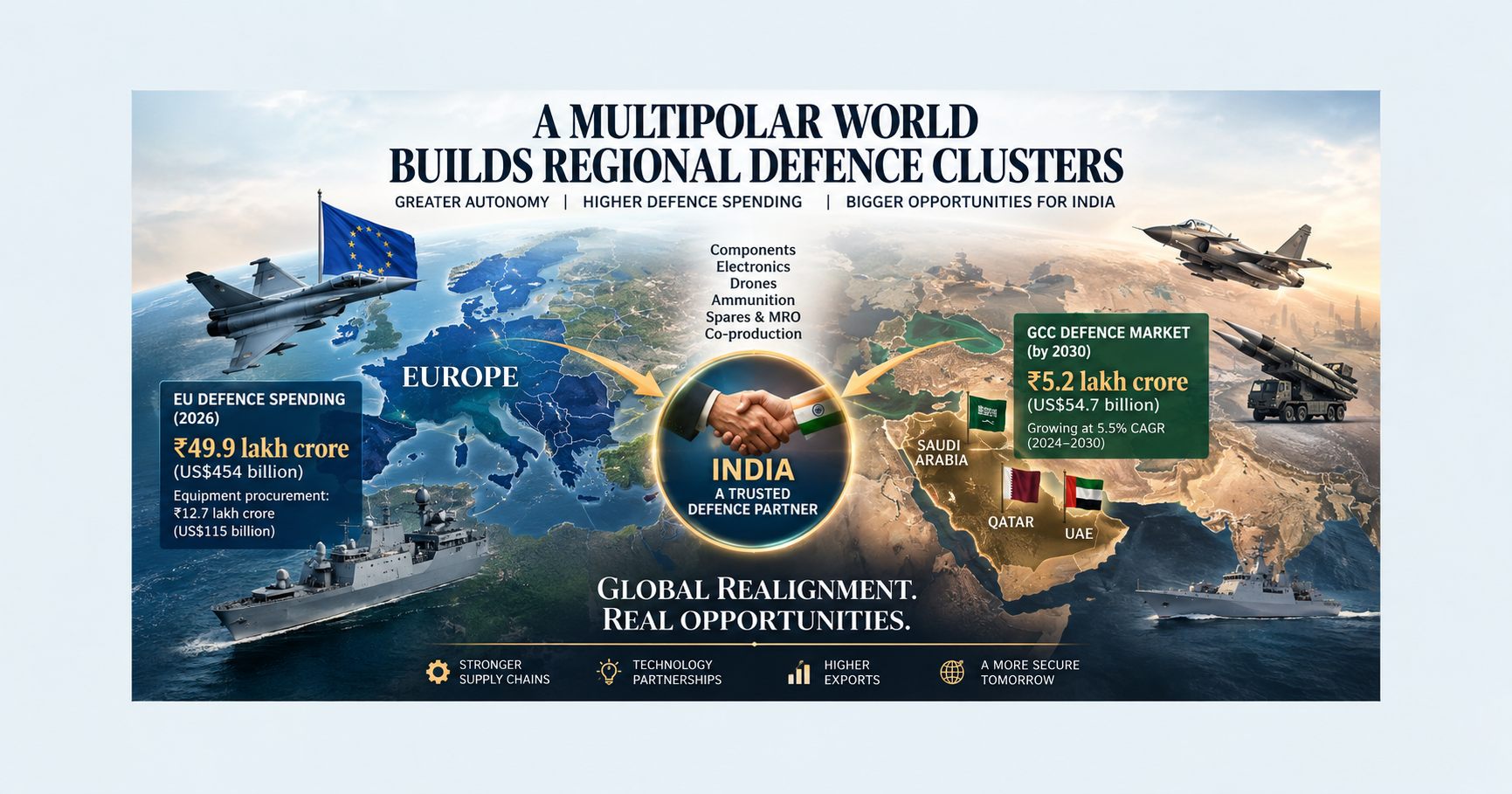
Europe and the Middle East could generate ₹379–568 lakh crore (US$4–6 trillion) in defence spending this decade as countries rearm, replenish stockpiles and reduce dependence on any single security provider. Europe is heading towards ₹49.9 lakh crore (US$454 billion) in defence spending in 2026, while the GCC market could reach ₹5.2 lakh crore (US$54.7 billion) by 2030. For India, the shift is an industrial opportunity — components, electronics, drones, ammunition, spares and MRO.
The strategic shift is not anti-American. It is anti-dependence.
For much of the post-Cold War era, the global security system rested on an implicit assumption: the United States would remain the ultimate provider of strategic security, particularly for Europe, the Gulf and other American partners.
That assumption is now being modified.
Not because Washington is disappearing. Not because Europe is abandoning NATO. And not because Gulf states are cutting their ties with the United States.
The change is subtler — and potentially more consequential.
Countries are building redundancy around existing alliances.
They want alternative suppliers, indigenous defence production, regional security arrangements, resilient supply chains and the ability to act when their principal security partner is unwilling, unavailable or pursuing a different priority.
That is the deeper meaning behind two developments unfolding almost simultaneously: Europe’s rearmament and strategic-industrial push, and the Gulf’s growing insistence on greater self-reliance.
The result could be a prolonged defence-industrial cycle — and a significant opening for Indian manufacturers.
Europe is spending at a scale not seen for decades
The numbers show the direction clearly.
Defence expenditure by the EU’s 27 member states reached ₹46.0 lakh crore (US$418 billion) in 2025, up 20% from 2024. It is expected to reach ₹49.9 lakh crore (US$454 billion) in 2026 — equivalent to 2.4% of EU GDP. Defence equipment procurement alone reached ₹12.7 lakh crore (US$115 billion) in 2025, while defence R&D is expected to reach ₹2.2 lakh crore (US$20 billion) in 2026.
And this is not simply a temporary response to the war in Ukraine.
The EU’s Readiness 2030/ReArm Europe framework aims to mobilise up to ₹88.1 lakh crore (US$800 billion) in additional defence spending. That includes a proposed ₹16.5 lakh crore (US$150 billion) SAFE loan instrument, while greater fiscal flexibility could create nearly ₹71.6 lakh crore (US$650 billion) in additional spending space over four years.
The strategic direction is equally important.
Europe wants greater joint procurement, stronger European defence-industrial capacity and more European content in defence investment. The Readiness Roadmap sets a political target of 35% joint procurement and at least 55% of defence investment through the European Defence Technological and Industrial Base.
NATO itself remains central. At the 2025 Hague summit, allies committed to reach 5% of GDP annually on defence and defence-related security spending by 2035, with at least 3.5% directed towards core defence requirements. European allies and Canada increased combined defence expenditure by nearly 20% in real terms in 2025.
So the message is not “Europe is leaving America.”
It is:
“Europe wants greater capacity to defend itself, even while remaining inside the transatlantic alliance.”
That distinction matters.
The Gulf is reaching the same conclusion from a different direction
The Gulf’s concern is not abstract strategic autonomy. It is the vulnerability of energy, trade, maritime routes and national security when a regional crisis overwhelms existing security arrangements.
At the Hili Forum in Abu Dhabi this week, Qatar’s foreign ministry spokesperson Majed Al Ansari said the Gulf could not rely solely on its strategic partnership with the US.
The US alliance remains important, he stressed. But self-sufficiency in security is becoming essential.
UAE presidential adviser Anwar Gargash made a similar argument: Washington remains an essential partner, but Gulf states need stronger national capabilities and cannot assume another country’s security priorities will always coincide with their own.
The UAE is already acting on the economic-security side of that calculation — expanding eastern port capacity, pipelines, railways and alternative trade routes so that its energy exports and commercial activity are not entirely dependent on the Strait of Hormuz.
Qatar has framed the problem more broadly: Gulf security is inseparable from global energy security, trade, maritime navigation and international supply chains. Its answer is a more resilient regional architecture based on collective security, diplomacy and economic interdependence.
This is a crucial signal for manufacturers.
Security localisation does not mean only buying weapons.
It means localising the industrial ecosystem around security — maintenance, logistics, electronics, unmanned systems, sensors, ammunition, communications, cyber capability and supply-chain resilience.
The Makkah agreement adds another layer
On 7 August, Saudi Arabia, Türkiye and Pakistan signed the Makkah Joint Defence Agreement.
The agreement says an armed attack against one member will be regarded as an attack against all three and calls for deeper defence cooperation.
Its significance goes beyond the political symbolism.
The three countries are discussing joint exercises, air defence, unmanned systems, electronic warfare, defence-industry cooperation, joint development and production, technology cooperation, maintenance and logistics.
Artificial intelligence and autonomous systems are specifically among the areas being prioritised.
But again, the important point is what the agreement does not mean.
Türkiye has made clear that the pact is not intended to replace existing alliances.
That makes it more interesting, not less.
The emerging model is layered security.
A country can remain allied with Washington, participate in NATO-linked structures, purchase Western equipment — and simultaneously build regional capabilities with other partners.
That is the architecture now emerging across several regions.
A new security economy is forming
The consequence is a world of regional security clusters and issue-based partnerships rather than one universal security architecture.
Europe is rebuilding stockpiles and industrial capacity.
The Gulf is seeking greater national and regional resilience.
Saudi Arabia is trying to move from being primarily a major defence buyer towards becoming a defence-industrial partner.
Türkiye is increasingly an important technology and production hub.
Pakistan brings military depth, manpower and defence cooperation.
And countries across Asia, Africa and Latin America are looking for affordable systems, localisation and technology partnerships.
This is why the defence opportunity should not be measured only by national defence budgets.
The larger opportunity is the industrial supply chain created around those budgets.
The uploaded research estimates that Europe and the Middle East together could represent ₹379–568 lakh crore (US$4–6 trillion) of defence-related spending over the decade, heavily weighted towards equipment, R&D, electronics, missiles, drones, air and missile defence, naval systems, C4ISR, electronic warfare and cyber capabilities.
That is not a forecast of one market or a guaranteed order book.
It is the scale of the strategic spending pool being created by rearmament, stockpile replenishment, localisation and industrial diversification.
Where India fits
India has an unusually strong starting position.
Defence exports reached ₹38,400 crore in FY26, up 63% year-on-year and above the government’s ₹30,000-crore target. The domestic procurement programme has also created a much larger base for private-sector production, with ₹2.38 lakh crore of domestic procurement cited in the research.
More importantly, the policy environment is changing.
DRDO-developed missile technologies are increasingly being opened to private industry for full-system production, including guidance, propulsion, seekers, software and testing.
That changes the opportunity for smaller manufacturers.
The question is no longer simply:
“Can an Indian company supply a component?”
It is:
“Can it own a subsystem?”
That distinction could determine who captures the next decade of defence manufacturing.
Five opportunity pools for Indian manufacturers
1. Defence electronics, C4ISR and electronic warfare
Radars, electro-optics, infrared systems, communications, datalinks, navigation, IFF, mission computers, electronic-warfare systems and cyber-hardened networks will sit at the centre of modern defence.
Indian specialist firms can enter through RF/microwave engineering, embedded software, signal processing, power electronics, sensors and cybersecurity.
These are precisely the areas where a smaller company can become strategically important without manufacturing an entire weapons platform.
2. Drones and counter-drone systems
The battlefield is rapidly becoming an ecosystem of unmanned platforms.
That creates demand not only for UAVs but for gimbals, avionics, composites, datalinks, ground-control systems, navigation, propulsion and counter-UAS radar/RF/EO systems.
The opportunity is particularly attractive because Gulf, African and Asian buyers are simultaneously looking for capability, affordability and localisation.
3. Missiles, ammunition and precision subsystems
Private participation in DRDO-developed missile systems opens a much wider field: seekers, guidance electronics, propulsion, launchers, fire-control systems, guided rockets and loitering munitions.
Ammunition is another immediate opportunity.
India’s FY26 ammunition exports were approximately ₹3,446 crore, compared with imports of about ₹581 crore. The opportunity extends across artillery shells, mortar ammunition, fuzes, propellants, primers and casings.
4. Spares and MRO
This may be the least glamorous — and one of the most commercially attractive — segments.
A larger installed base creates recurring demand for engines, hydraulics, actuators, bearings, fasteners, wiring harnesses, aerospace and ship components, test benches and vehicle spares.
The Gulf’s localisation drive creates an additional opportunity for regional MRO centres and long-term maintenance partnerships.
5. European defence supply chains
European rearmament should not be viewed only as an opportunity to sell finished products.
Indian manufacturers can potentially enter European supply chains as subsystem, electronics, sensor, composite, precision-engineering, ammunition-subassembly and software suppliers.
But the entry ticket is higher: aerospace-quality systems, traceability, cybersecurity, certification, quality consistency and the ability to scale.
The opportunity is real. But being cheap will not be enough.
This is where Indian manufacturers need to think differently.
The next wave of defence localisation in the Gulf and Europe will favour companies that can demonstrate quality, traceability, certification, repeatability and technology ownership.
A manufacturer dependent entirely on job work will remain a vendor.
A manufacturer that develops its own subsystem, intellectual property and testing capability can become a strategic supply-chain partner.
The distinction could be enormous.
What Indian manufacturers should do in the next 24 months
The first step is not to chase every defence opportunity.
Choose two or three segments.
Then build capability around them.
Upgrade to AS9100 or relevant military-quality standards, strengthen cybersecurity and traceability, develop internal engineering capability and move progressively from job work towards subsystem design and proprietary IP.
For Gulf markets, approach localisation differently: not simply export, but co-production, technology cooperation, MRO, local assembly and long-term support.
For Europe, identify where Indian capabilities can complement rather than compete directly with major European primes.
And use India’s existing policy architecture — including DPEPP 2020, iDEX/ADITI, SRIJAN, Defence Industrial Corridors and simplified export mechanisms — as a platform rather than treating them as government schemes sitting outside the business strategy.
The strategic window is opening now
The most important conclusion is not that America is losing its position.
It is that the value of having only one security provider is declining.
Europe wants greater industrial autonomy without abandoning NATO.
The Gulf wants greater self-protection without abandoning its US relationships.
Saudi Arabia, Türkiye and Pakistan are adding another layer of regional defence cooperation without formally replacing existing alliances.
The resulting world will be more complicated.
But for manufacturers, complexity can create opportunity.
Every new security cluster needs components. Every new weapons platform needs subsystems. Every larger fleet needs spares. Every localisation programme needs suppliers. Every new defence technology needs testing, maintenance and upgrades.
India has the engineering base, cost advantage, growing export credibility and strategic flexibility to participate.
The question for Indian defence manufacturers is therefore no longer whether this spending cycle will happen.
The question is whether they will remain component vendors — or use the next 24 months to become global defence-industrial partners.
That is the opportunity.
And the window is open now.
Source credit
European Defence Agency; Council of the European Union; European Commission — Readiness 2030/ReArm Europe; NATO; Qatar Ministry of Foreign Affairs; Saudi Arabia National Platform; Reuters; Euronews; and the accompanying research compilation on regional defence clusters and Indian defence manufacturing opportunities.
Currency basis for conversions: approximately ₹94.7 per US$1 and ₹110.1 per €1, using September 2026 reference rates.




Leave a Reply