
MSME Briefing Bureau
Cheap Chinese compressors and kits threaten India’s manufacturing base
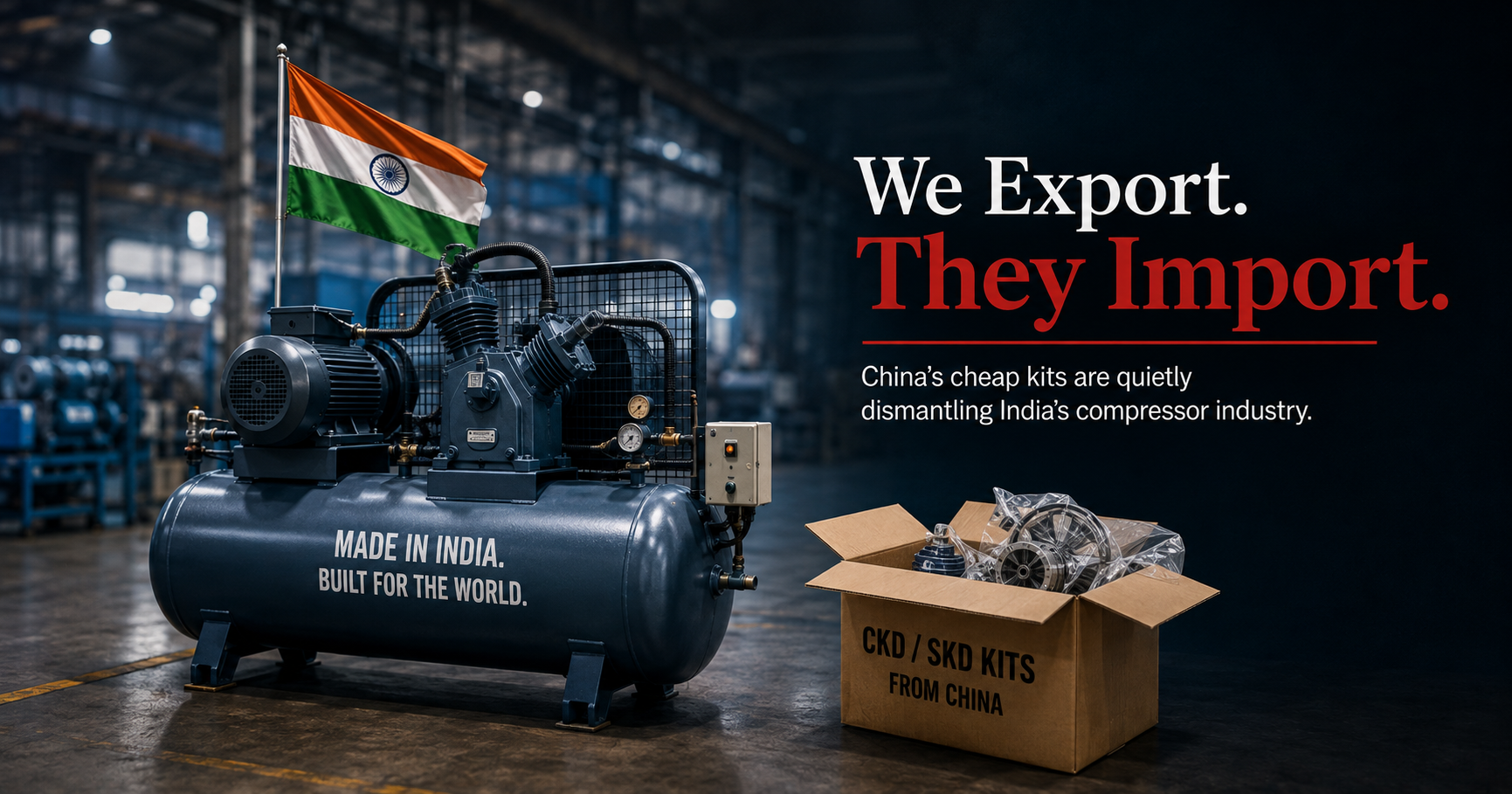
India’s air compressor industry—once a global benchmark for rugged, cost-effective engineering—is being structurally hollowed out. Fully built Chinese units and CKD/SKD (completely knocked down/semi-knocked down) kits now land at 25–35% below Indian production costs, forcing foundries to close and manufacturers to become assemblers of foreign sub-assemblies. Yet the same Indian firms export over half a billion dollars of compressors yearly to the United States, Europe, and beyond—proof that domestic engineering and quality standards are globally competitive. Without targeted trade remedies, quality standards enforcement, and technology-upgrade support, India risks surrendering a strategic industrial capability built over half a century.
From Global Contender to Import-Dependent Assembly Hub
For decades, Indian compressor manufacturers—anchored by firms like ELGi Equipments and dense MSME clusters in Coimbatore, Ahmedabad, Faridabad, and Rajkot—built an internationally recognised reputation for thermal durability, serviceability, and value-for-money. They competed directly with multinationals such as Atlas Copco, Ingersoll Rand, and Kaeser Kompressoren in the mid-range segment, and exported reciprocating and rotary screw compressors across Africa, the Middle East, and Southeast Asia.
Today, that competitive position is eroding rapidly.
Market analysis valued India’s overall air compressor market at approximately ₹8,600–9,400 crore (USD 1.03–1.13 billion) in 2024–25, with projections to reach ₹13,300–14,100 crore (USD 1.6–1.7 billion) by 2030–34, representing a compound annual growth rate (CAGR) of 5.4–7.4%. The industrial compressor segment alone—the core of domestic manufacturing—is estimated at ₹9,400–₹10,000 crore (USD 1.13–1.2 billion), growing at a far slower 3.5–3.8% CAGR.
On paper, this should be a growth story for domestic manufacturers. In practice, an expanding and rapidly rising share of this demand is being met by imports—overwhelmingly from China.
The Undercutting Weapon: Finished Units and CKD/SKD Kits
Chinese compressors and sub-assemblies began entering India in substantial volume around 2014–2016, as overcapacity in Jiangsu and Zhejiang provinces drove manufacturers to target developing markets. Backed by integrated component ecosystems and massive production scale, Chinese suppliers now account for an estimated 53% of India’s compressor import value—approximately USD 501 million in the broader turbo/rotary/reciprocating category in 2024.
Industry intelligence suggests that finished and semi-finished Chinese compressor units and kits account for roughly USD 350–420 million annually in industrial and commercial segments. In physical volume, this translates to 65,000–75,000 fully built units and 85,000+ CKD/SKD kit equivalents landing in India each year, with kit imports expanding at a CAGR of 11.5–14.2%—significantly outpacing domestic production growth.
The price differential is stark and economically decisive.
A Chinese-manufactured 10 horsepower (HP) rotary screw compressor can arrive at Indian ports at a wholesale price 25–35% lower than the raw material and labour cost incurred by a domestic MSME manufacturing the same machine locally. Indian manufacturers, already burdened by 10.5–13% working capital interest rates, elevated industrial electricity tariffs, and fragmented logistics infrastructure, simply cannot match these landed prices without sacrificing profit margins or quality standards.
This is not marginal competition. This is structural underpricing that makes manufacturing economically irrational.
Manufacturing Closures Versus Assembly-Line Proliferation
The financial squeeze is translating into visible structural shifts on the ground.
Field intelligence and regional industry association data suggest that 12–15% of unorganised and semi-organised small-scale compressor manufacturing units—roughly 50–75 registered small enterprises—shut down their foundry and machining operations between 2023 and 2026.
A representative case study: a Rajkot-based manufacturer that ran a steady reciprocating-compressor business for over a decade found itself unable to compete when direct-import Chinese portable units undercut its production cost by approximately 30%. Unable to finance transition to variable-speed-drive (VSD) automated production lines, the firm made a rational business decision: it closed its foundry wing, laid off skilled workers, and repositioned itself as a low-margin trading and service agency for imported sub-assemblies.
Simultaneously, a contrasting pattern has emerged. 180–220 new light assembly and packaging operations have opened across industrial corridors in the past 3–4 years. These require minimal capital investment—₹40 lakh to ₹1 crore (USD 45,000–120,000)—compared to ₹10–30 crore (USD 1.2–3.5 million) for a full-fledged manufacturing facility with casting, precision machining, motor winding, and testing laboratories.
Instead of manufacturing air-ends, pressure blocks, or electric motors, these new entities import Chinese CKD/SKD kits, apply domestic brand labels, and compete primarily on price. Imports of CKD/SKD kits are expanding faster than domestic component production, indicating that local assembly depth is growing whilst indigenous manufacturing capability is contracting.
This represents a fundamental economic shift: the sector is becoming import-dependent rather than domestically productive.
A Globally Competitive Industry Loses Ground at Home
What makes this structural decline particularly troubling is that India’s compressor industry is not uncompetitive by global standards.
In 2024, India exported “air or gas compressors and hoods” (HS classification 841480) worth approximately USD 554 million, representing 22.8 million units worldwide. The United States is the largest export destination by value (USD 145 million, 26% of total exports), followed by China (USD 52 million, 9.3%), Germany (USD 38 million, 6.8%), the Netherlands, and Brazil.
This export pattern demonstrates unambiguously that Indian manufacturers meet stringent quality, reliability, and performance requirements in advanced markets. American and European procurement officers do not accept sub-standard equipment; Indian firms are competing and winning.
Yet at home, the identical companies are losing market share to cheaper, frequently lower-efficiency imports.
Average import unit prices for compressors have collapsed from approximately USD 136 per unit in 2012 to merely USD 56 per unit in 2024—a 59% decline in less than a decade. By contrast, India’s average export unit price stands at only USD 25 per unit, reflecting a strategic focus on volume-driven, lower-value products—precisely the segment most exposed and vulnerable to CKD/SKD competition and price undercutting.
The Policy Gaps: Standards, Trade Defence, and Technology Support
Three critical policy gaps amplify this vulnerability.
First: Standards Enforcement Remains Weak
The Bureau of Indian Standards (BIS) has been transitioning towards Quality Control Orders (QCOs) for various engineering products. However, comprehensive and rigorously enforced QCOs for industrial compressors and critical sub-assemblies—air-ends, electric motors, pressure vessels—remain incomplete or inadequately implemented. This regulatory vacuum permits sub-standard CKD/SKD kits to enter the Indian market with minimal friction or inspection.
Second: Trade Defence Has Not Kept Pace
The Directorate General of Trade Remedies (DGTR) anti-dumping framework exists, but as of 2024–25, there is no widely known, active anti-dumping duty specifically on industrial air compressors from China—despite repeated, documented complaints from industry associations about injurious pricing and market disruption.
Whilst PLI (Production Linked Incentive) schemes and “Make in India” initiatives boost electronics, auto components, and white goods, industrial compressors and their critical sub-systems remain conspicuously absent from targeted support programmes. Domestic MSMEs thus lack access to targeted concessional finance, capital expenditure subsidies, or R&D grants to transition from legacy fixed-speed compressor designs to VSD, IE3/IE4 motor-based, and IoT-enabled compressors—the very technologies that global buyers increasingly demand.
Comparable engineering sectors have deployed anti-dumping measures successfully. Compressors have not. This represents a significant policy anomaly and a gap in government’s trade defence apparatus.
Third: Technology-Upgrade Support Is Limited
The result is a perverse policy outcome: Indian firms export hundreds of millions of dollars of compressors to the United States and Europe, yet domestically they are being reduced to contract assemblers of foreign kits.
The Broader MSME Stress Context
This compressor sector narrative sits within a wider pattern of MSME distress. Official data reveal 35,567 MSME closures in FY25—nearly double the 19,828 closures in FY24—with Maharashtra, Tamil Nadu, and Gujarat among the worst-affected states. Whilst these figures encompass all MSME sectors, compressor clusters in Coimbatore, Ahmedabad, and Faridabad are demonstrably part of this broader pattern of manufacturing attrition.
The sector is not isolated in its distress; it is emblematic of wider structural challenges in Indian manufacturing.
The Road Ahead: Preserve Core Capability, Not Merely Capacity
India’s compressor market is projected to continue expanding, but the composition and character of that growth sits at a critical juncture. Without stricter BIS quality enforcement, targeted anti-dumping action where demonstrable injury is proven, and focused financial and technology-upgrade support for domestic manufacturers, the nation risks a strategic outcome: retaining only assembly capacity whilst losing core manufacturing capability—casting, precision machining, air-end design, systems integration, and quality assurance—that Indian industry spent half a century developing.
The question is no longer whether cheap imports will persist; they will. The question is whether India will permit its globally competitive compressor industry to survive as more than a low-margin distribution channel for foreign CKD/SKD kits.
Required Action: Targeted Policy Intervention
Policymakers, industry bodies, and end-users must act decisively and together on three fronts:
First: Enforce robust quality standards. The BIS must implement comprehensive, rigorously monitored Quality Control Orders for industrial compressors and critical sub-assemblies. Sub-standard imports undermine domestic manufacturers and consumer confidence.
Second: Deploy trade remedies where injury is demonstrated. The DGTR must investigate anti-dumping petitions in the compressor sector with the same rigour applied to other engineering products. Below-cost imports merit measured trade defence.
Third: Channel technology-upgrade support to the sector. PLI-style schemes or concessional credit programmes must enable domestic manufacturers to transition to VSD, IE-rated motors, and smart compressors—the technologies that ensure competitiveness globally.
Without these three interventions, “Make in India” in compressors will devolve into little more than “Assemble in India”—relabelling Chinese CKD/SKD kits for domestic and export markets. That outcome serves neither industrial capability nor employment.
Sources and References
Directorate General of Trade Remedies (DGTR), Ministry of Commerce & Industry, Government of India – Anti-dumping framework and trade defence notifications
Department for Promotion of Industry and Internal Trade (DPIIT), Government of India – BIS Quality Control Orders and import regulation directives
United Nations Comtrade / World Bank WITS Database – India exports of “air or gas compressors and hoods” (HS 841480), 2024; price and volume trends 2012–2024
IndexBox – India turbo/rotary/reciprocating compressors market analysis, trade shares, import pricing trends, 2024–2026
IMARC Group, Next Move Strategy Consulting, Spherical Insights – India air compressor and industrial air compressor market size and forecasts, 2024–2035
KNN India – MSME closures surge to 35,567 in FY25; state-wise breakdown and sector analysis
EEPC India (Engineering Exports Promotion Council), DTSSIA Coimbatore (Downsizing to Sustain, Support, Improve—Compressor Associations) – Cluster-level insights on manufacturing closures, assembly-line growth, import pressure, and regional employment trends




Leave a Reply