
MSME Briefing Bureau
Customer concentration can turn growth into a strategic vulnerability.
A strong customer is an asset. A dominant customer can become a strategic risk. The difference is not sales volume; it is concentration. One client may keep your machines busy today, but what happens when ownership changes, strategy shifts, or its competitor becomes your customer? Growth without concentration control is not strategy. It is exposure. Sahdevsinh Jhala, Managing Director of Sapna Metal Technology Limited and founding partner of Parv Metals Processing Company learned this early — and turned one industry lesson into a disciplined business strategy policy.
The Strategy Hidden Inside Procurement and Sales
Ask an entrepreneur, “What is your business strategy?” Many will speak about expansion, new machines, turnover or exports. Ask a more uncomfortable question — “How dependent are you on one supplier or one customer?” — and the answer often exposes the real strategy.
About 25 years ago, Jhala had a conversation with a friend whose forging business depended heavily on two major customers. His entire forging line was dedicated to them. Other companies approached him for job work, but he declined. His confidence was absolute: these customers, he believed, would never leave.
Jhala advised him to accept work from other customers and gradually diversify his client base. The advice was rejected.
Years later, the friend returned with a painful lesson. A family dispute split one of his major customers. The younger brother established his own forging unit and brought the work in-house. The second customer also left. A business that once looked secure suddenly had to search for new customers.
For Jhala, the lesson was permanent.
A 25% Customer-Concentration Rule
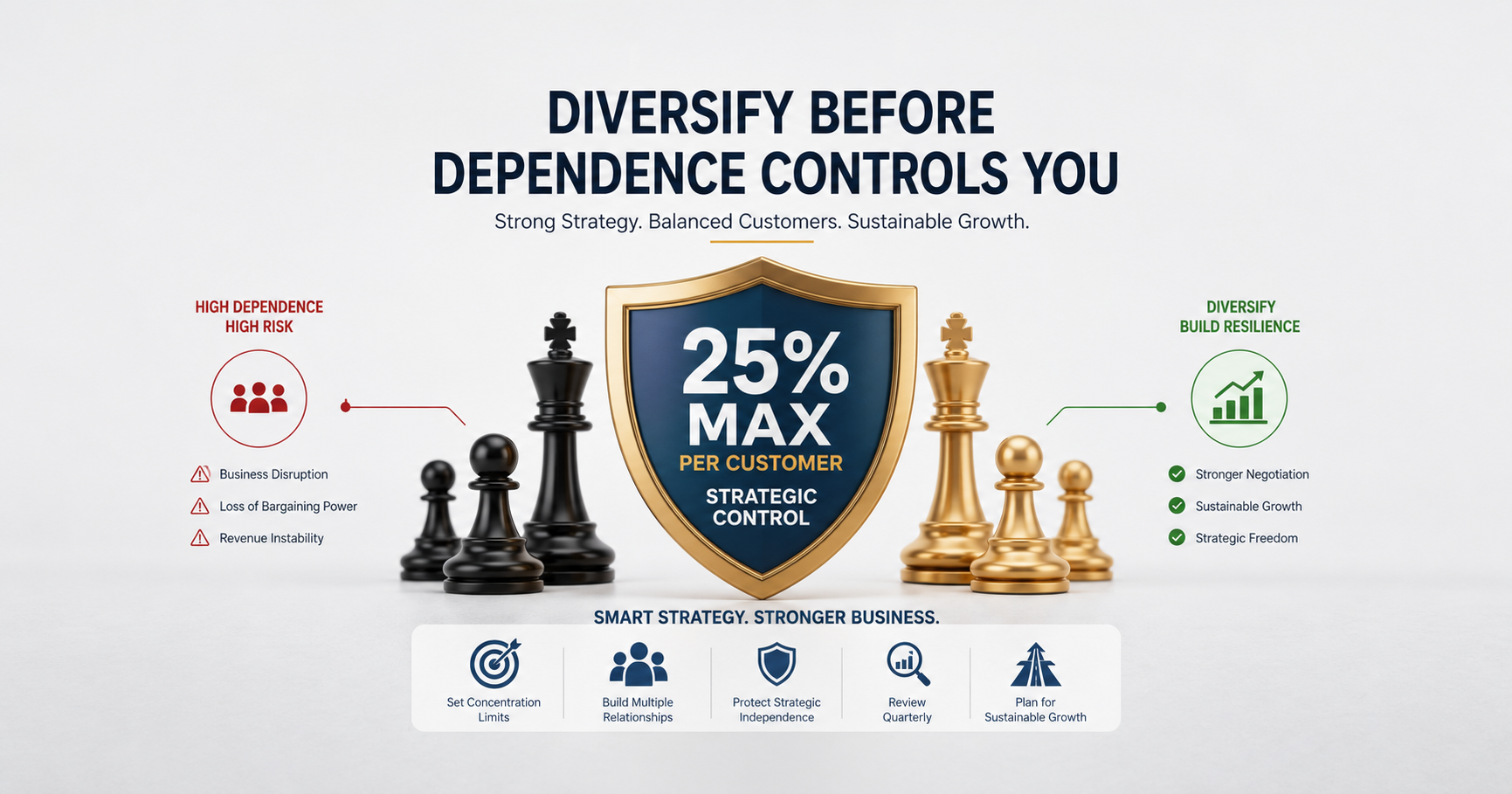
Jhala subsequently made one principle mandatory at Parv Metals and now at Sapna Metal Technology Ltd: no single customer’s job work should exceed 25% of installed capacity.
Importantly, this is not merely a sales rule. It is a business strategy policy.
He follows it even when doing so means turning away attractive business. That requires discipline because short-term revenue can be seductive. But strategic resilience often demands refusing apparently profitable dependence.
The principle was tested in his own business.
Parv Metals was undertaking CNC work for a leading company. The relationship was commercially valuable. Then a competitor of that customer approached Jhala for similar work. When the first customer discovered this, it stopped giving him business.
Jhala did not retreat.
His response was unequivocal: the company and its partners decide the business strategy — not an individual customer.
That is the mindset founders need.
Growth Must Come With Guardrails
A founder should define concentration limits before growth creates dependency. Customer concentration, supplier concentration, product concentration and even sector concentration should be reviewed regularly.
The strategic policy is straightforward:
- Set a maximum revenue or capacity exposure to any single customer.
- Build alternative customers before the largest account becomes indispensable.
- Avoid allowing one buyer to influence investment or capacity decisions.
- Review concentration quarterly, not after a customer exits.
- Protect the right to serve the market without surrendering strategic independence.
The lesson is not “never depend on a customer”. Every business needs anchor customers. The lesson is to ensure that no customer becomes powerful enough to control your choices.
For founders, this is a simple test of strategy: if losing one customer can force you to change your business model overnight, you do not have a resilient growth strategy yet.
The Growth Play
Do not measure growth only by turnover, machines or capacity. Measure the quality and resilience of your customer portfolio.
Define your concentration limits. Write them into your business strategy. Review them regularly. Then build growth around those guardrails.
Build the business you control — before the market controls you.






Leave a Reply