
Why good leaders lose teams despite acting fairly and honestly
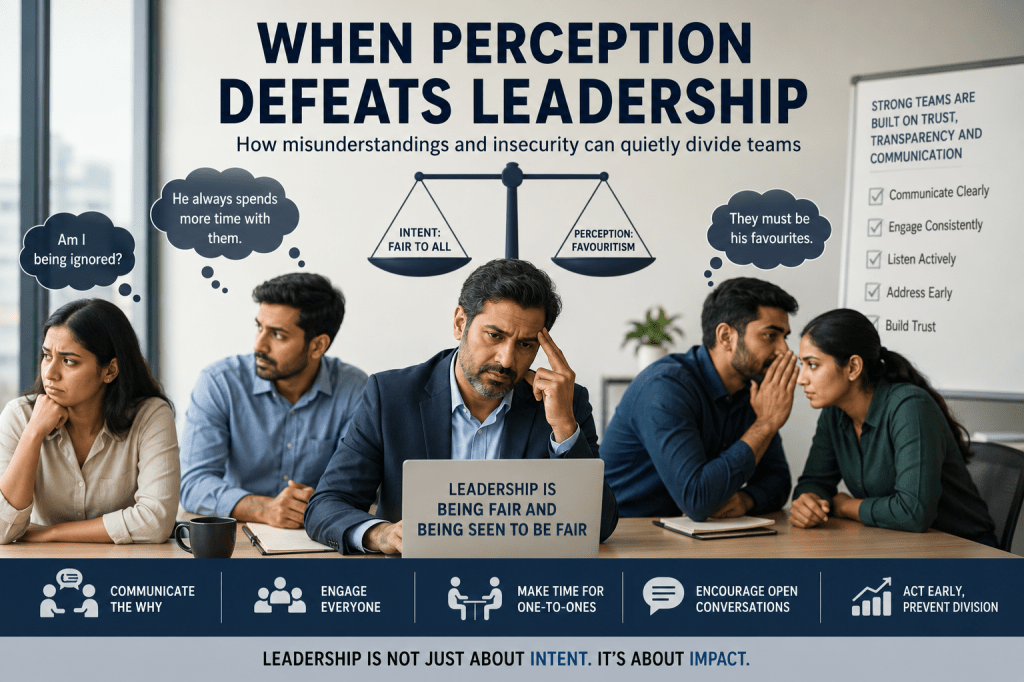
Leadership fails when perception outruns communication
MSME Briefing Leadership Mantra Desk
Most leadership failures do not begin with incompetence, favouritism, or poor intentions.
They begin with a leader’s inability to recognise how their actions are being interpreted.
One of the most dangerous assumptions leaders make is believing that fairness automatically creates trust. It does not. Teams judge leaders not only by what they do, but by what they see.
A leader may genuinely treat every employee as part of one team. Yet business realities often require spending more time with certain individuals. A key project, an urgent client issue, or a trusted specialist naturally receives more attention.
The leader sees operational necessity.
The rest of the team may see something entirely different.
Without seeking clarification, insecure team members often create their own explanations. They begin asking questions not to the leader, but to one another. Informal conversations gradually become rumours. Rumours become beliefs. Before long, a narrative emerges that the leader has favourites, an inner circle, or a political agenda.
The tragedy is that the leader often notices the problem too late.
At that stage, attempts to explain or justify actions rarely solve the issue. Once people become emotionally invested in a belief, facts alone seldom change minds. In many cases, the explanation itself is viewed as further evidence that something is being hidden.
I have seen similar failures when leaders repeatedly consult the same senior employee. What begins as seeking experience soon creates the perception of a power centre. Others stop contributing, believing decisions have already been made elsewhere.
The same pattern appears during organisational change. Leaders involve a handful of trusted performers to execute a strategy, while the wider team remains uninformed. The result is predictable: uncertainty, suspicion and resistance.
The lesson is simple but uncomfortable.
Leadership is not about managing people. It is about managing trust.
The moment team members start creating stories to explain a leader’s behaviour, trust is already under pressure. If left unchecked, perception becomes reality, and reality becomes division.
The strongest leaders understand that communication is not an event. It is a continuous discipline. They work as hard to manage perceptions as they do to manage performance.
Practical Leadership Actions
• Explain the “why” behind key interactions before questions arise.
• Rotate visibility and engagement across team members wherever possible.
• Conduct regular team conversations to eliminate information gaps.
• Address signs of insecurity early rather than waiting for conflict.
• Measure team trust as seriously as productivity and performance.
A leader’s intentions may be honourable. But teams do not follow intentions. They follow trust. And trust is built not by what leaders mean, but by what people consistently experience.






 MSME Briefing
Leave a comment