
By Haresh B. Jhala:
How Parakramsinh Jadeja turned a Rajkot workshop into a global CNC business
When Parakramsinh Jadeja started a small engineering workshop in Rajkot in 1989, he had no formal 20-year business plan. What he had was an understanding of machines, an instinct for emerging technology and the willingness to invest before the market demanded it. More than a decade later, a business seminar introduced him to the importance of vision and mission. That learning changed how he approached growth, technology, acquisitions and the institution he wanted to build.
From opportunity-driven entrepreneurship to strategic thinking
Jadeja’s early entrepreneurial journey was rooted in practical opportunity. Having studied technical subjects at Graduation High School in Rajkot, he understood the fundamentals of machine operations. In 1989, he started a small job shop with a lathe machine, financed through a government employment-generation loan of approximately ₹33,000.
His first significant technology investment came in 1991. He spent approximately ₹1.70 lakh on a computer and AutoCAD software, recognising that computer-aided design could replace labour-intensive manual drawing.
For a small engineering enterprise, this was a substantial commitment. More importantly, it revealed an early strategic instinct: technology adoption could change the productivity and competitive position of a business, even before customers began demanding it.
As computerisation advanced, Jadeja recognised that conventional production machines would increasingly depend on computer-based controls. In 1999, he designed and developed his first machine, marking a transition from job work towards manufacturing complete machines.
However, technological ambition alone does not automatically create a scalable enterprise. The next transformation would come from a change in how he thought about the business itself.
The 20-year perspective: Learning to build beyond the present
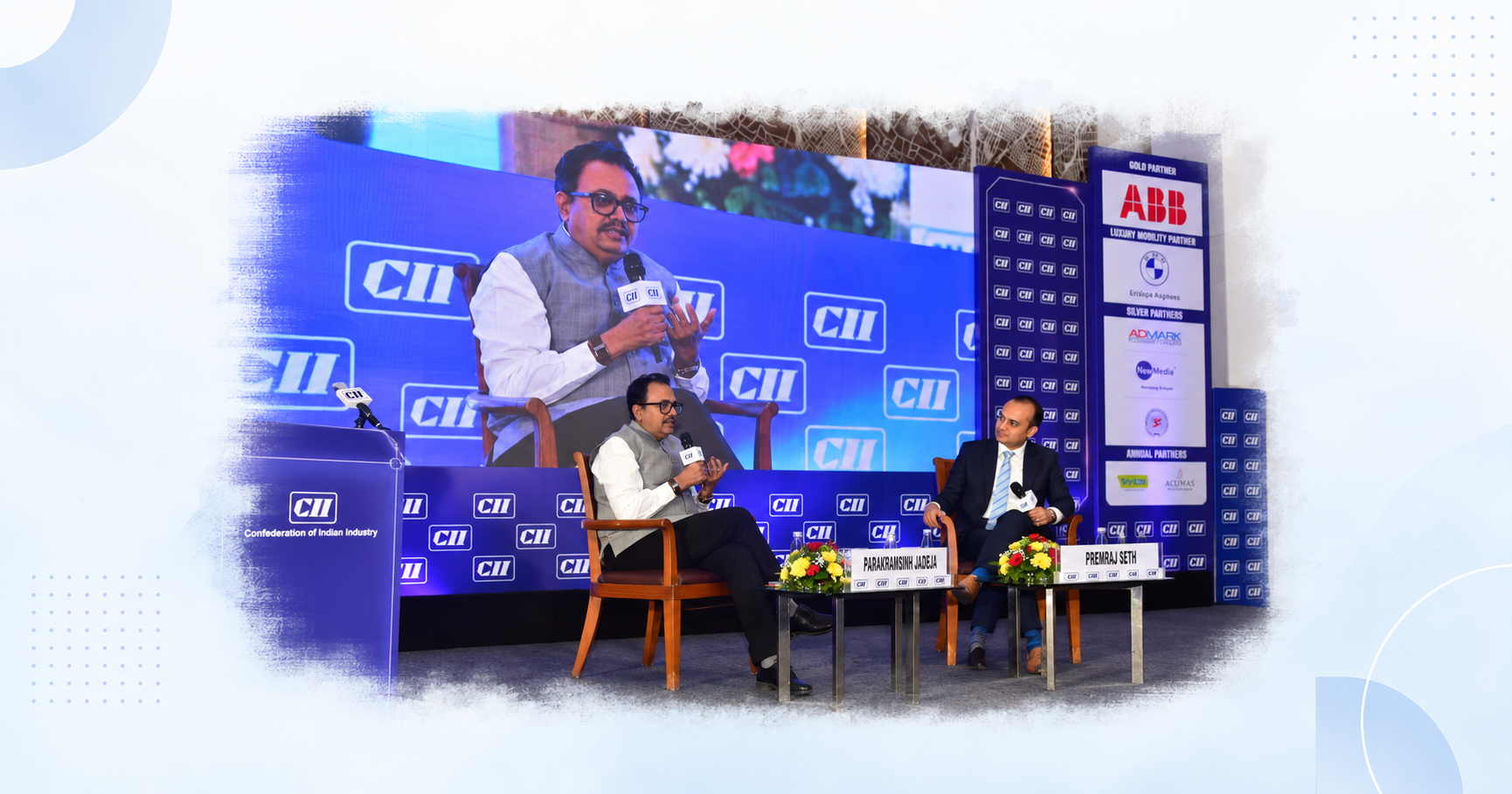
One of the most revealing admissions in Jadeja’s conversation at the CII MSME Conclave on 30 October 2026 was that he had not initially approached business with a formal long-term vision or structured plan.
That changed after attending a business seminar in 2002–03, where he learnt about the importance of defining an organisation’s vision, mission and purpose.
He subsequently initiated a nine-month exercise involving his management team. The objective was to establish why the organisation existed, what it wanted to achieve and where it should be positioned over the following two decades.
The outcome was the vision statement: “Propel Technology and Prosperity in Life.”
The exercise also produced a 20-year perspective plan, which Jadeja said had largely materialised by 2025.
From a business strategy perspective, this was a significant transition. Until then, the company’s decisions had largely evolved through operational opportunities and technological requirements. The vision exercise attempted to connect those individual decisions to a common long-term direction.
A 20-year perspective changes the questions a promoter asks. Instead of concentrating only on immediate production, sales and profitability, the organisation begins evaluating the technologies, people, investments and management systems it will need in the future.
Jyoti’s implementation of SAP in 2003–04 was one manifestation of this transition towards structured management. The company was attempting to build systems that could support growth beyond the promoter’s direct supervision.
For MSME founders, the lesson is important: a vision statement has little strategic value unless it influences capital allocation, technology choices, organisational structure and measurable business priorities.
Huron acquisition: Buying technological capability
By 2005, Jadeja recognised that access to advanced technology was becoming a constraint on the company’s ambitions. Rather than wait for the domestic ecosystem to provide all the required expertise, he explored acquiring an established international machine-tool business.
This led to the acquisition of Huron Graffenstaden, a French machine-tool manufacturer, through Jyoti’s French subsidiary. The acquisition was completed in 2007, with effective control beginning in January 2008.
The strategic rationale was to acquire more than manufacturing capacity. Huron brought established European engineering knowledge, advanced milling capabilities and experience in sophisticated multi-axis machine tools.
This was a decision to accelerate technological learning through acquisition rather than develop every capability organically.
However, international acquisitions in capital-intensive industries involve a difficult trade-off. The buyer acquires technological expertise and market access, but also inherits integration responsibilities, operating costs and the financial requirements of the acquired business.
Jyoti’s experience with Huron illustrates both sides of that equation.
The financial cost of technological ambition
The acquisition created a prolonged financial commitment for Jyoti India.
During an investor conference call in November 2024, Jadeja disclosed that the Indian parent had supported Huron for approximately 15 years. This included financial support and guarantees for banking facilities.
Huron was not generating sufficient profits to meet its obligations towards the parent company. Consequently, accumulated interest and guarantee commission receivables remained outstanding.
At the CII conclave, Jadeja also referred to a 19-year technology journey during which the company experienced losses in 17 years. He used this experience to explain the persistence required to develop advanced technology.
The specific business activity and financial scope of those losses should not be confused with the consolidated performance of Jyoti CNC as a whole. Nevertheless, his account highlights a central challenge in capital-goods manufacturing: technology development can demand sustained investment long before commercial returns become adequate.
For MSME founders considering international acquisitions or substantial R&D commitments, this raises an essential strategic question: how much financial pressure can the parent company sustain while waiting for the acquired technology or business to deliver returns?
Technological ambition must be accompanied by cash-flow planning, debt discipline and realistic integration timelines. Otherwise, an acquisition that strengthens a company’s capabilities can simultaneously constrain its financial flexibility.
IPO: Strengthening the financial architecture
Jyoti CNC’s January 2024 IPO marked an important stage in its financial evolution.
The company reported net proceeds of approximately ₹949.45 crore. Of this, ₹475 crore was earmarked for debt repayment, ₹360 crore for long-term working capital and ₹114.45 crore for general corporate purposes.
The company utilised the entire ₹475 crore allocated for debt repayment by 31 March 2024.
Its consolidated profit after tax also increased from approximately ₹5.5 crore in FY2022–23 to ₹150.9 crore in FY2023–24.
The IPO should not be viewed as the sole reason for the improvement in performance. Operational growth, margins and the performance of group businesses also contributed. Nevertheless, it provided an important opportunity to strengthen the balance sheet, reduce borrowings and improve working-capital capacity.
The strategic lesson is that growth capital and financial restructuring must be considered together. A company investing in advanced technology needs the financial capacity to sustain that investment without compromising its operating requirements.
By FY2025–26, Jyoti CNC reported consolidated revenue from operations of approximately ₹2,093 crore and profit after tax of ₹336 crore.
The next strategic frontier: Indigenous technology
Jadeja’s ambitions now extend beyond manufacturing sophisticated CNC machines.
At the CII conclave, he spoke about the company’s initiative to develop its own CNC controllers, input-output controllers and sensors—components for which Indian machine-tool manufacturers have traditionally depended on Japanese and German suppliers.
He described a team of more than 100 engineers working on this electronic manufacturing initiative.
The strategic significance is considerable. A manufacturer may assemble sophisticated machines, but its long-term technological competitiveness depends on its ability to develop and control critical components, software and engineering systems.
Jyoti’s Industry 4.0 initiatives, including 7th Sense and PreciProtect, reflect the company’s movement towards connected manufacturing, machine monitoring and intelligent protection systems.
Jadeja also argued that companies must invest in R&D and innovation rather than assume that existing products will remain competitive indefinitely. He suggested that smaller businesses could consider allocating around 5% of their top line to R&D, depending on their financial capacity and industry requirements.
For Indian MSMEs, the implication is clear: technological advancement need not begin with developing an entire machine or product independently. It can start with improving a critical component, process, design capability or production system.
From promoter-led business to institution building
Another important aspect of Jadeja’s management philosophy is the development of professional leadership within the organisation.
He recalled that the management review process, which initially involved around ten people, now brings together approximately 40 professionals from different departments every quarter. He sees these professionals as future successors who will help run the organisation.
This reflects a broader institutional challenge faced by promoter-led Indian businesses: how to transfer decision-making authority, knowledge and organisational responsibility beyond the founder.
His statement that the leader should reserve the right to fail is also relevant in this context. It reflects the importance of allowing managers to experiment, take responsibility and learn from mistakes without making the entire organisation dependent on the promoter’s decisions.
What MSME founders should take away
Parakramsinh Jadeja’s journey offers a useful strategic perspective on building a manufacturing enterprise.
- Adopt technology early: Invest in capabilities that will determine future competitiveness, not merely those that improve today’s production.
- Convert ambition into strategy: A long-term vision must guide investments, people, systems and measurable targets.
- Acquire capabilities carefully: International acquisitions can accelerate technological development, but their financial and integration costs must be evaluated realistically.
- Protect financial flexibility: Long-term R&D and technology investments require adequate working capital and disciplined debt management.
- Develop leadership beyond the promoter: Sustainable growth requires professional systems and successors capable of taking independent decisions.
The most important lesson from Jadeja’s journey is not that every MSME should acquire a foreign company, invest heavily in technology or pursue a 20-year plan.
It is that entrepreneurs must progressively move from managing today’s opportunities to building the capabilities their businesses will need tomorrow.
A small workshop can become a significant manufacturing enterprise, but scaling production alone is not enough. The lasting competitive advantage comes from technology, strategic clarity, financial discipline and the ability to build an institution that can outgrow its founder.





Leave a Reply