
MSME Briefing Bureau
Madhur Sugar: How SRSL shifted distribution to AWL’s wider network
When a business is losing money, the instinct is often to inject more capital. But what if the bigger problem lies not in manufacturing, but in the cost of reaching customers? The Madhur Sugar arrangement between Shree Renuka Sugars Limited (SRSL) and AWL Agri Business offers a useful case study in strategic restructuring. By separating manufacturing from marketing and distribution, the group can potentially combine SRSL’s production capabilities with AWL’s established food-products network—without assuming that the benefits are guaranteed.
A strategic lesson in restructuring
In business, a company’s biggest weakness is not always its product or manufacturing capacity. Sometimes, it is the cost of taking that product to market. The Madhur Sugar arrangement between Shree Renuka Sugars Limited (SRSL) and AWL Agri Business Limited illustrates how companies within the same corporate group can reorganise their roles to improve operational efficiency.
The arrangement also raises an important question for founders: must a loss-making business always receive fresh capital, or can its cost structure be redesigned to make it more sustainable?
The financial pressure behind Madhur Sugar
SRSL, the manufacturer of Madhur Sugar, reported a consolidated net loss of approximately ₹792 crore in FY2025–26. Its consolidated net worth stood at minus ₹2,676.6 crore as at 31 March 2026. These figures indicate the financial pressure facing the business. They do not, by themselves, establish that Madhur’s distribution costs caused the losses. SRSL’s FY2025–26 financial results.
Madhur is nevertheless an established consumer brand. SRSL’s FY2024–25 business responsibility report stated that Madhur held a 33 per cent share of the packaged sugar segment, according to the company. This is a company-reported share of the packaged segment, not the entire Indian sugar market.
The strategic challenge, therefore, is to build on an existing brand while improving how efficiently it reaches retailers and consumers.
What changed under the SRSL–AWL agreement?
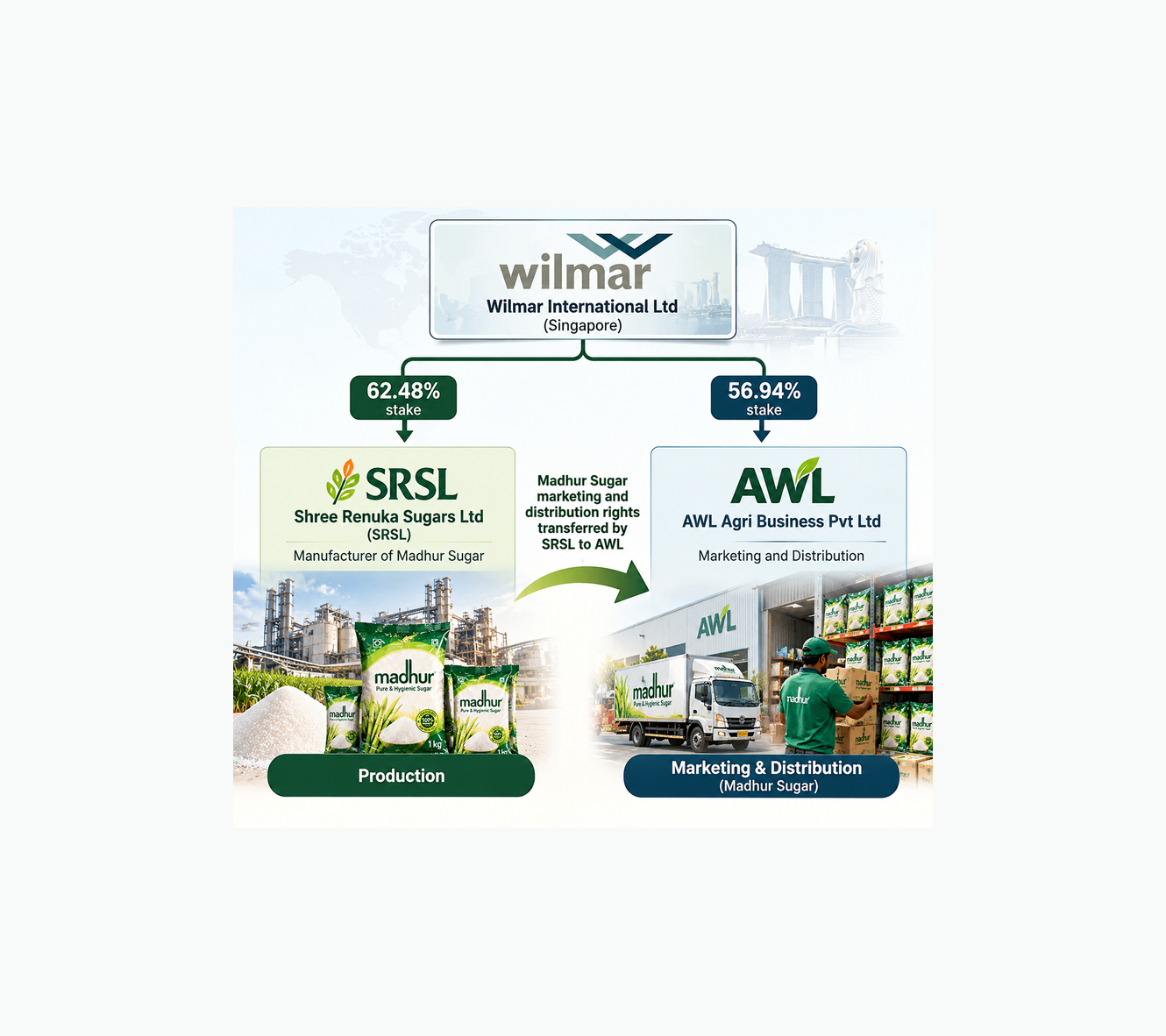
On 28 May 2026, SRSL entered into definitive agreements with AWL for the supply, marketing and distribution of refined sugar sold under the Madhur brand. The arrangement took effect on 1 July 2026 and is for five years.
Under this structure:
- SRSL continues manufacturing Madhur Sugar and retains ownership of the Madhur trademark and related intellectual property.
- AWL takes responsibility for pan-India marketing, sales and distribution, using its established food-products business and distribution capabilities.
- SRSL supplies the product to AWL under the agreed commercial arrangement, rather than independently managing the entire retail distribution operation.
The companies’ stated rationale is to strengthen Madhur’s market reach and expand its presence across channels and geographies. SRSL’s corporate disclosures.
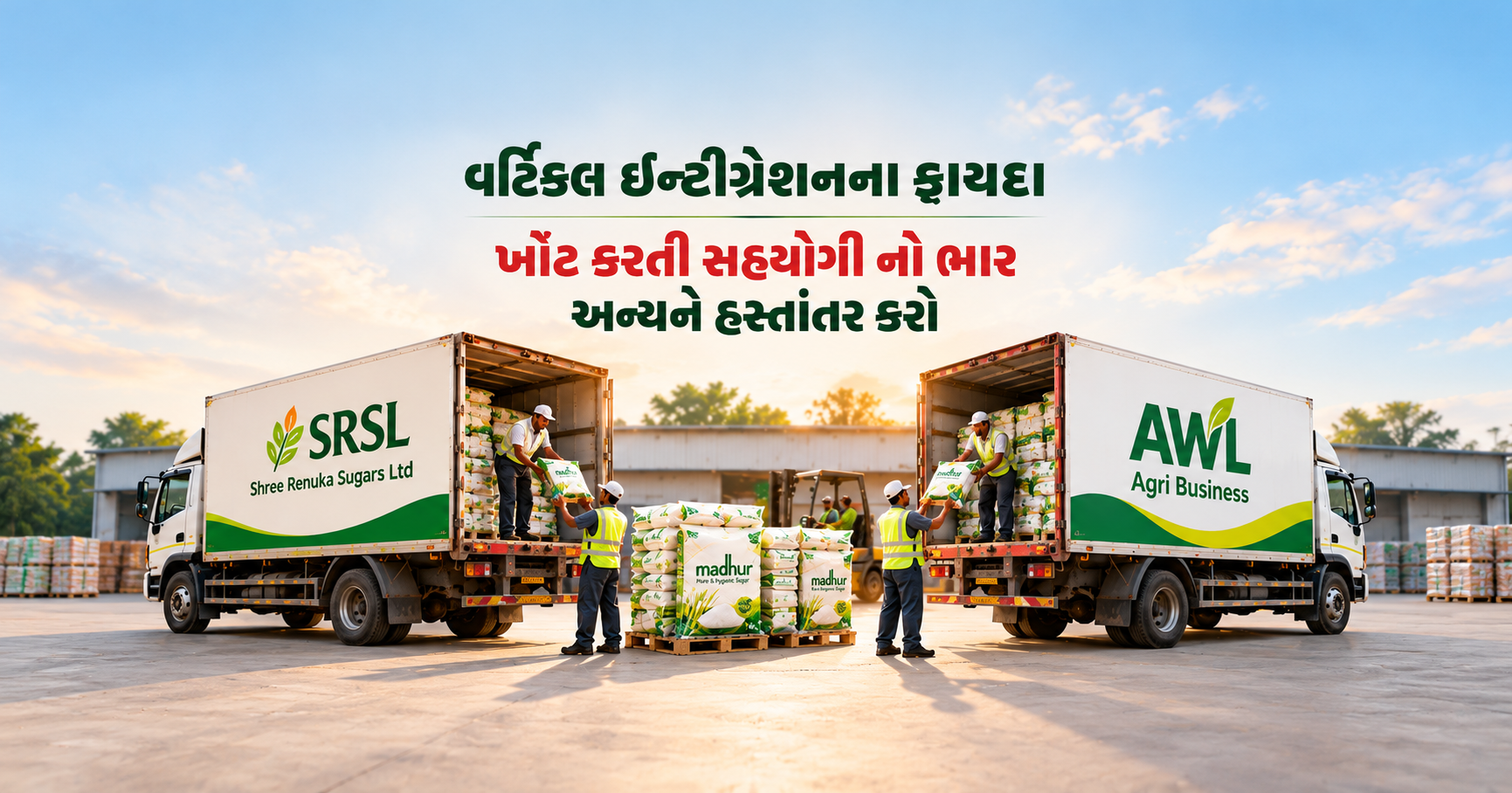
This is a form of strategic supply-chain integration across related businesses. More precisely, it is a redistribution of responsibilities within a common corporate group: manufacturing remains with one company, while market access is managed by another.
Why AWL’s wider product basket matters
The economic logic becomes clearer when the two businesses are compared.
SRSL manufactures sugar and other products associated with its sugar and bioenergy operations. AWL, meanwhile, operates a broader food and FMCG portfolio, including Fortune edible oils, wheat flour, rice, pulses and sugar. Its website reports a distribution infrastructure comprising 118 stock points, more than 10,000 distributors and sub-distributors, and 2.6 million retail outlets. These are company-reported figures. AWL Agri Business.
This network creates an opportunity to distribute Madhur alongside products already moving through AWL’s supply chain.
Consider the costs involved in reaching a retailer: transportation, warehousing, depot operations, sales personnel, order processing and delivery. A business distributing one principal packaged product may find it difficult to spread these costs across a broad range of sales. A multi-product distributor can potentially use the same routes, warehouses and retailer relationships for several product categories.
The opportunity is to lower the incremental cost of distributing Madhur, rather than building an entirely separate network for it.
AWL may also gain an advantage in negotiations with distributors and retailers because it offers a wider product basket. A retailer ordering edible oil, atta, rice and pulses may have an additional reason to order Madhur Sugar through the same channel. However, better commercial terms are a possibility—not a guaranteed outcome. Actual savings will depend on route economics, volumes, margins and execution.
What Wilmar gains from the arrangement
The wider corporate relationship is central to the strategy. Singapore-based Wilmar International is the parent group behind both businesses. Its subsidiary Wilmar Sugar and Energy is the holding company of SRSL, while Wilmar subsidiary Lence became AWL’s majority shareholder, holding 56.94 per cent of its paid-up equity following the Adani Group’s exit.
This common ownership creates scope for the group to coordinate manufacturing, brand ownership and distribution across its businesses.
For SRSL, using AWL’s network may reduce the need to fund and manage a separate nationwide distribution operation. For AWL, Madhur adds another packaged-food brand to its existing portfolio and may increase the productive use of its logistics infrastructure.
For Wilmar, the strategic objective can be understood as using the strengths of one group company to support the commercial reach of another.
However, the arrangement should not automatically be described as a financial bailout. Nor can it yet be assumed that SRSL’s losses will fall or that AWL will benefit financially. Those outcomes must be established through subsequent financial results and operational data.
The risk: a good strategy still needs execution
A change in distribution arrangements can disrupt supply if the transition is poorly managed. Distributor onboarding, credit terms, inventory planning, billing systems and retailer relationships must be coordinated carefully. If the old distribution channel is wound down before the new one is fully operational, the brand risks losing shelf space and sales.
The arrangement must therefore be judged on more than the scale of AWL’s network. Relevant measures include distribution cost per kilogram, retailer availability, order fulfilment, sales volumes, working-capital requirements and the profitability of the arrangement for both companies.
The transfer of responsibilities may create the conditions for efficiency. It does not, on its own, prove that those efficiencies have been realised.
Five lessons for founders and MSME leaders
1. Diagnose the cost structure before injecting capital.
Fresh money may be necessary, but founders should first identify whether a business is being weakened by production costs, distribution expenses, working capital or poor commercial terms.
2. Do not build infrastructure you can access through a partner.
A company does not always need its own nationwide distribution network. Third-party distributors, shared logistics and strategic partnerships may provide a more economical route to market.
3. Use a broader product basket to improve distribution economics.
Where products serve similar retailers, shared transport, warehousing and sales relationships may help reduce the incremental cost of serving each customer.
4. Separate core strengths from supporting activities.
A manufacturer may be best at production, quality and procurement, while another business may be better equipped to handle sales and distribution. Organising responsibilities around these strengths can improve efficiency.
5. Measure the results, not merely the intention.
Track unit distribution costs, working-capital cycles, stock availability, sales and margins before and after a restructuring. Without measurable improvements, strategic integration remains a hypothesis rather than a demonstrated success.
The final lesson
The Madhur Sugar arrangement offers a useful lesson in strategic cost-sharing and supply-chain integration. A business under financial pressure may have more options than raising fresh capital or cutting production. It can also examine whether another company within its wider group—or an external partner—can perform a costly supporting function more efficiently.
The decisive question for founders is not simply, “How can we sell more?” It is “What is the most efficient way to reach the customer, and must we own every part of that process ourselves?”
For SRSL and AWL, the potential lies in combining SRSL’s manufacturing capabilities with AWL’s established distribution platform. Whether that translates into lower costs, stronger availability and improved financial performance will become clear only through evidence from the months ahead.
Sources and references
- Shree Renuka Sugars Limited — FY2025–26 audited financial results, including net loss and net-worth figures. Official financial results.
- Shree Renuka Sugars Limited — Corporate disclosures on the Madhur Sugar supply, marketing and distribution arrangement with AWL, announced on 28 May 2026 and effective from 1 July 2026. SRSL website.
- AWL Agri Business Limited — Company profile and reported distribution infrastructure. Official website.
- AWL Agri Business Limited — Annual Report 2024–25, covering its food-product portfolio, including edible oils, wheat flour, rice, pulses and sugar. Annual report PDF.
- AWL Agri Business Limited — Shareholding and corporate disclosures relating to Wilmar subsidiary Lence’s 56.94 per cent stake. NSE shareholding disclosures.
Editorial note: The potential distribution savings discussed above are strategic analysis, not reported savings. The article does not attribute SRSL’s FY2025–26 losses solely to Madhur Sugar or assert that the new arrangement has already improved profitability.


Leave a Reply