

By Haresh B. Jhala :
A ₹3,000–15,000 crore potential market—but who can qualify to supply?
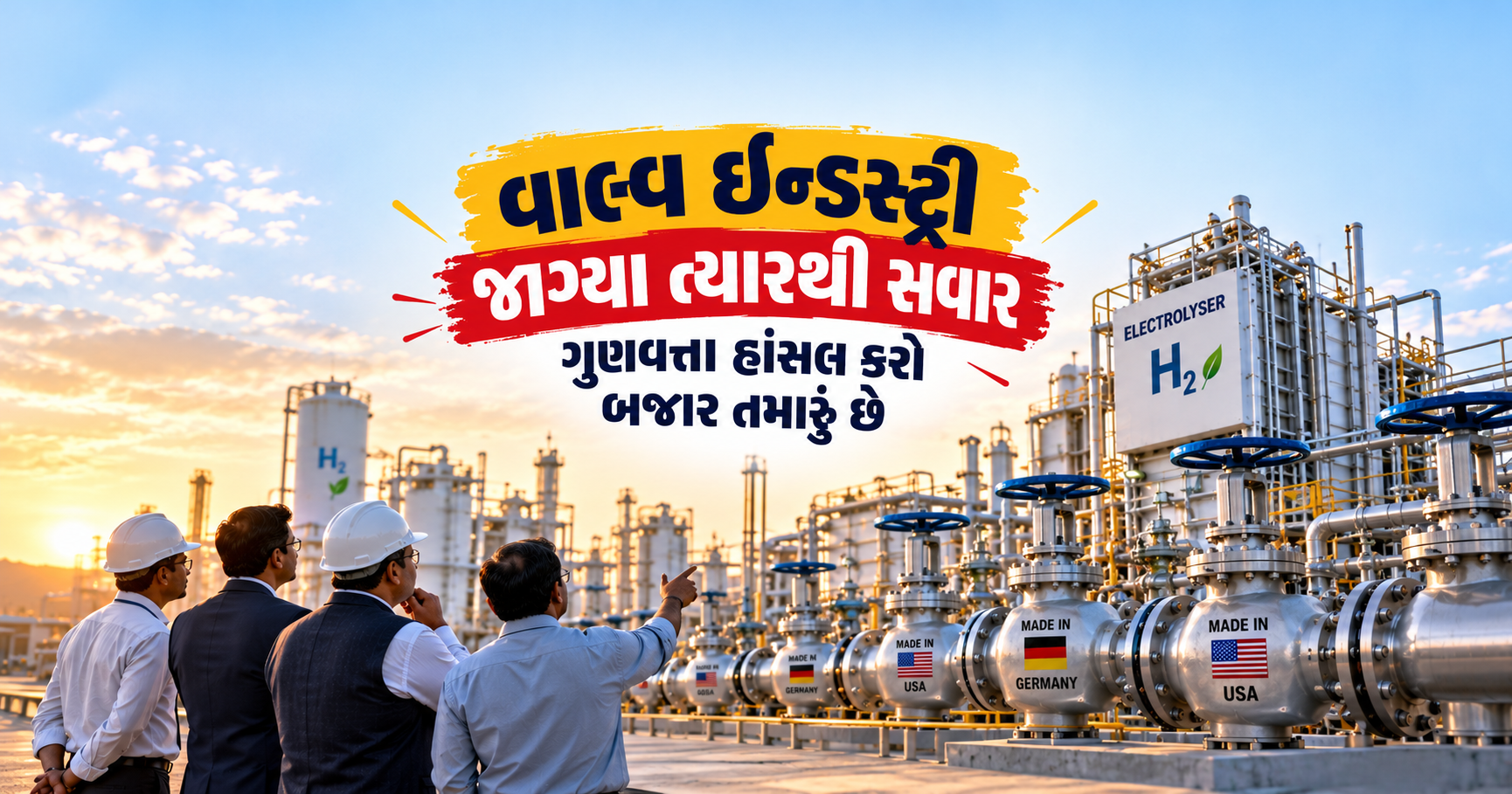
India’s green-hydrogen ambition could open a substantial new market for valve manufacturers, but the opportunity is neither automatic nor guaranteed. Electrolysers, gas purification, compression, storage and green-ammonia plants require valves designed for demanding hydrogen and oxygen service. Our business-standard modelling suggests a potential cumulative valve opportunity of ₹3,000–15,000 crore (US$350 million–US$1.75 billion) if India builds 60–100 GW of electrolyser capacity. These are scenario estimates, not confirmed orders. For Indian manufacturers, qualification, procurement access and execution will determine who captures the value.
India’s ambition is large. The order book is not—yet.
The Union Cabinet approved the National Green Hydrogen Mission in January 2023 with an outlay of ₹19,744 crore. The mission targets at least 5 million metric tonnes (MMT) of green-hydrogen production annually by 2030.
Official planning estimates have associated this ambition with approximately 125 GW of additional renewable-energy capacity and 60–100 GW of electrolyser capacity. These are requirements associated with the production target, not a guarantee that the entire capacity will be installed by 2030.
The distinction matters to valve manufacturers. A government target can indicate the direction of industrial policy, but it cannot substitute for a project schedule, engineering specification or purchase order.
The implementation picture is already more concrete, though still at an early stage. In March 2026, the government reported that 3,000 MW per year of electrolyser manufacturing capacity had been awarded to 15 companies. It also reported that 8,62,000 tonnes per annum of green-hydrogen production capacity had been awarded to 18 companies. Awarded capacity, however, is not the same as commissioned production capacity. [1]
For valve manufacturers, the immediate question is not how many gigawatts India hopes to install. It is how much of the equipment required by projects that are moving towards procurement can be supplied by qualified Indian companies.
Why green-hydrogen plants need specialised valves
An electrolyser uses electricity to split water into hydrogen and oxygen. But the stack is only one part of the installation. A functioning plant may also require water treatment, cooling, gas-liquid separation, drying, purification, pressure control, compression, storage and safety systems. Green-ammonia facilities and other downstream applications add further process equipment.
Valves perform several jobs across these systems: controlling flow, isolating equipment, preventing reverse flow, regulating pressure, venting gases and protecting equipment against unsafe operating conditions.
Not all these valves require the same materials, design or qualification. A valve used in a cooling-water circuit is not equivalent to one handling high-pressure hydrogen. An oxygen-service valve also requires appropriate cleanliness controls to reduce ignition risks associated with contamination.
Hydrogen presents particular leakage challenges because of its small molecular size and the demanding conditions in which it may be handled. Material suitability depends on the actual operating conditions, including pressure, temperature, hydrogen exposure, design and component geometry. Certain materials can be vulnerable to hydrogen-related degradation.
Oxygen service raises a different concern: oils, grease and other combustible contamination can become dangerous in oxygen-rich environments. Cleaning, inspection, assembly, packaging and handling therefore need to follow the applicable oxygen-service requirements.
This is why a manufacturer’s existing industrial-valve business does not automatically qualify it for every green-hydrogen application.
The opportunity is not simply to manufacture a valve that fits a pipe. It is to deliver the specified performance, with the required material traceability, testing records and quality documentation.
Where are the opportunities in the plant?
For an established Indian valve manufacturer, the most sensible entry point may be outside the most demanding part of the electrolyser package.
| Application | Potential products | What the manufacturer must establish |
|---|---|---|
| Water treatment and cooling | Isolation, check and control valves | Compatibility with water quality, pressure, temperature and flow requirements |
| Utility and balance-of-plant systems | Gate, globe, butterfly and check valves | Applicable design codes, pressure ratings, reliability and buyer specifications |
| Hydrogen separation and purification | Isolation, bleed and pressure-control valves | Hydrogen compatibility, leakage performance and operating conditions |
| Oxygen separation and venting | Oxygen-service isolation and vent valves | Applicable oxygen-cleaning procedures and documented cleanliness |
| Safety systems | Relief and specialised isolation valves | Required safety function, design basis, applicable codes and qualification |
| Compression and storage | High-pressure valves and associated components | Pressure rating, materials, leakage criteria, testing and customer approval |
| Maintenance and aftermarket | Spares, seals, packing, actuators and refurbishment | OEM compatibility, safe maintenance procedures and proven service capability |
This is an indicative application map, not a universal specification. The actual requirements must be obtained from the project owner, engineering contractor, electrolyser OEM or package supplier.
The distinction is commercially important. A company that already makes industrial isolation valves may be able to adapt its existing manufacturing processes for selected balance-of-plant applications. A company seeking to supply critical high-pressure hydrogen control valves may face a much larger engineering, testing and qualification challenge.
The first decision for an MSME should be which product family it can qualify for—not how quickly it can enter the entire hydrogen market.
How large could the valve market become?
There is no single publicly established figure that can be treated as the verified value of India’s future green-hydrogen valve market. The market depends on the number of projects actually built, the configuration of each plant, the equipment included in the procurement package, valve specifications and the extent of domestic sourcing.
To provide manufacturers with a starting point for business planning, MSME Briefing has developed an illustrative scenario model.
Our model: valve spend per MW
For planning purposes, we use three assumed levels of specialised-valve expenditure:
- Low case: ₹5 lakh (approximately US$5,800) per MW.
- Base case: ₹10 lakh (approximately US$11,600) per MW.
- High case: ₹15 lakh (approximately US$17,400) per MW.
These are editorial modelling assumptions, not published industry averages, supplier quotations or audited procurement data. They are deliberately presented as a range because the actual spend will depend on the project boundary and valve specifications.
For currency conversion, the model uses an illustrative exchange rate of ₹86 per US dollar. The resulting dollar values are rounded.
The estimates cover specialised valves associated with the electrolyser and its immediate balance-of-plant systems. They do not automatically include every valve in a full green-ammonia plant, downstream pipeline, port, large storage complex or wider industrial facility.
Estimated valve-market scenarios
| Electrolyser capacity built | Low case: ₹5 lakh/MW | Base case: ₹10 lakh/MW | High case: ₹15 lakh/MW |
|---|---|---|---|
| 1 MW | ₹5 lakh (US$5,800) | ₹10 lakh (US$11,600) | ₹15 lakh (US$17,400) |
| 100 MW | ₹5 crore (US$0.58 million) | ₹10 crore (US$1.16 million) | ₹15 crore (US$1.74 million) |
| 1 GW | ₹50 crore (US$5.8 million) | ₹100 crore (US$11.6 million) | ₹150 crore (US$17.4 million) |
| 5 GW | ₹250 crore (US$29 million) | ₹500 crore (US$58 million) | ₹750 crore (US$87 million) |
| 10 GW | ₹500 crore (US$58 million) | ₹1,000 crore (US$116 million) | ₹1,500 crore (US$174 million) |
All figures are modelled estimates. One GW equals 1,000 MW. Values represent cumulative specialised-valve spend associated with the stated capacity, not annual revenue or confirmed orders.
Under this model, a hypothetical 5 GW build-out corresponds to ₹250–750 crore (approximately US$29–87 million) in specialised-valve expenditure. A 10 GW build-out corresponds to ₹500–1,500 crore (approximately US$58–174 million).
If India eventually builds 60–100 GW of electrolyser capacity, the same assumptions produce a cumulative potential valve market of:
- Low case: ₹3,000 crore (approximately US$349 million).
- Base case at 10 lakh/MW: ₹6,000–10,000 crore (approximately US$698 million–US$1.16 billion).
- High case: ₹9,000–15,000 crore (approximately US$1.05–1.74 billion).
These figures are arithmetic outcomes of the stated assumptions. They should not be interpreted as an independent forecast of actual industry spending.
The model also does not imply that all expenditure will be available to Indian MSMEs. Some products may be bundled into equipment packages, some may be sourced from established global suppliers, and some may be manufactured by large Indian companies. A manufacturer can address only the portion that matches its products, technical qualifications, capacity and commercial access.
Why we have not used a valve count per MW
A universal claim that every MW requires a fixed number of specialised valves can be misleading.
The US National Renewable Energy Laboratory’s balance-of-plant cost analysis estimates piping, valves and instrumentation using a particular process-flow design and engineering judgement. Its illustrative configuration includes several types of valves in different quantities; it does not establish a universal industry-wide valve count per MW. [2]
An alkaline system and a PEM system may have different process arrangements. Even two plants using the same technology may have different package boundaries, redundancy requirements and pressure-control designs.
For that reason, we have used a spend-per-MW scenario as an initial commercial model rather than presenting an unverified valve count as a standard engineering benchmark.
The next level of research should replace the assumed spend with actual bills of materials, EPC package specifications and quotations from qualified valve manufacturers.
What the estimates mean for a Gujarat manufacturer
A large national market does not translate automatically into a large addressable market for an individual factory.
Consider a manufacturer that already supplies industrial isolation and check valves. Its first opportunity might be a defined category of water-system or balance-of-plant valves. Another manufacturer with relevant stainless-steel machining, pressure-testing and documented quality systems might be better positioned for more demanding applications.
The manufacturer’s addressable market must therefore be calculated separately from the national market:
Addressable opportunity = relevant project demand × eligible product share × realistic supplier-access share.
Each input needs evidence. Relevant project demand requires a credible pipeline; eligible product share depends on technical capability; and supplier-access share depends on qualification, customer relationships, pricing, capacity and procurement arrangements.
Gujarat has an industrial base that could support this progression. Ahmedabad, Vadodara, Rajkot and nearby manufacturing corridors contain engineering and component manufacturers, while the state is also associated with electrolyser manufacturing, green-hydrogen projects, refineries, ports and potential green-ammonia developments.
However, announced projects must be distinguished from commissioned plants and projects with actual procurement milestones. A planned gigawatt-scale complex is not equivalent to a purchase order for valves.
The most useful opportunity map for a manufacturer should identify each project, its location, current status, expected commissioning, electrolyser technology, EPC contractor or OEM, package scope and procurement stage. Only then can a company decide where to spend its business-development time.
Who specifies, approves and buys the valve?
The commercial chain is often more important than the headline market estimate.
A project developer may own the plant, while an EPC contractor manages engineering and procurement. An electrolyser OEM or skid manufacturer may specify particular components, maintain an approved-vendor list or supply an integrated package. In other cases, the EPC contractor may procure valves directly.
The exact arrangement varies by project. A manufacturer must establish who controls the specification, who approves the supplier and who issues the purchase order.
Before making a significant investment, an MSME should seek answers to five questions:
- Which valve categories are specified for the target application?
- Who has authority to approve the product and the manufacturer?
- Which tests, certificates and quality records are mandatory?
- Is the component procured directly or included in an OEM/EPC package?
- What is the actual procurement timetable, and can a new supplier qualify in time?
A technically capable manufacturer that cannot reach the right buyer may fail to secure an order. Conversely, a manufacturer that understands the procurement chain early can build relationships and address qualification gaps before a tender is released.
The standards question: what does hydrogen-ready actually mean?
There is no single certificate that makes every industrial valve suitable for every hydrogen application.
Depending on the product and buyer specification, the manufacturer may need to demonstrate material compatibility, pressure integrity, leakage performance, cycle life, manufacturing quality and traceability.
ISO 15848-1, API 624 and API 641 address particular fugitive-emission testing and qualification requirements. Their applicability depends on valve design, test scope and service conditions. They should not be presented as interchangeable universal approvals for all hydrogen valves.
Oxygen-service cleaning is a separate discipline. CGA G-4.1 and ASTM G93 are relevant references for cleaning and controlling contamination in oxygen systems, but a manufacturer must confirm the applicable edition, requirements and acceptance criteria for the particular equipment and purchaser.
The required technical programme should be established with the customer or a competent engineering/testing partner. It may include material review, design verification, pressure testing, leakage testing, cleanliness controls, documented inspection and application-specific qualification.
The business implication is straightforward: certification and testing costs should be budgeted against a specific target product and customer requirement, not against the vague ambition of becoming a hydrogen-valve supplier.
What will it cost an MSME to enter?
The cost of entry cannot responsibly be expressed as one universal investment figure.
A manufacturer upgrading an existing plant may need additional testing equipment, material traceability, documentation systems, cleaning capability and design validation. A manufacturer entering a demanding high-pressure product category may require more extensive engineering, tooling, testing and customer qualification. A new dedicated manufacturing line would have a different capital profile again.
The first step is a gap assessment covering:
- Existing machines, tooling and dimensional-control capability.
- Material sourcing, certificates and traceability.
- Pressure and leakage testing.
- Welding, heat treatment and relevant process controls.
- Oxygen-cleaning, inspection and packaging where required.
- Engineering documentation and quality assurance.
- Product-specific testing and third-party laboratory costs.
- Customer audits, qualification batches and working capital.
The manufacturer should then obtain actual quotations for the missing equipment and services. Shared testing facilities or accredited external laboratories may be more economical than building every capability in-house.
An investment decision should follow confirmed customer specifications and a realistic qualification route—not precede them.
A practical roadmap for valve manufacturers
First six months: choose the entry product
Select two or three valve categories that align with existing manufacturing strengths. Speak to electrolyser OEMs, EPC contractors, skid manufacturers and hydrogen-project developers to obtain actual specifications.
Prepare a gap assessment covering materials, pressure ratings, testing, cleanliness, documentation, production capacity and quality systems. Do not invest in specialised equipment until the likely qualification route is understood.
Months six to twelve: build the missing capability
Strengthen material traceability, test documentation and production controls. Where oxygen-service products are targeted, develop appropriate cleaning, inspection, packaging and handling procedures.
Use accredited testing partners where practical. Obtain a clear view of the product-specific testing requirements, cost and timetable.
Months twelve to eighteen: validate the product
Develop and test selected designs against the actual customer specification. Resolve any material, sealing, pressure or leakage issues. Build a documented quality package that an OEM or EPC contractor can review.
The objective is not to collect certificates indiscriminately. It is to demonstrate that a defined product meets the requirements of a defined application.
Months eighteen to thirty: pursue approved-vendor status
Approach the identified buyer with the product dossier, test results, manufacturing capability and a clear commercial offer. Seek a pilot order or a controlled qualification batch where possible.
A partnership with an established supplier or system integrator may provide a more practical entry route than attempting to win a major package independently.
Months thirty to thirty-six: convert qualification into repeat business
Build on successful supply with framework agreements, spares, maintenance support, refurbishment and replacement programmes where the application and customer allow them.
Track rejection rates, delivery performance, warranty costs, repeat orders and profitability. Hydrogen-related revenue should be evaluated on commercial returns, not simply on the prestige of entering a new sector.
These stages are an indicative management roadmap, not a promise that qualification will be completed within a fixed period. Actual timelines depend on product complexity, customer requirements, testing availability and procurement schedules.
What should the government do?
The National Green Hydrogen Mission has supported electrolyser manufacturing and green-hydrogen production. A stronger domestic component ecosystem would also benefit from measures that help Indian manufacturers demonstrate product capability and reach buyers.
1. Create shared testing infrastructure. Accredited facilities could provide relevant pressure, leakage, material and oxygen-cleanliness testing. Shared access could reduce the initial burden on smaller manufacturers, provided the facilities are technically competent and accepted by purchasers.
2. Support qualification, not merely machinery purchases. Targeted assistance could help eligible MSMEs pay for product testing, design validation, quality-system upgrades and technical documentation. Support should be linked to credible qualification plans and defined product categories.
3. Build first-reference opportunities. Public-sector projects and supported pilots could create controlled opportunities for capable Indian suppliers to demonstrate performance under appropriate engineering oversight. Safety and technical requirements must remain paramount.
4. Improve procurement transparency. Project developers and public-sector buyers could publish supplier-registration procedures, relevant technical specifications and anticipated procurement stages where commercially and technically appropriate.
5. Encourage OEM–MSME partnerships. Collaboration between electrolyser manufacturers, EPC contractors, established valve companies, laboratories and smaller component manufacturers could help bridge gaps in design, testing and customer approval.
6. Develop a verified supplier directory. A database could list product categories, demonstrated qualifications, testing facilities and documented references. Claims of hydrogen readiness should be supported by evidence and clearly defined scope.
7. Support cluster-level collaboration. Gujarat’s valve manufacturers could explore shared testing, training, technical services and market-development initiatives rather than duplicating expensive facilities across individual factories.
The objective should not be to compel buyers to accept an unqualified domestic product. It should be to help capable Indian manufacturers become credible suppliers without compromising safety or reliability.
The final call: catch the bus before it leaves
India’s green-hydrogen ambition offers valve manufacturers a reason to investigate a new industrial market. But the opportunity must be approached with commercial discipline.
Our scenario model indicates a potential cumulative specialised-valve market of ₹3,000–15,000 crore (approximately US$349 million–US$1.74 billion) if India builds 60–100 GW of electrolyser capacity and the assumed spend of ₹5–15 lakh per MW proves reasonable. The range is intentionally broad because the underlying spend benchmark still requires validation.
It is not a confirmed order book, a forecast of domestic sales or a measure of the revenue available to any one manufacturer.
For valve makers, particularly Gujarat’s MSMEs, the immediate priorities are more practical: identify the first product category, obtain actual specifications, understand the approval process, calculate the investment gap, secure a credible testing route and establish contact with the people who control procurement.
Do not attempt to compete for every hydrogen valve. Do not assume that an existing industrial certificate will satisfy every buyer. And do not commit substantial capital on the strength of a national market projection alone.
The manufacturers most likely to catch the bus will be those that combine existing engineering strengths with product-specific qualification, documented performance and early access to the supply chain.
The government’s role is to make that transition more achievable through shared testing, qualification support, transparent procurement and credible first-reference opportunities.
Green hydrogen may become a significant market for Indian valve manufacturers. Turning that possibility into profitable orders will require evidence, preparation and execution—not optimism alone.
Sources and estimation methodology
Official policy and project sources
- Ministry of New and Renewable Energy / Press Information Bureau, Government of India, National Green Hydrogen Mission and government update on awarded electrolyser manufacturing and green-hydrogen production capacity, 24 March 2026.
https://nghm.mnre.gov.in/sight.php
https://www.pib.gov.in/PressReleasePage.aspx?PRID=2244663 - National Renewable Energy Laboratory, Updated Manufactured Cost Analysis, including Appendix B on balance-of-plant cost-modelling assumptions.
https://www.nrel.gov/docs/fy24osti/87625.pdf
Technical references
- Compressed Gas Association, CGA G-4.1, Cleaning Equipment for Oxygen Service.
https://portal-web-test.cganet.com/Publication/Details.aspx?id=G-4.1 - ASTM International, ASTM G93, Standard Practice for Cleanliness Levels and Cleaning Methods for Materials and Equipment Used in Oxygen-Enriched Environments. The applicable edition and purchaser requirements must be confirmed for each application.
- ISO 15848-1, API 624 and API 641, for the applicable fugitive-emission testing and qualification frameworks. Product-specific applicability and scope must be verified with the purchaser.
Estimates and assumptions disclosed by MSME Briefing
- The ₹5 lakh, ₹10 lakh and ₹15 lakh per MW specialised-valve expenditure scenarios are editorial assumptions for business planning. They are not verified industry averages or supplier quotations.
- The ₹3,000–15,000 crore cumulative market range is calculated by multiplying the assumed spend per MW by the official 60–100 GW planning range. It is not a confirmed order book or an audited market forecast.
- Dollar conversions use an illustrative rate of ₹86 per US dollar and are rounded.
- The model covers specialised valves associated with the electrolyser and immediate balance-of-plant systems. It does not automatically include the full valve requirements of green-ammonia plants, downstream pipelines, ports or wider industrial infrastructure.
- No verified universal valve count per MW has been assumed.
- Import dependence, the value of orders lost to foreign suppliers, the market share of Indian manufacturers and the addressable opportunity for Gujarat MSMEs have not been quantified as established facts in this model.
- Before making an investment decision, manufacturers should validate the assumed spend against project bills of materials, OEM/EPC specifications, supplier quotations, testing requirements and procurement schedules.
Editorial note: The market figures in this article are scenario estimates intended to inform business decisions. They should be revised as reliable project-level procurement and supplier-cost evidence becomes available.




Leave a Reply