
MSME BRIEFING | TRADE, MANUFACTURING & GEOPOLITICS
MSME Briefing Bureau
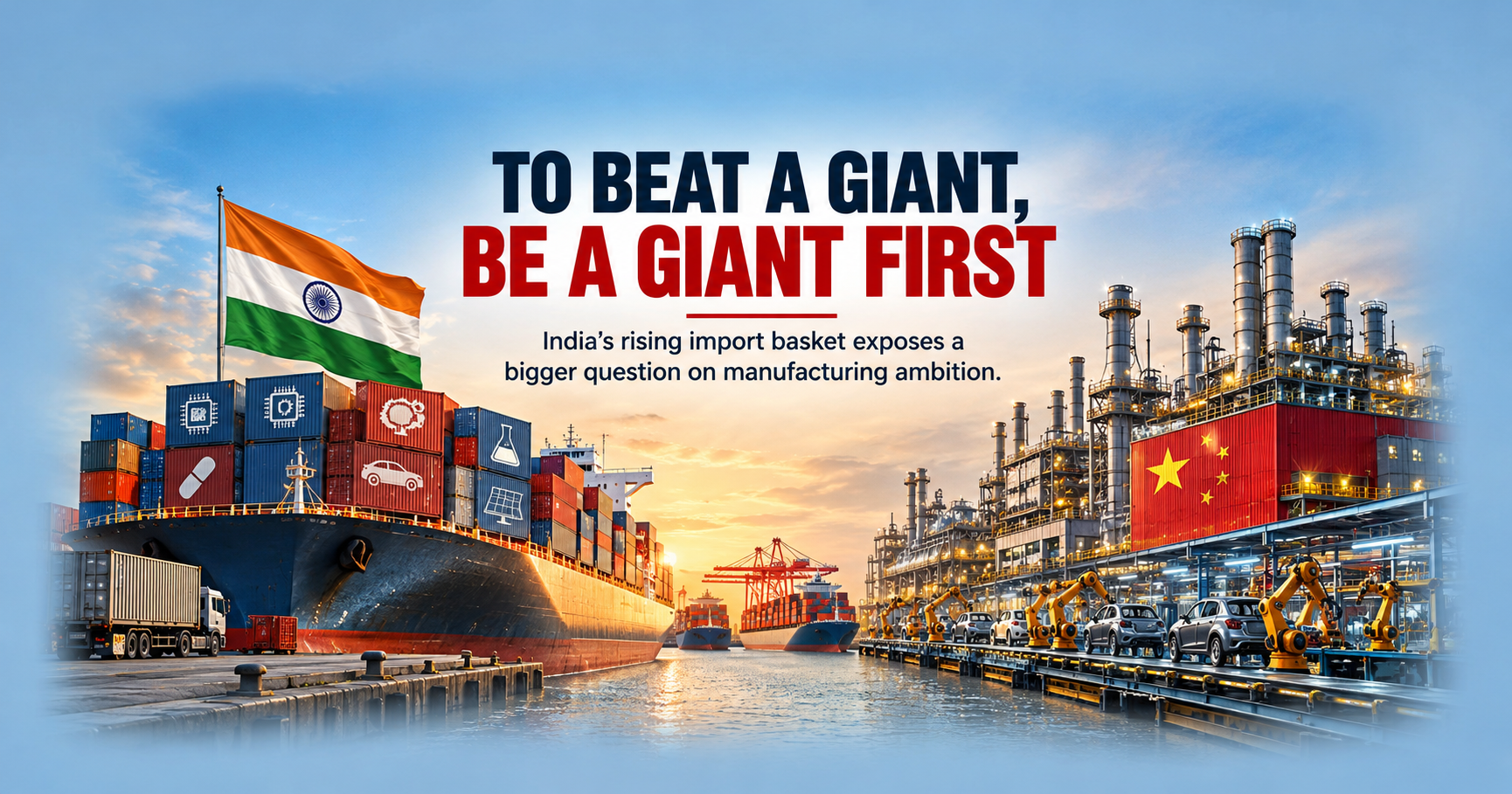
China’s trade barriers matter, but India’s manufacturing ambitions matter more
India’s trade deficit with China has crossed ₹9 lakh crore (US$100 billion), reviving questions about market access, industrial dependence and economic strategy. Finance Minister Nirmala Sitharaman has challenged Beijing’s non-tariff barriers, but the debate cannot end with China. Why does India continue to import enormous quantities of components, machinery and industrial inputs? More importantly, why has the country not built sufficient globally competitive manufacturing capacity? The answer lies in investment, industrial policy and the economics of assembly.
The deficit is a warning, not the whole story
India’s merchandise trade with China presents a persistent imbalance. In FY2024–25, India exported goods worth ₹1.25 lakh crore (US$14.25 billion) to China and imported ₹9.93 lakh crore (US$113.46 billion), resulting in a trade deficit of ₹8.68 lakh crore (US$99.21 billion).
The imbalance widened in FY2025–26. Exports increased to ₹1.70 lakh crore (US$19.47 billion), but imports rose to ₹11.52 lakh crore (US$131.63 billion). The deficit reached ₹9.81 lakh crore (US$112.16 billion), while total bilateral goods trade touched approximately ₹13.22 lakh crore (US$151.10 billion).
The latest calendar-year figures underline the challenge. According to China’s General Administration of Customs, India’s deficit reached ₹9.27 lakh crore (US$105.93 billion) during January–September 2026. Chinese exports to India were valued at ₹10.95 lakh crore (US$125.19 billion), against Indian exports of ₹1.68 lakh crore (US$19.26 billion). Total bilateral trade reached approximately ₹12.64 lakh crore (US$144.45 billion).
The periods must not be confused: the first two comparisons use India’s April–March financial year, while the latest figures cover January–September under Chinese customs reporting. Differences in valuation, timing and classification can also produce discrepancies between the two countries’ trade statistics.
The direction is unmistakable. India’s imports from China substantially exceed its exports, and the gap has widened despite strong growth in Indian exports.
But a trade deficit is not, by itself, proof of unfair trade or economic loss. India imports machinery that can raise productivity, components that support domestic manufacturing and materials that may not be available competitively at home.
The more important question is what the composition of these imports reveals about India’s industrial capabilities—and why domestic manufacturing has not developed sufficiently in several critical areas.
Beijing’s barriers are real
Finance Minister Nirmala Sitharaman has identified China’s non-tariff barriers (NTBs) as a major obstacle to improving bilateral trade.
Speaking during an Atlantic Council interaction on the sidelines of the IMF–World Bank meetings in Bangkok on 16 October 2026, she argued that Indian exporters had spent years seeking market access without securing adequate progress.
Her criticism deserves serious consideration. Non-tariff barriers can include product registration, licensing, inspection, technical standards, certification procedures and sanitary or phytosanitary requirements. Such measures can serve legitimate health and safety objectives, but opaque, inconsistent or unnecessarily burdensome implementation can restrict market access.
Indian pharmaceutical companies seeking approval for generic medicines, agricultural exporters facing phytosanitary requirements and other manufacturers seeking access to China’s market need transparent rules, predictable procedures and timely decisions.
The commercial implications are substantial. A manufacturer cannot confidently invest in export capacity if approval timelines are uncertain or the requirements for market entry remain unclear.
India is therefore justified in seeking reciprocal and non-discriminatory market access. Negotiations should focus on specific products, documented restrictions, transparent procedures and measurable commitments.
Yet even if Beijing improves access to its market, India must have the production capacity, product quality, price competitiveness and scale to exploit those opportunities.
Better market access can create an opportunity. It cannot substitute for the manufacturing capability needed to use it.
What India buys from China
The composition of imports provides a clearer picture of the industrial relationship.
In FY2025–26, India’s imports from China included the following major categories:
| Import category | Value in INR (US$ value) |
|---|---|
| Electronic goods | ₹4.31 lakh crore (US$49.21bn) |
| Electrical and non-electrical machinery | ₹2.14 lakh crore (US$24.51bn) |
| Organic and inorganic chemicals | ₹71,663 crore (US$8.19bn) |
| Artificial resins and plastic materials | ₹61,338 crore (US$7.01bn) |
| Transport equipment | ₹51,713 crore (US$5.91bn) |
| Non-ferrous metals | ₹42,963 crore (US$4.91bn) |
| Iron and steel | ₹35,613 crore (US$4.07bn) |
| Chemical materials and products | ₹33,863 crore (US$3.87bn) |
| Medicinal and pharmaceutical products | ₹32,113 crore (US$3.67bn) |
| Machine tools | ₹21,700 crore (US$2.48bn) |
Source: India Brand Equity Foundation’s FY2025–26 India–China trade summary. Rupee equivalents use ₹87.50 per US dollar; figures are rounded.
These are not all consumer goods. They include inputs and equipment used by Indian manufacturers in electronics, pharmaceuticals, chemicals, electrical equipment, automotive production, plastics and engineering.
Electronic goods alone accounted for imports worth ₹4.31 lakh crore (US$49.21 billion). Machinery represented another ₹2.14 lakh crore (US$24.51 billion). Organic and inorganic chemicals accounted for approximately ₹71,663 crore (US$8.19 billion).
The categories do not, on their own, tell us what proportion comprises finished products, components, intermediate goods or capital equipment. That distinction matters: importing a machine that improves domestic productivity is different from importing a finished product that an Indian factory could competitively manufacture.
Nevertheless, the figures identify the sectors in which domestic capacity, supplier development and supply-chain resilience deserve closer investigation.
The policy objective should not be to eliminate imports indiscriminately. It should be to identify where India can build competitive domestic alternatives, diversify supply and retain more value through viable manufacturing.
India exports manufactured goods too—but the scale is different
India’s export basket is more diverse than the description of a raw-material supplier suggests.
In FY2025–26, exports to China included approximately:
| Export category | Value in INR (US$ value) |
|---|---|
| Engineering goods | ₹30,888 crore (US$3.53bn) |
| Electronic goods | ₹27,825 crore (US$3.18bn) |
| Petroleum products | ₹21,525 crore (US$2.46bn) |
| Iron ore | ₹13,913 crore (US$1.59bn) |
| Marine products | ₹13,563 crore (US$1.55bn) |
| Organic and inorganic chemicals | ₹13,388 crore (US$1.53bn) |
| Mica, coal, other ores and processed minerals | ₹9,800 crore (US$1.12bn) |
| Spices | ₹4,538 crore (US$518.64m) |
Source: IBEF’s FY2025–26 trade summary; INR values converted at ₹87.50 per US dollar.
The engineering and electronics figures demonstrate that India does export manufactured products to China. But even engineering goods exports of approximately ₹30,888 crore (US$3.53 billion) are small compared with the machinery and electronic goods India imports.
The opportunity is to expand competitive exports in engineering, chemicals, pharmaceuticals, processed products and other sectors where Indian manufacturers can meet international standards and prices.
However, the export gap cannot be explained by market access alone. Manufacturers also need competitive input costs, dependable production, technology, quality certification, scale and reliable delivery.
India must pursue two objectives simultaneously: challenge unjustified restrictions in China and strengthen the domestic industrial base that can compete in global markets.
From manufacturing to assembly: the strategic danger
The most important question is whether India is building a sufficiently deep manufacturing ecosystem—or relying too heavily on importing components and assembling finished products.
Assembly has contributed to India’s industrial expansion. It can create jobs, attract investment, improve production processes and provide entry into global value chains. It can also help replace imports of finished products with locally assembled goods.
The risk arises when assembly becomes the final destination rather than the starting point for more sophisticated manufacturing.
Consider an electronic product. Its components may include semiconductors, printed circuit boards, displays, sensors, connectors, batteries and power-management systems. Assembly may take place in India, while substantial portions of the technology, materials and component value originate abroad.
Similar patterns can occur in electrical equipment, machinery, automotive systems and consumer appliances.
The production chain can look like this:
Imported components → Indian assembly → finished product → domestic or export market.
The finished product may be labelled Indian-made, but the depth of domestic manufacturing depends on how much of its component value, technology, engineering and production capability has actually been developed in India.
Electronics: the numbers reveal the next challenge
India’s electronics manufacturing expansion demonstrates both progress and the work still required.
According to figures reported by the Ministry of Electronics and Information Technology, domestic value addition in electronics manufacturing had reached an estimated 18–20 per cent by April 2026.
Over the preceding decade, annual electronics production rose from ₹1.90 lakh crore (approximately US$21.71 billion) in FY2014–15 to around ₹12 lakh crore (approximately US$137.14 billion) in FY2024–25. Electronics exports reached approximately ₹3.30 lakh crore (US$37.71 billion) in FY2024–25.
Mobile-phone production increased from ₹18,000 crore (approximately US$2.06 billion) to ₹5.45 lakh crore (approximately US$62.29 billion) over the same period.
These figures show that India can attract investment, expand manufacturing and develop export-oriented production. They should not be dismissed as mere assembly.
But the value-addition estimate also highlights the next challenge. The production of finished products does not automatically create domestic capacity in semiconductors, displays, components, specialised materials and manufacturing equipment.
The 18–20 per cent figure is an aggregate estimate, not a uniform value-addition rate for every electronic product or company. Actual domestic value addition varies by product, sourcing arrangements and the stage of production.
Nevertheless, the policy implication is clear: India must build on its success in finished-product manufacturing by deepening the component and materials ecosystem.
Pharmaceutical ingredients: a measurable dependency
Pharmaceuticals provide another example of industrial dependence, with implications for both competitiveness and supply-chain security.
Government data for FY2024–25 show that India imported approximately ₹38,043 crore (US$4.35 billion) of active pharmaceutical ingredients (APIs), bulk drugs and drug intermediates across 200 identified categories.
China supplied approximately ₹28,041 crore (US$3.205 billion) of these imports, accounting for 73.71 per cent of the total.
This is not China’s share of every pharmaceutical import into India. It is the share reported for the specified categories of APIs, bulk drugs and intermediates.
Even with that qualification, the concentration is significant. Disruption, price volatility or changes in supply conditions could affect Indian pharmaceutical manufacturers that depend on these inputs.
India has pursued domestic bulk-drug manufacturing initiatives, but the relevant questions are how much capacity is operational, whether it can produce competitively, which inputs remain dependent on imports and what further investment is commercially viable.
The broader lesson is that strategically important domestic capacity must be technically capable, cost-competitive and sufficiently diversified to reduce avoidable supply-chain vulnerabilities.
Why Indian entrepreneurs choose assembly
It is tempting to describe the preference for assembly as a failure of entrepreneurial ambition. That would be an incomplete diagnosis.
For an individual entrepreneur, importing components and assembling a finished product may be the most rational commercial decision available.
Establishing a component-manufacturing facility can require substantial investment in plant and machinery, specialised tooling, research and development, quality systems, skilled workers and environmental compliance. The business may take years to reach efficient production volumes. Returns depend on securing customers willing to buy locally manufactured components at prices that compete with established global suppliers.
Assembly offers a different risk profile. A firm can enter a market with lower initial investment, use established components, shorten product-development time and respond quickly to changing demand.
The problem is not that entrepreneurs calculate commercial risk. The problem arises when the wider industrial environment consistently makes importing and assembling more attractive than investing in deeper manufacturing.
Several factors contribute to this outcome:
- Capital and finance: long-gestation manufacturing projects need financing that matches the time required to develop capacity and customers.
- Scale disadvantages: domestic manufacturers may struggle to match the unit costs of established global suppliers until production volumes increase.
- Technology and skills: advanced components require specialised engineering, testing, precision manufacturing and continuous process improvement.
- Uncertain demand: businesses are reluctant to invest in new production lines without credible orders or longer-term procurement commitments.
- Infrastructure and compliance: utility costs, logistics, industrial facilities and approval processes affect competitiveness.
- Price competition: imported products may be cheaper because overseas producers benefit from established supplier networks and large production volumes.
These constraints reinforce one another. A manufacturer may be unable to invest because demand is uncertain, while buyers may refuse to commit to domestic sourcing because the manufacturer lacks scale.
Changing entrepreneurial behaviour therefore requires more than exhortations to manufacture. It requires reducing investment risks, improving the economics of production and creating conditions in which deeper manufacturing can deliver sustainable returns.
Why China manufactures at global scale
China’s industrial position cannot be explained simply by low labour costs or government subsidies. Its competitive advantage has developed through a combination of production scale, supplier density, infrastructure, technical capability, financing and integration into global markets.
Large manufacturing clusters allow companies to source components, materials, machinery, maintenance services and specialised labour within established industrial networks. Suppliers can serve multiple customers, spread fixed costs over larger production volumes and improve products through repeated manufacturing experience.
A dense supplier ecosystem also shortens development cycles. Manufacturers can identify suppliers, test prototypes and begin production more quickly when specialised capabilities are already available within the industrial cluster.
China’s state-directed financing, local-government support, industrial infrastructure and sustained investment have contributed to capacity creation. These policies have helped establish large manufacturing ecosystems, although they have also been associated with debt, excess capacity and intense competition in some industries.
India cannot—and need not—replicate every element of the Chinese model. Its fiscal constraints, democratic institutions, land-acquisition processes and development priorities differ. Nor should it attempt to manufacture every product regardless of cost or commercial viability.
The relevant lesson is that globally competitive manufacturing is built as an ecosystem, not as a collection of isolated factories.
A major factory requires more than land, buildings and machinery. It needs suppliers, technical personnel, dependable utilities, logistics, quality testing, access to technology and customers capable of absorbing its output.
India’s investment strategy must therefore consider the entire value chain surrounding a factory.
Pumping money into manufacturing is not enough
India needs a stronger manufacturing investment pipeline in sectors where it can build competitive capacity. But the objective should be productive investment that creates sustainable capabilities, not expenditure measured by the number or size of factories announced.
Three distinctions matter.
First, investment must match demand. Building excess capacity without customers can leave companies with high fixed costs, debt and poor returns. Production scale alone does not guarantee commercial success.
Secondly, public money should address identifiable market failures. Shared testing facilities, industrial infrastructure, research support, skills development and incentives for strategically important components can reduce barriers facing private investors. Permanent subsidies to inefficient producers can divert resources from more productive uses.
Thirdly, investment must connect large manufacturers with domestic suppliers. A factory may contribute relatively little to the wider industrial ecosystem if it imports most of its inputs and develops few local supplier relationships. Conversely, an anchor manufacturer can create substantial opportunities when domestic firms can supply components, materials, tooling and services competitively.
The policy test should be more demanding than the announcement of capital expenditure.
How much competitive capacity is created? How much domestic value is added? How many suppliers become globally qualified? What happens to productivity and exports? Can the business remain viable without permanent support?
These are the questions that should guide India’s industrial investment.
The MSME opportunity: building the missing links
For Gujarat and other industrial states, the debate has direct commercial implications.
When a large manufacturer imports a complete sub-assembly, fewer opportunities may arise for domestic component makers. When it sources locally produced castings, moulded parts, precision components, fasteners, wiring systems, tooling and specialised materials, a wider network of suppliers can participate.
But local sourcing cannot be demanded successfully without considering price, quality, consistency, certification, delivery schedules and scale. An MSME cannot become a viable supplier merely because a policy document identifies a domestic-sourcing opportunity.
It must have the technology, capital, skilled workforce and assured demand needed to manufacture competitively.
The priority should therefore be to develop Tier-2 and Tier-3 supplier ecosystems around large manufacturers. This is particularly relevant to Gujarat’s chemical, pharmaceutical, engineering, plastics, electrical equipment and precision-manufacturing clusters.
A practical approach would begin with a product-level investigation: identify the inputs being imported, establish their annual import value, examine existing Indian manufacturing capabilities and determine why domestic suppliers are not winning orders.
The opportunity should then be assessed commercially. Can Indian firms meet the buyer’s specifications? What investment would be required? Is the domestic market large enough? Could suppliers serve export markets as well? Would technology, finance or shared infrastructure make local production competitive?
Without that groundwork, localisation targets risk becoming administrative exercises rather than sustainable industrial development.
What the government must change
India’s industrial policy should make manufacturing a more attractive long-term business proposition while preserving competition and fiscal discipline.
1. Shift incentives towards deeper manufacturing
Incentives can support the establishment of manufacturing operations, but their design should encourage progression into components, materials, sub-assemblies, production machinery and specialised tooling.
Support should be linked to verifiable investment, domestic value addition, productivity and competitive output. The objective is not to penalise assembly, but to prevent it from becoming the endpoint of industrial development.
2. Expand patient capital
Component manufacturing can involve longer gestation periods and higher upfront costs than assembly. Financing must reflect those realities.
Government agencies, financial institutions and industry-development bodies should examine whether viable manufacturing projects can obtain appropriately structured, longer-tenure finance for machinery, technology adoption, certification and capacity expansion.
Credit support should be based on credible business plans, customer demand and productive capability—not simply on the strategic importance claimed by a promoter.
3. Build shared industrial infrastructure
Many MSMEs cannot independently finance sophisticated testing laboratories, precision-tooling facilities, specialised utilities or research infrastructure.
Shared facilities can spread costs across multiple firms and improve access to technology. Industrial clusters should also provide reliable power, water, waste treatment, logistics and predictable regulatory processes.
The aim should be to lower the cost of entering and scaling up manufacturing, particularly for firms supplying larger manufacturers.
4. Make anchor manufacturers develop domestic suppliers
Large domestic and multinational manufacturers should identify components that can be sourced competitively from Indian suppliers.
Supplier-development programmes should help MSMEs meet technical specifications, improve quality systems, obtain certifications and adopt production technologies.
Where commercially justified, multi-year procurement visibility and credible purchase commitments can reduce the uncertainty that discourages smaller firms from investing in specialised production capacity.
The goal is to create viable supplier relationships, not to mandate local sourcing regardless of quality or cost.
5. Invest in technology, skills and productivity
India’s manufacturing challenge is not only about factories and finance. It is also about the ability to manufacture consistently to demanding international specifications.
Technical institutes, research organisations, industry associations and manufacturers should work together on practical skills in precision engineering, tool-and-die making, industrial automation, chemical processing, electronics, testing and quality control.
Technology-adoption support should help firms improve productivity and reduce defects, downtime and production costs. That is essential if domestic manufacturers are to compete without depending indefinitely on protection.
6. Use trade protection selectively
India has legitimate instruments to investigate dumping, safeguard domestic industries where the legal conditions are met and enforce rules of origin.
But trade remedies should be transparent, evidence-based and appropriately targeted. Excessive protection can raise input costs for Indian manufacturers, weaken downstream competitiveness and reduce incentives to innovate.
The priority should be to protect fair competition while helping viable domestic producers build the capabilities needed to compete internationally.
7. Measure industrial policy by outcomes
Government programmes should be assessed not only by investment commitments, production announcements or the number of factories supported, but also by measurable industrial outcomes.
Relevant indicators include:
- Domestic value addition, measured consistently by sector.
- Productivity growth and the cost competitiveness of domestic production.
- The share of strategically important inputs sourced competitively within India.
- The number of domestic suppliers meeting global quality and certification standards.
- Growth in manufactured exports and participation in global value chains.
- Private investment generated per rupee of public support.
- The commercial viability of supported businesses after incentives expire.
These indicators would help distinguish between the expansion of assembly capacity and the development of a genuinely deeper manufacturing base.
The change in mindset: from the quickest return to lasting capability
Government policy alone cannot build the manufacturing ecosystem India needs. Industrialists must also reconsider how they define growth and where they invest.
For some businesses, importing components and assembling products will remain the most commercially sensible model. Others may have opportunities to move into component manufacturing, process engineering, specialised materials, tooling or higher-value products. The decision must depend on technology, demand, capital and competitive advantage.
But Indian industry needs more businesses willing to undertake the difficult work of building production capabilities that take years to mature.
That means investing in research and development, developing proprietary processes, training technical personnel, improving productivity and pursuing export markets. It also means recognising that manufacturing competitiveness cannot be created through protection alone.
Industry associations and large manufacturers have a role in identifying gaps in domestic supply chains and helping smaller firms become qualified suppliers. Financial institutions must understand the economics of industrial investment. Government agencies must make infrastructure and policy support more predictable.
The desired change in mindset is from seeking the quickest route to market to identifying where India can build a lasting manufacturing advantage.
This does not mean every entrepreneur should establish a component factory. It means the industrial ecosystem should offer commercially viable opportunities for those who can do so—and avoid creating incentives that favour assembly regardless of its wider economic consequences.
Conclusion: the deficit is a symptom; industrial capability is the test
India has legitimate reasons to challenge China’s non-tariff barriers. Better market access could create opportunities for Indian pharmaceutical companies, agricultural exporters, engineering manufacturers and other businesses. New Delhi should continue to seek transparent rules, fair treatment and measurable progress through bilateral engagement.
But India cannot make its industrial future dependent on Beijing’s decisions.
The trade deficit also reflects the scale of India’s demand for imported goods and the capabilities available to supply that demand. Some imports are essential to productivity and economic growth. Others may reveal areas where domestic production could become more competitive, improve supply-chain resilience and create new opportunities for Indian manufacturers.
The strategic task is to distinguish between the two—and then invest accordingly.
India has demonstrated that it can attract manufacturing investment, expand production and become a significant exporter of finished products. The next stage requires a deeper industrial ecosystem: more competitive components, materials, machinery, specialised suppliers and technology-intensive production.
That will demand substantial private investment, well-designed public support, patient finance, shared infrastructure, technical skills and reliable demand. It will also require Indian industrialists to consider whether the easiest commercial choice today might limit the manufacturing capabilities they could build for tomorrow.
China’s barriers should be challenged. India’s manufacturing capabilities must be strengthened. Neither task can substitute for the other.
The ultimate objective is not to eliminate India’s trade deficit with China at any cost. It is to build an Indian economy that can manufacture more of what it needs competitively, export more of what it makes well and participate in global supply chains on the strength of its own industrial capabilities.
That is the measure by which India’s response to the China trade imbalance should be judged.
Sources and references
All dollar-denominated source figures have been converted at ₹87.50 per US dollar for consistency. Rupee equivalents are rounded. Original source values may use different exchange rates.
1. Embassy of India, Beijing — India–China Trade and Economic Relations. Bilateral merchandise trade data for FY2024–25 and FY2025–26.
2. The Economic Times, 14 October 2026 — India’s trade deficit with China crosses US$100 billion in the first nine months. Chinese customs data for January–September 2026, including exports, imports and total bilateral trade.
3. Business Standard, 16 October 2026 — China’s non-tariff barriers a major export hurdle: Finance Minister Nirmala Sitharaman. Reporting on the Finance Minister’s remarks and Indian exporters’ market-access concerns.
4. India Brand Equity Foundation (IBEF) — India–China Trade and Economic Relations. FY2025–26 export and import values by major product category.
5. Ministry of Electronics and Information Technology, Government of India, reported through IBEF in April 2026 — Domestic value addition in electronics manufacturing rises to 18–20%. Electronics production, exports, mobile-phone manufacturing and domestic value-addition estimates.
6. Department of Pharmaceuticals, Government of India, 3 February 2026 — India’s dependence on imported APIs. FY2024–25 imports of APIs, bulk drugs and intermediates, including China’s 73.71% share.
7. Ministry of Commerce and Industry, Government of India — TradeStat: Export–Import Data Bank. Official trade data for further verification of periods, commodity classifications and bilateral trade values.
8. Business Standard, September 2026 — India relies on China for core electronic components in 71 product lines. Research on import concentration in electronic and electrical product lines.
Editorial note: The original estimates of ₹3.5–4.2 lakh crore in additional annual value retention from higher electronics value addition, and 3.5–4 indirect jobs per direct job, have not been included as established figures because their underlying methodologies have not been independently verified. They should be restored only if the relevant studies and assumptions can be identified. The article’s central argument is analytical; the trade figures alone do not establish how much of the bilateral deficit is caused by assembly-led manufacturing.






Leave a Reply