
MSME Briefing Bureau
How a century-old family business changed ownership across generations
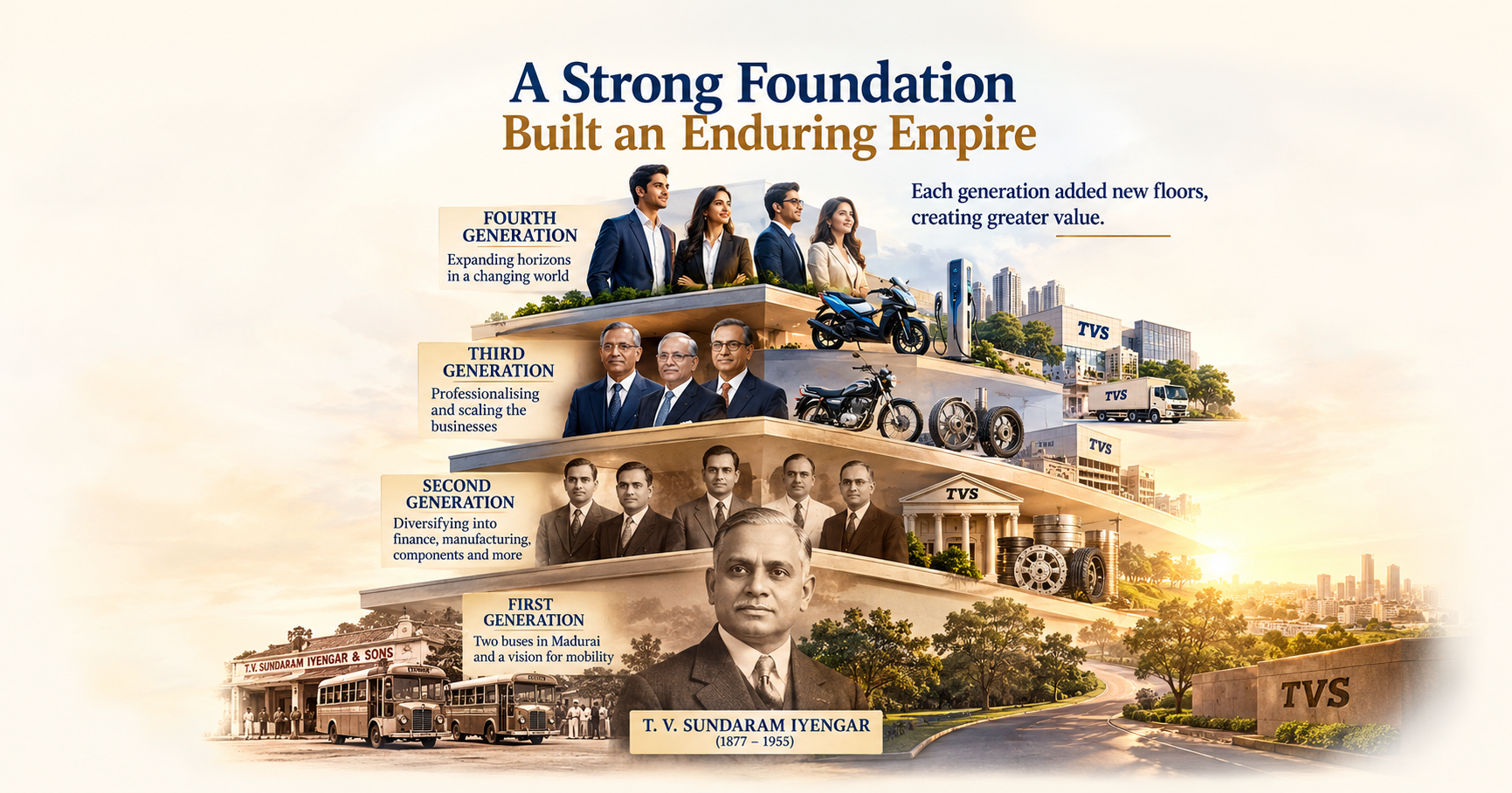
TVS began with two buses in Madurai in 1911. More than a century later, its businesses span two-wheelers, automotive components, finance, logistics and mobility. Yet the more instructive story is inside the family itself. As four generations entered the enterprise, shared ownership became difficult to reconcile with specialised management. TVS eventually chose a radical answer: separate ownership and business responsibility across family branches, while preserving a common identity. Its lesson is governance, not diversification alone.
It started with mobility — not manufacturing
T. V. Sundram Iyengar did not set out to build an industrial conglomerate.
He began with two buses in Madurai in 1911, after leaving secure employment in banking and railways to build a transport business.
The early business taught him the economics of mobility: vehicle operations, passenger demand, maintenance, tyres, spare parts, fuel and distribution.
That knowledge shaped the group’s first phase of expansion.
During periods of fuel scarcity, Sundram Iyengar experimented with a gas plant. He entered rubber retreading and automobile servicing and moved into vehicle distribution.
The logic was important.
TVS expanded from capabilities it already understood.
It moved from operating vehicles to selling them, servicing them and supplying parts. Vehicle distribution began in 1919 and the family obtained a General Motors dealership in 1929, according to historical accounts.
The business was therefore becoming an automotive ecosystem before it became an automotive manufacturer.
Four sons, four business directions
The founder had five sons and three daughters. His eldest son, T. S. Doraisamy, died young. The four surviving sons — T. S. Rajam, T. S. Santhanam, T. S. Srinivasan and T. S. Krishna — became the principal builders of the next phase of the enterprise.
They did not simply replicate their father’s business.
They developed different capabilities.
T. S. Rajam remained associated with automobile distribution and mobility.
T. S. Santhanam became associated with finance, wheels and related mobility businesses.
T. S. Srinivasan became closely associated with manufacturing and the two-wheeler business.
T. S. Krishna developed the automotive-components side, particularly Sundram Fasteners.
The family enterprise was therefore becoming asymmetric.
One family had begun creating different businesses with different economics, customers and capabilities.
That distinction would become crucial several decades later.
From selling vehicles to building the ecosystem
The next stage was not random diversification.
In 1954, the family established Sundaram Finance to finance buses and trucks. In 1960, Wheels India was established, adding manufacturing capability to the mobility ecosystem. Sundram Fasteners followed in 1966.
The strategic pattern was becoming clear:
Transport → Distribution → Finance → Components → Manufacturing
Finance extended the family’s understanding of transport customers.
Components moved the group backwards in the automotive value chain.
Manufacturing created capabilities that could eventually support finished vehicles.
By the 1960s, businesses such as Wheels India, Sundaram-Clayton, Brakes India and Lucas-TVS had strengthened the group’s engineering and manufacturing base. Sundaram-Clayton began operations in 1962, producing automotive components including brakes, exhausts and compressors.
The family business was no longer one company.
It was becoming a system of specialised companies.
The move from components to vehicles
The most important forward move came when TVS entered finished two-wheelers.
A manufacturing plant for mopeds was established at Hosur in 1976, and the TVS 50 was launched in 1979. The company subsequently entered motorcycles and developed technology capabilities through its relationship with Suzuki.
The strategic progression was now:
Components → Mopeds → Motorcycles → Scooters and newer products
This mattered because TVS was no longer simply supplying the automotive industry.
It was building a consumer-facing vehicle business of its own.
When the Suzuki relationship ended, TVS Motor had to strengthen its own product development, engineering, manufacturing and distribution capabilities.
That challenge became one of the defining tests of the third generation.
The third generation changed the way TVS worked
The third generation inherited businesses, but it also inherited a new problem.
The family enterprise was becoming too large and technically complex to run through family relationships alone.
The answer was professionalisation.
Quality systems, engineering, exports, global partnerships, professional managers and international operations became increasingly important.
Venu Srinivasan became the most visible third-generation leader associated with TVS Motor. He helped transform the business from its moped origins into a larger motorcycle and scooter manufacturer and navigated the difficult period following the end of the Suzuki relationship.
At Sundram Fasteners, Suresh Krishna and his branch developed another path: manufacturing depth, precision engineering, exports and international operations.
The Santhanam and Rajam branches developed their own businesses across finance, wheels, distribution, logistics and mobility.
The lesson was already emerging:
A family business does not need every branch to build the same business.
It needs every branch to build a capable business.
Family relationships were not allowed to become management rules
One of the less visible but important features of the TVS model was how the family prepared successive generations.
Contemporary reporting noted that members of the next generation were not simply placed under their fathers. Working with other branches helped separate family relationships from workplace authority.
The principle was even more important when the fourth generation began arriving.
Joining the business was not compulsory. The family’s own approach was that the desire to join had to be matched by aptitude, and that career paths should reflect capability.
That creates a crucial distinction:
Being a family member does not automatically make someone a business leader.
For a family enterprise, this may be more important than succession itself.
Then came the fourth generation
By 2017, reporting identified 15 members of the fourth generation working alongside 16 members of the third generation.
This is where the TVS story becomes particularly interesting.
There was no single successor waiting to inherit “the TVS business”.
There were multiple cousins entering different businesses.
Sudarshan Venu became associated with TVS Motor.
Lakshmi Venu took leadership responsibilities in the manufacturing businesses associated with her family branch.
R. Dinesh developed TVS Logistics.
Srivats Ram became associated with Wheels India.
Arathi Krishna and Arundathi Krishna entered senior roles in Sundram Fasteners.
Sriram Viji became part of the next-generation leadership at Brakes India.
Arvind Balaji became associated with Lucas-TVS.
Shobana Ramachandran led TVS Srichakra.
These examples matter not because the article needs a catalogue of family members, but because they demonstrate a larger principle:
The fourth generation was being distributed across businesses rather than assembled behind one throne.
Education and experience outside the family businesses also became part of the preparation. Reporting in 2017 noted that several members had management or engineering qualifications from leading overseas universities and had gained experience outside the group.
The family was therefore attempting to combine inherited values with acquired capability.
But growth created a governance problem
The businesses were becoming increasingly independent.
Ownership was not.
Different branches managed different companies, faced different competitors, required different amounts of capital and prepared different successors.
Yet the old structure involved common holding companies and cross-holdings.
This created a fundamental mismatch:
Management had become specialised while ownership remained interconnected.
The potential problems were obvious.
Who should control a business?
Who should benefit from its growth?
What happens when one branch manages a company in which another branch has an ownership interest?
What happens when cousins disagree over capital allocation, succession or board appointments?
What happens when one branch wants to move faster than another?
The family had reached a point where informal trust alone could no longer carry the entire structure.
There had also been earlier evidence of the difficulty. After T. S. Rajam’s death in 1982, a dispute arose over an executive appointment at TVS & Sons. The case was eventually withdrawn, but it demonstrated that questions of authority and succession could not always be settled simply through family relationships.
The lesson was not that TVS was a conflict-free family.
It was that conflict could reveal weaknesses in governance.
The family chose structural separation
The decisive change came with the Memorandum of Family Arrangement signed in December 2020.
The philosophy was straightforward:
The family branch managing a business should have clearer ownership of that business.
The restructuring sought to:
- reduce or eliminate cross-holdings;
- give individual family branches greater ownership of the businesses they managed;
- dismantle the earlier common holding-company structure;
- preserve management continuity; and
- establish formal rules for the continued use of the family brand.
The arrangement was followed by a composite scheme of amalgamation and arrangement, with the process involving the NCLT and regulatory approvals. The Competition Commission of India approved the internal restructuring in October 2021.
This was not simply a corporate reorganisation.
It was a family-governance redesign.
The family was effectively saying:
We can remain one family without remaining one ownership structure.
They separated ownership — but not the name
This is perhaps the most unusual part of the TVS solution.
The family did not completely dismantle its common identity.
A formal brand arrangement provided the respective family groups rights to use the TVS, Sundaram and Sundram marks within their respective businesses and areas. The arrangement was designed to preserve the common identity while separating business ownership.
That created a distinctive model:
Ownership — more branch-specific
Management — business-specific
Capital — increasingly independent
Strategy — independently determined
Brand — shared under formal rules
Family legacy — retained
The family was therefore separating control from identity.
That may be the most important idea in the entire TVS case.
The fourth generation is now the operating reality
The succession story has moved beyond preparation.
In 2025, Sudarshan Venu was appointed Chairman and Managing Director of TVS Motor, while Venu Srinivasan became Chairman Emeritus. TVS Motor’s current board information identifies Sudarshan Venu as Chairman and Managing Director.
That is significant because it shows the TVS model moving from one generation to the next without requiring the entire family enterprise to have one central successor.
The fourth generation can lead individual businesses.
Different cousins can pursue different strategies.
The family can remain connected.
But the companies can increasingly operate according to their own commercial realities.
That is the practical meaning of branch autonomy.
What TVS teaches an Indian family business
The lesson is not to copy TVS.
Most MSMEs will never become a group of dozens of companies.
The useful lesson is to recognise the moment when a family business has outgrown its original governance structure.
1. Build from capability
TVS did not diversify randomly.
It moved from transport into distribution, finance, components and manufacturing because each step was connected to capabilities it already understood.
Growth should have a strategic bridge.
2. Separate family membership from management qualification
Children and cousins may have the right to belong to the family.
That does not automatically give them the right to manage a company.
Ownership can be inherited. Leadership must be earned.
3. Prepare the generation before it arrives
Do not wait until cousins become shareholders to discuss succession.
Decide early:
Who wants to join?
Who is qualified?
Who works where?
Who reports to whom?
What happens when someone wants to leave?
4. Review cross-holdings as the family grows
A structure that works for two brothers may become unmanageable for 20 cousins.
The question should be asked periodically:
Does shared ownership still create value — or merely complexity?
5. Allow different branches to become entrepreneurial
TVS did not require every branch to run the same type of company.
One developed two-wheelers.
Another components.
Another finance and mobility.
Another logistics and distribution.
Autonomy can create entrepreneurship without destroying family continuity.
6. Put the family rules in writing
Ownership, succession, employment, capital allocation, related-party transactions, share transfers, dispute resolution and brand use should not depend entirely on goodwill.
Family harmony is not a governance system.
7. Preserve the identity even when ownership changes
TVS demonstrates that separation does not necessarily mean fragmentation.
The family can separate businesses while retaining:
a common name, common values and a shared legacy.
The real TVS lesson
The TVS story began with two buses.
It became a network of businesses.
Then it became a network of family branches.
And eventually, the family had to redesign the ownership system itself.
That is the part of the story that matters most to today’s Indian family-owned MSME.
The first generation builds the business.
The second generation expands it.
The third professionalises it.
The fourth asks whether the old family structure can still contain it.
TVS’s answer was not to force everyone back into one structure.
It was to create clearer ownership, accountable management, greater branch autonomy and formal rules — while retaining a shared identity.
For founders, the lesson is simple:
Do not wait for the family to become complicated before designing the rules that will govern it.
Build the business for growth.
Build the ownership structure for the family you have today.
But build the governance system for the family you may have tomorrow.
That is how a family business can grow beyond its founder without being consumed by its own success.
Sources
- TVS Motor Company — company history, current leadership, corporate disclosures and 2025–26 annual report. TVS Motor Company
- TVS Motor Company — Sudarshan Venu appointed Chairman and Managing Director effective 25 August 2025.
- TVS Motor Company — current investor information identifying Sudarshan Venu as Chairman and Managing Director.
- Economic Times — TVS fourth-generation family members, business roles and family-business practices. Economic Times — TVS fourth generation
- Business Today — TVS GenNext and the family’s fourth-generation operating model. Business Today — Driven by Values
- Business Standard — TVS family ownership restructuring and the 2020 family arrangement.
- Competition Commission of India — approval of the internal TVS restructuring.
- Financial Express / other contemporary reporting — TVS brand agreement and restructuring.
- Primary research draft supplied for this article, including the historical chronology and source framework.




Leave a Reply