
By Haresh Jhala:
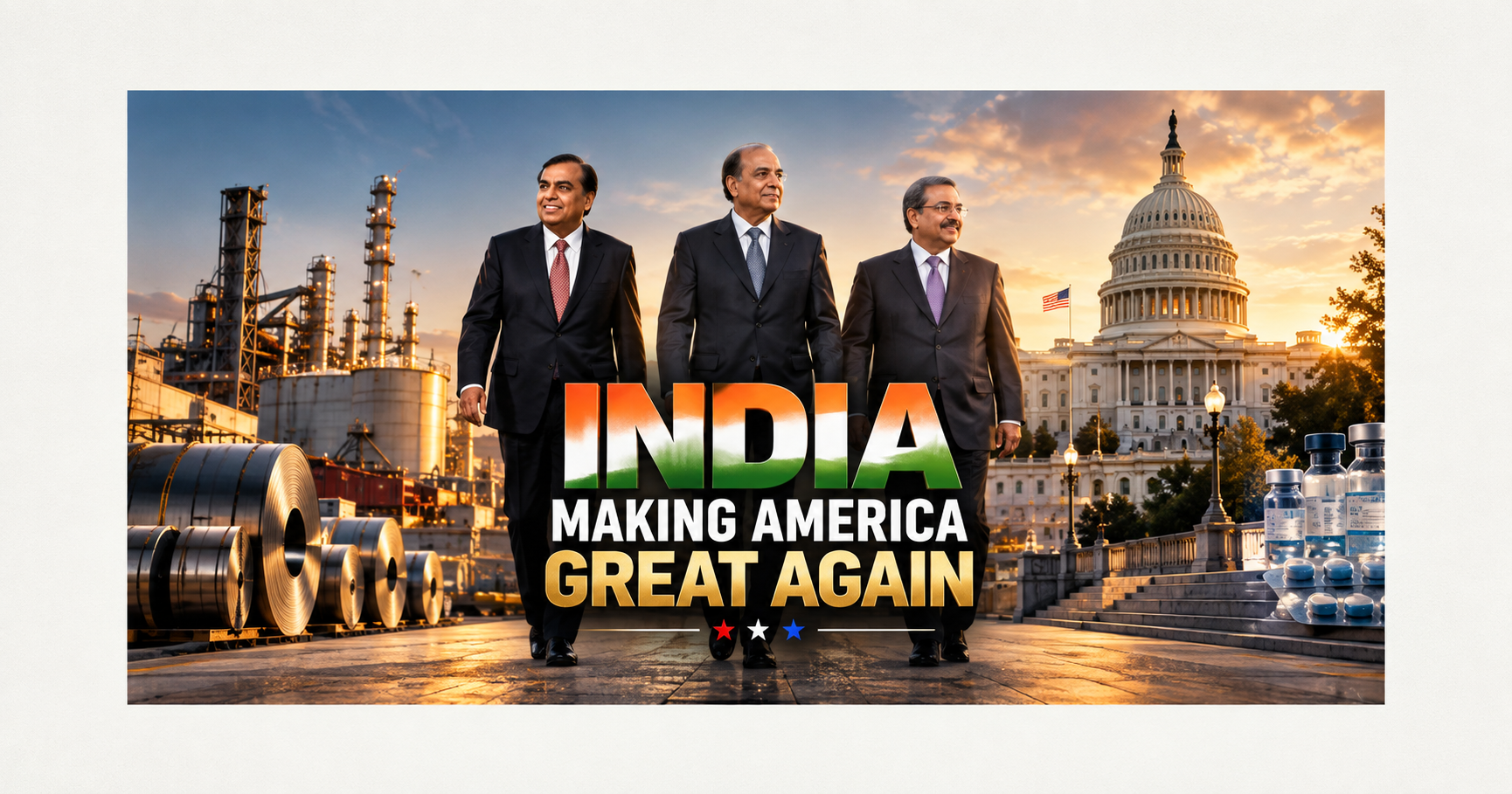
Indian capital is moving from selling to America to building inside America
India may be entering a new phase in its corporate relationship with the United States. Essar-backed Mesabi Metallics is planning an approximately US$18 billion steel and mining programme linking Minnesota and Iowa. Reliance Industries is pursuing a refinery project in Texas. Sun Pharma has joined a US drug-pricing agreement involving lower prices and pharmaceutical supply commitments. Three separate businesses, three different sectors—but one emerging pattern: Indian capital is increasingly moving from exporting to America to building inside America.
These are not coordinated projects, and there is no public evidence that New Delhi directed them. Yet taken together, they reveal a significant change in the India–US economic relationship.
Indian companies are no longer looking only at America as a market for goods and services. They are increasingly looking at it as a place to mine resources, manufacture products, process energy and participate directly in domestic supply chains.
That distinction matters.
For Washington, foreign capital becomes more attractive when it builds inside the United States, creates American jobs and strengthens domestic supply chains. For Indian companies, local production can provide access to customers, infrastructure, financing, technology and policy advantages while reducing dependence on exports into a market that is becoming increasingly protectionist.
The question for India is therefore more complicated:
When Indian companies build America, how much value eventually comes back to India?
ESSAR: FROM INDUSTRIAL AMBITION TO REBUILDING
The Essar story provides the most revealing case study.
Founded in 1969 by brothers Shashi and Ravi Ruia, Essar grew from construction and infrastructure into a diversified industrial group spanning shipping, ports, engineering, steel, oil, power and telecommunications.
Its expansion reflected the opportunities created by India’s economic liberalisation.
Essar built steelmaking capacity at Hazira in Gujarat, developed the Vadinar refinery in Kutch and assembled a network of ports, power facilities, shipping assets and logistics operations.
The underlying strategy was vertical integration.
Control raw materials, transport, ports, power and manufacturing, and a company can potentially capture value across the entire industrial chain.
But vertical integration also requires enormous capital.
Projects need money long before they generate sufficient cash flow. Delays, cost overruns, commodity-market weakness and the global financial slowdown eventually placed pressure on Essar’s balance sheet.
By the middle of the 2010s, the group had accumulated a very large debt burden. Contemporary estimates varied according to the companies and liabilities included, with some assessments placing total debt at around ₹1 lakh crore or more.
The problem was not one failed project.
It was the difficulty of financing a large number of capital-intensive businesses simultaneously.
WHEN ESSAR LOST ITS STEEL BUSINESS
Essar Steel became the most visible symbol of the crisis.
The company accumulated substantial liabilities and entered India’s insolvency process. The Ruias attempted to resolve the situation, but the process eventually resulted in a resolution led by ArcelorMittal and Nippon Steel.
In November 2019, the Supreme Court cleared the way for the acquisition. The resolution plan included an upfront payment of approximately ₹42,000 crore to Essar Steel’s financial creditors.
For the Ruia family, it was a decisive break.
The steel business that had helped define Essar’s identity was no longer under their control.
The episode also changed the way the group’s earlier expansion was viewed.
What had once looked like an ambitious strategy to build an integrated industrial empire increasingly came to be seen as a warning about debt-funded expansion, execution risk and concentration in cyclical industries.
But Essar did not disappear.
Its next move was survival through asset monetisation.
THE SALE THAT RESET ESSAR
In 2017, Essar sold Essar Oil to a consortium led by Rosneft, together with Trafigura and UCP.
The transaction was valued at approximately US$12.9 billion and included the 20-million-tonne Vadinar refinery, a captive port, a power plant and a fuel-retailing network.
It was one of India’s largest corporate transactions at the time.
More importantly for Essar, it became a major part of the group’s deleveraging strategy.
Contemporary reports said Essar intended to use approximately ₹70,000 crore from the proceeds to reduce debt, including substantial obligations to Indian banks.
The transaction should therefore not be presented simply as a voluntary strategic exit from oil.
The group was under severe financial pressure.
The sale created financial breathing space and became part of a wider effort to reduce liabilities and preserve the organisation.
The Ruias were also not permanently barred from returning to Indian refining and fuel retailing. The non-compete arrangement described at the time was understood to last three years.
The larger story was therefore not an exit from business.
It was restructuring for survival.
THE GREAT DELEVERAGING
Essar subsequently monetised additional assets, including infrastructure, ports and power holdings.
In 2022, ArcelorMittal Nippon Steel agreed to acquire certain Essar infrastructure assets for approximately US$2.4 billion.
News agencies reported that the transaction formed part of Essar’s wider debt-repayment programme.
Essar later announced that it had completed its asset-monetisation programme and repaid approximately US$25 billion, or around ₹2 lakh crore, to Indian banks and financial institutions.
That is the foundation of the group’s “phoenix” narrative.
The Ruias lost major assets.
But they did not leave business.
They used the sale of oil, steel-related infrastructure, ports and power assets to reduce the legacy debt burden and reorganise the group around a smaller portfolio.
The Essar of today is therefore not the same conglomerate that existed at its peak.
Its stated interests now include energy, infrastructure and logistics, metals and mining, technology and retail.
The more important change is strategic: the group is attempting to rebuild with greater emphasis on international assets, project-level financing and sectors linked to energy transition and supply-chain security.
That distinction matters when looking at its latest American ambition.
THE MINNESOTA PROJECT’S LONG STRUGGLE
The Mesabi project in Minnesota is not a story of uninterrupted success.
Essar began developing the project in 2008. The plan involved an iron-ore mine, processing facilities, pellet production and ultimately direct-reduced-iron manufacturing.
The project was expected to be completed much earlier.
Instead, it encountered delays, financing problems, unfinished infrastructure and ownership disputes.
In 2016, the project entered Chapter 11 bankruptcy. It was subsequently acquired through a bankruptcy process by Chippewa Capital Partners and renamed Mesabi Metallics.
Essar later regained control through a complicated sequence of ownership and financing arrangements.
The project consequently became a two-decade saga.
Its history included state support, disputed obligations, financing difficulties and repeated attempts to restart construction.
Minnesota reporting described a project that had effectively run out of money while only partially built.
That history makes the current development significant—but it also requires caution.
Essar did not simply carry a fully functioning North American asset through its Indian debt crisis.
The Minnesota project went through bankruptcy, ownership changes and years of uncertainty before reaching its current stage.
Today, Mesabi is described as the first new taconite mine in Minnesota in approximately 50 years.
It is expected to produce direct-reduction-grade iron-ore pellets for lower-carbon steelmaking.
The US Export-Import Bank has announced support of up to US$10 billion for the wider minerals and manufacturing development.
But “potential support” is important wording.
It does not automatically mean the entire amount has been approved, drawn or provided. Financing remains dependent on conditions, approvals, construction progress and commercial viability.
FROM MINNESOTA ORE TO IOWA STEEL
On 28 September 2026, President Donald Trump announced Mesabi Metallics’ plan for approximately US$15 billion in investment in an integrated steel complex in Iowa.
Together with the roughly US$2.5–3 billion already associated with the Minnesota mine and pelletising facilities, the overall programme has been presented as an approximately US$18 billion American steel and mining investment.
The proposed Iowa complex is expected to produce approximately 7.5 million tonnes of steel annually in its first phase, eventually reaching around 10 million tonnes.
Production is targeted for around 2030.
The project is expected to create thousands of construction jobs and approximately 1,750 permanent positions once operational.
The proposed production route uses direct-reduced iron and electric-arc-furnace technology, rather than the conventional coal-intensive blast-furnace model.
The planned supply chain is strikingly domestic:
Iron ore mined in Minnesota.
Pellets produced in Minnesota.
Steel manufactured in Iowa.
American workers operating the facilities.
That is precisely why the project fits several of the Trump administration’s stated industrial priorities.
It strengthens domestic minerals and steel production while reducing reliance on imported raw materials.
But there is another important point.
This is an announced programme, not US$18 billion already sitting inside an operating steel plant.
Construction, financing, permitting, execution and commercial viability still matter.
WHAT AMERICA GETS FROM INDIAN CAPITAL
For Washington, the attraction of such projects is straightforward.
Foreign capital is economically useful when it creates domestic production, jobs, infrastructure and supply-chain capacity.
That suggests something broader about the current American economic model.
Trump’s policy does not necessarily mean the United States wants to shut itself off from global capital.
Instead, it can be understood as encouraging a form of selective globalisation:
foreign companies can access the American market while locating production, jobs and supply chains inside America.
For Indian companies, that changes the calculation.
Exporting from India means dealing with tariffs, trade barriers, shipping costs and geopolitical uncertainty.
Producing inside America can turn a foreign supplier into a domestic participant.
Essar’s steel project illustrates this transformation most dramatically.
RELIANCE: THE ENERGY CONNECTION
Reliance Industries provides the energy dimension of this emerging pattern.
The company is associated with a proposed 168,000-barrel-per-day refinery in Brownsville, Texas, on the US southern border.
The precise financial contribution from Reliance has not been publicly disclosed, and the widely circulated US$300 billion figure should not be confused with the construction cost of the refinery.
The commercial logic is nevertheless clear.
A US refinery could provide access to American crude, infrastructure, customers and the domestic energy market.
For the United States, a new refining facility could contribute to domestic processing capacity and energy security.
For Reliance, local production would mean participating directly in the American energy system rather than simply exporting refined products or relying on an overseas market.
The project should, however, be treated as a proposal rather than an operating asset.
A presidential announcement or corporate plan is not the same as a fully financed, permitted and functioning refinery.
There is also no verified evidence that the Reliance and Essar projects represent a renewed Ambani–Ruia corporate contest in America.
The more meaningful connection is strategic:
Indian-owned companies are increasingly willing to put industrial assets inside the United States.
SUN PHARMA: FROM PRODUCTS TO SUPPLY SECURITY
Sun Pharma adds a third dimension: pharmaceuticals and healthcare supply chains.
On 31 August 2026, the White House announced that Sun Pharma was among nine pharmaceutical companies joining an agreement involving most-favoured-nation pricing for state Medicaid programmes and commitments related to pharmaceutical supply security.
The nine companies collectively committed at least US$19.6 billion towards US manufacturing in the near term.
Sun Pharma’s individual investment figure was not made public in the announcement.
The company also agreed to contribute active pharmaceutical ingredients to the Strategic Active Pharmaceutical Ingredients Reserve, including clindamycin and doxycycline.
These commitments place Sun Pharma within a broader American effort to strengthen domestic pharmaceutical supply chains.
The development should not be reduced to the claim that Sun Pharma chairman Dilip Shanghvi personally promised Trump that medicines would become affordable.
The public information points instead to a negotiated corporate-government arrangement involving pricing and supply commitments.
That distinction matters.
The pharmaceutical example also demonstrates that America’s localisation push is not confined to factories producing steel and energy.
It extends to medicines, strategic inputs and supply security.
THREE COMPANIES. THREE SECTORS. ONE PATTERN.
| Indian company | Sector | US economic interest |
|---|---|---|
| Essar-backed Mesabi Metallics | Iron ore and steel | Domestic minerals, steel and jobs |
| Reliance Industries | Refining and energy | Domestic energy processing and supply |
| Sun Pharma | Pharmaceuticals | Medicine pricing and supply security |
The companies are pursuing different strategies.
Their projects are not coordinated.
But the direction is increasingly similar:
Build inside America.
That is the larger story.
IS NEW DELHI BEHIND THE PROJECTS?
The scale of these announcements naturally raises another question.
Could Indian companies make such commitments without some form of government encouragement or diplomatic support?
The answer requires a distinction between government direction, diplomatic facilitation and strategic convergence.
There is currently no public evidence that New Delhi instructed Essar, Reliance or Sun Pharma to undertake these projects.
Nor is there sufficient evidence to describe the developments as a covert India–US government package.
Diplomatic facilitation is possible.
Large companies routinely interact with embassies, investment agencies, trade ministries and bilateral business forums. Governments can help create a favourable environment, address procedural obstacles and promote national companies overseas.
But:
Facilitation is not control.
What is clearly visible is strategic convergence.
Indian companies want access to the US market, customers, financing, technology and policy advantages.
Washington wants factories, jobs, minerals, medicines and energy capacity inside America.
New Delhi benefits when Indian companies become global players and deepen the commercial foundation of the India–US relationship.
The available evidence therefore points towards alignment rather than secret command.
WHAT DOES INDIA GET?
This is where the story becomes more complicated.
India gains when its companies develop the scale to own and operate major assets abroad.
Overseas expansion can generate foreign earnings, managerial experience, technology links and new opportunities for Indian engineering and professional-service companies.
It can also give Indian companies greater commercial weight in sectors important to Washington.
A country whose companies operate in American steel, energy and medicines has a different economic relationship with the United States from one whose connection rests mainly on exporting goods.
But the immediate benefits of these investments will largely be felt inside America.
American states will receive factories, jobs, tax revenue and industrial output.
American consumers and manufacturers will use locally produced steel and energy.
US patients may benefit from the pricing arrangements involving participating pharmaceutical companies.
That creates a legitimate question for India.
How much of the value created in America returns to India?
Will Indian companies source equipment and services from Indian suppliers?
Will Indian engineers and managers participate?
Will profits and dividends return to Indian shareholders?
Will overseas projects generate technology and supply-chain connections with India?
Will Indian companies strengthen their global balance sheets without reducing productive investment at home?
These questions are more important than simply celebrating the headline number.
THE REAL CORPORATE QUESTION
The significance of the Essar, Reliance and Sun Pharma developments is therefore not that Indian companies are suddenly “taking over” America.
They are not.
Nor are the three projects evidence of one coordinated Indian strategy.
The significance is that Indian corporate ambition is increasingly adapting to a world in which market access and local production are becoming closely connected.
For decades, the conventional model was relatively straightforward:
Make in India → export to America.
The emerging model is different:
Invest in America → manufacture in America → sell inside America.
That is a profound change in corporate strategy.
It is also a lesson in how globalisation is changing.
INDIA’S CORPORATE AMERICA MOMENT
Essar, Reliance and Sun Pharma are operating in different industries and pursuing different commercial objectives.
But their American strategies point towards the same broader development.
Indian capital is becoming part of America’s domestic production system.
For President Trump, that supports an economic model built around domestic manufacturing, supply-chain resilience and American production.
For Indian companies, it provides access to one of the world’s largest markets while reducing some of the risks associated with exporting into an increasingly protectionist environment.
For India, however, the outcome should not be judged merely by the size of the investment announcement.
The more important question is where the value ultimately travels.
If Indian shareholders gain, Indian suppliers participate, Indian engineers and managers acquire experience, technology flows back and global earnings strengthen Indian companies, then overseas investment can create a wider economic benefit.
If most of the value remains entirely within the American production system, the Indian benefit will be more limited.
That is why the real significance of India’s corporate America moment lies somewhere between nationalism and globalisation.
Indian companies may be helping America rebuild parts of its industrial base with Indian capital.
At the same time, they are using America’s market, infrastructure and capital ecosystem to build global scale.
The next phase of India–US economic relations may therefore not be defined only by what India sells to America.
It may increasingly be defined by what Indian companies build in America—and how much of the value created there ultimately comes home.



Leave a Reply