
MSME Briefing Bureau
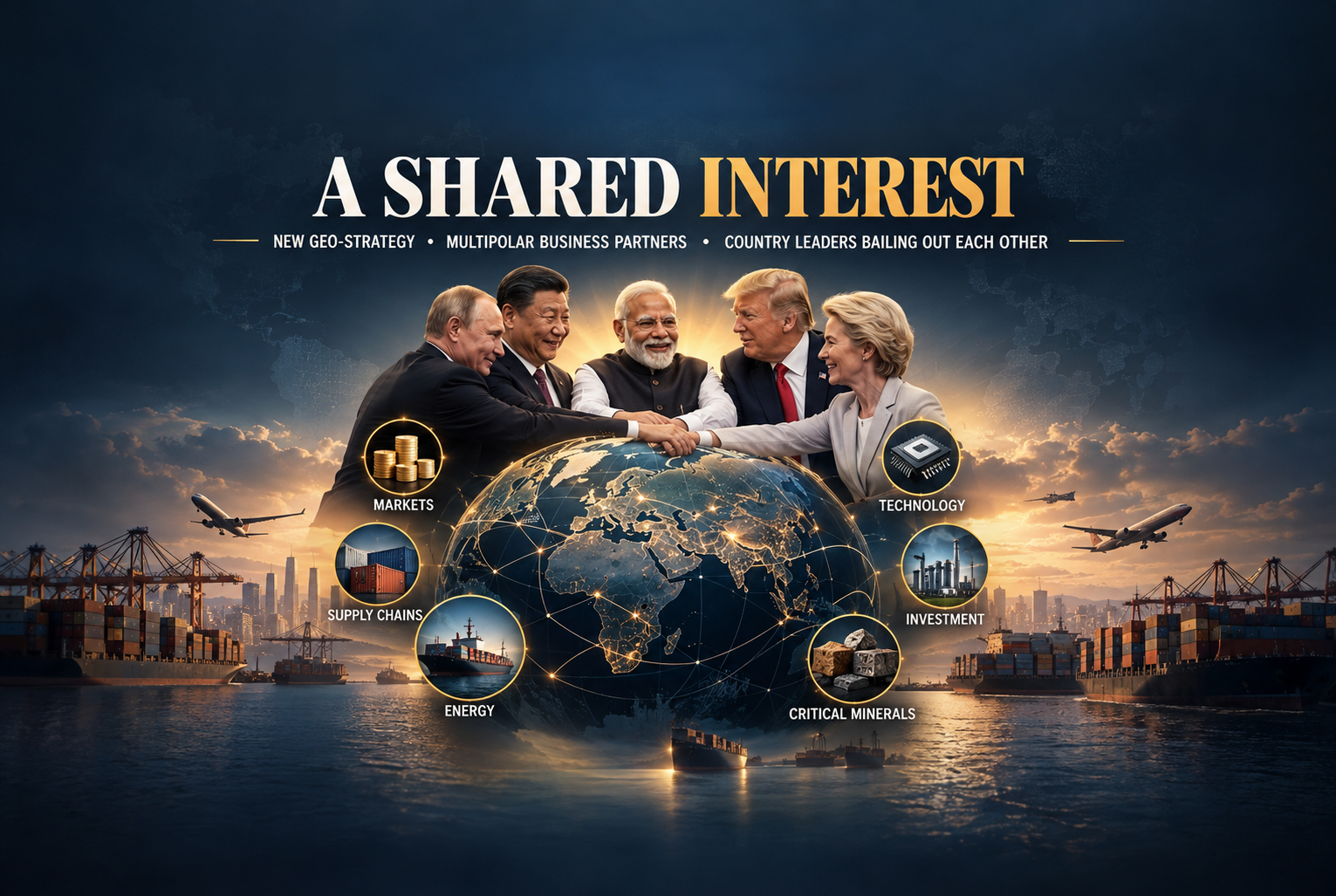
Everyone wants everyone at the table.
But nobody wants to be dependent on anyone.
That may be the most important shift in global geopolitics today.
Defence alliances still matter. Strategic partnerships still matter.
But increasingly, markets, tariffs, energy, technology, capital, minerals and supply chains are becoming instruments of national strategy.
India illustrates this perfectly.
It buys Russian energy.
It competes with China while remaining dependent on Chinese industrial inputs.
It deepens economic and strategic engagement with America.
It remains part of BRICS.
This is not necessarily inconsistency.
It is option management.
For a business leader, the analogy is familiar:
You don’t want one customer to control your business.
You don’t want one supplier to control your production.
You don’t want one market to determine your future.
Countries are increasingly thinking the same way.
But there is a difficult question.
Can you remain everyone’s partner when the interests of your partners begin to collide?
A tariff can become geopolitical leverage.
An oil purchase can become a diplomatic issue.
A technology partnership can become a national-security concern.
A supply chain decision can suddenly become a strategic decision.
This is why the old distinction between business interest and national interest is becoming increasingly difficult to maintain.
And there is another lesson for businesses.
Relationships can last for decades.
But interests change.
Suppliers change.
Markets change.
Partners change.
The smart strategy is therefore not to abandon relationships.
It is to avoid irreversible dependence on any one relationship.
India is trying to do that at a geopolitical scale.
The real test will come when keeping every door open is no longer enough — because the people sitting around the table start asking India to choose.
The world may not be moving towards permanent alliances.
It may be moving towards permanent negotiations.



Leave a Reply