
MSME Briefing Bureau
Sunday Musing
Why he listened first—and changed the system driving behaviour
Before asking people to perform better, examine what your system makes them compete for.
What happens when talented people spend more energy defeating colleagues than defeating competitors? Microsoft provides an unusually revealing answer. Before Satya Nadella became CEO, internal competition, hierarchy and forced ranking had turned performance management into a political game. Nadella did not begin with another motivational speech. He went looking for the people inside the system, listened across levels, and then began changing the rules that shaped behaviour. The lesson for founders lies in that sequence—not the slogan.
When colleagues became competitors
The problem Nadella inherited was not simply that Microsoft needed a new strategy.
It was that the organisation had begun working against itself.
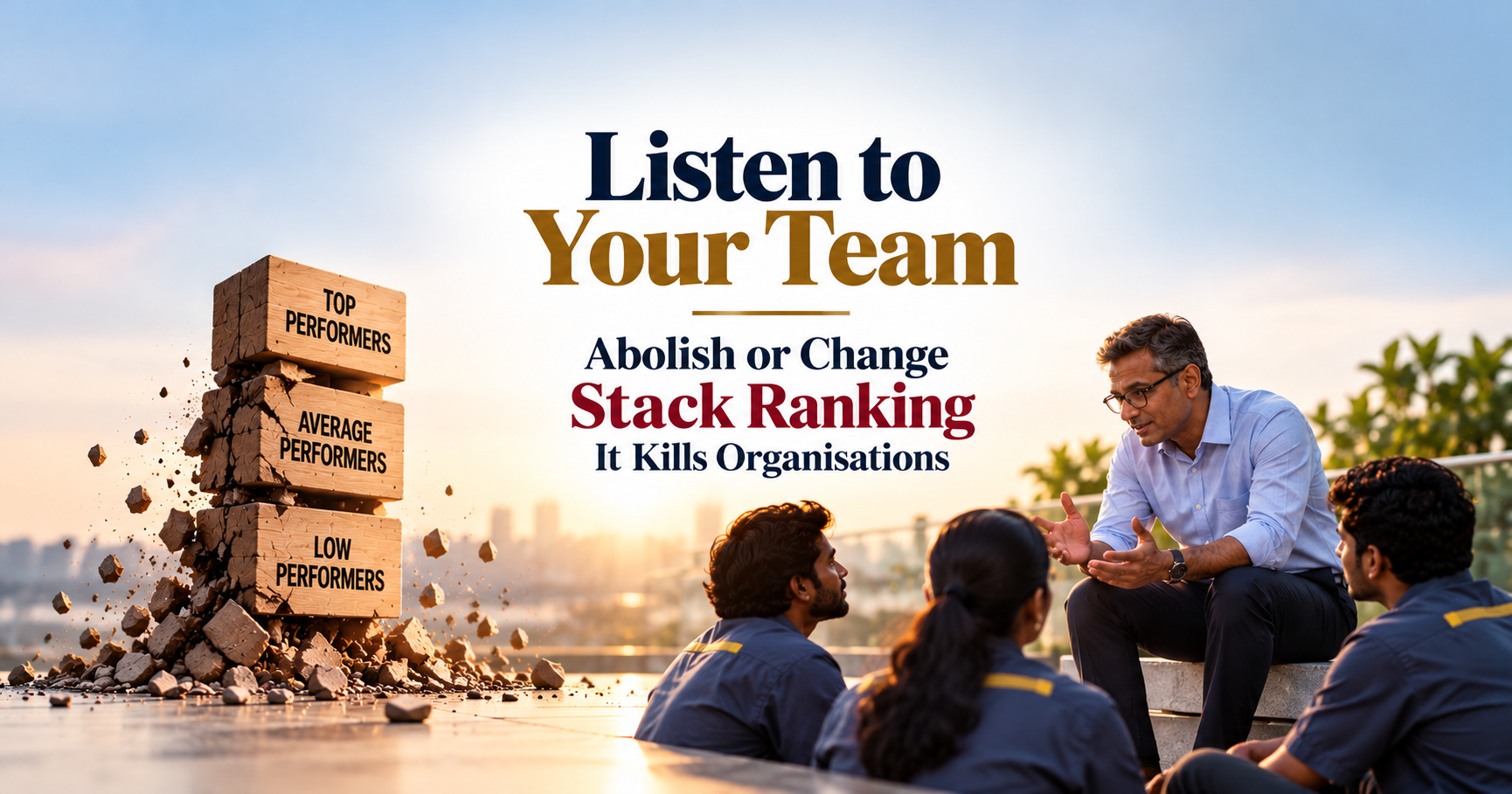
Its controversial stack-ranking system forced employees into relative performance categories, with a predetermined share placed at the bottom. The practice was effectively a forced distribution or “Bell Curve” approach—not the Bell Curve theory itself.
The consequences went beyond an unpopular appraisal form.
Reports described employees becoming reluctant to share information, cooperate with strong colleagues or take actions that might help another person’s ranking. One account described employees focusing on competing with one another rather than competing with other companies.
Nadella later described the culture he inherited as rigid. Employees had to prove they were the smartest person in the room. Hierarchy and pecking order had become so entrenched that reaching someone lower down the organisation could require moving through layers of management.
INSEAD’s case study goes further, describing political infighting as one of the conditions Nadella encountered when he took charge.
So the question was not:
“How do we motivate Microsoft’s people?”
It was:
“What has the system taught our people to do?”
Nadella’s first move: listen
This is the part of the story founders should pay attention to.
He listened before prescribing.
During his first year, Nadella heard from employees across levels and parts of Microsoft, including through focus groups. Employees told him they wanted change, clearer direction and—significantly—that engineers wanted to lead again, not simply follow.
His early communications also show him speaking directly with employees in Redmond, Boston and Northern California, while asking the senior leadership team to set the example for the new chapter.
For a founder, this is not a soft leadership lesson.
It is an information strategy.
The lower you go towards the work, the more likely you are to hear the friction that management reports have filtered out.
Then he changed what success meant
Listening would have meant little if the system remained unchanged.
Microsoft moved away from the old forced-ranking model towards a performance approach that placed greater emphasis on customer results, individual contribution, contribution to the success of others, and building on other people’s work.
That changed the incentive.
Previously, helping a colleague could potentially weaken your relative position.
Now, helping the organisation—and helping others succeed—became part of performance itself.
That is the real management intervention.
Dweck gave the idea a language
This is where psychologist Carol Dweck’s growth-mindset theory fits.
A fixed mindset assumes that ability is largely fixed. A growth mindset sees capability as developable through learning, effort, feedback and new approaches. Nadella translated that thinking into Microsoft’s now-famous shift from “know-it-all” to “learn-it-all”.
But there is a crucial lesson here:
A growth mindset cannot survive inside a system that rewards fear.
If employees are punished for every failed experiment, no poster about learning will make them innovative.
Nadella therefore pushed the change through managers and leadership behaviour, not just employee messaging. Microsoft says the cultural transformation was propagated through leadership at all levels.
From internal rivalry to external collaboration
The change also appeared in Microsoft’s business decisions.
In 2014, Microsoft brought Office to the iPad—a visible signal that serving customers could matter more than protecting an old platform boundary. It also moved more openly towards Linux and open-source technologies.
The strategic message was powerful:
Stop protecting yesterday’s position. Go where the customer and the opportunity are.
That required collaboration—inside Microsoft and outside it.
Then came the measurable change
Culture alone did not create Microsoft’s transformation. Strategy, technology, capital allocation and market opportunity mattered enormously.
But the cultural change helped create an organisation capable of executing a new strategy.
Microsoft shifted aggressively towards cloud computing and later AI. Its own account describes the combination of cultural transformation and cloud infrastructure as setting the stage for major technological innovation.
The financial scale of the transformation is striking.
Microsoft’s market value was roughly $300 billion when Nadella became CEO in 2014. A decade later, it had reached around $3 trillion.
The number does not prove that culture alone created the value.
It shows the scale of what became possible when culture and strategy began pulling in the same direction.
What should an MSME founder copy?
Not Microsoft’s size.
Not its technology.
Copy the sequence.
1. Go down the pyramid.
Speak directly to people closest to the work.
2. Find the behaviour your system is creating.
Are employees solving problems—or protecting themselves?
3. Change the incentive.
Reward contribution to colleagues, customers and the wider business.
4. Make managers coaches.
Their job is not simply to monitor people. It is to remove barriers to performance.
5. Open the walls.
Ask where collaboration can create more value than internal competition.
The real Nadella lesson
Culture is not what the CEO says. Culture is what the system makes people do repeatedly.
So before your next strategy meeting, ask one question:
“What are my people doing to survive that I actually need them to stop doing to grow?”
The answer may tell you more about your company’s future than another strategy presentation.
Sources
- Satya Nadella, Hit Refresh: The Quest to Rediscover Microsoft’s Soul and Imagine a Better Future for Everyone — Microsoft’s account of its cultural transformation.
- Microsoft — Code Book / Culture — Microsoft’s articulation of “Growth Mindset”, “learn-it-all” and its manager principles.
- Microsoft Inside Track — Cultural Transformation — background on the shift in Microsoft’s culture and performance expectations under Nadella.
- Carol Dweck / Stanford University — research and definitions concerning fixed and growth mindsets.





Leave a Reply